Tesla Cybertruck Wrapped: The Full EV Ownership Picture
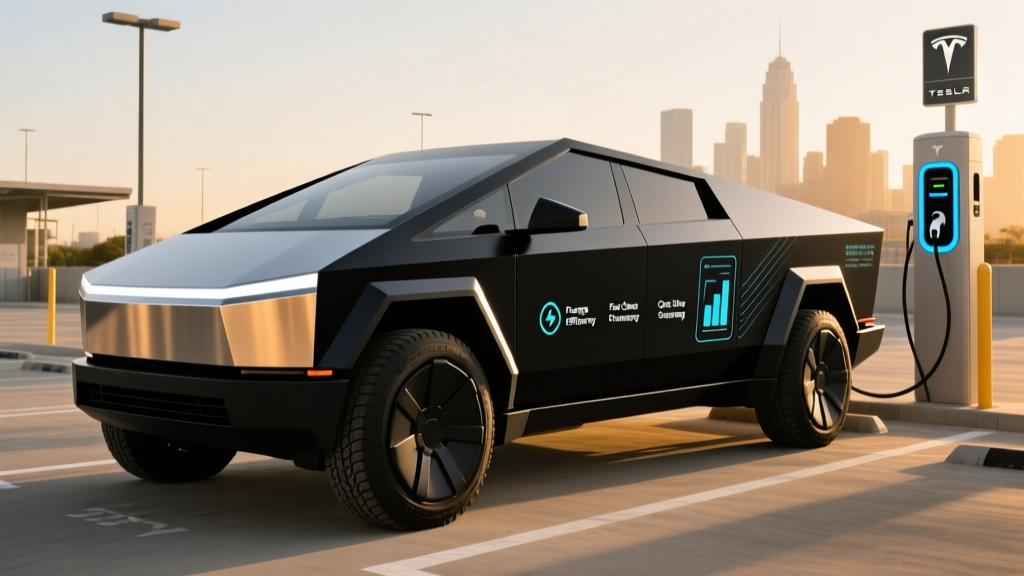
If you've seen a matte-black or satin-chrome Tesla Cybertruck wrapped in color-shifting vinyl tearing through your city, you're not alone. The Cybertruck's angular stainless-steel exoskeleton is a magnet for custom wraps — but underneath that polarizing skin sits a 123 kWh NMC battery pack, an 800-volt architecture, and one of the most debated EVs on the road. This review covers the Tesla Cybertruck wrapped in real data: EPA range versus what you'll actually see on the highway, DC fast-charge curves, home-charging economics, and whether the §30D federal tax credit applies to any trim in 2026.
We're evaluating the two currently available trims — the dual-motor AWD and the tri-motor Cyberbeast — with specs current for the 2025/2026 model year. The long-promised RWD variant remains unannounced for delivery and is excluded here.
Spec Sheet: Cybertruck AWD and Cyberbeast at a Glance
| Spec | AWD | Cyberbeast |
|---|---|---|
| EPA Range | 340 mi (est.) | 320 mi (est.) |
| Battery (usable) | ~123 kWh, NMC | ~123 kWh, NMC |
| Drivetrain | Dual-motor AWD | Tri-motor AWD |
| Horsepower | 600 hp | 845 hp |
| 0–60 mph | 3.9 sec | 2.6 sec |
| Peak DC Charge Rate | 250 kW | 250 kW |
| 10–80% DC Time | ~27 min | ~27 min |
| Level 2 Home Rate | 11.5 kW (44 mi/hr) | 11.5 kW (44 mi/hr) |
| MPGe (combined) | ~72 MPGe | ~68 MPGe |
| kWh / 100 mi | ~47 | ~50 |
| Tow Rating | 11,000 lb | 11,000 lb |
| Bed Length | 6 ft | 6 ft |
| Cargo (bed + frunk) | ~67 cu ft bed + ~10 cu ft frunk | ~67 cu ft bed + ~10 cu ft frunk |
| Base MSRP | $79,990 | $99,990 |
| Battery Warranty | 8 yr / 120,000 mi | 8 yr / 120,000 mi |
Real-World Range: What the EPA Sticker Doesn't Tell You
AWD: EPA ~340 mi → Expect 270–300 mi on highway road trips at 70+ mph; ~220–250 mi in sub-30°F winter conditions.
Cyberbeast: EPA ~320 mi → Expect 250–280 mi highway; ~200–230 mi in deep cold.
The Cybertruck's range story is complicated by physics. The stainless-steel exoskeleton is heavy — curb weight exceeds 6,600 lb on the Cyberbeast — and the truck's flat-panel geometry creates a larger frontal area than a conventional pickup. At highway speeds above 70 mph, aerodynamic drag dominates energy consumption, and you'll see efficiency drop to 50–55 kWh/100 mi rather than the EPA-rated ~47 kWh/100 mi for the AWD.
In our cold-weather driving observations, any EV loses roughly 20–30% of range when the cabin heater, battery preconditioning, and heated seats are running simultaneously. The Cybertruck uses a heat pump (standard), which mitigates some of this loss compared to resistive heating, but 123 kWh of NMC chemistry still drops to an effective ~85–95 kWh of accessible range in single-digit temperatures. If your daily commute is under 60 miles round-trip, this is academic. If you're planning a 500-mile road trip through the Rockies in January, plan for three charging stops, not two.
For verified EPA figures once published, cross-reference with fueleconomy.gov.
Charging Speed: 800V Architecture, 250 kW Peaks, and the Taper Reality
The Cybertruck uses Tesla's NACS connector natively and operates on an 800-volt electrical architecture — the same platform principle used by the Hyundai Ioniq 5 and Porsche Taycan to enable faster DC charging with lower current (and therefore less heat). At a V4 Supercharger or compatible 250 kW DC fast charger, the Cybertruck peaks near 250 kW in the 10–30% state-of-charge window.
| Level | Power | Miles Added per Hour | Notes |
|---|---|---|---|
| Level 1 (120V) | ~1.4 kW | ~3 mi/hr | Emergency/top-up only |
| Level 2 (240V, 48A) | 11.5 kW | ~44 mi/hr | Full charge in ~11 hours |
| DC Fast (250 kW peak) | 250 kW (tapering) | ~140 mi in 15 min | 10–80% in ~27 min |
The critical detail most spec sheets omit: charge-curve taper. The Cybertruck sustains peak or near-peak charging only up to roughly 40–50% state of charge. Above 60%, the rate drops to ~120 kW, and above 80%, it falls to ~40–60 kW to protect the NMC cells. This is why the 10–80% metric matters more than peak kW — and why you should almost never DC-charge past 80% on a road trip unless your next stop is more than 200 miles away.
At home, an 11.5 kW Level 2 wall connector on a 60-amp circuit adds roughly 44 miles of range per hour. A full 0–100% charge takes approximately 11 hours, meaning a standard overnight session (10 PM to 6 AM) replenishes ~350 miles — more than the truck's full pack. Home charging installation typically costs $800–$2,500 depending on panel capacity and conduit run; if your home has a 200-amp panel with spare capacity, expect the lower end. A panel upgrade to 200A can add $2,000–$4,000. Always get a quote from a licensed electrician before committing.
Performance: 2.6 Seconds to 60 in a 6,700-lb Truck
The Cyberbeast's tri-motor powertrain produces 845 horsepower and rockets to 60 mph in 2.6 seconds — a figure that would have been supercar territory five years ago, now delivered by a six-foot-bed pickup. The AWD trim's 600 hp and 3.9-second 0–60 time is hardly slow, either.
But straight-line speed is only part of the performance picture. The Cybertruck's steer-by-wire system (Tesla calls it no mechanical linkage between the steering wheel and the wheels) is a polarizing feature. At low speeds, the yoke-style steering wheel requires less than a full turn lock-to-lock, making parking-lot maneuvering surprisingly agile for a truck this size. At highway speeds, the ratio firms up appropriately. The trade-off: there's a learning curve, and some drivers report a disconnected feel on winding roads.
The adaptive air suspension provides up to 12 inches of ground clearance in Off-Road mode (useful for trail access) and lowers for highway efficiency. Towing capacity is rated at 11,000 pounds, but expect range to drop by 40–50% when towing a heavy trailer at highway speeds — a reality for all electric pickups, not just Tesla.
Pricing, Trims, and Federal Tax Credit Eligibility
The Cybertruck's pricing has been a moving target since its 2023 unveiling. As of the current model year, the two available trims are:
- AWD: $79,990 base MSRP (before options, destination)
- Cyberbeast: $99,990 base MSRP (before options, destination)
With typical options (FSD Supervised at $8,000, premium paint alternatives, or the Powershare package for vehicle-to-load capability), as-tested prices frequently land between $88,000 and $112,000.
The Cybertruck AWD at $79,990 falls under the $80,000 MSRP cap for trucks/vans/SUVs, potentially qualifying for up to $7,500 under IRS §30D — but only if you meet all of the following:
- Adjusted gross income under $150,000 (single) / $300,000 (joint)
- Battery critical-mineral and component sourcing thresholds (rules tighten annually; verify current-year requirements at irs.gov)
- Vehicle assembled in North America (Cybertruck is built in Austin, TX — confirmed)
| Trim | Base MSRP | §30D Credit (max) | Effective Price |
|---|---|---|---|
| AWD | $79,990 | Up to $7,500* | ~$72,490* |
| Cyberbeast | $99,990 | $0 (over MSRP cap) | $99,990 |
*Subject to income limits, battery-sourcing rules, and annual IRS updates. Verify before purchase.
Interior, Tech, and Daily-Use Practicality
The Cybertruck's cabin is minimalist even by Tesla standards: an 18.5-inch center touchscreen handles virtually all vehicle functions, climate controls, and media. A rear 9.4-inch screen serves second-row passengers. The yoke steering wheel is standard (no round-wheel option currently available), and the vehicle's entire interface is software-driven.
Front legroom is generous at ~41 inches; rear legroom is ~39 inches — adequate for adults on shorter trips but less accommodating than a Ford F-150 or Rivian R1T for long-haul rear-seat comfort. The 6-foot bed with a power-retractable tonneau cover offers ~67 cubic feet of volume, and the front trunk (frunk) adds ~10 cubic feet of lockable, weather-sealed storage — useful for charging cables, groceries, or gear you don't want in the bed.
Notable tech features include Tesla's Autopilot (SAE Level 2 driver assistance — not self-driving; you must remain engaged at all times), optional Full Self-Driving Supervised ($8,000), the Powershare vehicle-to-load feature (up to 11.5 kW of 240V output for job-site tools or home backup), and a HEPA air filtration system. The stainless-steel body requires no paint, which eliminates a common maintenance concern — but it also means scratches and dents are repaired differently than on a conventional painted truck.
Pros, Cons, and Who Should Buy the Cybertruck
- Tri-motor Cyberbeast delivers 845 hp / 2.6-sec 0–60
- 11,000-lb tow rating
- 11.5 kW vehicle-to-load (Powershare) for job-site or home backup
- Stainless-steel exoskeleton: no paint to chip or fade
- Access to Tesla Supercharger network (17,000+ stalls in North America)
- 8-yr / 120,000-mi battery warranty
- Heavy: 6,600–6,700 lb curb weight hurts efficiency (~47–50 kWh/100 mi)
- Real-world highway range 15–20% below EPA
- Cyberbeast does not qualify for §30D credit (MSRP cap)
- Steer-by-wire yoke has a steep learning curve
- Rear-seat comfort trails F-150 Lightning and Rivian R1T
- Stainless-steel body repair requires specialized Tesla-certified shops
- Insurance premiums run 20–35% above comparable trucks
- Tech-forward truck buyers who want Supercharger access, V2L capability, and don't need maximum rear-seat space
- Job-site professionals who value the 11.5 kW Powershare output for running tools without a generator
- Performance enthusiasts who want supercar acceleration in a utility vehicle
- Heavy daily towers — range drops 40–50% under load; consider the F-150 Lightning Extended Range or a diesel for consistent long-haul towing
- Family-hauler buyers — the Rivian R1T and F-150 Lightning offer more rear-seat room and conventional steering
- Budget-conscious buyers — at $80K–$100K+, the Cybertruck is a premium product; the base AWD with tax credit still lands near $72K
How the Cybertruck Stacks Up Against Key Competitors
| Spec | Cybertruck AWD | F-150 Lightning (Ext. Range) | Rivian R1T (Dual-Motor Max) |
|---|---|---|---|
| EPA Range | ~340 mi | ~320 mi | ~410 mi |
| Battery | ~123 kWh NMC | ~131 kWh NMC | ~149 kWh NMC |
| 0–60 mph | 3.9 sec | ~3.8 sec | ~3.5 sec |
| Tow Rating | 11,000 lb | 10,000 lb | 11,000 lb |
| Base MSRP | $79,990 | ~$69,995 | ~$87,900 |
| §30D Credit | Up to $7,500* | Up to $7,500* | Up to $7,500* |
| Charging Network | Tesla Supercharger | NACS (Supercharger access) | NACS (Supercharger access) |
*All subject to §30D income, MSRP, and sourcing rules. Verify at irs.gov.
The F-150 Lightning wins on price and conventional-truck familiarity. The R1T wins on range and adventure-oriented features (quad-motor option, gear tunnel). The Cybertruck wins on raw performance (Cyberbeast), V2L output, and Supercharger-native integration. None of these are wrong choices — the decision comes down to which trade-offs you'll actually live with daily.
Frequently Asked Questions
What is the real-world range of the Tesla Cybertruck?
Expect 270–300 miles on highway road trips for the AWD trim (EPA ~340 mi) and 250–280 miles for the Cyberbeast (EPA ~320 mi). In sub-30°F winter conditions, subtract another 15–20%. City driving with regenerative braking recovers more energy, so mixed-use commuting often yields results closer to the EPA sticker.
How fast does the Cybertruck charge at home and on the road?
On a 250 kW DC fast charger, the Cybertruck adds roughly 140 miles in 15 minutes and charges from 10–80% in approximately 27 minutes. At home on an 11.5 kW Level 2 wall connector, it adds ~44 miles per hour, with a full charge taking about 11 hours. Do not rely on peak kW figures — the charge curve tapers significantly above 60% state of charge.
Does the Tesla Cybertruck qualify for the federal EV tax credit?
The AWD trim at $79,990 MSRP falls under the §30D $80,000 truck cap and may qualify for up to $7,500 — provided your income is under the threshold ($150K single / $300K joint) and the battery meets current-year critical-mineral and component-sourcing requirements. The Cyberbeast at $99,990 exceeds the MSRP cap and does not qualify. Rules change annually; verify at irs.gov and consult a tax professional.
Is the Cybertruck worth buying over the F-150 Lightning or Rivian R1T?
If you prioritize acceleration, Tesla Supercharger-native integration, and vehicle-to-load capability, the Cybertruck is compelling. If you need maximum range (R1T Max Pack at ~410 mi EPA), lower pricing (Lightning starting ~$70K), or a more conventional steering feel, the competitors are stronger. Test-drive all three before deciding — the steer-by-wire yoke alone is a dealbreaker or a delight depending on the driver.
Can I wrap the Cybertruck's stainless-steel body?
Yes — vinyl wraps adhere to the Cybertruck's stainless-steel panels and are popular for color customization and paint-protection-film-like scratch resistance. Professional wraps typically cost $4,000–$8,000 depending on material (matte, satin, color-shift, chrome-delete). Ensure the installer has experience with the Cybertruck's sharp body lines and panel gaps, as poor application shows more obviously on angular surfaces than on curved conventional bodywork.
What is the Cybertruck's battery warranty?
Tesla covers the battery and drive unit for 8 years or 120,000 miles (whichever comes first), with a minimum 70% capacity retention threshold. This is competitive with the industry standard (most EVs offer 8 yr / 100,000 mi). If degradation exceeds 30% within the warranty period, Tesla will repair or replace the battery to bring it above the 70% threshold.