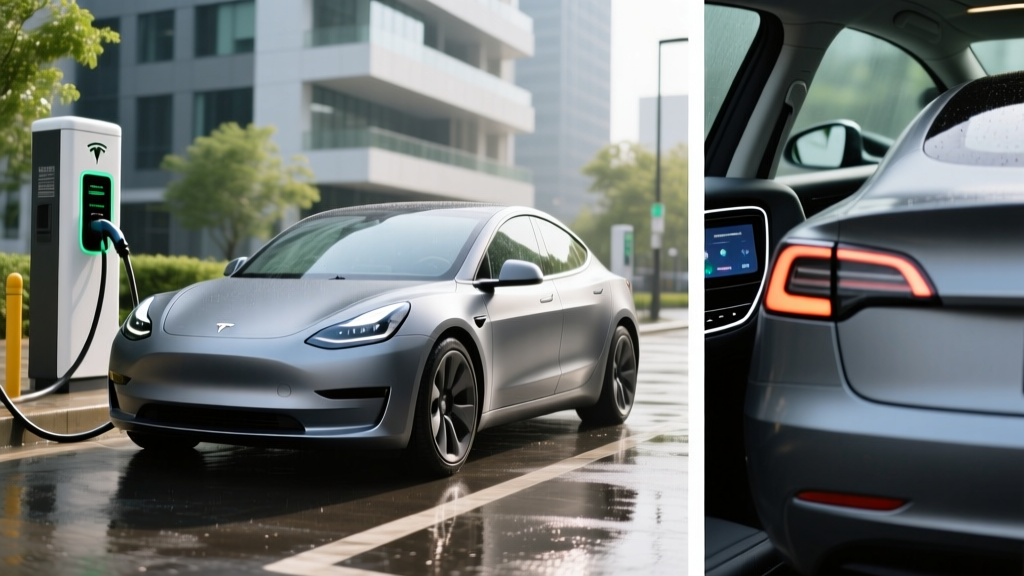
The search term "Tesla accident" trends for a reason: high-profile crashes involving Autopilot and FSD make headlines, and buyers want to know if the cars are actually safe. This review tackles the data head-on — NHTSA star ratings, IIHS crash-test results, NHTSA's SFADS (Standing General Order) crash reporting, and real-world Autopilot mileage statistics — while delivering a full 2026 Tesla Model 3 profile covering range, charging, pricing, and tax credits.
Crash-Test Ratings: What NHTSA and IIHS Actually Say
The current-generation Model 3 (refreshed "Highland" platform introduced for MY2024 and carried into 2026) earns top marks from both major U.S. safety agencies:
- NHTSA: 5-Star Overall Safety Rating across all trims, with 5 stars in frontal crash, side crash, and rollover resistance (nhtsa.gov).
- IIHS: TOP SAFETY PICK+ designation when equipped with acceptable headlights, earning Good ratings in all crashworthiness tests including the updated moderate overlap and side tests (iihs.org).
The Model 3's low center of gravity (battery pack under the floor) gives it a rollover risk of approximately 9.3% per NHTSA — among the lowest of any sedan. The body structure uses a mix of ultra-high-strength steel and aluminum, with reinforced A-pillars and a robust safety cell.
Autopilot, FSD, and Tesla Accident Statistics
Let's address the headline concern directly. Tesla publishes quarterly Vehicle Safety Reports; the most recent reports show:
- With Autopilot engaged: ~1 crash per 4–5 million miles driven.
- Without Autopilot (Tesla vehicles): ~1 crash per 1.5–2 million miles.
- U.S. average (all vehicles): ~1 crash per 670,000 miles (NHTSA data).
These numbers require context. Tesla's methodology counts any airbag deployment or significant impact at 12+ mph as a "crash," and the fleet skews toward newer vehicles with modern ADAS. Independent analyses from groups like the IIHS have found that partial-automation users sometimes exhibit higher rates of certain crash types due to over-reliance.
NHTSA Standing General Order (SFADS) Data
Since July 2021, NHTSA has required manufacturers to report crashes involving Level 2+ ADAS. Tesla accounts for a large share of reported incidents — but also for the vast majority of Level 2-equipped vehicle miles on U.S. roads. Raw incident counts without mileage context are misleading; per-mile incident rates are the more honest metric, and on that basis Tesla's ADAS record is competitive with legacy automakers' Level 2 systems (GM Super Cruise, Ford BlueCruise).
2026 Model 3: Range, Battery, and Real-World Efficiency
| Spec | Long Range RWD | Long Range AWD | Performance |
|---|---|---|---|
| EPA Range | 363 mi | 346 mi | 315 mi |
| Battery (usable) | ~75 kWh (NMC) | ~75 kWh (NMC) | ~75 kWh (NMC) |
| Efficiency | 132 MPGe / 25 kWh/100mi | 126 MPGe / 27 kWh/100mi | 113 MPGe / 30 kWh/100mi |
| 0–60 mph | 4.9 sec | 4.2 sec | 2.9 sec |
| Drivetrain | RWD, single motor | AWD, dual motor | AWD, dual motor |
| Horsepower | ~295 hp | ~384 hp | ~510 hp |
| Base MSRP | $44,130 | $49,130 | $55,630 |
The Long Range trims use NMC (nickel-manganese-cobalt) chemistry for higher energy density. The base RWD Standard Range variant (when offered) typically uses LFP (lithium iron phosphate) — slightly lower range but longer cycle life and tolerance for regular 100% charging. Check your specific VIN/build sheet to confirm.
Charging Speed: Supercharger Network Advantage
| Level | Power | Miles Added/Hour | Notes |
|---|---|---|---|
| Level 1 (120V) | ~1.4 kW | 3–5 mi/hr | Emergency/trickle only |
| Level 2 (240V home) | 11.5 kW (48A) | ~44 mi/hr | Full charge overnight, ~8 hrs |
| DC Fast (Supercharger V3) | Peak 250 kW | ~1,000 mi/hr peak | 10–80% in ~22 min |
| DC Fast (V4 / newer stalls) | Up to 250 kW (Model 3 limit) | Similar | Cable/cooled connector improvements |
The Model 3's charge curve peaks near 250 kW up to roughly 40–50% SoC, then tapers progressively. Preconditioning the battery (automatic when a Supercharger is set as your nav destination) is essential — arriving cold can halve peak charge rate. NACS is the native connector; no adapter required at Tesla Superchargers, and an included adapter enables CCS-network access at Electrify America, EVgo, and others.
Pricing, Trims, and the Federal EV Tax Credit
| Trim | MSRP | Est. After §30D Credit* |
|---|---|---|
| Long Range RWD | $44,130 | ~$36,630 |
| Long Range AWD | $49,130 | ~$41,630 |
| Performance | $55,630 | ~$48,130 |
*Assumes buyer eligibility. Destination charge adds ~$1,390.
- MSRP cap: Sedans must be ≤$55,000 — all 2026 Model 3 trims qualify on MSRP.
- Buyer income caps (MAGI): $150k single / $225k HOH / $300k joint filers.
- Battery sourcing: Critical-mineral and battery-component thresholds tighten annually under the Inflation Reduction Act; Tesla's U.S. and allied-supply-chain sourcing has kept the Model 3 eligible, but verify at fueleconomy.gov before purchase.
- Point-of-sale transfer: As of 2024+, buyers can transfer the credit to the dealer for an upfront price reduction rather than waiting for tax filing.
Interior, Cargo, and Daily-Use Practicality
The Highland refresh brought meaningful interior upgrades: ventilated front seats, ambient lighting, acoustic glass (quieter cabin), rear touchscreen for passengers, and improved materials. Cargo space:
- Rear trunk: 21 cu ft (plus under-floor storage)
- Front trunk (frunk): 3.1 cu ft — useful for charging cables
- Rear legroom: 35.3 inches (tight for tall adults on long trips)
- Front headroom: 40.3 inches
The minimalist cabin is polarizing: no physical stalks (turn signals are steering-wheel buttons), no instrument cluster, and nearly all controls route through the 15.4-inch center touchscreen. Most owners adapt within a week, but test-drive before committing.
Warranty Coverage
- Basic vehicle: 4 years / 50,000 miles
- Battery & drive unit (Long Range/Performance): 8 years / 120,000 miles, with a minimum 70% capacity retention guarantee
- Battery & drive unit (Standard Range/RWD): 8 years / 100,000 miles, 70% retention
Tesla's battery warranty is competitive with Hyundai/Kia (10yr/100k) and slightly behind on years but strong on miles. Real-world degradation data from Recurrent and TeslaFi communities shows ~10–12% capacity loss at 100,000 miles for NMC packs, well within the warranty floor.
Pros, Cons, and Who Should Buy
- Best-in-class Supercharger network reliability
- Top NHTSA 5-star and IIHS TSP+ ratings
- Class-leading efficiency (kWh/100mi)
- Over-the-air updates add features post-purchase
- Strong resale value vs. most EVs
- No physical controls; touchscreen dependency
- Rear seat space tight for families with tall teens
- FSD (Supervised) subscription adds $99/mo or $8k outright — still Level 2
- Insurance premiums run 15–25% above segment average
- Service center wait times can stretch in metro areas
Best for: Tech-forward commuters and couples who prioritize efficiency, charging-network access, and top safety ratings. Consider alternatives (Hyundai Ioniq 6, BMW i4, Polestar 2) if you need physical controls, more rear-seat space, or a traditional luxury badge.
FAQ: Tesla Accident Safety & Model 3 Ownership
Is a Tesla more likely to crash than other cars?
Per NHTSA-normalized data and Tesla's own safety reports, Teslas with Autopilot engaged show lower per-mile crash rates than the U.S. average. However, misuse of Level 2 systems (inattention, hands-off-wheel) is a documented risk factor in the crashes that do occur.
Does Autopilot prevent accidents?
Autopilot's automatic emergency braking, lane-keeping, and adaptive cruise reduce certain crash types (rear-end, lane-departure) but do not eliminate risk. It is a driver-assist, not a driver-replacement. NHTSA emphasizes that the human driver remains responsible.
What happens to the battery in a Tesla crash?
The battery pack is encased in a reinforced titanium/steel shield. Post-crash thermal events (battery fires) are statistically rare — far rarer per vehicle-mile than gasoline fires in ICE vehicles. First responders receive specific Tesla rescue guides.
Is the Model 3 safe in snow and ice?
Dual-motor AWD trims perform well with winter tires. The low CG and precise traction control help. Range drops 20–35% in sub-freezing temps; precondition while plugged in to mitigate.
Does the Model 3 qualify for the full $7,500 federal tax credit in 2026?
All current trims fall under the $55,000 sedan MSRP cap and Tesla's supply chain has maintained eligibility — but income caps, battery-sourcing rules, and point-of-sale transfer requirements apply. Confirm at fueleconomy.gov and with a tax professional before purchase.