The refreshed Tesla Model 3 (internally dubbed "Highland") entered production in late 2023 and carries into the 2025 model year with meaningful upgrades to cabin materials, noise isolation, and suspension tuning. While the exterior tweaks are subtle, the 2025 Tesla Model 3 interior represents the most significant cabin overhaul since the car launched in 2017. This review covers the full ownership picture: real-world range, charging speed, pricing after tax credits, and how the Model 3 stacks up against rivals like the Hyundai Ioniq 6 and BMW i4.
2025 Tesla Model 3 Interior: What Changed and Why It Matters
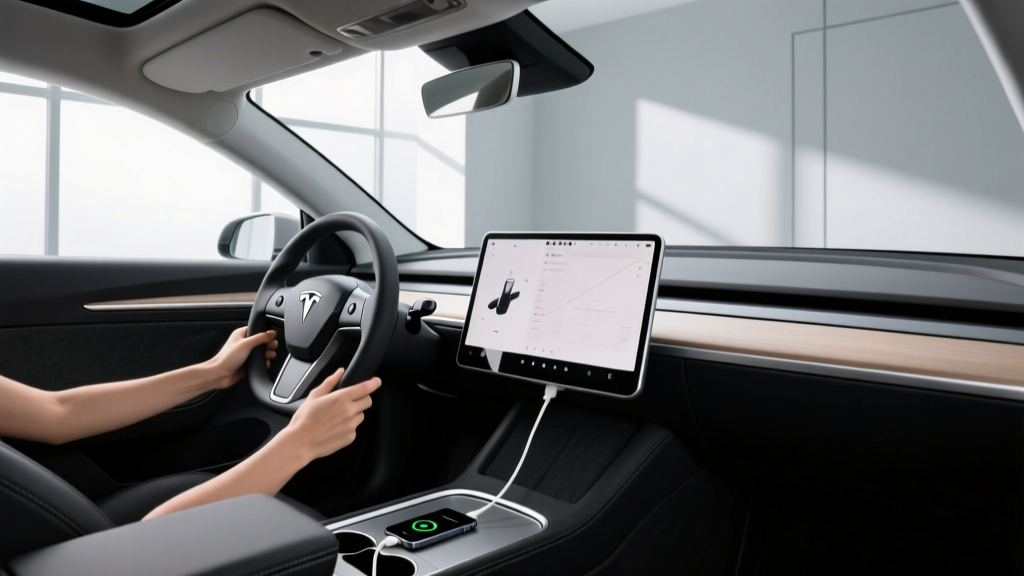
Tesla overhauled the Model 3 cabin with higher-grade materials, ventilated front seats, ambient lighting, a rear 8-inch touchscreen for climate and media controls, and substantially improved acoustic glass. The result is a noticeably quieter ride at highway speeds — Tesla claims a 30% reduction in cabin noise compared to the pre-refresh model.
The minimalist philosophy remains. There is still no instrument cluster; all driver information lives on the 15.4-inch center touchscreen. Turn signals are now integrated into the steering wheel (replacing the column stalk), and gear selection moves to the touchscreen with backup buttons on the overhead console. This is the most polarizing aspect of the 2025 Tesla Model 3 interior — some owners adapt quickly, others find it a persistent annoyance during three-point turns and car-wash visits.
Material quality has improved markedly. The dash and door panels now use soft-touch materials and fabric inserts, replacing the previous hard plastics. The aluminum trim across the dash adds visual warmth. However, the "vegan leather" (synthetic) seats, while durable, still don't match the suppleness of what you'll find in a BMW i4 or Mercedes EQB at similar price points.
Range, Battery, and Real-World Efficiency
Tesla offers two battery chemistries in the 2025 Model 3 lineup:
- Long Range AWD: ~75 kWh usable capacity, NMC (nickel manganese cobalt) chemistry. Higher energy density, better cold-weather performance, but Tesla recommends daily charging to 80% for longevity.
- Rear-Wheel Drive (base): ~57.5 kWh usable capacity, LFP (lithium iron phosphate) chemistry. Lower energy density but can be charged to 100% daily without degradation concerns. LFP also offers a longer cycle life and avoids cobalt sourcing concerns.
Efficiency remains a Tesla strong suit. The Long Range AWD achieves 132 MPGe combined (25 kWh/100 mi) per EPA data on fueleconomy.gov. The RWD model returns 132 MPGe combined as well, aided by its lighter curb weight. These are among the best efficiency figures in the segment.
| Spec | RWD (Base) | Long Range AWD | Performance AWD |
|---|---|---|---|
| EPA Range | 272 mi | 363 mi | 315 mi |
| Battery (usable) | ~57.5 kWh (LFP) | ~75 kWh (NMC) | ~75 kWh (NMC) |
| Horsepower | 271 hp | 346 hp | 510 hp |
| 0–60 mph | 5.8 sec | 4.2 sec | 2.9 sec |
| Drivetrain | RWD (single motor) | AWD (dual motor) | AWD (dual motor) |
| MPGe (combined) | 132 MPGe | 132 MPGe | 113 MPGe |
| Top Speed | 125 mph | 125 mph | 163 mph |
Charging Speed: DC Fast Charging and Home Level 2
Charging speed is where the refreshed Model 3 shows incremental but meaningful gains. All 2025 Model 3 variants use the NACS (North American Charging Standard) connector natively — no adapter needed for Tesla Superchargers, and increasingly compatible with non-Tesla networks as operators add NACS cables.
| Charging Level | Power | Rate / Time |
|---|---|---|
| Level 1 (120V household) | ~1.4 kW | ~3–5 mi/hr |
| Level 2 (240V home, 48A) | 11.5 kW | ~44 mi/hr |
| DC Fast Charge (peak) | 250 kW (LR/Perf), 170 kW (RWD) | 10–80% in ~25 min (LR) |
| DC Sustained (avg 10–80%) | ~150–170 kW (LR) | ~200 mi in 15 min |
The Long Range and Performance models peak at 250 kW on V3 Superchargers, though that peak is sustained only briefly (typically between 10–30% SoC). The charge curve tapers significantly above 60%, and especially above 80% — this is normal for NMC lithium-ion chemistry and is managed by the battery thermal system. Plan road-trip stops around the 10–80% window for the fastest sessions.
The base RWD model with its LFP battery peaks at a lower 170 kW. LFP cells accept charge differently, and while DC sessions are slower, the trade-off is the ability to charge to 100% regularly without long-term degradation concerns.
For home charging, a Tesla Wall Connector on a 60-amp circuit delivers up to 11.5 kW / 48 amps, adding roughly 44 miles of range per hour. A full overnight charge from 20% to 80% takes about 5–6 hours — more than adequate for daily use. Installation costs for a 240V/60A circuit typically range from $800 to $2,500 depending on panel proximity and local permitting, though a panel upgrade to 200A service can push costs to $3,000–$5,000 in older homes.
Pricing, Trims, and Federal Tax Credit Eligibility
The 2025 Model 3 is available in three trims. Pricing below reflects MSRP before destination fees ($1,390):
| Trim | MSRP | Est. After §30D Credit | Credit Eligibility |
|---|---|---|---|
| Rear-Wheel Drive | $38,990 | ~$31,490 | Up to $7,500 (verify sourcing) |
| Long Range AWD | $45,240 | ~$37,740 | Up to $7,500 (verify sourcing) |
| Performance AWD | $52,990 | ~$45,490 | Up to $7,500 (verify sourcing) |
Federal tax credit (§30D) critical caveats: The full $7,500 credit requires meeting both critical-mineral and battery-component sourcing thresholds as defined by the IRS. These thresholds tighten annually. Buyer income caps apply ($150K single / $300K joint modified AGI), and the vehicle MSRP must not exceed $55,000 for sedans. All three Model 3 trims fall under the sedan MSRP cap. As of 2025, Tesla has restructured some battery supply chains to meet sourcing requirements, but eligibility can shift — always verify current status on IRS.gov's clean vehicle credits page before purchase. The credit can now be transferred to the dealer at point of sale, effectively reducing your out-of-pocket price at delivery.
Cargo Space, Passenger Room, and Daily Practicality
The Model 3 is a compact executive sedan, and interior space reflects that classification:
- Front legroom: 42.7 inches
- Rear legroom: 35.2 inches — adequate for adults under 6 feet, tight for taller passengers on long drives
- Cargo (trunk): 21.0 cu ft (including under-floor storage)
- Frunk (front trunk): 3.1 cu ft — fits a charging cable bag or small backpack
- Total cargo: ~24.1 cu ft
The rear seat is the Model 3's weakest practicality point. The sloping roofline cuts into headroom, and the seat cushion is mounted low, creating a "knees-up" seating position that compromises thigh support on longer trips. Families with rear-facing car seats will find the space tight. If rear-seat comfort is a priority, the Hyundai Ioniq 6 (39.5 inches rear legroom) or the Model Y crossover are better choices.
The glass roof provides an airy feel but offers no shade panel — Tesla includes a tinted panel that reduces heat, but in hot climates, many owners install an aftermarket sunshade ($30–$60) for summer months.
Technology, Driver Assistance, and Safety
The 15.4-inch center touchscreen runs Tesla's proprietary infotainment OS, which remains one of the most responsive and feature-rich systems in the EV market. Navigation, media, climate, and vehicle settings are all integrated. Wireless phone mirroring is notably absent — Tesla does not support Apple CarPlay or Android Auto. For many Tesla owners this is a non-issue given the quality of Tesla's native navigation and streaming apps; for others, it's a dealbreaker.
Standard driver-assistance features (branded Basic Autopilot) include:
- Adaptive cruise control with stop-and-go
- Lane-centering assist (highway)
- Automatic emergency braking
- Blind-spot monitoring
The optional Enhanced Autopilot ($6,000) adds automatic lane changes, Navigate on Autopilot (highway on/off-ramp guidance), and Smart Summon. Full Self-Driving (Supervised) is available for $8,000 (or $99/month subscription) and adds traffic-light/stop-sign recognition and city-street autosteer.
The 2025 Model 3 earned a 5-star overall safety rating from NHTSA and Top Safety Pick+ recognition from IIHS, continuing the Model 3's strong crash-test record.
Warranty and Battery Longevity
- Basic vehicle warranty: 4 years / 50,000 miles
- Battery & drive unit warranty: 8 years / 100,000 miles (RWD); 8 years / 120,000 miles (Long Range & Performance)
- Battery capacity threshold: Tesla warrants retention of at least 70% of original capacity during the warranty period
Real-world degradation data from Tesla's fleet suggests most Model 3 batteries retain approximately 85–90% capacity after 100,000 miles. LFP batteries in the RWD model tend to degrade more slowly over calendar life, though they are heavier per kWh and offer less range. Battery replacement outside of warranty is expensive — estimated at $12,000–$16,000 depending on pack size — but is rarely needed based on current fleet data.
Pros, Cons, and Who Should Buy
Pros
- Best-in-class efficiency (25 kWh/100 mi)
- Supercharger network access (NACS native)
- Strong real-world range (300+ mi highway, Long Range)
- Over-the-air updates add features post-purchase
- Improved cabin quietness and material quality
- Excellent safety ratings (NHTSA 5-star, IIHS TSP+)
Cons
- Rear seat space is tight for taller passengers
- No Apple CarPlay / Android Auto
- Steering-wheel turn signals require adjustment period
- Stalkless gear selection is unintuitive at first
- FSD subscription cost is high for Level 2 capability
- Glass roof lacks a retractable shade
Who the 2025 Model 3 suits best: Daily commuters and road-trippers who prioritize range, efficiency, and access to the Supercharger network. The Long Range AWD is the sweet spot — 363 miles EPA, dual-motor traction in rain and snow, and fast DC charging make it ideal for 300-mile corridor trips. Solo drivers or couples without frequent rear-seat passengers will get the most from this package.
Who should look elsewhere: Families needing generous rear-seat space (consider the Model Y or Kia EV9), drivers who rely on CarPlay for their workflow, and buyers in areas with limited Supercharger coverage who might benefit from the growing CCS/NACS-open networks.
Frequently Asked Questions
What is the real-world range of the 2025 Tesla Model 3?
The Long Range AWD is EPA-rated at 363 miles. In real-world highway driving at 70 mph, expect 300–320 miles. In cold weather below 30°F, range drops to roughly 240–270 miles. The base RWD (LFP) is EPA-rated at 272 miles with real-world highway range around 230–250 miles.
How fast does the 2025 Model 3 charge?
On a V3 Supercharger (250 kW peak), the Long Range charges from 10–80% in approximately 25 minutes. The RWD model peaks at 170 kW and takes roughly 30 minutes for the same session. At home on a 48-amp Level 2 charger (11.5 kW), you gain about 44 miles of range per hour.
Does the 2025 Tesla Model 3 qualify for the federal EV tax credit?
All three trims fall under the $55,000 MSRP cap for sedans. Eligibility for the full $7,500 depends on battery-sourcing requirements (critical minerals and component manufacturing), buyer income limits ($150K single / $300K joint), and current IRS rules. Verify eligibility at IRS.gov before purchasing. The credit can be applied at point of sale.
Is the 2025 Model 3 worth buying over competitors?
Against the Hyundai Ioniq 6 (EPA 361 mi, $42,450 base), the Model 3 offers comparable range, a more mature charging network, and stronger OTA updates — but less rear-seat room and no CarPlay. Against the BMW i4 (EPA 307 mi, $52,200 base), the Model 3 is significantly less expensive and more efficient, though the BMW offers superior ride quality and traditional controls. The Model 3 Long Range remains the best value proposition in the segment when factoring in Supercharger access and efficiency.
What's the biggest change to the 2025 Tesla Model 3 interior?
The Highland refresh brought ventilated front seats, a rear 8-inch touchscreen, ambient lighting, acoustic glass (30% quieter cabin), and upgraded soft-touch materials throughout. Turn signals moved to the steering wheel and gear selection moved to the touchscreen — both require an adaptation period.