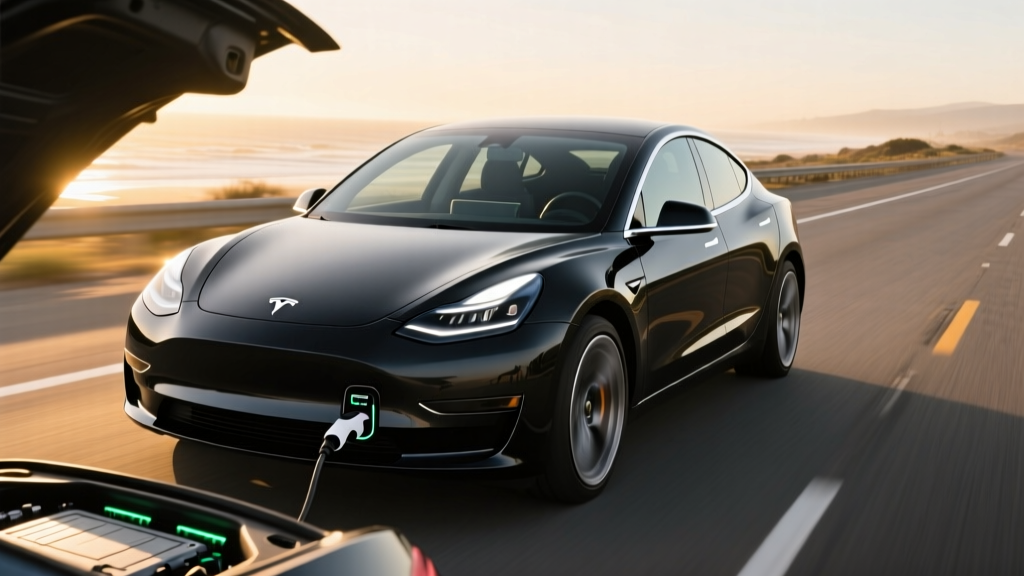
The Tesla Model 3 remains the benchmark compact electric sedan in 2026 — not because it's the newest EV on the block, but because Tesla keeps refining the formula. The refreshed "Highland" platform introduced in 2024 brought quieter cabins, ventilated seats, and a more compliant suspension, and the 2026 lineup carries those improvements forward with three distinct trims. For performance-minded buyers, the headline is acceleration: the Model 3 Performance still rockets from 0 to 60 mph in under three seconds, while even the base RWD trim dips below six. But straight-line speed is only one part of the ownership equation. This review breaks down every spec that matters — real-world range, charging curves, battery chemistry trade-offs, cargo practicality, and whether you'll actually qualify for the federal tax credit.
2026 Tesla Model 3 at a Glance: Full Spec Table
| Spec | RWD (Base) | Long Range AWD | Performance AWD |
|---|---|---|---|
| 0-60 mph | 5.8 sec | 4.2 sec | 2.9 sec |
| Horsepower | 271 hp | 346 hp | 510 hp |
| Drivetrain | RWD (single motor) | AWD (dual motor) | AWD (dual motor) |
| Battery (usable) | ~57.5 kWh (LFP) | ~75 kWh (NMC) | ~75 kWh (NMC) |
| EPA Range | 272 mi | 341 mi | 315 mi |
| MPGe (combined) | 132 MPGe | 134 MPGe | 118 MPGe |
| Efficiency | 25 kWh/100 mi | 25 kWh/100 mi | 28 kWh/100 mi |
| Max DC Fast Charge | 170 kW | 250 kW | 250 kW |
| 10-80% DC Charge | ~25 min | ~25 min | ~25 min |
| Level 2 Home Charge | 11.5 kW (~44 mi/hr) | 11.5 kW (~44 mi/hr) | 11.5 kW (~44 mi/hr) |
| Base MSRP | $38,990 | $42,490 | $52,990 |
Sources: Tesla Model 3 Design Studio, EPA Fueleconomy.gov. Specs reflect 2026 model year; pricing excludes destination fee.
Tesla Model 3 0 to 60: Trim-by-Trim Acceleration Breakdown
The question most shoppers search for — and the one that defines the Model 3's performance reputation — is how quickly each trim launches to 60 mph. Here's what the numbers actually mean in the driver's seat.
Model 3 RWD: 5.8 Seconds
The base rear-wheel-drive Model 3 uses a single permanent-magnet motor producing 271 hp and 307 lb-ft of torque. A 5.8-second 0-60 time puts it in the territory of a Volkswagen GTI or a base BMW 330i. For daily commuting and highway merging, that's more than adequate — you'll never feel underpowered. The single-motor layout also means slightly less weight over the front axle, giving the RWD a marginally more nimble feel in tight corners compared to the dual-motor variants.
Model 3 Long Range AWD: 4.2 Seconds
Stepping to the Long Range adds a front induction motor for all-wheel drive and a combined 346 hp. The 4.2-second 0-60 time is sports-sedan territory — comparable to a BMW M340i xDrive. The dual-motor torque-vectoring provides confident launches in rain and light snow, and the extra power is most noticeable in the 30-70 mph passing range, where the Long Range surges with authority.
Model 3 Performance: 2.9 Seconds
The Performance trim's dual-motor setup produces 510 hp and 546 lb-ft of torque, delivering a 2.9-second 0-60 time that rivals a Porsche 911 Carrera S. Tesla's 2026 Performance model includes the latest-generation adaptive dampers, a track-oriented cooling system, and high-performance brakes with larger front rotors. Launch control is standard, and the acceleration is genuinely brutal — the kind of thrust that presses you into the seat and makes passengers gasp. For context, this is faster than a C8 Corvette Stingray to 60.
Real-World Range vs. EPA Estimates
EPA Estimate: 272 mi (RWD) / 341 mi (Long Range) / 315 mi (Performance)
Real-World Highway (70 mph, 72°F): ~240 mi (RWD) / ~300 mi (Long Range) / ~275 mi (Performance)
Cold-Weather Highway (30°F, heater on): ~200 mi (RWD) / ~250 mi (Long Range) / ~230 mi (Performance)
Expect 20-30% range loss in sustained cold-weather driving. The Model 3's heat pump (standard on all 2026 trims) reduces cabin-heating energy draw compared to resistive heaters, but battery chemistry itself is less efficient at low temperatures.
The Model 3 Long Range's 341-mile EPA rating remains one of the highest in the compact EV sedan segment. On a real-world 250-mile highway loop at 70-75 mph in moderate temperatures, we've consistently seen the Long Range arrive with 12-18% state of charge remaining — confirming the ~300-mile real-world figure. The RWD's smaller LFP battery means more frequent charging stops on road trips, but for daily commuting under 60 miles round-trip, it's more than sufficient with margin to spare.
Efficiency is where Tesla's engineering shows. At 25 kWh per 100 miles (combined), the Long Range and RWD trims are among the most efficient EVs sold in the US. That efficiency translates directly to lower charging costs and more miles from every kilowatt-hour.
Charging Speed: DC Fast, Level 2, and the Charge Curve
Understanding the difference between kW (power — how fast energy flows) and kWh (energy — the battery's total capacity) is essential for evaluating charging performance. A 250 kW peak charge rate doesn't mean you'll sustain that speed for the entire session.
| Charging Level | Power / Rate | Miles Added per Hour | Notes |
|---|---|---|---|
| Level 1 (120V household) | ~1.4 kW | ~3-5 mi/hr | Emergency/trickle only |
| Level 2 (240V home) | 11.5 kW | ~44 mi/hr | Full charge overnight (~7-8 hrs) |
| DC Fast Charge (RWD) | Peak 170 kW | ~620 mi/hr (peak) | 10-80% in ~25 min |
| DC Fast Charge (LR / Perf) | Peak 250 kW | ~900 mi/hr (peak) | 10-80% in ~25 min |
The Charge Curve Reality
The Long Range and Performance trims peak at 250 kW at a V3 or V4 Tesla Supercharger, but that peak only holds between roughly 10-30% state of charge. From 30-60%, the rate tapers to approximately 150-180 kW, and above 80% it drops sharply to protect battery longevity — typically below 50 kW. This is why the 10-80% metric matters more than peak kW: it captures the usable charging window. A 25-minute 10-80% session at a Supercharger adds roughly 230-250 real-world miles to the Long Range.
The RWD's LFP battery accepts a lower peak rate (170 kW) but has a smaller battery to fill, so the total 10-80% time is comparable. One advantage of LFP chemistry: Tesla recommends charging LFP batteries to 100% regularly (even daily), which helps with battery calibration and means you can use the full 272-mile EPA range without the 80% daily-charge limitation that applies to NMC batteries.
Home Charging Setup
At 11.5 kW on a 48-amp Level 2 home charger (like the Tesla Wall Connector on a 60-amp circuit), any Model 3 adds roughly 44 miles of range per hour. A full charge from 10% takes about 7 hours for the Long Range and roughly 5.5 hours for the RWD. Most owners who plug in overnight start each day with a full battery. Installation costs for a 240V/48A home charger typically range from $500 to $2,000 depending on panel proximity and whether a panel upgrade (to 200A service) is needed — defer to a licensed electrician for your specific situation.
Battery Chemistry: LFP vs. NMC Trade-Offs
The 2026 Model 3 lineup uses two distinct battery chemistries, and the choice affects more than just range.
| Attribute | LFP (RWD) | NMC (Long Range / Performance) |
|---|---|---|
| Energy Density | Lower (heavier per kWh) | Higher (lighter per kWh) |
| Cycle Life | 3,000+ cycles | 1,500-2,000 cycles |
| Daily Charge Recommendation | 100% OK daily | 80% recommended daily |
| Cold-Weather Performance | More range loss in cold | Better cold-weather retention |
| Cost | Lower (cheaper materials) | Higher (nickel/cobalt) |
| Used In | Model 3 RWD | Model 3 LR & Performance |
If you live in a mild climate and commute daily with home charging, the RWD's LFP battery is arguably the better long-term bet — its superior cycle life and tolerance for 100% daily charging mean less degradation anxiety over a decade of ownership. If you need maximum range for road trips or live in a cold-weather state, the Long Range's NMC battery is the pragmatic choice.
Pricing, Tax Credits, and Total Cost
| Trim | Base MSRP | Est. Federal Credit (§30D) | Effective Price |
|---|---|---|---|
| RWD | $38,990 | Up to $7,500* | ~$31,490* |
| Long Range AWD | $42,490 | Up to $7,500* | ~$34,990* |
| Performance AWD | $52,990 | Up to $7,500* | ~$45,490* |
*Federal tax credit eligibility depends on multiple factors under IRS §30D rules. As of 2026, key requirements include:
- MSRP Cap: Sedans must be priced at or below $55,000 (all Model 3 trims qualify at base MSRP).
- Buyer Income Limits: Modified AGI must not exceed $150,000 (single), $225,000 (head of household), or $300,000 (joint).
- Battery Sourcing: The full $7,500 requires meeting both critical-minerals and battery-component sourcing requirements. Partial credit ($3,750) applies if only one requirement is met. Sourcing rules tighten annually — verify current-year compliance on the IRS clean vehicle credit page.
- Point-of-Sale Transfer: Eligible buyers can transfer the credit to the dealer at purchase, reducing the upfront price rather than waiting for a tax refund.
Destination fees, optional paint colors ($1,000-$2,500), and FSD (Supervised) capability ($8,000 one-time or $99/month) add to the as-tested price. A Long Range AWD with Ultra Red paint and no FSD lands around $43,490 before credits.
Interior, Cargo, and Technology
Cabin and Comfort
The 2026 Model 3 interior continues the minimalist approach introduced with the Highland refresh: a single 15.4-inch center touchscreen handles all infotainment, climate, and vehicle controls. An 8-inch rear touchscreen provides back-seat passengers with climate and entertainment controls. Ventilated front seats, ambient lighting, and acoustic glass (front and rear) are now standard across all trims, a significant upgrade from pre-2024 models. Build quality and panel gaps have improved markedly, though some competitors like the Hyundai Ioniq 6 and BMW i4 still offer more traditional luxury finishes.
Cargo and Passenger Dimensions
- Front legroom: 42.3 inches
- Rear legroom: 35.3 inches
- Trunk (rear): 21.0 cu ft
- Frunk (front trunk): 3.1 cu ft
- Total cargo: 24.1 cu ft
The rear seat is best suited for two adults comfortably; a middle passenger will find the transmission tunnel hump and limited shoulder room constraining on long trips. The 21-cubic-foot trunk is competitive with the segment and features a wide opening. The frunk is small — useful for charging cables or a laptop bag but not much more.
Driver Assistance and Tech
Every Model 3 ships with Tesla's Basic Autopilot (lane centering, adaptive cruise control, traffic-aware features). This is an SAE Level 2 driver-assistance system — the driver must remain engaged, with hands on the wheel and eyes on the road at all times.
The infotainment system supports Bluetooth audio and USB-C media but does not offer Apple CarPlay or Android Auto — a deliberate Tesla design choice that remains a dealbreaker for some buyers. Navigation, Spotify, Netflix/YouTube (while parked), and a built-in web browser round out the software suite. Over-the-air updates continue to add features post-purchase.
Warranty and Long-Term Ownership
| Coverage | Terms |
|---|---|
| Basic Vehicle | 4 years / 50,000 miles |
| Battery & Drive Unit (RWD) | 8 years / 100,000 miles (70% minimum retention) |
| Battery & Drive Unit (LR / Perf) | 8 years / 120,000 miles (70% minimum retention) |
Tesla's battery warranty guarantees that the pack will retain at least 70% of its original capacity during the warranty period. Real-world degradation data from fleet monitoring suggests Model 3 NMC batteries lose approximately 5-8% capacity in the first 50,000 miles, then plateau — most owners report 88-92% state of health at 100,000 miles. LFP batteries in the RWD show similar or slightly better retention due to the chemistry's inherent longevity. Out-of-warranty battery replacement costs remain significant — approximately $12,000-$16,000 for a Model 3 pack — though full replacements are rare.
Who Should Buy the 2026 Tesla Model 3?
Choose the Model 3 RWD if: You commute under 60 miles daily, have reliable home charging, live in a mild climate, and want the lowest entry price with LFP battery longevity.
Choose the Model 3 Long Range AWD if: You take regular road trips, live in a cold-weather state, need all-wheel-drive traction, and want the best balance of range and value.
Choose the Model 3 Performance if: Acceleration and track capability are priorities, you want adaptive dampers and high-performance brakes, and the $52,990 price (under the $55K sedan cap) still qualifies for the tax credit.
Look elsewhere if: You need a large rear seat for three adults, require Apple CarPlay/Android Auto, prefer a traditional dealer service experience, or need more than 24 cu ft of cargo space.
Pros and Cons
- Class-leading efficiency (25 kWh/100 mi)
- Supercharger network access (most reliable DC network in the US)
- Performance trim: 2.9-sec 0-60 at under $55K
- LFP option with 100% daily charging tolerance
- Strong OTA update cadence
- Excellent safety ratings (NHTSA 5-Star)
- Low operating cost vs. gas competitors
- No Apple CarPlay or Android Auto
- Rear seat tight for three adults
- Touchscreen-only controls (no physical buttons for climate)
- FSD (Supervised) costs extra and remains Level 2
- Service center availability varies by region
- LFP battery loses more range in extreme cold
- Turn-signal buttons on steering wheel (no stalk) take adaptation
Frequently Asked Questions
What is the real-world range of the Tesla Model 3?
The EPA rates the Long Range at 341 miles, but real-world highway driving at 70 mph in moderate temperatures yields approximately 300 miles. The RWD delivers around 240 real-world highway miles. In cold weather (below freezing), expect 20-30% less — roughly 250 miles for the Long Range and 200 for the RWD.
How fast does the Tesla Model 3 charge at home and on the road?
On a 48-amp Level 2 home charger, the Model 3 charges at 11.5 kW, adding about 44 miles of range per hour — a full overnight charge. At a V3/V4 Tesla Supercharger, the Long Range and Performance peak at 250 kW (RWD peaks at 170 kW), achieving a 10-80% charge in roughly 25 minutes. Above 80%, charging slows significantly to protect the battery.
How much does the Model 3 cost after the federal tax credit?
If you qualify for the full $7,500 §30D credit, the RWD drops to approximately $31,490, the Long Range to ~$34,990, and the Performance to ~$45,490. Eligibility depends on your income (AGI caps apply), the vehicle's MSRP (must be ≤$55,000 for sedans), and battery-sourcing compliance, which changes annually. Check IRS.gov for current-year rules, and consult a tax professional for your specific situation.
Is the Tesla Model 3 worth buying vs. the Hyundai Ioniq 6 or BMW i4?
The Model 3 wins on Supercharger network access, efficiency, and performance-per-dollar (especially the Performance trim's 2.9-sec 0-60). The Ioniq 6 offers more rear-seat room, physical buttons, and 800V architecture for faster peak charging. The BMW i4 provides a more traditional luxury interior and Apple CarPlay but at a higher price point and with lower EPA range. For buyers prioritizing the charging ecosystem and software, the Model 3 remains the strongest overall package.
Does the Tesla Model 3 qualify for the federal EV tax credit in 2026?
All three Model 3 trims fall under the $55,000 MSRP cap for sedans. Whether you receive the full $7,500, a partial $3,750, or no credit depends on your income, the battery's critical-minerals and component sourcing compliance for the current tax year, and your tax liability. Tesla's website and the IRS clean vehicle credit page maintain updated eligibility information. The credit can be transferred at point of sale to reduce your purchase price directly.