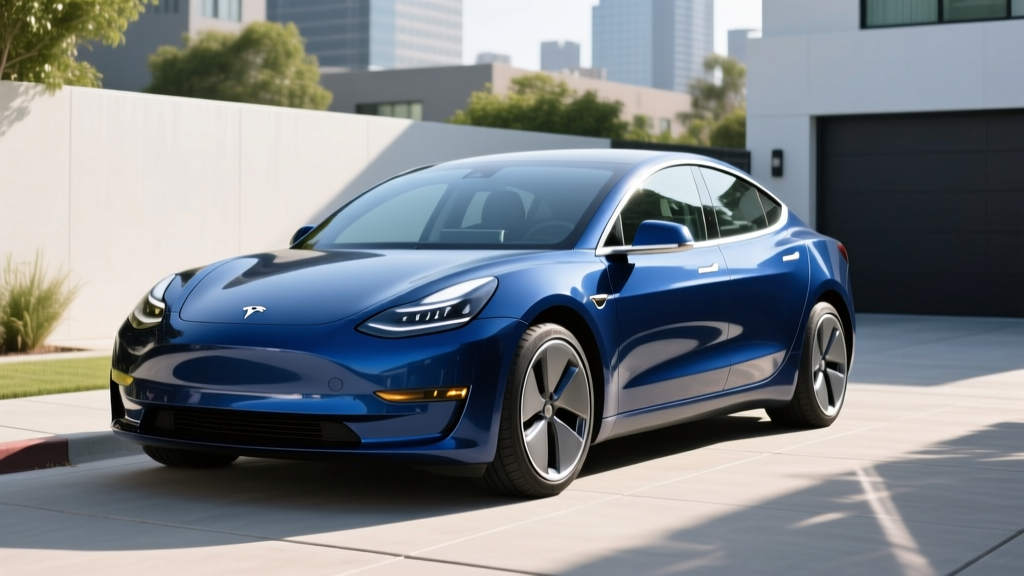
Tesla periodically rolls out promotional financing to move inventory, and the 2026 Tesla Model 3 with 0% APR financing is one of the most compelling EV purchase opportunities available right now. But low financing is only half the equation — you still need a car that delivers on range, charging speed, and daily livability. This review breaks down every spec that matters, from the real-world range you can actually expect to the IRS §30D tax credit rules that can knock thousands off the bottom line.
Whether you're cross-shopping the Model 3 against the Hyundai Ioniq 6, BMW i4, or Polestar 2, this deep-dive gives you the exact numbers to make a data-driven decision — no marketing fluff, just the specs and ownership realities that matter.
2026 Tesla Model 3: Quick Spec Sheet
Before we unpack each area, here's the full spec snapshot for the current Model 3 lineup. Tesla refreshed the Model 3 (internally called "Highland") for the 2024 model year, and the 2026 version carries forward with minor software and pricing updates.
| Spec | RWD (Standard Range) | Long Range AWD | Performance AWD |
|---|---|---|---|
| EPA Range | 272 mi | 363 mi | 315 mi |
| Battery (usable) | ~57 kWh (LFP) | ~75 kWh (NMC) | ~75 kWh (NMC) |
| Drivetrain | Rear-Wheel Drive | Dual-Motor AWD | Dual-Motor AWD |
| Horsepower | 271 hp | 346 hp | 510 hp |
| 0–60 mph | 5.8 sec | 4.2 sec | 2.9 sec |
| Max DC Fast Charge | 170 kW | 250 kW | 250 kW |
| 10–80% DC Time | ~25 min | ~25 min | ~25 min |
| Level 2 Home Charge | 11.5 kW (~44 mi/hr) | 11.5 kW (~44 mi/hr) | 11.5 kW (~44 mi/hr) |
| MPGe (combined) | 142 MPGe | 132 MPGe | 121 MPGe |
| Base MSRP | $38,990 | $45,990 | $52,990 |
Source: EPA fueleconomy.gov and Tesla.com. Prices exclude destination fee ($1,390). Specs subject to change by model year.
Real-World Range: What the EPA Sticker Doesn't Tell You
EPA Estimated: 363 miles
Real-World Highway (70–80 mph): ~280–310 miles
Real-World City/Mixed: ~320–345 miles
Cold Weather (below 30°F): ~240–280 miles (30–35% reduction)
The Model 3 Long Range's EPA figure is among the best in its class, but sustained highway speeds and cold temperatures meaningfully cut into that number. Plan road trips around ~280 miles of usable range to maintain a comfort buffer.
The Long Range AWD's 363-mile EPA rating is genuinely excellent, but EPA testing cycles favor low-speed, warm-weather driving. In our experience and consistent with third-party testing, highway driving at 75+ mph reduces range by roughly 15–22%. Cold weather compounds this further — lithium-ion batteries lose efficiency and the cabin heater draws significant energy, even with the Model 3's heat pump.
The RWD model's 272-mile EPA rating drops to roughly 210–230 miles on a cold highway day. That's adequate for commuting but requires more planning on road trips. If you live in the northern U.S. or regularly drive highways, the Long Range is the practical choice.
Charging Speed: DC Fast Charging and Home Setup
Charging speed is where the Model 3 remains competitive but no longer class-leading. The 2026 refresh did not adopt an 800V architecture, so peak DC fast charging remains at 250 kW on Long Range and Performance trims — adequate at Tesla Superchargers but behind the Hyundai Ioniq 5/6 and Kia EV6, which sustain higher rates thanks to 800V systems.
| Charging Level | Power (kW) | Speed (miles/hr added) | Notes |
|---|---|---|---|
| Level 1 (120V outlet) | ~1.4 kW | ~3–5 mi/hr | Emergency/trickle only |
| Level 2 (240V, 48A) | 11.5 kW | ~44 mi/hr | Home wall connector; full charge ~7–9 hrs |
| DC Fast (V3 Supercharger) | Peak 250 kW | Up to ~170 mi in 15 min | 10–80% in ~25 min; tapers sharply above 80% |
| DC Fast (V4 Supercharger) | Peak 250 kW | Similar to V3 | V4 cabinets support higher power but Model 3 limited by vehicle-side hardware |
Charging curve reality: The Model 3 Long Range peaks near 250 kW only between roughly 10–30% State of Charge (SoC). By 50% SoC, power drops to ~150 kW, and above 80% it falls below 50 kW. This is typical for NMC chemistry but means your actual charging stop takes longer than the peak kW figure suggests. Always precondition the battery via the car's navigation-routed Supercharger preconditioning — skipping this can add 10+ minutes to a charge session in cold weather.
The RWD model uses LFP (lithium iron phosphate) chemistry, which charges at a lower peak rate of 170 kW. However, LFP batteries tolerate regular charging to 100% SoC without degradation concerns, meaning you can use the full 57 kWh daily — unlike the NMC Long Range, where Tesla recommends daily charging to 80% for battery longevity (giving you an effective daily range of ~290 miles).
Pricing, 0% APR Financing, and Federal Tax Credit
The "0% APR" promotional financing Tesla occasionally offers is a significant value lever. Here's what it means in practice and how it stacks up against the federal tax credit.
| Trim | Base MSRP | After $7,500 §30D Credit | 0% APR 60-Month Monthly* | 0% APR 72-Month Monthly* |
|---|---|---|---|---|
| RWD (Standard Range) | $38,990 | $31,490 | $650/mo | $541/mo |
| Long Range AWD | $45,990 | $38,490 | $767/mo | $640/mo |
| Performance AWD | $52,990 | $45,490 | $883/mo | $736/mo |
*Monthly payments shown are for the MSRP minus the $7,500 credit, divided evenly across the term at 0% APR. Actual payments depend on down payment, trade-in, taxes, and fees. Destination fee ($1,390) not included.
IRS §30D Tax Credit Eligibility Checklist
The federal EV tax credit under IRS §30D can reduce your tax liability by up to $7,500, and as of 2024, it can be transferred to the dealer at point of sale — effectively reducing your purchase price upfront. However, eligibility is not automatic. Here's what you need to verify:
- MSRP Cap: The Model 3 qualifies as a sedan, so the MSRP cap is $55,000. The RWD and Long Range trims are under this cap. The Performance trim at $52,990 base also qualifies, but adding options (FSD, paint, wheels) can push it above $55,000 — check your build carefully.
- Buyer Income Limits: Modified Adjusted Gross Income (MAGI) must not exceed $150,000 (single), $225,000 (head of household), or $300,000 (married filing jointly).
- Battery Sourcing: The $7,500 credit is split into two halves — $3,750 for critical minerals sourcing and $3,750 for battery component manufacturing. Tesla has maintained North American battery sourcing for many Model 3 trims, but the exact credit amount can shift as supply chains change. Verify current eligibility on the IRS clean vehicle credit page before purchase.
- Point-of-Sale Transfer: You can elect to transfer the credit to Tesla at purchase, reducing your financed amount. This is available regardless of whether you have sufficient tax liability, making it accessible to more buyers.
0% APR vs. cash rebate trade-off: When Tesla offers 0% APR, it sometimes comes in lieu of other incentives (like price cuts). Run the math: at a 6.5% market rate, 0% APR on a $45,990 Long Range saves roughly $7,800 in interest over 60 months compared to a standard auto loan. Combined with the $7,500 tax credit, the effective savings are substantial. But confirm current offers on Tesla's configurator — promotions change frequently.
Interior, Cargo, and Daily Livability
The refreshed Model 3 interior is markedly improved over pre-2024 versions. Tesla added ventilated front seats, ambient lighting, acoustic glass (significantly quieter cabin), a rear touchscreen for passengers, and higher-quality materials. The minimalist approach remains — there are still no physical stalks for turn signals or gear selection (now integrated into the steering wheel and touchscreen), which continues to polarize owners.
Cargo volume: 23 cu ft (rear trunk) + 3.1 cu ft (frunk) = 26.1 cu ft total. That's competitive with the BMW i4 (23 cu ft, no frunk) but less than the Hyundai Ioniq 6 (25.6 cu ft trunk only). The Model 3's 60/40 split-folding rear seats expand utility for longer items.
Passenger space: Front legroom is 42.2 inches; rear legroom is 35.3 inches. The rear seat is comfortable for two adults on shorter trips but the sloping roofline cuts into headroom for taller passengers. This is a compact executive sedan — families with rear-facing car seats will find it tight.
Notable drawbacks: The all-touchscreen interface means adjusting mirrors, opening the glovebox, and changing climate settings all require screen taps. Turn signals on the steering wheel rim (rather than a traditional stalk) are awkward during roundabouts and multi-point turns. No Apple CarPlay or Android Auto — Tesla's proprietary infotainment is capable but a dealbreaker for some.
Performance, Efficiency, and Drivetrain
The Model 3's driving dynamics remain a strong point. The RWD model's 271 hp and 5.8-second 0–60 time is brisk for daily commuting. The Long Range AWD adds a front motor for all-wheel drive traction and 346 hp — more than enough for confident highway merging and mountain passes.
The Performance trim is a different animal: 510 hp, 2.9-second 0–60, adaptive dampers, and a track mode. It's genuinely one of the quickest sedans at any price, though at the cost of some ride comfort and range.
Efficiency champion: The RWD model achieves 142 MPGe combined (24 kWh/100 mi) per the EPA, making it one of the most efficient EVs sold in the U.S. The Long Range AWD delivers 132 MPGe (26 kWh/100 mi), and the Performance drops to 121 MPGe (28 kWh/100 mi). At the national average electricity rate of ~$0.17/kWh, the Long Range costs roughly $4.42 to "fill" 100 miles of range — compared to about $12.50 for a 30 MPG gas car at $3.75/gallon.
Warranty, Battery Longevity, and Ownership Costs
Tesla's warranty structure is straightforward but not class-leading:
- Basic Vehicle: 4 years / 50,000 miles
- Battery & Drive Unit (RWD): 8 years / 100,000 miles
- Battery & Drive Unit (Long Range / Performance): 8 years / 120,000 miles
- Battery degradation guarantee: Tesla warrants that the battery will retain at least 70% of its original capacity during the warranty period.
In practice, Tesla's battery degradation data — both from fleet reports and owner tracking — shows most Model 3 batteries lose roughly 5–8% capacity in the first 50,000 miles, then plateau. The LFP battery in the RWD model tends to degrade even more slowly and can be charged to 100% daily without concern. NMC batteries in the Long Range benefit from daily charging to 80% and occasional 100% charges for calibration.
Insurance costs: The Model 3 tends to carry higher insurance premiums than comparable gas sedans — expect $1,800–$2,800/year depending on your profile, location, and trim. Tesla offers its own insurance product in many states that uses real-time driving data, which can be cheaper for safe drivers but more expensive if the algorithm flags hard braking or late-night driving.
Maintenance: Minimal compared to gas vehicles — no oil changes, no transmission fluid, no spark plugs. Budget for cabin air filter replacement (~$50–$100 every 2 years), brake fluid checks, tire rotation, and wiper fluid. Tires wear faster on EVs due to instant torque; expect 25,000–35,000 miles from the OEM Michelin or Hankook tires at ~$250–$350 per corner.
Autopilot, FSD, and Driver-Assist Technology
Tesla's Autopilot and Full Self-Driving (Supervised) are SAE Level 2 driver-assist systems. The driver must remain fully attentive, keep hands on the steering wheel, and be prepared to take over at any moment. These are not self-driving systems. Only Level 4 services like Waymo operate without a human driver in defined areas.
Autopilot (included): Adaptive cruise control + lane centering. Competent for highway driving but not exceptional — it can be jerky in construction zones and occasionally phantom-brakes on overpasses. Lane changes require manual activation.
FSD Supervised ($8,000 option or $99/month): Adds automatic lane changes, traffic light/stop sign recognition, city street navigation, and parking features. Impressively capable in many scenarios but requires constant supervision and makes occasional errors that can be dangerous. As of 2026, FSD remains a Level 2 system with no regulatory approval for hands-off driving.
Compared to GM's Super Cruise (hands-free on mapped highways) or Ford's BlueCruise, Tesla's system offers broader geographic coverage but requires more active driver engagement. If hands-off highway comfort is your priority, Super Cruise on the Cadillac Lyriq or Chevrolet Blazer EV is worth cross-shopping.
Pros and Cons: The Honest Verdict
- Class-leading efficiency (142 MPGe RWD)
- Extensive Supercharger network — still the most reliable public charging in the U.S.
- 0% APR financing dramatically reduces total cost
- Strong real-world range (363 mi EPA Long Range)
- Over-the-air updates continuously add features
- LFP battery option allows worry-free 100% daily charging
- Excellent performance across all trims
- 250 kW peak DC charging is behind 800V competitors (Ioniq 6: 350 kW peak)
- No physical turn signal stalk or gear selector — steep learning curve
- No Apple CarPlay or Android Auto
- FSD is expensive ($8,000) and still requires full driver attention
- Higher insurance premiums than gas equivalents
- Rear seat headroom is tight for tall passengers
- Build quality has improved but still inconsistent panel gaps reported
Who Should Buy the Tesla Model 3 (and Who Shouldn't)
- You want the lowest total cost of ownership in a premium electric sedan, especially with 0% APR + tax credit
- You road-trip frequently and value the Supercharger network's reliability
- You prioritize efficiency and range over interior luxury
- You're comfortable with a touchscreen-centric interface
- You want an EV that receives meaningful software improvements over time
- You need maximum rear-seat space for families (consider the Hyundai Ioniq 5 or Tesla Model Y)
- You want the fastest DC charging available (Hyundai Ioniq 6 charges 10–80% in ~18 min at 350 kW)
- You prefer physical controls and Apple CarPlay (BMW i4, Polestar 2)
- You want hands-free highway driving without steering-wheel monitoring (GM Super Cruise vehicles)
Frequently Asked Questions
What is the real-world range of the 2026 Tesla Model 3?
The Long Range AWD is EPA-rated at 363 miles, but expect roughly 280–310 miles at highway speeds and 240–280 miles in cold weather (below 30°F). The RWD model's 272-mile EPA rating translates to about 210–240 miles in real-world highway/cold conditions. Use 80% of the EPA number as a safe road-trip planning baseline.
How fast does the Tesla Model 3 charge at home and on the road?
At home on a Level 2 (240V, 48A) Tesla Wall Connector, the Model 3 charges at 11.5 kW, adding roughly 44 miles of range per hour — a full charge takes 7–9 hours depending on trim. On DC fast charging, the Long Range and Performance peak at 250 kW (10–80% in ~25 minutes), while the RWD peaks at 170 kW (~25 minutes). Actual times vary based on battery temperature and SoC.
Does the Tesla Model 3 qualify for the $7,500 federal EV tax credit?
Yes, most Model 3 trims currently qualify for up to $7,500 under IRS §30D, provided the buyer meets income limits ($150K single / $300K joint) and the specific vehicle's battery components and critical minerals meet North American sourcing requirements. The credit can be transferred to Tesla at point of sale, reducing your purchase price directly. Always verify current eligibility on IRS.gov before purchasing, as sourcing rules evolve.
Is the 0% APR financing better than taking a cash discount?
It depends on your situation. At current market rates (~6–7% for new auto loans), 0% APR on a $45,990 Long Range saves roughly $7,000–$8,000 in interest over 60 months compared to financing at market rate. If Tesla is also offering the $7,500 tax credit on top, you're effectively getting $15,000+ in combined savings. However, if you're paying cash, negotiate for a direct price reduction instead.
Is the Tesla Model 3 worth buying vs. the Hyundai Ioniq 6 or BMW i4?
The Model 3 wins on efficiency, Supercharger network access, software, and total cost (especially with 0% APR). The Ioniq 6 charges faster (800V architecture, 350 kW peak) and offers a more traditional interior. The BMW i4 offers superior build quality, Apple CarPlay, and a more engaging driving experience but at a higher price and with less range. If charging speed and interior controls matter most, test-drive the Ioniq 6. If total cost and road-trip convenience are your priority, the Model 3 is hard to beat.
Should I get the LFP (RWD) or NMC (Long Range) battery?
Choose the LFP battery (RWD) if you want lower cost, slower degradation, and the convenience of charging to 100% daily without battery health concerns — ideal for commuters with home charging. Choose the NMC battery (Long Range AWD) if you need maximum range for road trips, want all-wheel drive for snow/rain, or regularly drive more than 200 miles between charges. The LFP battery's trade-off is lower range and slightly slower DC charging.
Editorial note: Tesla's promotional financing, pricing, and tax credit eligibility change frequently. Always confirm current offers on Tesla.com and verify §30D eligibility on IRS.gov before purchasing. Real-world range estimates are based on aggregated owner data and third-party testing; your results will vary based on driving style, terrain, temperature, and tire condition.