If you have been following Tesla's product roadmap, the Tesla Model 2 — the unofficial name for the company's long-rumored next-generation, compact, affordable electric vehicle — is the single most anticipated EV launch in the industry. First teased by Elon Musk at Tesla's 2020 Battery Day as a $25,000 vehicle, and reinforced at the September 2023 Investor Day with details on a next-generation manufacturing platform, the Model 2 represents Tesla's bid to compete head-on with sub-$30,000 EVs from legacy automakers and Chinese manufacturers.
As of early 2026, however, the Tesla Model 2 has not been officially launched, priced, or made available for purchase. What follows is a comprehensive briefing on every confirmed and credibly reported detail about the platform, alongside a realistic assessment of what buyers should expect when (and if) it arrives.
What Is the Tesla Model 2 (Next-Gen Platform)?
The "Model 2" is media and community shorthand. Tesla has not officially branded the vehicle, though internal references and supply-chain reporting point to a compact hatchback/crossover built on Tesla's next-generation platform — a ground-up architecture designed to cut production costs roughly in half compared to the Model 3/Y platform.
Key engineering pillars disclosed at Tesla's 2023 Investor Day and subsequent updates include:
- Unboxed manufacturing: A modular assembly process where sub-assemblies (front, rear, underbody, sides) are built in parallel and snapped together, replacing the century-old sequential assembly line. Tesla claims this reduces factory footprint by ~40%.
- 48-volt low-voltage architecture: Replacing the industry-standard 12V system, cutting wiring-harness weight and copper cost substantially.
- Steer-by-wire and brake-by-wire: Eliminating mechanical linkages, reducing parts count and enabling a configurable interior.
- Ethernet-based vehicle network: Replacing CAN bus with a high-bandwidth Ethernet backbone for faster sensor/actuator communication.
- Structural battery integration: An evolution of the 4680-cell structural pack used in the Cybertruck and some Model Y variants.
The target: a vehicle with a footprint similar to a Volkswagen Golf or Volvo EX30, but with Tesla's software stack, Supercharger access, and a sticker price approaching $25,000 before incentives.
Projected Range, Battery, and Efficiency
Tesla has not published an official EPA range figure. However, based on the platform's stated efficiency goals, the 4680 cell roadmap, and competitive positioning against vehicles like the Chevrolet Bolt EV/EUV successor and Volvo EX30, credible estimates cluster around these numbers:
| Spec | Estimated Figure | Basis |
|---|---|---|
| EPA Range (target) | ~250 miles | Musk Battery Day statement; competitive with Bolt/EX30 |
| Battery Chemistry | LFP (lithium iron phosphate) likely for base trim | Tesla already uses LFP in Model 3 RWD; lower cost, cobalt-free |
| Usable Battery Capacity | ~50–60 kWh | Consistent with 250-mi target at ~4 mi/kWh efficiency |
| Efficiency Target | ~120–130 MPGe / 25–28 kWh/100 mi | Tesla's ~20% platform-efficiency improvement claim |
| Drivetrain | Single-motor RWD (base); possible AWD variant | Cost-first platform; AWD optional on higher trims |
| 0–60 mph (RWD) | ~6.0–6.5 sec (est.) | Comparable to base Model 3 RWD (5.8 sec) |
A 250-mile EPA target is useful, but real-world results depend on conditions. Based on observed performance of similarly sized LFP-pack Teslas:
- 70-mph highway (mild weather): expect ~215–230 miles
- City / suburban mixed: close to EPA sticker, ~240–250 miles
- Cold weather (below freezing, highway): ~170–195 miles — LFP chemistry is more sensitive to cold than NMC, though Tesla's heat pump and battery preconditioning mitigate this
For a compact commuter EV, this is acceptable — but buyers in northern climates or with long highway commutes should plan around ~200 miles of usable range in worst-case conditions.
Charging Speed: DC Fast and Home Level 2
Charging specs are unconfirmed, but Tesla's trajectory with the Cybertruck's 800V-class architecture and the refreshed Model 3 Highland's improved charge curve gives us a reasonable window:
| Level | Power | Estimated Speed |
|---|---|---|
| Level 1 (120V household) | ~1.4 kW | ~3–4 miles per hour |
| Level 2 (240V home, 48A) | ~11.5 kW | ~45 miles per hour; full charge in ~5–6 hours |
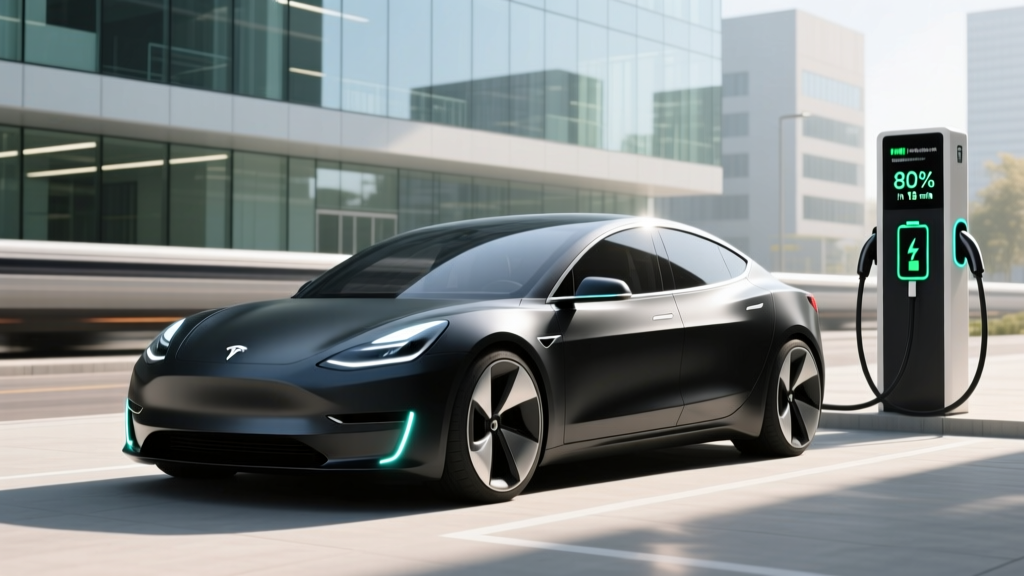
| DC Fast Charge (peak) | ~150–175 kW (est.) | 10–80% in ~25–30 minutes |
A critical nuance buyers should understand: peak kW is not sustained kW. LFP packs typically hold their charge curve flatter through the mid-SoC range than NMC, but charging still tapers significantly above 80% to protect cell longevity. A 175-kW peak may average closer to 110–120 kW over a full 10–80% session. For a ~55-kWh pack, that still translates to a usable 25–30 minute highway stop — competitive with the segment.
The Model 2 will almost certainly ship with the NACS (Tesla) charging port natively, granting access to the full Supercharger network — now the largest and most reliable DC network in North America. Given that Ford, GM, Rivian, Hyundai, and Volvo now use NACS adapters or native NACS ports, the Model 2 will compete on a level playing field for public charging access.
Pricing, Trims, and the $7,500 Federal Tax Credit Question
The headline number — $25,000 — came directly from Elon Musk at Battery Day 2020 and has been reiterated in various earnings calls since. Inflation, tariff pressures, and supply-chain realities have pushed that target, and most analysts now expect a base MSRP between $25,000 and $30,000 at launch, with higher trims (AWD, larger battery, premium interior) pushing past $35,000.
| Trim (Projected) | Est. MSRP | §30D Credit Eligibility |
|---|---|---|
| Base RWD | $25,000–$28,000 | Likely eligible — well under $55K MSRP cap |
| Long Range / AWD | $32,000–$38,000 | Likely eligible — under cap |
| Performance (if offered) | $40,000+ | Eligible if under $55K sedan / $80K SUV cap |
The IRS §30D Clean Vehicle Credit offers up to $7,500 — split into $3,750 for battery-component sourcing and $3,750 for critical-minerals sourcing — but eligibility hinges on several buyer- and vehicle-side requirements that change frequently. Current rules include:
- MSRP caps: $55,000 for sedans; $80,000 for SUVs/pickups — the Model 2 clears this easily.
- Buyer income caps: AGI ≤ $150K single / $225K head-of-household / $300K joint filers.
- North American final assembly: expected to be satisfied (likely Fremont or a new dedicated plant).
- Battery sourcing requirements: the $7,500 total requires both critical-minerals AND battery-component thresholds to be met; LFP cells sourced from China-linked supply chains have been a sticking point. Tesla's shift to domestic and FTA-partner sourcing will determine whether buyers get the full $7,500 or only $3,750.
- Point-of-sale transfer: as of 2024+, buyers can transfer the credit to the dealer at purchase for an immediate price reduction, rather than waiting for tax filing.
- FEOC exclusion: vehicles with battery components or critical minerals from a "foreign entity of concern" (largely Chinese-linked firms) may be disqualified entirely — a key risk for LFP-pack Teslas.
Bottom line: A base-trim Model 2 at $27,000 with a full $7,500 point-of-sale credit could net out around $19,500 before destination and taxes — which would make it the cheapest new EV ever sold in the U.S. Consult a tax professional and verify sourcing on the specific VIN at fueleconomy.gov before purchasing.
Interior, Cargo, Tech, and Driver Assistance
Tesla has kept the interior under wraps, but patent filings and Investor Day imagery suggest a minimalist cabin with:
- A single center touchscreen (likely 15.4") running Tesla's latest vehicle OS
- No traditional instrument cluster — all info on the central display, as in current Teslas
- A "flex" interior enabled by steer-by-wire: potentially a fold-away yoke or sliding bench
- Estimated cargo volume: ~18–22 cu ft rear hatch + a small front trunk (frunk)
- Rear legroom: likely ~34–36 inches, competitive with a Golf-class hatchback
Autopilot will be standard; FSD (Supervised) will likely be a paid add-on. Important clarification: both are SAE Level 2 driver-assistance systems, meaning the driver must remain engaged, hands on or near the wheel, eyes on the road at all times. They are not "self-driving." Tesla has not shipped a Level 3 or Level 4 consumer vehicle as of 2026.
Who Should Wait for the Tesla Model 2 — and Who Should Buy Now?
Wait for the Model 2 if:
- Your budget is firmly under $30,000 and you want a new (not used) EV
- You value Supercharger-native access and Tesla's software ecosystem
- You can defer purchase 12–24 months — launch timing remains fluid
- You want a compact city/suburban commuter, not a family hauler
Buy something else now if:
- You need a vehicle in the next 6 months — the Model 2 is not orderable
- You need 300+ miles of range, AWD, or towing (consider Model Y, Ioniq 5, or Equinox EV)
- You need proven crash-test data — the Model 2 has no NHTSA or IIHS ratings yet
- You want a physical dealership experience and traditional service network
Strong current alternatives in the same price class include the Chevrolet Equinox EV (~$33K base, ~315-mi range), the Volvo EX30 (~$35K, ~275 mi), and the next-gen Chevrolet Bolt (expected 2025–2026, sub-$30K). Each has trade-offs in charging speed, software, and network access that the Model 2 aims to resolve.
Biggest Pros and Cons (Projected)
- Sub-$30K base price with full §30D credit potential
- Native NACS + Supercharger access
- Tesla software, OTA updates, and mobile app ecosystem
- Strong efficiency (~4 mi/kWh target)
- LFP battery: long cycle life, 100% SoC daily charging OK
- Not yet available — timeline uncertain
- LFP cold-weather range loss more pronounced than NMC
- Minimalist interior may lack physical controls buyers want
- No crash-test data until post-launch
- FSD (Supervised) remains Level 2, not autonomous
Frequently Asked Questions
When will the Tesla Model 2 be available to order?
Tesla has not confirmed an official on-sale date. Production was originally hinted for mid-2025, but recent reports suggest a 2026–2027 timeline depending on factory ramp (likely starting in Mexico or Austin). Treat any firm date as speculative until Tesla opens reservations.
Will the Tesla Model 2 really cost $25,000?
That was the 2020 target. Inflation, battery-cost fluctuations, and tariff policy make a base MSRP of $25,000–$30,000 more realistic at launch. With a full $7,500 §30D credit and point-of-sale transfer, an effective net price near $20,000 is plausible — but not guaranteed.
Will the Model 2 qualify for the full $7,500 federal tax credit?
It should clear the MSRP, assembly, and income-cap hurdles. The open question is battery sourcing — specifically, whether Tesla's LFP cell supply chain meets the FEOC and critical-minerals thresholds. This may vary by model year and trim. Always verify on fueleconomy.gov at purchase.
How does the Model 2 compare to the Model 3?
Smaller, less powerful, less range, and significantly cheaper. The Model 3 is a midsize sedan (~$38K+ base); the Model 2 targets the compact hatchback segment and is not a direct substitute for buyers who need rear-seat space, 330+ mile range, or performance variants.
Is it worth waiting for the Tesla Model 2 vs buying a used Model 3?
It depends on timeline and budget. A 2023–2024 used Model 3 RWD currently trades around $25,000–$30,000 and is available today with known specs and crash ratings. The Model 2 offers newer hardware and potentially better efficiency, but with launch-delay risk. If you need a car now, a used Model 3 or new Equinox EV is the rational move.
Will the Model 2 have a frunk and hatchback cargo layout?
Expected yes — Tesla's recent vehicles (Model Y, Cybertruck) all feature front trunks, and a hatchback body style maximizes utility in a compact footprint. Exact cargo cubic feet are unconfirmed.