If you have been searching for answers to when will Tesla Model 2 be available, you are not alone. The compact, budget-friendly Tesla—often referred to informally as the "Model 2" or "Redwood" internally—has been one of the most anticipated electric vehicles since rumors first surfaced in 2023. As of early 2026, Tesla has not officially launched or opened reservations for this vehicle, but production signals and executive statements have sharpened the timeline considerably.
This article compiles everything we know from confirmed reports, Tesla earnings calls, and supply-chain intelligence—and pairs it with the hard numbers EV buyers need: estimated range, charging speed, pricing, tax credit eligibility, and how it stacks up against rivals already on the road.
Release Timeline: What We Know as of 2026
Tesla CEO Elon Musk first referenced a next-generation, lower-cost vehicle platform during the company's 2023 Investor Day, targeting a production start in late 2025. That timeline has slipped—common for Tesla's ambitious schedules. Here is the current picture based on reporting from Reuters and supply-chain sources:
- Q1–Q2 2025: Tesla began tooling installation at Giga Mexico (Monterrey) and Giga Texas for the next-gen platform.
- Q3 2025: Pilot production vehicles were reportedly built for validation testing.
- Q1–Q2 2026 (projected): Start of volume production, likely at Giga Texas first.
- Late 2026 (projected): First customer deliveries in the U.S. market.
- 2027+: Ramp at Giga Mexico and potentially Giga Berlin for global markets.
Estimated Specs: Range, Battery, and Efficiency
Tesla's next-generation platform is engineered around a radical cost-reduction strategy: a smaller, lighter unboxed body, a 4680-cell structural battery pack, and a simplified wiring harness. Here is what the numbers are expected to look like based on Tesla's public statements and engineering analysis:
| Spec | Estimated Value |
|---|---|
| EPA Range (est.) | 250–300 miles |
| Battery Capacity (usable) | ~50–60 kWh |
| Battery Chemistry | LFP (Lithium Iron Phosphate) expected for base RWD; NMC possible for AWD/Long Range |
| Efficiency | ~120–130 MPGe / 25–28 kWh/100 mi |
| Drivetrain | RWD standard; AWD dual-motor likely optional |
| 0–60 mph | ~5.5–6.5 sec (RWD); ~4.0 sec (AWD Performance est.) |
| Horsepower | ~200 hp (RWD); ~350 hp (AWD est.) |
| Max DC Fast Charge | ~170–200 kW (peak) |
| 10–80% DC Fast Charge | ~22–28 minutes (est.) |
| Level 2 Home Charging | ~11.5 kW / ~35–40 mi/hr |
| Connector | NACS (native Tesla, Supercharger compatible) |
| Cargo Volume | ~18–22 cu ft (rear hatch) + frunk |
| Base MSRP (target) | ~$25,000 |
| Battery/Powertrain Warranty | Expected 8 yr / 100,000 mi (consistent with Tesla's current policy) |
Charging Speed and Infrastructure Access
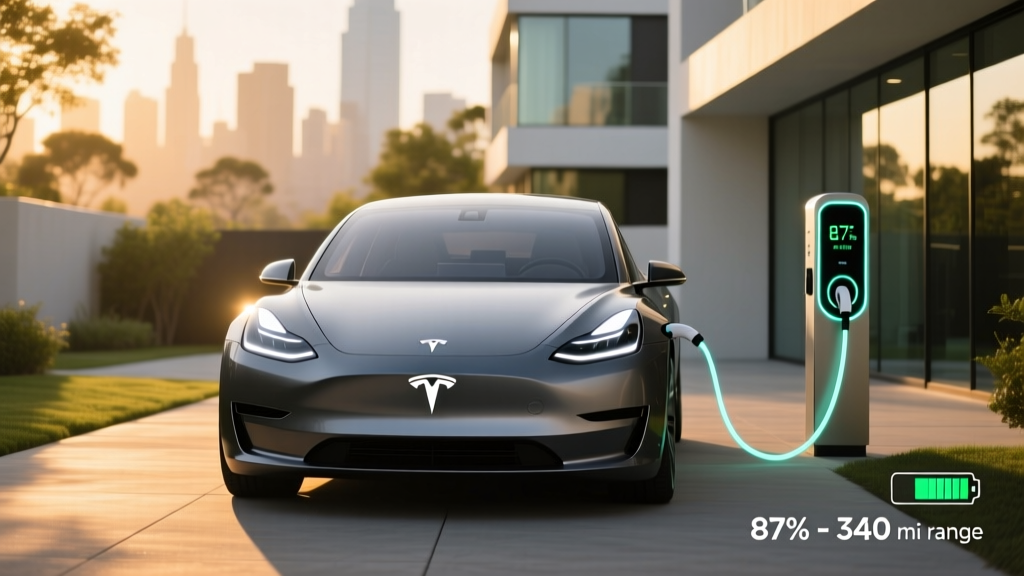
Charging speed is where Tesla's next-gen platform faces an interesting tradeoff. The smaller ~50–60 kWh battery limits absolute peak kW compared to the 100 kWh packs in the Model S or Cybertruck, but a smaller battery also means a 10–80% session finishes faster in absolute time.
| Level | Power | Miles Added per Hour | Notes |
|---|---|---|---|
| Level 1 (120V) | ~1.4 kW | ~4–5 mi/hr | Emergency/top-up only |
| Level 2 (240V, 48A) | ~11.5 kW | ~35–40 mi/hr | Full charge overnight (~6–7 hrs) |
| DC Fast Charge | ~170–200 kW peak | ~650+ mi/hr (peak) | 10–80% in ~22–28 min; tapers above 80% |
The Model 2 will charge natively on the Tesla Supercharger network—the most reliable and expansive DC fast-charging network in the U.S. with over 25,000 stalls. This is a significant ownership advantage over competitors relying on Electrify America or third-party CCS networks, though those networks are improving rapidly.
Charging-curve reality check: Peak kW is never sustained across the full session. Expect the Model 2 to hold near-peak rates from roughly 10–50% State of Charge, then taper progressively. A 10–80% session at a V3 or V4 Supercharger should take approximately 22–28 minutes, while 80–100% could add another 15–20 minutes. For road trips, plan stops around the 10–80% window for efficiency.
Pricing, Trims, and Federal Tax Credit Eligibility
Tesla's stated goal is a starting price of approximately $25,000 for the base RWD model, which would make it the most affordable new EV on the U.S. market. However, Tesla's pricing history shows frequent adjustments, and the final MSRP at launch could land between $25,000 and $30,000 depending on battery costs and tariff conditions.
| Trim | Est. MSRP | §30D Credit (max) | Effective Price |
|---|---|---|---|
| Base RWD | ~$25,000 | Up to $7,500 | ~$17,500 |
| Long Range RWD | ~$30,000 | Up to $7,500 | ~$22,500 |
| AWD / Performance | ~$35,000 | Up to $7,500 | ~$27,500 |
§30D Federal Tax Credit Rules (2026)
Under current IRS §30D rules, the $7,500 federal clean vehicle credit is available at the point of sale, but eligibility is not guaranteed. Key requirements for the Model 2:
- MSRP cap: Vehicle must have an MSRP at or below $55,000 (sedans/hatchbacks). All expected Model 2 trims clear this easily.
- Buyer income cap: Adjusted gross income must not exceed $150,000 (single), $225,000 (head of household), or $300,000 (joint).
- Battery sourcing: A percentage of critical minerals and battery components must be sourced from the U.S. or free-trade-agreement countries. These thresholds increase annually. Tesla's LFP cells have historically been sourced from CATL (China), which could disqualify the base RWD from the full credit if Tesla does not shift to a compliant supplier for the U.S. market.
- North American final assembly: Required. Giga Texas production satisfies this.
- Point-of-sale transfer: Buyers can apply the credit as a down-payment reduction at purchase rather than waiting for a tax refund.
Tech, Interior, and Driver Assistance
Tesla's next-gen platform is expected to debut a significantly simplified interior—fewer parts, a single central touchscreen (likely 15.4"), and Tesla's latest HW5 (Hardware 5) computer for Autopilot and FSD (Supervised). Key expected features:
- Infotainment: 15.4" touchscreen, Tesla OS, over-the-air updates, streaming, gaming, no Apple CarPlay/Android Auto (consistent with Tesla's approach).
- Driver Assistance: Basic Autopilot standard (lane centering, adaptive cruise). FSD (Supervised) available as a paid add-on or subscription.
- Vision-only autonomy stack: No lidar or radar; camera-based perception.
- Minimalist cabin: Reduced physical controls; most functions routed through the touchscreen.
- Heat pump: Standard for efficient cabin heating and cold-weather range preservation.
- Sentry Mode, Dashcam, Dog Mode: Expected to carry over.
Notable Drawbacks to Consider
- No CarPlay/Android Auto: A dealbreaker for some buyers who prefer phone-mirroring interfaces.
- Touchscreen-dependent controls: Adjusting mirrors, climate, and glovebox via screen can frustrate traditionalists.
- Rear-seat space uncertainty: As a compact hatchback, rear legroom may be tighter than a Model 3. Official dimensions pending.
- Build quality variability: Tesla's panel-gap and paint consistency have improved but remain a known concern at new production ramps.
- FSD cost: FSD (Supervised) adds $8,000 or ~$99/month—significant on a $25,000 vehicle.
How It Compares: Model 2 vs. Today's Affordable EVs
You don't have to wait. Several sub-$35,000 EVs are available now that cover similar ground. Here is how the projected Model 2 stacks up against current competitors:
| Spec | Tesla Model 2 (Est.) | Chevrolet Equinox EV | Hyundai Kona Electric | Volvo EX30 |
|---|---|---|---|---|
| Base MSRP | ~$25,000 | ~$33,000 | ~$32,975 | ~$34,950 |
| EPA Range | 250–300 mi | 319 mi | 261 mi | 275 mi |
| Max DC Charge | ~170–200 kW | 150 kW | ~100 kW | 153 kW |
| 10–80% Time | ~22–28 min | ~32 min | ~43 min | ~27 min |
| Charging Network | Supercharger (NACS) | NACS (Supercharger access) | CCS / NACS adapter | CCS / NACS adapter |
| §30D Credit | TBD (sourcing risk) | Up to $7,500 | Up to $7,500 | Likely ineligible (EU assembly) |
Key takeaway: If the Model 2 launches at $25,000, it undercuts every competitor here by $7,000–$10,000. But the Equinox EV is available now with a confirmed 319-mile range and full tax credit eligibility. Waiting 12–18 months for the Model 2 carries opportunity cost—especially if LFP sourcing limits the credit.
Who Should Wait for the Model 2 (and Who Shouldn't)
✅ Wait for the Model 2 If:
- Your budget is strictly under $30,000 and you want a new EV
- You already own a Tesla and want Supercharger-native convenience
- You want the latest Tesla software/AI stack at the lowest entry price
- You have reliable home charging and don't need 300+ miles of range
- You can comfortably wait until late 2026 or 2027 for delivery
❌ Buy Now Instead If:
- You need a vehicle within the next 3–6 months
- You want guaranteed full $7,500 tax credit eligibility today
- You need 300+ miles of EPA range for frequent road trips
- You prefer Apple CarPlay/Android Auto or physical controls
- You want to test-drive before committing (no prototypes available for public test drives)
Frequently Asked Questions
When will the Tesla Model 2 be available to order?
Based on current production signals, Tesla is expected to begin volume production in the first half of 2026, with first U.S. customer deliveries in late 2026. Reservations have not opened as of this writing. International availability (Europe, Asia) would follow in 2027.
What is the real-world range of the Tesla Model 2?
With an estimated EPA range of 250–300 miles, expect roughly 220–240 miles on sustained highway driving at 70–75 mph, and 180–200 miles in cold weather (below 30°F). LFP chemistry is slightly more affected by cold than NMC, but Tesla's heat pump and battery preconditioning help mitigate losses.
How fast does the Tesla Model 2 charge?
Estimated peak DC fast charging is 170–200 kW, achieving a 10–80% charge in approximately 22–28 minutes on a Tesla V3 or V4 Supercharger. At home on a Level 2 (240V, 48A) charger, expect ~35–40 miles of range added per hour, or a full overnight charge in 6–7 hours.
How much will the Tesla Model 2 cost after tax credits?
If the base MSRP is $25,000 and the vehicle qualifies for the full $7,500 §30D credit, the effective price could be as low as $17,500. However, LFP battery sourcing from China could reduce or eliminate credit eligibility. Final pricing and credit status will not be confirmed until launch.
Does the Tesla Model 2 qualify for the federal EV tax credit?
It should qualify on MSRP and assembly grounds (built in Texas, well under the $55,000 cap). The main risk is battery-sourcing requirements under §30D. If Tesla uses CATL (China) LFP cells, the vehicle may receive only a partial credit ($3,750) or none at all. Tesla may switch to a compliant cell supplier for the U.S. market. Verify on irs.gov before purchasing.
Is the Tesla Model 2 worth waiting for vs. buying a Chevrolet Equinox EV or Hyundai Kona Electric?
If price is your top priority and you can wait 12–18 months, the Model 2 at ~$25,000 would be the most affordable new EV in America. If you need a car now, the Equinox EV (319 mi range, ~$33,000, full credit eligible) and Kona Electric (~$33,000, full credit eligible) are proven, available alternatives with competitive features.
Will the Tesla Model 2 have Autopilot and FSD?
Yes. Basic Autopilot (adaptive cruise + lane centering) is expected to be standard. FSD (Supervised) will likely be available as an $8,000 add-on or ~$99/month subscription. Both are SAE Level 2 systems requiring full driver attention—they are not self-driving.
What body style will the Tesla Model 2 be?
All credible reports point to a compact 5-door hatchback, slightly smaller than the Model 3, similar in footprint to the Volvo EX30 or Hyundai Kona Electric. A crossover/SUV variant may follow later.