Tesla's long-rumored compact electric vehicle — colloquially called the "Model 2" and reportedly badged internally as "Redwood" — has dominated EV search trends for years. With a target price hovering around $25,000 before incentives, the vehicle promises to undercut every Tesla sedan and SUV in the lineup and compete directly with the Chevrolet Bolt EV successor, Hyundai Kona Electric, and Nissan's next-generation Leaf. But what about the Tesla Model 2 interior, its real-world range, charging speed, and whether it will qualify for the full federal tax credit?
As of early 2026, Tesla has not officially unveiled or opened reservations for the Model 2. The following profile is built from confirmed Tesla investor-day disclosures, supply-chain reporting, patent filings, and credible industry analysis. All specifications are preliminary and subject to change until Tesla publishes final production data. We will update this article the moment official figures drop.
Tesla Model 2 Interior: What to Expect
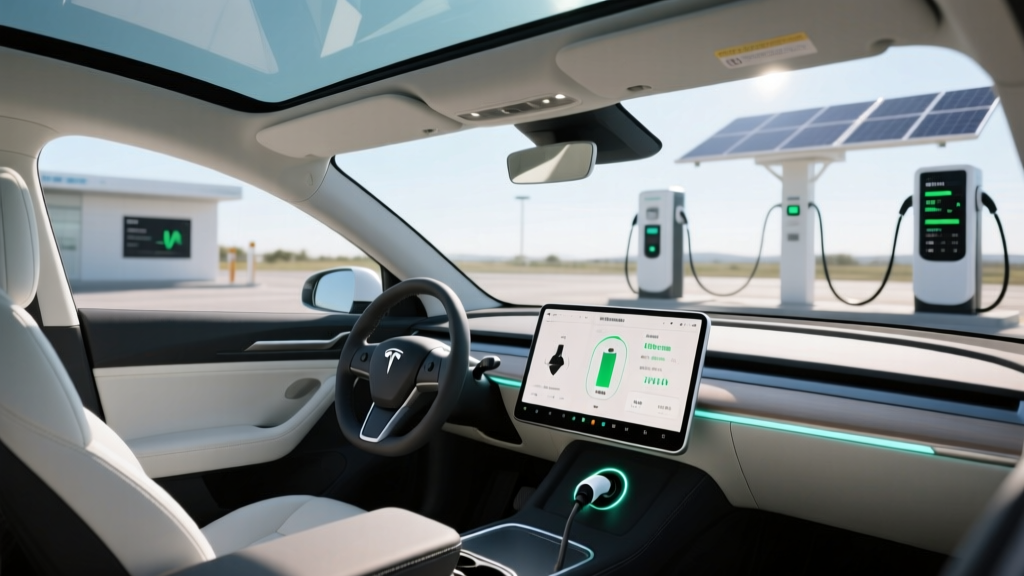
The Tesla Model 2 interior is the single most-searched aspect of this vehicle, and for good reason: Tesla's cost-reduction strategy relies heavily on a radically simplified cabin built on what the company calls its "unboxed" manufacturing process. Based on patent imagery and supply-chain leaks, here is what buyers can reasonably anticipate:
- Minimalist dashboard: A single, centrally mounted touchscreen (likely 12.9–15 inches) handles infotainment, climate, and vehicle controls. No physical instrument cluster behind the steering wheel — consistent with Model 3 Highland.
- Seating configuration: Five-passenger, two-row layout with a flat floor thanks to the structural battery pack. Expect cloth or vegan-leather upholstery on the base trim, with a premium synthetic option on higher trims.
- Materials: Heavy use of recycled textiles and single-piece molded door panels to cut part count. Tesla has publicly stated it aims to halve interior component count versus the Model 3.
- Front trunk (frunk): A modest frunk is expected — roughly 2–3 cubic feet — suitable for a charging cable kit or a small grocery bag.
- Rear cargo: Estimated 18–22 cubic feet behind the rear seats, with a 60/40 split-folding rear row to expand capacity. This puts it in line with the Hyundai Kona Electric but below the Model 3's ~23 cu ft.
- Legroom: Projected ~41 inches front / ~35 inches rear. Taller riders may find the rear seat less accommodating than in the Model Y, given the lower roofline and compact wheelbase.
- Ambient lighting & glass: A full panoramic glass roof is expected on all trims, consistent with Tesla's current design language.
The trade-off for the low price point is clear: fewer physical buttons, simpler materials, and less sound insulation than the Model 3. Buyers who prioritize cabin refinement may find the Model 2 interior spartan. Buyers who want a tech-forward, no-nonsense commuter cabin will likely find it perfectly adequate.
Projected Range, Battery, and Efficiency
| Spec | Estimate |
|---|---|
| EPA Range (target) | ~250–275 miles |
| Battery Capacity (usable) | ~50–55 kWh |
| Chemistry | LFP (Lithium Iron Phosphate) — likely CATL or BYD cells |
| Efficiency (target) | ~120–130 MPGe / ~25–27 kWh/100 mi |
| Drivetrain | RWD (single motor); AWD possible on a Performance variant |
| Horsepower (est.) | ~200–250 hp (RWD) |
| 0–60 mph (est.) | ~5.5–6.5 seconds |
Tesla's decision to use LFP chemistry in the base Model 2 is nearly certain. LFP batteries offer lower energy density than NMC but compensate with longer cycle life, better thermal stability, and lower cost. They also tolerate being charged to 100% regularly — something Tesla actually recommends for LFP packs to maintain cell-balancing accuracy. This is a significant ownership advantage for daily commuters who charge at home overnight.
Charging Speed: DC Fast Charge and Home Level 2
| Charging Level | Power (kW) | Speed / Time |
|---|---|---|
| Level 1 (120V household) | ~1.4 kW | ~3–4 miles per hour |
| Level 2 (240V home / public) | ~7.7–11.5 kW | ~25–37 miles per hour; full charge in 5–7 hours |
| DC Fast Charge (peak) | ~150–170 kW (est.) | 10–80% in ~22–28 minutes |
Tesla's smaller battery pack means absolute charge speeds won't match the Model 3 or Model Y, which peak above 250 kW on V3 Superchargers. However, the smaller pack also means less total energy to replenish. A 10–80% session at a V3 or V4 Supercharger should still complete in roughly half an hour — competitive with the Hyundai Kona Electric and significantly faster than many budget EVs limited to 50–100 kW DC charging.
The Model 2 will ship with the NACS (North American Charging Standard) connector natively, granting access to Tesla's Supercharger network — the most reliable DC fast-charging network in the U.S., with over 25,000 stalls as of 2026. Third-party networks like Electrify America and EVgo are also adding NACS cables, though CCS-to-NACS adapters will remain useful for some public stations during the transition period.
Home charging reality: On a 48-amp Level 2 wall connector (the Tesla Wall Connector), expect ~37 miles of range added per hour of charging. A full overnight charge from 20% to 100% takes roughly 6–7 hours. Installation cost for a dedicated 60-amp circuit typically runs $500–$1,500 depending on panel proximity and local permitting. Homes with older 100-amp electrical panels may need a $1,500–$3,000 panel upgrade.
Pricing, Trims, and Federal Tax Credit Eligibility
| Trim | Est. MSRP | §30D Credit Potential | Effective Price |
|---|---|---|---|
| Base RWD | ~$25,000 | Up to $7,500 (if sourcing rules met) | ~$17,500 |
| Long Range RWD | ~$29,000 | Up to $7,500 | ~$21,500 |
| AWD / Performance | ~$33,000 | Up to $7,500 | ~$25,500 |
The $25,000 base price is Tesla's stated ambition and would make the Model 2 the cheapest new EV sold in the United States at launch. However, final MSRP depends on battery cost trajectories, tariff environments, and whether Tesla includes destination fees in the headline number.
Federal tax credit (§30D) eligibility is the wildcard. Under current IRS rules, a new EV must satisfy several conditions to qualify for the full $7,500 credit:
- MSRP cap: Sedans/hatchbacks must have an MSRP ≤ $55,000. The Model 2 clears this easily.
- Buyer income cap: Modified AGI ≤ $150,000 (single) / $300,000 (joint). Most target buyers will qualify.
- Battery sourcing: A percentage of critical minerals and battery components must be sourced from the U.S. or FTA partners. This threshold rises annually. If Tesla sources LFP cells from CATL (China), the credit could be partially or fully disqualified.
- Final assembly: Must occur in North America. Tesla's likely production sites (Giga Texas or a future Mexico facility) would satisfy this, depending on the country's FTA status.
- Point-of-sale transfer: As of 2024+, buyers can transfer the credit to the dealer at purchase, reducing the upfront price rather than waiting for a tax refund.
The critical-minerals requirement is the biggest risk to the full credit. Tesla has been aggressively diversifying its supply chain, but LFP cell production remains overwhelmingly concentrated in China. Buyers should check the official fueleconomy.gov tax credit list at the time of purchase for the definitive answer.
Driver Assistance, Tech, and Software
Expect the Model 2 to launch with Tesla's current-generation hardware suite — likely HW5 (also called "AI5") — supporting:
- Basic Autopilot (included): Adaptive cruise control, lane-centering, automatic emergency braking, blind-spot monitoring. This is an SAE Level 2 system requiring continuous driver supervision.
- FSD Supervised (optional, ~$8,000 or subscription): Adds automated lane changes, navigation-guided on/off-ramp transitions, traffic-light and stop-sign recognition, and city-street autosteer. Still SAE Level 2 — the driver must remain engaged at all times.
- Infotainment: 15-inch touchscreen, over-the-air updates, Tesla app integration, Sentry Mode, Dashcam, streaming media, and gaming while parked.
- Phone-as-key: Bluetooth-based passive entry, as on all current Tesla vehicles.
Who Should Buy the Tesla Model 2?
✅ Best For
- Budget-conscious EV buyers who want a new vehicle under $25K (after credit)
- Urban and suburban commuters with home Level 2 charging
- First-time EV owners who want Tesla's Supercharger network access
- Tech enthusiasts who prefer a minimalist, software-centric cabin
- Fleet and rideshare operators seeking low per-mile operating costs
❌ Not Ideal For
- Large families needing three rows or substantial cargo space
- Frequent long-distance road trippers in cold climates (250 mi range with LFP winter loss = frequent stops)
- Buyers who value physical controls and premium cabin materials
- Towing — expect minimal or zero towing rating
- Buyers who need a vehicle now — this car is not yet on sale
Warranty and Ownership Costs
Based on Tesla's current warranty structure, the Model 2 should carry:
- Basic vehicle warranty: 4 years / 50,000 miles
- Battery & drive unit warranty: 8 years / 100,000 miles (with ≥70% capacity retention guaranteed)
LFP chemistry's slower degradation curve is a major long-term advantage here. Industry data suggests LFP packs retain 90%+ capacity after 1,000 equivalent full cycles — roughly 250,000 miles for a 250-mile-range vehicle. Most owners will never need a battery replacement under normal use.
Estimated annual operating cost: At $0.14/kWh (U.S. average residential electricity rate), a full home charge costs roughly $7.50 for 250 miles — about $0.03/mile. Compare that to a 30-MPG gas car at $3.50/gallon, which costs ~$0.12/mile in fuel alone. Over 15,000 miles/year, that's roughly $1,350 in annual fuel savings.
Insurance premiums for Tesla vehicles tend to run 15–30% higher than segment averages due to repair costs. Budget accordingly — get a quote before committing.
Tesla Model 2 vs. the Competition
| Vehicle | Est. Range | Est. MSRP | DC Fast Charge | Connector |
|---|---|---|---|---|
| Tesla Model 2 | ~250–275 mi | ~$25,000 | ~150–170 kW | NACS |
| Chevrolet Bolt EV (next-gen) | ~259 mi | ~$28,000 | ~115 kW | NACS |
| Hyundai Kona Electric | 261 mi | ~$33,000 | ~100 kW | CCS1/NACS |
| Nissan Leaf (next-gen) | ~240 mi (est.) | ~$30,000 | ~100 kW (est.) | NACS |
The Model 2's primary advantage — if Tesla hits its price target — is cost. At $25,000 before incentives, it undercuts every rival. Combined with Supercharger access, OTA software updates, and Tesla's industry-leading efficiency, it would be the default recommendation for budget EV buyers. Its main risk is the interior experience: competitors like Hyundai offer more conventional cabins with physical controls, which many buyers still prefer.
Frequently Asked Questions
When will the Tesla Model 2 be available to buy?
Tesla has not confirmed an exact launch date. Industry reporting points to a reveal sometime in late 2025 or 2026, with deliveries potentially starting in late 2026 or 2027. Reservations are not yet open.
Does the Tesla Model 2 qualify for the $7,500 federal EV tax credit?
It likely qualifies on MSRP and income-cap grounds, but the critical-minerals and battery-component sourcing requirements under IRS §30D are the deciding factor. If Tesla uses Chinese-sourced LFP cells, the credit may be reduced or eliminated. Check fueleconomy.gov at the time of purchase for the definitive answer.
What is the real-world range of the Tesla Model 2?
Targeting an EPA rating of ~250–275 miles, expect roughly 210–240 miles in real-world highway driving and 190–210 miles in freezing temperatures due to LFP chemistry's cold-weather sensitivity.
Will the Model 2 have a frunk?
Yes, a small front trunk (~2–3 cu ft) is expected, enough for a charging cable bag or small items.
Is the Tesla Model 2 interior too minimalist?
That depends on your tolerance for screen-based controls. Everything — climate, mirrors, glovebox — is operated through the central touchscreen. If you prefer physical buttons, test-drive a Model 3 Highland first to gauge your comfort level with Tesla's interface philosophy.
Can I charge the Model 2 on non-Tesla chargers?
Yes. The NACS connector is becoming the U.S. standard, and most major networks (Electrify America, EVgo, ChargePoint) are adding NACS cables. A CCS-to-NACS adapter may be needed at some legacy CCS-only stations during the transition.