If you've ever Googled Tesla minivan doors, you've probably watched a Model X's rear falcon-wing doors glide upward in a parking lot and wondered: are they genuinely practical for family duty, or just an expensive parlor trick? In 2026, the Tesla Model X remains the only three-row electric SUV with roof-hinged rear doors, and that singular design choice defines the ownership experience — for better and for worse. Below, we break down everything a family-hauler shopper needs to know: real-world range, charging speed, interior dimensions, tax-credit eligibility, and how it stacks up against the Kia EV9, Rivian R1S, and Hyundai Ioniq 9.
Quick Verdict: Is the Model X Still the Default Electric Family Hauler?
The 2026 Tesla Model X Long Range AWD starts at $79,990 before destination and delivers an EPA-estimated 320 miles of range, seating for up to seven, and access to the Supercharger network with a native NACS port. The falcon-wing rear doors genuinely shine in tight parking spaces and when loading car seats, but they add weight, complexity, and a repair-cost risk that conventional sliding-door minivans (even electrified ones like the Chrysler Pacifica PHEV) simply don't carry. If you need three rows, want a BEV, and value tech-forward convenience over minivan-maximalist cargo space, the Model X is compelling. If you prioritize maximum interior volume and lowest cost per seat, look at the EV9 or Ioniq 9 first.
Range, Efficiency, and Real-World Expectations
Real-World Expectation: ~260–285 miles at sustained 70–75 mph highway speeds; ~220–250 miles in sub-freezing winter conditions with cabin heat. City/regenerative driving can push closer to or slightly above the EPA sticker.
The Model X Long Range AWD uses a ~100 kWh usable battery pack built on NMC (nickel-manganese-cobalt) chemistry, chosen for its high energy density in a heavy, aerodynamically challenged three-row SUV. Efficiency lands at approximately 102 MPGe combined, or roughly 33 kWh per 100 miles, per fueleconomy.gov. That's thirstier than the two-row Model Y or Model 3, which is expected given the X's 5,185-pound curb weight and frontal area.
For context, a 300-mile highway road trip in 40°F weather with the heat pump running will likely require one 15–20-minute DC fast-charge stop. In mild weather around town, many owners report stretching past 300 miles before hitting a 10% state of charge.
Charging Speed: DC Fast, Level 2, and the Supercharger Advantage
| Charging Level | Peak Power | Rate / Time | Notes |
|---|---|---|---|
| DC Fast Charge (Supercharger V4) | 250 kW peak | 10–80% in ~30 minutes | Curve tapers sharply above 60%; precondition via nav for max speed |
| DC Fast Charge (CCS adapter, non-Tesla) | ~170 kW typical | 10–80% in ~40 minutes | Adapter included; speed limited by vehicle-side handshake |
| Level 2 Home (48A / 11.5 kW) | 11.5 kW | ~34 miles of range per hour | Full 0–100% in ~9.5 hours; ideal overnight |
| Level 1 (120V / 12A) | 1.4 kW | ~4 miles of range per hour | Emergency/trickle only |
The Model X uses a native NACS charge port — no adapter needed at any of Tesla's 6,500+ North American Supercharger stalls. The charge curve peaks near 250 kW below 40% state of charge, then steps down progressively; don't expect sustained 250 kW across the whole session. For home charging, Tesla's Wall Connector on a 60-amp circuit delivers the full 48 amps / 11.5 kW the onboard charger can accept. Budget $800–$2,000 for a licensed electrician to install a 240V/60A circuit, depending on panel proximity and whether your home needs a service upgrade to 200A.
Performance and Drivetrain
The 2026 Model X Long Range AWD runs a dual-motor all-wheel-drive layout producing 670 horsepower. Tesla quotes a 0–60 mph time of 3.8 seconds — absurdly quick for a three-row family vehicle, and genuinely useful for highway merging with a full load. The Plaid trim (tri-motor, 1,020 hp, 0–60 in 2.5 seconds) remains available for $94,990 but is harder to justify on a family-hauler budget.
Adaptive air suspension is standard, offering adjustable ride height from ~5.5 to ~8.1 inches of ground clearance. The lowest setting activates at highway speed for efficiency; raise it for snow, driveways, or rough roads. Towing capacity is rated at 5,000 pounds when properly equipped — enough for a small boat or light camper, though towing will cut range by 35–50% depending on trailer aerodynamics.
Interior, Cargo, and Those Falcon-Wing Doors
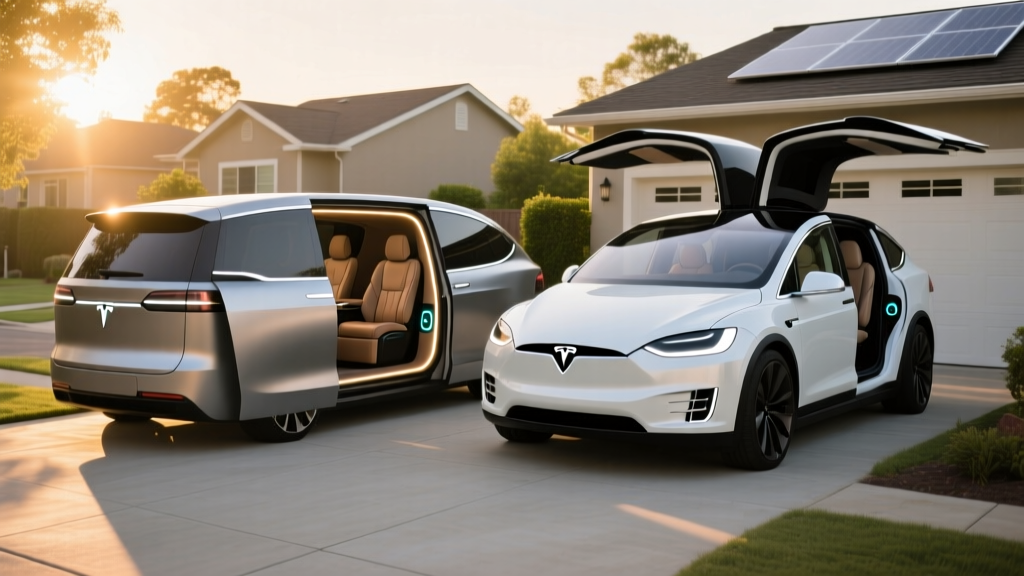
The headline feature remains the Tesla minivan doors — officially, dual-hinged falcon-wing rear doors that open upward rather than outward. Here's the practical breakdown:
- Opening clearance: Only ~12 inches of side clearance needed, vs. 30+ inches for a conventional SUV door. This is genuinely transformative in tight parking garages and when loading kids in car seats.
- Standing room: Adults can stand nearly upright next to the second-row seats while loading children — a minivan-like benefit without the minivan silhouette.
- Ultrasonic sensors: The doors use sensors to detect overhead and side obstacles, stopping before hitting low garage ceilings or adjacent cars. Mostly reliable, but occasionally over-cautious with tree branches or car-wash equipment.
Cargo volume (behind third row): 15.3 cu ft — modest, comparable to a midsize sedan trunk. Fold the third row and you get 41.1 cu ft; fold both rear rows for 81.5 cu ft. The front trunk (frunk) adds 6.6 cu ft for charging cables or groceries.
Seating configurations: Five-seat (two-row bench), six-seat (second-row captains with center aisle), or seven-seat (second-row bench). The six-seat layout is the sweet spot for car-seat families, offering easy third-row walk-through access.
Legroom: 41.2 inches front / 40.9 inches second row / 32.7 inches third row. That third row is best suited for children or adults under 5'8" on short trips — a genuine drawback versus the boxier Kia EV9 (32.0" third row but with more headroom) or a traditional minivan.
Pricing, Trims, and Federal Tax Credit Eligibility
| Trim | Base MSRP | Est. After §30D Credit | Notes |
|---|---|---|---|
| Long Range AWD (5-seat) | $79,990 | $72,490 (if eligible) | Most popular family config |
| Long Range AWD (6-seat) | $81,490 | $73,990 (if eligible) | Captains chairs, walk-through |
| Long Range AWD (7-seat) | $81,490 | $73,990 (if eligible) | Bench second row, tighter access |
| Plaid (tri-motor) | $94,990 | $87,490 (if eligible) | Performance-focused, stiffer ride |
Federal tax credit eligibility (§30D): The Model X qualifies for up to $7,500 under current IRS rules, but eligibility is not automatic. Per IRS.gov, buyers must meet all of the following:
- MSRP cap: The Model X is classified as an SUV (not a sedan), so the cap is $80,000. Long Range trims qualify; the Plaid at $94,990 does NOT unless optioned below the threshold (unlikely).
- Buyer income cap: Modified AGI must not exceed $300,000 (married filing jointly), $225,000 (head of household), or $150,000 (single).
- Battery sourcing: Critical-mineral and battery-component requirements phase in annually. Tesla sources from multiple suppliers, and eligibility can shift by production batch. Confirm your specific VIN's eligibility at the point of sale — the dealer or Tesla can run this check, and you can transfer the credit to the seller for an immediate price reduction.
Always verify with a tax professional before relying on the credit. State incentives (California's CVRP, Colorado's innovative motor vehicle credit, etc.) may stack on top.
Warranty, Ownership Costs, and Long-Term Outlook
Tesla provides a 4-year/50,000-mile basic vehicle warranty and an 8-year/150,000-mile battery and drive unit warranty with a guaranteed minimum 70% capacity retention. That battery warranty is among the most generous in the segment and reflects the NMC pack's proven longevity in the Model S/X fleet — many high-mileage examples show 10–15% degradation at 100,000 miles.
Insurance premiums run 15–30% higher than a comparable Kia EV9 or Hyundai Ioniq 9, driven by Tesla's collision-repair costs and parts pricing. Expect $2,200–$3,500 annually depending on your state, age, and driving record. Maintenance is minimal — no oil changes, brake pads last 80,000+ miles thanks to regenerative braking, and cabin air filter replacement every 2–3 years is the main recurring cost.
Standout Tech and Notable Drawbacks
Pros
- Falcon-wing doors genuinely ease car-seat loading in tight spaces
- Supercharger network remains the most reliable DC fast-charging ecosystem in North America
- Class-leading acceleration (3.8s 0–60) for a three-row vehicle
- Over-the-air updates continuously add features
- 17" center touchscreen with excellent navigation and trip-planning integration
- HEPA air filtration ("Bioweapon Defense Mode") is legitimately effective
Cons
- Falcon-wing doors add weight, complexity, and potential out-of-warranty repair cost ($2,000–$4,000 per door actuator replacement)
- Third-row legroom (32.7") is tight for adults vs. EV9 or minivan competitors
- Cargo space behind third row (15.3 cu ft) is modest
- No Apple CarPlay or Android Auto — Tesla's proprietary system only
- Autopilot and FSD (Supervised) are SAE Level 2 driver-assist systems requiring full driver attention, not self-driving
- Build-quality consistency still trails legacy automakers in panel gaps and interior trim
On the tech front, the Model X ships with Tesla's latest infotainment hardware, including a rear-seat 8" touchscreen for climate and media, a 22-speaker audio system, and wireless phone charging. Autopilot (adaptive cruise + lane centering) is standard; Full Self-Driving (Supervised) is a $8,000 add-on or $99/month subscription. Both are SAE Level 2 systems — your hands stay near the wheel and your eyes stay on the road.
Who the Model X Suits Best
Choose the Model X if: You want a three-row BEV with premium performance, need falcon-wing door convenience for tight urban parking or frequent car-seat loading, and value Supercharger access for road trips.
Look at the Kia EV9 if: You want more third-row space, a lower starting price ($54,900), and don't mind CCS charging (or NACS via adapter as Kia transitions).
Look at the Rivian R1S if: You need genuine off-road capability, more cargo volume, and prefer a more traditional SUV form factor.
Look at a PHEV minivan (Chrysler Pacifica Hybrid) if: Maximum cargo volume, sliding doors, and lowest cost per seat are your top priorities, and you're not ready to go fully electric.
Frequently Asked Questions
What is the real-world range of the 2026 Tesla Model X?
EPA-estimated at 320 miles for the Long Range AWD on 20" wheels. Expect 260–285 miles on highway road trips at 70–75 mph, and 220–250 miles in freezing weather with cabin heat active. City driving with regenerative braking can match or slightly exceed the EPA number.
How fast does the Model X charge at home and on the road?
On a V4 Supercharger, the Model X peaks at 250 kW and charges from 10–80% in approximately 30 minutes. At home on a 48-amp Level 2 Wall Connector, it adds roughly 34 miles of range per hour, fully charging overnight in about 9.5 hours.
Does the Model X qualify for the $7,500 federal EV tax credit?
The Long Range AWD (MSRP under $80,000) can qualify for up to $7,500 under §30D, subject to buyer income caps ($300K joint / $150K single), battery-sourcing requirements, and point-of-sale transfer rules. The Plaid trim's $94,990 MSRP exceeds the SUV cap. Always verify your specific VIN's eligibility with Tesla and a tax professional.
Are the Tesla falcon-wing minivan doors reliable long-term?
They're covered under the 4-year/50,000-mile basic warranty. Out of warranty, actuator or hinge repairs can cost $2,000–$4,000 per door. Most owners report reliable operation, but the complexity is undeniably higher than a conventional or sliding door. The ultrasonic obstacle sensors occasionally false-trigger in car washes or under low tree canopies.
How does the Model X compare to the Kia EV9 for families?
The EV9 starts ~$25,000 lower, offers more third-row headroom, and has conventional doors. The Model X wins on acceleration, Supercharger access, and falcon-wing convenience in tight spaces. If budget and space are paramount, the EV9 is the rational pick; if tech, performance, and door convenience matter most, the Model X is unique.
Is Autopilot or FSD self-driving?
No. Both Autopilot and Full Self-Driving (Supervised) are SAE Level 2 driver-assistance systems. The driver must remain fully attentive, with hands near the steering wheel and eyes on the road. Only Level 4 services like Waymo operate without a human driver, and those are limited to specific geofenced areas.
Sources: fueleconomy.gov, IRS §30D Clean Vehicle Credit, Tesla Model X specifications.