The Short Answer on Tesla's Military Discount
If you're an active-duty service member, veteran, or military family researching a Tesla purchase, here is the essential fact up front: Tesla does not offer an official military discount on new vehicles in 2026. Unlike Ford, GM, or BMW — which run verified military appreciation programs through ID.me or SheerID — Tesla's direct-to-consumer sales model uses fixed, non-negotiable pricing across all buyers regardless of military status.
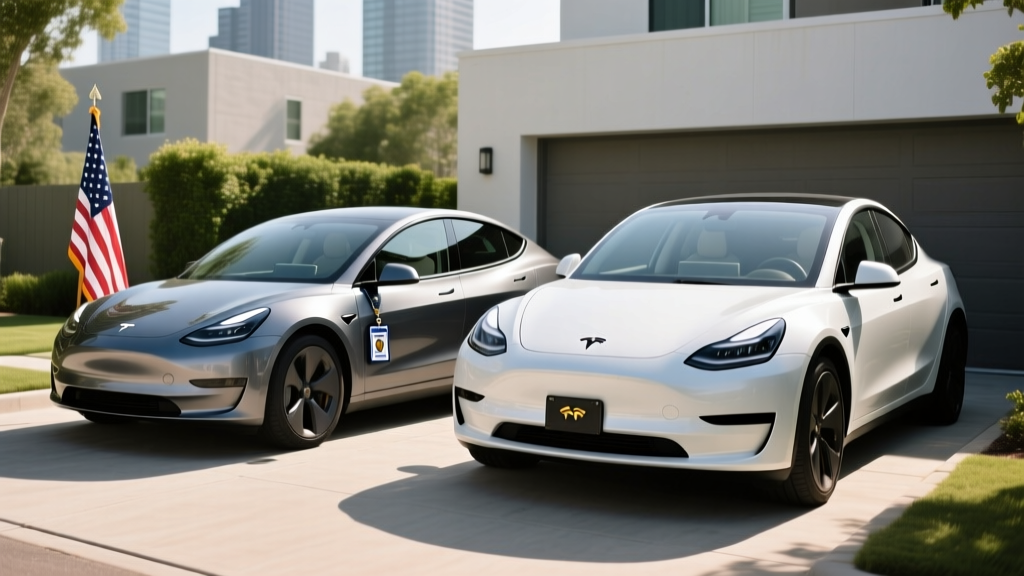
That doesn't mean service members are stuck paying full sticker. Between the IRS §30D federal EV tax credit, state-level incentives, military-specific lending rates, and Tesla's periodic referral or inventory deals, the real-world out-of-pocket cost for military buyers can be thousands below MSRP. This guide walks through exactly how to structure a Tesla purchase as a service member in 2026, using the Model 3 Long Range RWD and Model Y Long Range AWD as reference points.
Tesla's Pricing Model: Why There's No Haggling
Tesla sells directly — no dealers, no markups, no trade-in negotiations bundled into the purchase price. Every buyer in the US sees the same MSRP on Tesla.com on any given day. Prices do fluctuate (sometimes weekly) based on demand, production costs, and competitive pressure, but these adjustments apply universally.
What military buyers can leverage instead:
- Navy Federal Credit Union auto loans — often 0.5–1.0% below mainstream lender APRs for new EVs
- USAA insurance — competitive EV premiums with military-family eligibility
- State EV rebates — many states (CA, CO, MA, NY) offer $1,000–$7,500 rebates stackable with federal credits, with no military restriction
- Tesla referral credits — periodically active, typically $500–$1,000 off or free Supercharging miles
- Inventory/loaner vehicles — Tesla occasionally lists demo units at $2,000–$5,000 below new MSRP
2026 Model 3 Long Range RWD: The Military Commuter's Sweet Spot
The refreshed Model 3 Long Range RWD remains one of the most efficient sedans in the EV market and a natural fit for service members stationed at bases with Level 2 charging or who can install a home wall connector.
| Spec | Value |
|---|---|
| Base MSRP | $42,490 (before destination) |
| EPA Estimated Range | 363 miles |
| Battery Capacity / Chemistry | 79 kWh usable / NMC (nickel-manganese-cobalt) |
| MPGe (Combined) | 132 MPGe (25 kWh/100mi) |
| Max DC Fast Charge | 250 kW peak (V3 Supercharger) |
| 10–80% DC Charge Time | ~27 minutes |
| Level 2 Home Charge Rate | 11.5 kW (~44 miles/hour) |
| 0–60 mph | 4.9 seconds |
| Horsepower / Drivetrain | 271 hp / Single-motor RWD |
| Cargo Volume | 23 cu ft trunk + rear frunk |
| Rear Legroom | 35.3 inches |
| Battery & Drive Unit Warranty | 8 years / 120,000 miles |
| Basic Vehicle Warranty | 4 years / 50,000 miles |
2026 Model Y Long Range AWD: The Military Family Hauler
For service members with families, PCS moves, or gear-heavy lifestyles, the Model Y Long Range AWD offers crossover practicality with sedan-like efficiency. It remains Tesla's highest-volume vehicle for good reason.
| Spec | Value |
|---|---|
| Base MSRP | $47,990 (before destination) |
| EPA Estimated Range | 320 miles |
| Battery Capacity / Chemistry | 78.1 kWh usable / NMC |
| MPGe (Combined) | 122 MPGe (28 kWh/100mi) |
| Max DC Fast Charge | 250 kW peak |
| 10–80% DC Charge Time | ~28 minutes |
| Level 2 Home Charge Rate | 11.5 kW (~37 miles/hour) |
| 0–60 mph | 4.8 seconds |
| Horsepower / Drivetrain | 384 hp / Dual-motor AWD |
| Cargo Volume | 30 cu ft (rear seats up) / 72 cu ft (seats folded) |
| Rear Legroom | 37.0 inches |
| Battery & Drive Unit Warranty | 8 years / 120,000 miles |
| Towing Capacity | 3,500 lbs (with tow hitch option) |
Federal Tax Credit & Military-Specific Savings Breakdown
Under current IRS §30D rules, both the Model 3 Long Range and Model Y Long Range AWD qualify for up to $7,500 in federal clean vehicle credits — but eligibility depends on several factors that apply to all buyers, military or not:
- MSRP cap: Sedans (Model 3) must be under $55,000; SUVs/trucks (Model Y) under $80,000. Both base trims clear this easily.
- Buyer income cap: Modified AGI must not exceed $150,000 (single), $225,000 (head of household), or $300,000 (joint). Many junior-to-mid enlisted members and some officers fall well within these limits.
- Battery sourcing: Critical minerals and battery components must meet phased-in domestic/FHA sourcing thresholds. As of 2026, Tesla's Fremont and Austin-built vehicles largely meet these requirements, but confirm at point of sale — Tesla's checkout page shows credit eligibility per configuration.
- Point-of-sale transfer: Since 2024, buyers can transfer the credit to the dealer (Tesla) at purchase, reducing the purchase price directly rather than waiting for a tax refund.
| Line Item | Model 3 LR RWD | Model Y LR AWD |
|---|---|---|
| Base MSRP + Destination | $43,990 | $49,490 |
| Federal §30D Credit (if eligible) | –$7,500 | –$7,500 |
| State Rebate (example: CA CVRP) | –$2,000 | –$2,000 |
| Estimated Net Price | $34,490 | $39,990 |
| Navy Federal 60-mo Loan @ 5.24% | ~$657/mo | ~$762/mo |
Military-specific advantages beyond the sticker: Navy Federal and USAA often waive origination fees and offer gap coverage. Combined with BAH/OHA offsetting a home charger installation, the total cost of ownership for a service member can undercut a comparably equipped BMW i4 or Hyundai Ioniq 6 — both of which also lack dedicated military discounts but have higher base MSRPs.
Tech, Driver Assistance & Notable Drawbacks
Tesla's infotainment remains class-leading in responsiveness and over-the-air updates. The 15.4-inch center screen handles navigation, media, and vehicle controls (there are no physical buttons for climate or mirrors — everything is touchscreen). Standard Autopilot includes adaptive cruise and lane-keeping, which is SAE Level 2 — meaning the driver must remain fully engaged at all times. Full Self-Driving (Supervised) is a $8,000 option (or $99/month) that adds automated lane changes, traffic-light recognition, and city-street navigation, but it still requires active supervision and is not autonomous.
Notable drawbacks for military buyers:
- No physical controls: Glovebox, mirror adjustment, and vent direction are all touchscreen — frustrating with gloves or while driving.
- Service center density: Depending on your duty station (rural bases in particular), the nearest Tesla service center may be 100+ miles away. Mobile service handles many issues, but body repair requires an approved shop.
- Insurance premiums: Teslas tend to cost 15–30% more to insure than equivalent ICE sedans due to repair costs. USAA and GEICO offer competitive EV quotes — shop before ordering.
- No Apple CarPlay/Android Auto: Tesla uses its own OS. If your workflow depends on phone projection, this is a dealbreaker.
Who Should Buy — And Who Should Look Elsewhere
Best For:
- Solo service members or couples at bases with reliable charging
- Commute-heavy assignments (363-mi Model 3 covers most weekly driving on one charge)
- Tech-forward buyers who want OTA updates and Supercharger network access
- Families needing 72 cu ft cargo space (Model Y) for PCS moves or camping gear
Look Elsewhere If:
- You're stationed at a remote base with zero DC fast charging and can't install Level 2
- You need a true military discount program (check Ford A-Plan, GM Military, BMW)
- You require Apple CarPlay, physical buttons, or a traditional dealer service experience
- You tow heavy — the Model Y maxes at 3,500 lbs; the Rivian R1T or F-150 Lightning offer 7,700+ lbs
Frequently Asked Questions
Does Tesla verify military status for any discount?
No. Tesla does not use ID.me, SheerID, or any military verification service. There is no field at checkout for military affiliation. Any third-party site claiming to offer a "Tesla military discount code" is not affiliated with Tesla.
Can I use my VA loan or military benefits to buy a Tesla?
VA loans apply only to real estate, not vehicle purchases. However, military-specific lenders like Navy Federal, USAA, and PenFed offer competitive auto loan rates for EVs — often 0.5–1.5% below conventional lenders.
Do I qualify for the $7,500 federal tax credit as a service member?
Eligibility depends on your modified adjusted gross income, the vehicle's MSRP, and battery-sourcing compliance — not military status. Many enlisted members and junior officers fall within income caps. Confirm on IRS.gov and at Tesla checkout, where credit eligibility is displayed before you finalize.
Is the Supercharger network a real advantage on military bases?
It depends on location. Major installations near metro areas (San Diego, Norfolk, Washington DC) have abundant Superchargers. Remote posts (Fort Irwin, Mountain Home AFB) may be 60–100 miles from the nearest DC fast charger. Use Tesla's trip planner and PlugShare to map your duty station before ordering.
How does Tesla's warranty compare to competitors for military buyers who relocate often?
Tesla's 8-year/120,000-mile battery warranty is transferable and honored nationwide — no dealer network dependency. This matters for PCS moves: whether you're in Hawaii, Germany (where Tesla has service centers), or Alaska, the warranty follows the car. Hyundai offers a comparable 10-year/100,000-mile battery warranty, but service requires a dealer visit.