Search for a Tesla Megapack datasheet and you'll hit a wall of marketing copy and PDF links that skip the details grid operators actually need. Tesla publishes top-line numbers — 3.9 MWh per unit, megawatt-scale inverters, liquid-cooled LFP cells — but leaves critical context to integrators and utility engineers. This guide translates the Megapack 2 and Megapack XL specifications into plain language for EV owners, energy professionals, and anyone evaluating utility-scale storage in 2026.
Before we go further, a necessary clarification: the Megapack is not a vehicle. It's a utility-scale battery energy storage system (BESS) deployed by utilities, independent power producers, and data centers. If you arrived here looking for the Tesla Model S, Model Y, or Cybertruck, head to our EV reviews hub. But if you want to understand the grid-scale hardware that keeps your EV charged at night when solar goes dark, read on.
What the Tesla Megapack Datasheet Actually Tells Us
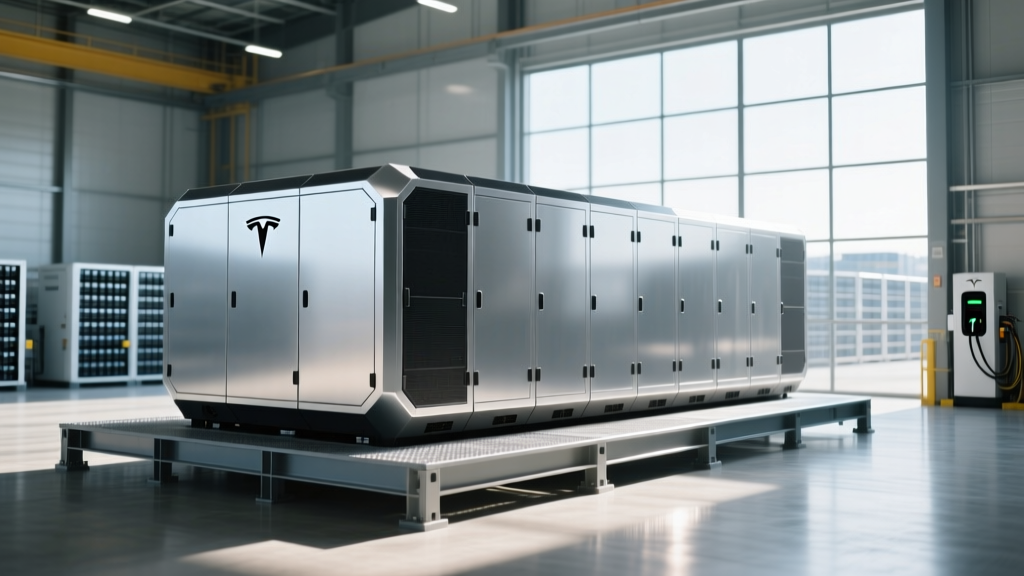
The Megapack is Tesla's flagship grid-scale battery product, manufactured at the Lathrop, California Megafactory. Each Megapack unit is a pre-assembled, containerized system integrating battery modules, bidirectional inverters, thermal management, and controls into a single enclosure. The current generation lineup includes the Megapack 2 and the larger Megapack XL.
| Specification | Megapack 2 | Megapack XL |
|---|---|---|
| Energy Capacity | 3.9 MWh (3,916 kWh) | ~5.2 MWh (estimated) |
| Continuous Power Output | 1.25 MW (AC) | ~1.65 MW (AC) |
| Cell Chemistry | LFP (Lithium Iron Phosphate) | LFP |
| Thermal Management | Liquid cooling/heating | Liquid cooling/heating |
| Integrated Inverter | Yes (bidirectional) | Yes (bidirectional) |
| Round-Trip Efficiency | ~87–90% (AC-AC) | ~87–90% (AC-AC) |
| Design Cycle Life | ~8,000–10,000 cycles | ~8,000–10,000 cycles |
| Design Lifespan | 25 years | 25 years |
| Footprint (per unit) | ~38 ft L × 8 ft W × 9 ft H | Larger (XL form factor) |
| Weight | ~84,000 lbs | Heavier (est. ~100,000+ lbs) |
The shift to LFP (lithium iron phosphate) chemistry — away from the NMC (nickel manganese cobalt) cells used in early Megapack generations — is the single most consequential spec on the datasheet. LFP sacrifices some energy density for dramatically improved cycle life, thermal stability, and reduced reliance on cobalt and nickel. For a stationary system where weight and volume are secondary to longevity and safety, LFP is the correct engineering choice.
Battery Chemistry Deep Dive: Why LFP Matters at Grid Scale
EV owners may already know LFP from the Tesla Model 3 Standard Range and Model Y rear-wheel-drive variants, which use CATL-sourced LFP packs. The same chemistry trade-offs apply at utility scale, but the economics become even more pronounced.
| Attribute | LFP (Megapack) | NMC (Competitors/Earlier Gen) |
|---|---|---|
| Cycle Life | 8,000–10,000+ cycles | 3,000–5,000 cycles |
| Energy Density (cell-level) | ~160–180 Wh/kg | ~220–280 Wh/kg |
| Thermal Runaway Risk | Very low (~270°C onset) | Moderate (~210°C onset) |
| Cobalt Content | None | Significant |
| Calendar Degradation | Lower | Higher |
| Cost per kWh (trend) | Lower and declining | Higher, commodity-sensitive |
At 10,000 cycles and one cycle per day, a Megapack could theoretically operate for over 27 years before reaching end-of-life capacity thresholds. This aligns with the 25-year design lifespan Tesla advertises and underpins the levelized cost of storage (LCOS) calculations that utilities run before procurement.
Power, Efficiency, and the Round-Trip Reality
The datasheet lists 1.25 MW continuous AC output for Megapack 2. To contextualize: a single Megapack at full output can supply roughly 1,000 average US homes (at ~1.2 kW continuous draw) for the duration of its discharge. A typical utility-scale deployment — say, 100 Megapacks — delivers a combined 390 MWh of stored energy and 125 MW of instantaneous power.
The round-trip efficiency of 87–90% (AC-to-AC) means that for every 100 kWh drawn from the grid to charge the system, roughly 87–90 kWh is returned. The 10–13% loss comes from inverter conversion (DC↔AC), thermal management parasitics, and internal resistance. This is competitive with pumped hydro (~75–80%) and comparable to rival BESS platforms from Fluence, BYD, and Wärtsilä.
How the Megapack Connects to EV Charging Infrastructure
For EV owners and charging-network operators, the Megapack is increasingly relevant as a behind-the-meter buffer for DC fast-charging stations. A 6-stall Supercharger site pulling 250 kW per stall can demand 1.5 MW instantaneously — enough to trigger utility demand charges of $15–25/kW per month in some jurisdictions. Deploying a Megapack on-site smooths grid draw, charges slowly during off-peak hours, and discharges during peak charging events.
Tesla has begun integrating Megapacks at high-traffic Supercharger locations, particularly where grid interconnection limits would otherwise cap the number of stalls or charging speeds. This is why some newer Supercharger sites can sustain 250 kW per stall even in areas with constrained grid capacity.
Competitive Landscape: Megapack vs Rival BESS Platforms
| Platform | Capacity per Unit | Chemistry | Integrated Inverter | Key Differentiator |
|---|---|---|---|---|
| Tesla Megapack 2 | 3.9 MWh | LFP | Yes | Vertical integration, Powerwall/Autobidder software |
| Fluence Grid (Siemens/AES) | ~3.5–5.0 MWh | LFP / NMC options | Varies | Modular, chemistry-agnostic |
| BYD Cube | ~3.3 MWh | LFP (Blade cells) | Yes | Blade battery structural pack |
| Wärtsilä GEMS | Varies (containerized) | Multiple | Yes | Hybrid plant integration |
| Sungrow PowerTitan 2.0 | ~4.4 MWh | LFP | Yes | High capacity per footprint |
Tesla's advantage is not any single spec — competitors match or exceed individual metrics. The advantage is vertical integration: Tesla controls cell procurement (CATL, BYD partnerships), pack assembly, inverter design, and the Autobidder energy-trading software that optimizes dispatch in wholesale electricity markets. For a utility signing a 20-year power purchase agreement, that single-vendor accountability matters.
Pricing, Procurement, and the Economics of Scale
Tesla does not publish per-unit Megapack pricing on its website. Based on public procurement filings and industry reporting in 2025–2026, Megapack pricing falls in the range of $250,000–$350,000 per unit (roughly $65–$90/kWh at the system level), depending on volume, contract terms, and balance-of-system requirements. A 100 MWh project typically lands between $200–$300/kWh fully installed, including inverters, transformers, switchgear, civil work, and grid interconnection.
For context, the US Energy Information Administration reports utility-scale battery storage costs have declined roughly 40% since 2020, driven by LFP cell cost reductions and manufacturing scale at facilities like Tesla's Lathrop Megafactory (targeting 40 GWh annual capacity).
Who Deploys Megapacks — and Who Should Pay Attention
Megapack buyers fall into distinct categories:
- Utilities and ISOs: Replacing peaker gas plants, providing frequency regulation, and shifting solar overproduction to evening demand peaks (California's "duck curve").
- Independent Power Producers: Co-locating storage with solar/wind farms to firm intermittent generation under PPA contracts.
- Data Centers: Providing UPS and demand-management for AI workloads with volatile power profiles.
- EV Charging Networks: Buffering high-power DC fast-charging sites against demand charges and grid constraints.
- Industrial/Commercial: Behind-the-meter peak shaving and backup power for manufacturing and logistics facilities.
If you're an EV owner, the Megapack matters indirectly: every grid-scale battery deployed reduces the carbon intensity of your charging, lowers peak electricity prices, and makes fast-charging infrastructure more viable in grid-constrained areas.
Frequently Asked Questions
How much energy does one Tesla Megapack store?
A single Megapack 2 stores 3.9 MWh (3,916 kWh). For comparison, that's roughly 50 times the battery capacity of a Tesla Model Y Long Range (~75 kWh usable) or enough to power approximately 3,200 average US homes for one hour.
Can I buy a Megapack for my home?
No. Megapack is a utility-scale product sold to energy developers, utilities, and commercial entities. For residential storage, Tesla offers the Powerwall 3 (13.5 kWh, integrated solar inverter). The Megapack's 84,000-lb weight, high-voltage interconnection requirements, and commercial contract structure make it unsuitable for residential deployment.
What is the Megapack's warranty?
Tesla offers a standard warranty covering 15 years with guaranteed capacity retention thresholds (typically ~70% of nameplate capacity at year 15, depending on duty cycle and operating conditions). Extended warranty and augmentation agreements are available for long-term PPA-backed projects.
Does the Megapack use the same cells as Tesla vehicles?
No. Megapack uses prismatic LFP cells sourced from suppliers including CATL and BYD — not the 4680 NMC cells used in the Cybertruck and newer Model Y. The chemistry choice prioritizes cycle life and safety over energy density, which is appropriate for stationary storage where weight is not a primary constraint.
Where is the Megapack manufactured?
The Megapack is assembled at Tesla's Megafactory in Lathrop, California, which began production in late 2022 and is scaling toward 40 GWh of annual output. Tesla has also announced a Megafactory in Shanghai, China, to serve Asia-Pacific markets.
How does Megapack compare to Tesla's Powerblock for smaller projects?
Tesla's Powerblock is a smaller, modular system aimed at commercial and light-industrial applications (typically 100–500 kWh scale). Megapack targets utility-scale deployments from 10 MWh to multiple GWh. The two products share LFP chemistry and Tesla's control software but differ fundamentally in scale, interconnection voltage, and procurement model.