Tesla Megapack Cost: The 2026 Buyer's Breakdown
If you've been following the energy storage boom, you've likely encountered the question: what does a Tesla Megapack actually cost? Unlike Tesla's consumer vehicles, the Megapack is a utility-scale battery energy storage system (BESS) designed for grid operators, utilities, and large commercial installations. It isn't something you'll park in your garage or claim a §30D federal EV tax credit on — but understanding Tesla Megapack cost structures is essential for energy professionals, investors, and EV owners curious about the grid infrastructure powering their vehicles.
This guide breaks down the per-unit hardware cost, project-level economics, battery specifications, and how Megapack pricing compares to competing grid-scale storage solutions in 2026.
What Is the Tesla Megapack?
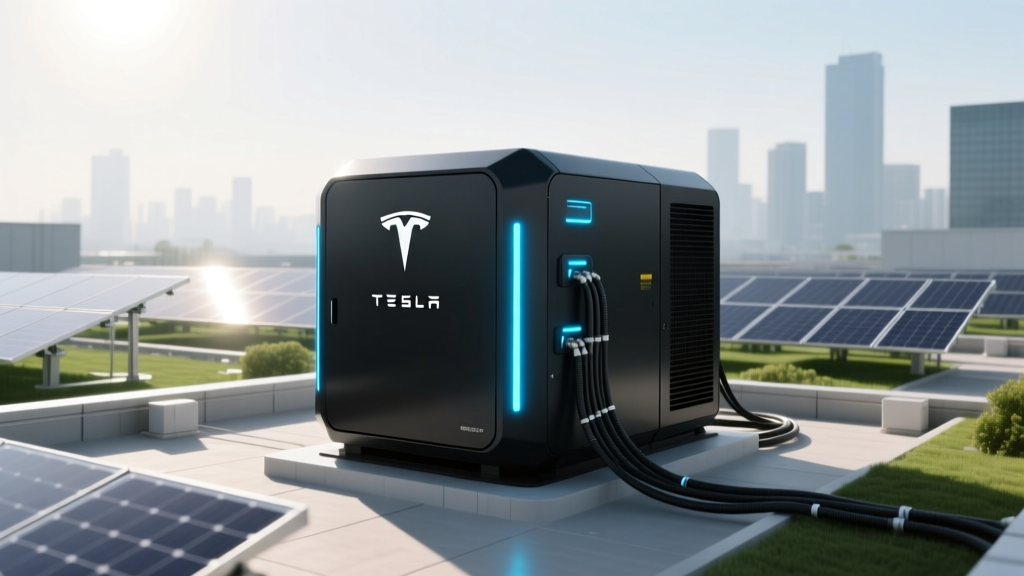
The Tesla Megapack is a pre-assembled, containerized lithium-ion battery system designed for utility-scale energy storage. Each Megapack 2 XL unit — the current-generation product shipping from Tesla's Lathrop, California Megafactory — houses approximately 3.9 MWh (3,916 kWh) of usable energy capacity using LFP (lithium iron phosphate) cell chemistry. Tesla chose LFP for its superior cycle life, thermal stability, and lower cost compared to NMC (nickel manganese cobalt), making it the dominant chemistry for stationary storage applications.
A complete Megapack installation includes the battery units themselves, Tesla's Powerhub AC/DC conversion and management system, switchgear, transformers, and the proprietary Autobidder software platform for automated energy trading and dispatch optimization.
Tesla Megapack Cost: Per-Unit and Project-Level Pricing
Tesla does not publish a consumer-facing MSRP for the Megapack the way it does for the Model Y or Cybertruck. Pricing is negotiated per project based on volume, configuration, and scope. However, industry data, Tesla's own earnings disclosures, and publicly filed utility contracts give us reliable cost benchmarks for 2026.
| Component | Estimated Cost | Notes |
|---|---|---|
| Megapack 2 XL (per unit, hardware) | $1.1M – $1.35M | ~3.9 MWh per unit; volume discounts apply at 50+ units |
| Cost per kWh (battery hardware) | $280 – $345/kWh | Declining from ~$380/kWh in 2024 |
| Powerhub + BOS (balance of system) | $80 – $130/kWh | Inverters, switchgear, transformers, cabling |
| Installation & commissioning | $50 – $90/kWh | Site prep, civil work, grid interconnection |
| Total installed project cost | $410 – $565/kWh | Varies significantly by site complexity and scale |
| 100 MW / 400 MWh project (typical) | $164M – $226M | ~102 Megapack 2 XL units + full BOS + install |
For context, Tesla's energy generation and storage segment reported gross margins improving through 2025, driven by LFP cell cost reductions and Megafactory production scaling. According to Tesla's Q4 2025 investor update, Megapack deployments exceeded 15 GWh annually, pushing unit economics lower with each production ramp.
Specifications: Energy Capacity, Power, and Efficiency
While the Megapack doesn't have an EPA range sticker or a 0-60 mph time, its performance specs are equally precise — they just measure different things. Here's what defines a Megapack 2 XL electrically:
| Specification | Value |
|---|---|
| Energy capacity | 3,916 kWh (3.9 MWh) usable |
| Cell chemistry | LFP (lithium iron phosphate) |
| Continuous power output | ~1.3 MW per unit (configurable) |
| Round-trip efficiency | ~85–88% (AC-to-AC) |
| Cycle life | 6,000+ cycles to 80% capacity retention |
| Calendar life | 25+ years at typical duty cycles |
| Dimensions (per unit) | ~24 ft L × 8 ft W × 9 ft H (shipping container footprint) |
| Weight | ~80,000 lbs (36,300 kg) |
| Thermal management | Liquid-cooled with integrated HVAC |
| Software | Autobidder (real-time energy trading), Powerhub (monitoring) |
| Warranty | 10-year product warranty; 15-year capacity guarantee (project-specific) |
Charging and Discharge: How Megapack Power Works
Megapack doesn't charge at a DC fast charger — it connects directly to the medium-voltage AC grid through the Powerhub system. Here's how the charge/discharge profile works:
| Parameter | Value | Context |
|---|---|---|
| Charge rate (per unit) | ~1.3 MW continuous | Grid-connected via Powerhub; 3-hour full charge from 0% |
| Discharge rate (per unit) | ~1.3 MW continuous | Sustained output; can burst higher for short grid-support events |
| Full charge time (0–100%) | ~3 hours | At rated power; actual depends on grid availability and dispatch |
| Full discharge duration | ~3 hours | At rated power; longer at partial discharge rates |
| Grid connection | Medium-voltage AC (typically 34.5 kV) | Requires substation or direct interconnection |
For a 100 MW / 400 MWh project (roughly 102 Megapack units), the system can absorb 100 MW of power from the grid during off-peak hours — enough to charge the entire installation in approximately 4 hours — and dispatch that same 100 MW back to the grid during peak demand periods.
Why LFP Chemistry Matters for Megapack
Tesla's decision to use LFP cells in the Megapack is one of the most consequential factors driving down Tesla Megapack cost over time. Here's how LFP compares to NMC in a stationary storage context:
| Factor | LFP (Megapack) | NMC (Typical Competitors) |
|---|---|---|
| Cycle life | 6,000–10,000 cycles | 3,000–5,000 cycles |
| Energy density | Lower (~160 Wh/kg cell-level) | Higher (~220–260 Wh/kg cell-level) |
| Thermal stability | Excellent — no thermal runaway at typical abuse temps | Good — requires more aggressive thermal management |
| Cost per kWh | ~$80–100/kWh (cell-level, 2026) | ~$110–140/kWh (cell-level, 2026) |
| Degradation (20-year projection) | ~20–25% capacity loss | ~25–35% capacity loss |
| Critical mineral dependency | No cobalt or nickel required | Requires cobalt and/or nickel |
For stationary storage, energy density matters far less than it does in EVs. A Megapack sits on a concrete pad — it doesn't need to minimize weight. What matters is cost per kWh, cycle life, and safety. LFP wins on all three, which is why virtually every major BESS manufacturer has shifted toward LFP for utility-scale products.
Megapack vs. Competitors: How Does the Cost Compare?
Tesla isn't the only player in utility-scale storage. Here's how Megapack stacks up against the major alternatives on a cost-per-kWh and specification basis:
| System | Capacity per Unit | Chemistry | Est. Installed $/kWh | Software Platform |
|---|---|---|---|---|
| Tesla Megapack 2 XL | 3.9 MWh | LFP | $410–$565 | Autobidder + Powerhub |
| BYD Cube Pro | 3.3 MWh | LFP (Blade cells) | $380–$520 | BYD BMS |
| Fluence Cube (Siemens/AES) | Variable (modular) | LFP / NMC options | $450–$600 | Mosaic / Ultramax |
| Sungrow PowerTitan 2.0 | 4.4 MWh | LFP | $370–$510 | Sungrow EMS |
Tesla's advantage isn't always the lowest hardware cost — Chinese competitors like BYD and Sungrow often undercut on pure $/kWh. Tesla's differentiator is the integrated software stack: Autobidder enables automated arbitrage trading (buying cheap off-peak power, selling at peak rates), which can add $10–$30/kWh-year in revenue for merchant storage projects. For project developers, that software advantage can justify a hardware premium over the system's 15–25 year operating life.
Degradation, Warranty, and Long-Term Value
A Megapack is a 20–25 year infrastructure asset. Understanding degradation is critical for financial modeling:
- Year 1 degradation: ~2–3% (initial formation losses)
- Annual degradation thereafter: ~1–1.5% per year depending on cycling intensity and thermal conditions
- 20-year projected retention: ~75–80% of original capacity
- Warranty floor: Tesla typically guarantees 70% capacity retention at year 15 for standard duty cycles
Tesla's warranty structure for Megapack is negotiated per project and varies based on the expected duty cycle (number of full cycles per year, depth of discharge, ambient temperature). A project cycling once daily at 90% depth of discharge will see faster degradation than one cycling at 50% DoD. The liquid-cooled thermal management system helps mitigate calendar and cycle degradation by keeping cells within an optimal temperature band.
Who Should Buy (or Specify) a Tesla Megapack?
Choose Megapack If:
- You're developing a utility-scale storage project (50+ MWh)
- You want integrated software for automated energy trading
- You value a single-vendor solution (battery + inverter + software)
- Your project requires bankable warranty from a publicly traded company
- You need proven deployment track record for project financing
Look Elsewhere If:
- Your project is under 10 MWh (consider Tesla Powerwall or commercial alternatives)
- Lowest $/kWh hardware cost is your primary driver (consider BYD or Sungrow)
- You need multi-hour durations beyond 4 hours cost-effectively (consider flow batteries or compressed air)
- You require open-source or third-party software integration
Frequently Asked Questions
How much does a single Tesla Megapack cost in 2026?
A single Megapack 2 XL unit costs approximately $1.1 million to $1.35 million for the battery hardware alone, equating to roughly $280–$345 per kWh. Fully installed project costs including balance-of-system equipment, site preparation, and grid interconnection run $410–$565 per kWh depending on project scale and complexity.
Does the Tesla Megapack qualify for any federal tax credits?
The Megapack does not qualify for the §30D EV tax credit (it's not a vehicle). However, standalone energy storage systems placed in service may qualify for the §48E Investment Tax Credit, which can provide up to 30% of project cost as a credit, subject to prevailing wage, apprenticeship, and domestic content bonus provisions. Always consult a tax professional and check current IRS rules before making financial decisions.
What is the lifespan of a Tesla Megapack?
Tesla designs the Megapack for a 25+ year operational life with LFP chemistry providing 6,000+ full cycles to 80% capacity retention. Real-world lifespan depends on cycling frequency, depth of discharge, ambient temperature, and thermal management effectiveness. Most project financial models assume 20 years with augmentation (adding replacement units) in years 10–15.
How does Megapack cost compare to a Powerwall?
A Tesla Powerwall 3 (residential) provides ~13.5 kWh at roughly $8,500–$11,000 installed — approximately $630–$815/kWh. The Megapack achieves $280–$345/kWh for hardware due to massive scale, standardized container design, and utility-grade engineering. The per-kWh cost drops dramatically at grid scale.
Can I buy a Megapack for my home or business?
No. The Megapack requires medium-voltage grid interconnection (typically 34.5 kV), dedicated switchgear, utility interconnection agreements, and environmental permitting. It's designed for utility-scale installations of 50+ MWh. For commercial applications, Tesla offers the Powerpack and Megapack in smaller configurations, but the minimum practical project size is typically several megawatt-hours.
What makes Tesla Megapack cost-competitive despite not being the cheapest?
Tesla's Autobidder software platform can generate $10–$30/kWh-year in additional revenue through automated energy arbitrage, frequency regulation, and capacity market participation. Over a 20-year project life, that software advantage can add millions in revenue, offsetting a higher upfront hardware cost versus Chinese competitors. Additionally, Tesla's deployment track record (including projects like Moss Landing and Victorian Big Battery) provides the bankability that project lenders require.