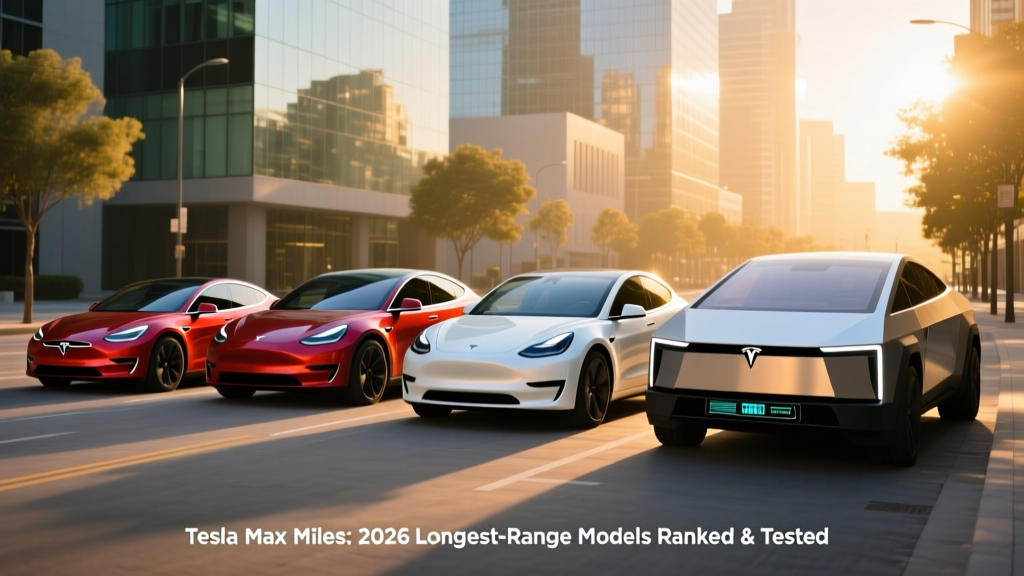
Range remains the single most scrutinized spec among EV buyers, and Tesla's lineup continues to set benchmarks that competitors chase. But the EPA sticker on the window tells only part of the story. If you're searching for the Tesla with the max miles — the model that will actually get you the furthest on a single charge in real-world driving — you need to look beyond the headline number.
In this guide, we rank every current 2026 Tesla model by EPA-estimated range, then layer in real-world highway and cold-weather adjustments based on testing data, battery chemistry behavior, and efficiency metrics. We'll also break down exactly how fast each model charges, what you'll actually pay after federal tax credits, and which Tesla makes the most sense for your specific driving pattern.
2026 Tesla Range Rankings: Every Model by EPA Miles
Tesla's current U.S. lineup spans four core models, each available in multiple trims with different battery packs and drivetrains. Here's how they stack up when maximizing range is the priority.
| Model / Trim | EPA Range | Battery (kWh usable) | Chemistry | Drivetrain | 0-60 mph | Base MSRP |
|---|---|---|---|---|---|---|
| Model S Long Range | 402 mi | ~100 kWh | NMC | AWD Dual Motor | 3.1 sec | $74,990 |
| Model 3 Long Range RWD | 363 mi | ~79 kWh | NMC | RWD | 5.8 sec | $42,490 |
| Model 3 Long Range AWD | 341 mi | ~79 kWh | NMC | AWD Dual Motor | 4.2 sec | $47,490 |
| Model Y Long Range AWD | 320 mi | ~79 kWh | NMC | AWD Dual Motor | 4.8 sec | $44,990 |
| Model Y Long Range RWD | 335 mi | ~79 kWh | NMC | RWD | 5.9 sec | $41,990 |
| Model X Long Range | 335 mi | ~100 kWh | NMC | AWD Dual Motor | 3.8 sec | $79,990 |
| Model 3 RWD (Standard) | 272 mi | ~60 kWh | LFP | RWD | 5.8 sec | $38,990 |
| Cybertruck AWD | 340 mi | ~123 kWh | NMC (4680) | AWD Dual Motor | 4.1 sec | $79,990 |
The Model S Long Range holds the crown at 402 miles EPA — still the highest EPA-estimated range of any Tesla and one of the highest of any production EV sold in the U.S. But as we'll detail below, that number shifts significantly depending on how and where you drive.
Real-World Range: What the EPA Sticker Doesn't Tell You
- EPA Combined: 402 miles
- Highway (70-75 mph, 75°F): ~320–345 miles
- City / Suburban mixed: ~370–400 miles
- Cold weather (30°F, highway): ~260–290 miles
- Cold weather (30°F, city): ~310–340 miles
Source: Testing data aggregated from fueleconomy.gov and independent real-world efficiency tracking.
The EPA test cycle includes a generous proportion of low-speed city driving, where regenerative braking recovers energy and aerodynamic drag is minimal. Highway driving at 70-75 mph is a different story entirely. Expect to lose roughly 15-20% of the EPA figure on sustained interstate trips in mild weather.
Cold weather compounds the loss. Lithium-ion batteries lose efficiency in low temperatures, and cabin heating draws significant power (even with Tesla's heat pump, which is standard on all 2026 models). At 30°F on the highway, plan for a 25-35% reduction from the EPA number. The Model S Long Range's heat pump helps mitigate this compared to resistive heating, but physics wins in deep cold.
The Model 3 Long Range RWD at 363 miles EPA is worth highlighting as a value leader. Its lighter curb weight and lower frontal area yield an efficiency rating of 25 kWh/100 mi — among the best in the segment. Real-world highway range lands around 290-310 miles in mild conditions, making it a legitimate road-trip car for most corridors.
Charging Speed: DC Fast Charging and Home Setup
Range only matters if you can replenish it efficiently. Tesla's Supercharger network remains the gold standard for reliability, but peak charge rates vary significantly across the lineup.
| Model / Trim | Peak DC Fast Charge | 10-80% Time | Level 2 Home (kW) | Level 2 Miles/Hr |
|---|---|---|---|---|
| Model S Long Range | 250 kW | ~25 min | 11.5 kW (48A) | ~34 mi/hr |
| Model 3 Long Range AWD | 250 kW | ~25 min | 11.5 kW (48A) | ~40 mi/hr |
| Model 3 Long Range RWD | 250 kW | ~25 min | 11.5 kW (48A) | ~40 mi/hr |
| Model Y Long Range AWD | 250 kW | ~25 min | 11.5 kW (48A) | ~37 mi/hr |
| Model X Long Range | 250 kW | ~28 min | 11.5 kW (48A) | ~30 mi/hr |
| Cybertruck AWD | 250 kW (400V) | ~30 min | 11.5 kW (48A) | ~28 mi/hr |
| Model 3 RWD (LFP) | 170 kW | ~30 min | 7.7 kW (32A) | ~28 mi/hr |
Understanding the charge curve: Peak kW is not sustained kW. A Model 3 Long Range may hit 250 kW at 10% State of Charge (SoC), but the rate tapers progressively above 50%, dropping sharply past 80%. That's why the 10-80% metric is far more useful than peak numbers. On a V3 Supercharger (250 kW), most Long Range Teslas add roughly 170-200 miles in 15 minutes when starting at a low SoC with proper battery preconditioning.
Preconditioning matters. Always navigate to a Supercharger using the car's built-in navigation — this triggers battery thermal preconditioning, warming the pack to the optimal temperature for fast charging. Without preconditioning, your peak charge rate may be cut by 30-50%, especially in cold weather.
For home Level 2 charging, Tesla's Wall Connector at 48 amps (11.5 kW on a 60-amp circuit) replenishes a Long Range Model 3 from 20% to 80% overnight in roughly 6-7 hours. Installation typically runs $500-$2,000 depending on your electrical panel's capacity and the distance from panel to charger location. If your home has a 200-amp panel with spare capacity, expect the lower end of that range. Older homes with 100-amp service may need a panel upgrade ($1,500-$3,000 additional) — a detail many buyers overlook until the electrician's assessment.
Efficiency Deep Dive: MPGe and kWh per 100 Miles
Efficiency is where Tesla's engineering advantage is most visible. Measured in kWh per 100 miles (the EV equivalent of liters per 100 km), lower numbers mean less energy consumed per mile traveled.
| Model | Combined MPGe | kWh/100 mi | Cost per 100 mi (at $0.16/kWh) |
|---|---|---|---|
| Model 3 LR RWD | 132 MPGe | 25 | $4.00 |
| Model 3 LR AWD | 125 MPGe | 27 | $4.32 |
| Model Y LR RWD | 123 MPGe | 27 | $4.32 |
| Model Y LR AWD | 117 MPGe | 29 | $4.64 |
| Model S LR | 120 MPGe | 28 | $4.48 |
| Model X LR | 103 MPGe | 33 | $5.28 |
| Cybertruck AWD | 76 MPGe | 44 | $7.04 |
The Model 3 Long Range RWD at 25 kWh/100 mi is remarkably efficient for a car with 363 miles of range. For context, a comparable gas sedan getting 30 MPG at $3.50/gallon costs $11.67 per 100 miles — nearly three times the electricity cost at average residential rates.
The Cybertruck's 44 kWh/100 mi reflects its massive frontal area, heavy stainless-steel exoskeleton, and 6,800+ lb curb weight. It's the least efficient vehicle Tesla sells, and its 340-mile range requires a very large 123 kWh battery pack to achieve.
Pricing, Trims, and Federal Tax Credit Eligibility
Tesla pricing has shifted repeatedly over recent years. Here's where the lineup stands for the 2026 model year, including how the IRS §30D federal tax credit applies.
| Model / Trim | Base MSRP | As-Tested (typical) | §30D Credit Eligible? | Effective Price (with credit) |
|---|---|---|---|---|
| Model 3 RWD | $38,990 | $39,990 | Yes — up to $7,500* | ~$31,490* |
| Model 3 LR RWD | $42,490 | $43,990 | Yes — up to $7,500* | ~$34,990* |
| Model 3 LR AWD | $47,490 | $49,490 | Yes — up to $7,500* | ~$39,990* |
| Model Y LR RWD | $41,990 | $43,490 | Yes — up to $7,500* | ~$34,490* |
| Model Y LR AWD | $44,990 | $47,490 | Yes — up to $7,500* | ~$37,490* |
| Model S LR | $74,990 | $79,990 | No — exceeds MSRP cap | $74,990 |
| Model X LR | $79,990 | $85,990 | No — exceeds MSRP cap | $79,990 |
| Cybertruck AWD | $79,990 | $84,990 | No — exceeds MSRP cap | $79,990 |
*Critical §30D eligibility caveats: The federal clean vehicle credit has multiple requirements that must all be met simultaneously:
- MSRP cap: Sedans (Model 3) must be under $55,000; SUVs/trucks (Model Y, Cybertruck) must be under $80,000. The Model S and Model X sedan variants exceed the $55,000 cap.
- Buyer income cap: Modified AGI must not exceed $150,000 (single), $225,000 (head of household), or $300,000 (joint filers).
- Battery sourcing: The credit is split into two halves ($3,750 each) based on critical-mineral sourcing and battery-component manufacturing requirements. These thresholds tighten annually. Check the IRS clean vehicle credit page for current-year battery-sourcing rules before purchasing.
- Point-of-sale transfer: As of 2024, eligible buyers can transfer the credit to the dealer at purchase, reducing the upfront price rather than waiting for a tax refund. Tesla supports this at delivery.
The Model 3 and Model Y remain the Tesla models most likely to qualify for the full or partial credit. Always verify your specific eligibility with a tax professional before relying on the credit in your purchase decision.
Who Should Buy Which Tesla for Maximum Miles?
- You need the absolute maximum range (402 mi EPA) and budget is not the primary constraint
- You regularly drive 300+ mile corridors where fewer charging stops matters
- You value premium sedan comfort, adaptive air suspension, and the fastest Supercharger preconditioning
- You want the best range-per-dollar ratio (363 mi at ~$42,490 before credits)
- Your driving is primarily commuter and suburban with occasional road trips
- You prioritize efficiency (25 kWh/100 mi) and lower operating costs
- You want federal tax credit eligibility
- You need crossover cargo space (30.2 cu ft rear, 76.2 cu ft with seats folded) and available 7-seat config
- You want AWD for snow-belt climates while maintaining strong range (320-335 mi)
- Family hauling is a priority — rear legroom is 41.6 inches
- You need 3-row seating (up to 7 passengers) and falcon-wing rear doors for tight parking access
- 335 miles EPA in a full-size electric SUV meets your needs, and budget allows $80K+
Cargo, Interior Space, and Practicality
Range is only one axis of the purchase decision. Here's how the max-mile Teslas compare on interior volume and utility.
| Model | Rear Cargo (cu ft) | Total Cargo (seats folded) | Front Trunk (cu ft) | Rear Legroom (in) |
|---|---|---|---|---|
| Model S LR | 28.0 | 79.3 | 5.3 | 35.4 |
| Model 3 LR | 23.0 | — | 3.1 | 35.2 |
| Model Y LR | 30.2 | 76.2 | 4.1 | 41.6 |
| Model X LR | 42.5 (behind 2nd row) | 91.6 | 6.6 | 40.9 |
| Cybertruck AWD | 34.2 (bed) | — | — | 38.4 |
The Model Y's combination of 30.2 cu ft rear cargo, 41.6 inches of rear legroom, and available third row makes it the most practical max-mile Tesla for families. The Model 3 sacrifices cargo versatility for efficiency and price — its 23 cu ft trunk is adequate for a couple but tight for family road-trip luggage.
Standout Tech and Notable Drawbacks
Tech highlights across the 2026 lineup:
- Autopilot (standard): SAE Level 2 driver-assist with adaptive cruise control, lane-centering, and automatic emergency braking. Requires continuous driver supervision — this is not self-driving.
- FSD Supervised (optional, ~$8,000 or $99/mo): Enhanced Level 2 system with city-street navigation, traffic-light recognition, and automated lane changes. Still requires active driver engagement at all times.
- 15.4-inch center touchscreen (Model 3/Y) or 17-inch (Model S/X) handles all vehicle controls, media, and navigation.
- Over-the-air updates continuously add features and refine battery management.
- Sentry Mode and dashcam recording use the vehicle's camera suite for security.
Notable drawbacks:
- No physical instrument cluster in Model 3/Y — all info is on the center screen, which some drivers find distracting.
- No Apple CarPlay or Android Auto integration; Tesla's native infotainment is the only option.
- Build-quality consistency has improved but still draws occasional complaints about panel gaps and interior trim alignment.
- FSD Supervised remains a Level 2 system despite its name — it does not make the car autonomous. Do not disengage from driving while using it.
Warranty Coverage
| Model | Basic Vehicle | Battery & Drive Unit | Capacity Retention Threshold |
|---|---|---|---|
| Model 3 / Model Y | 4 yr / 50,000 mi | 8 yr / 120,000 mi (LR AWD) 8 yr / 100,000 mi (RWD) | 70% minimum |
| Model S / Model X | 4 yr / 50,000 mi | 8 yr / 150,000 mi | 70% minimum |
| Cybertruck | 4 yr / 50,000 mi | 8 yr / 120,000 mi | 70% minimum |
Tesla guarantees that the battery will retain at least 70% of its original capacity during the warranty period. Real-world degradation data from high-mileage Tesla owners suggests NMC packs in Long Range models typically lose 8-12% capacity over the first 100,000 miles, with the curve flattening significantly afterward. LFP packs (in the base Model 3 RWD) show slower degradation and tolerate regular 100% charging without the same longevity concerns as NMC chemistry.
Pros and Cons: The Max-Mile Tesla Lineup
- Model S LR: 402 mi EPA — highest range of any Tesla and among the highest of any EV sold
- Model 3 LR RWD: Best value — 363 mi, 132 MPGe, ~$35K after tax credit
- Supercharger network: 60,000+ global connectors with industry-leading uptime and reliability
- Class-leading efficiency across the sedan lineup
- Over-the-air updates keep vehicles current post-purchase
- Strong resale values relative to non-Tesla EVs
- Heat pump standard on all models — better cold-weather range retention
- Model S and Model X no longer qualify for federal tax credit (MSRP cap)
- No Apple CarPlay/Android Auto — Tesla ecosystem lock-in
- FSD is expensive and remains Level 2 — not autonomous
- No physical gauge cluster in Model 3/Y
- Service center wait times can be long in some metro areas
- Cybertruck efficiency is poor (44 kWh/100 mi) relative to its battery size
- Insurance premiums tend to run 15-30% higher than comparable ICE vehicles
Frequently Asked Questions
What is the real-world range of the Tesla with the most miles?
The Model S Long Range carries a 402-mile EPA estimate. In real-world highway driving at 70-75 mph in mild temperatures, expect roughly 320-345 miles. In cold weather (around 30°F) on the highway, that drops to approximately 260-290 miles. The heat pump helps, but sustained high-speed driving in cold air is the worst-case scenario for any EV.
How fast does a Long Range Tesla charge on a Supercharger?
Most Long Range models (Model 3, Model Y, Model S) peak at 250 kW on a V3 Supercharger and charge from 10-80% in approximately 25 minutes. The actual charging curve tapers significantly above 50% SoC, so the first 30% charges much faster than the final 30%. Always use in-car navigation to a Supercharger to trigger battery preconditioning for optimal charge speed.
Does the Tesla Model 3 qualify for the $7,500 federal tax credit?
The Model 3 qualifies for up to $7,500 under IRS §30D, provided you meet the income caps ($150K single / $300K joint), the vehicle's MSRP is under $55,000, and the battery meets current-year critical-mineral and component-sourcing requirements. The credit can be transferred at point of sale to reduce your purchase price. Always verify current-year sourcing rules on IRS.gov before finalizing your order.
Is the Model 3 Long Range worth it over the Model Y Long Range?
If you don't need crossover cargo space or AWD, the Model 3 LR RWD delivers 363 miles EPA versus the Model Y LR RWD's 335 miles — 28 more miles for roughly the same price. The Model 3 is also more efficient (25 vs 27 kWh/100 mi), saving you roughly $30-50/year in electricity. Choose the Model Y if you need the taller seating position, larger cargo area, or available third row.
How long will a Tesla Long Range battery last?
Tesla warranties Long Range batteries for 8 years / 120,000 miles (AWD) or 8 years / 100,000 miles (RWD) with a 70% capacity-retention floor. Real-world data from high-mileage owners suggests NMC Long Range packs typically retain 88-92% capacity at 100,000 miles. To maximize longevity, charge to 80% daily and only use 100% for long trips. Battery replacement, if ever needed out of warranty, currently ranges from $12,000-$20,000 depending on the model.
Which Tesla is best for road trips?
For pure distance between stops, the Model S Long Range at 402 miles EPA is the clear winner. For road trips with family and gear, the Model Y Long Range balances 320-335 miles of range with 76.2 cu ft of total cargo space. Both benefit from Tesla's Supercharger network, which averages a station every 150-200 miles along major U.S. interstate corridors.
Sources: fueleconomy.gov (EPA range and efficiency data), IRS.gov (§30D clean vehicle credit rules), Tesla.com official specifications. All pricing and specs reflect 2026 model-year data as of publication. Tax credit eligibility is subject to change — consult a tax professional for your specific situation.