The Tesla Supercharger network has long been the gold standard for DC fast charging in North America. For years, it was an exclusive club — Tesla owners only. That changed with the rollout of the Tesla Magic Dock, a built-in CCS adapter integrated directly into select Supercharger stalls that allows non-Tesla electric vehicles to charge without carrying a separate adapter. As of 2026, the Magic Dock is central to Tesla's strategy of opening its network to the broader EV market while the industry transitions to the North American Charging Standard (NACS).
But how does the Magic Dock actually work? Which Supercharger stations have it? What charging speeds can non-Tesla EVs expect? And is it reliable enough to plan a road trip around? This guide covers everything EV owners and shoppers need to know about the Tesla Magic Dock, including real-world charging data, compatibility, and practical ownership implications.
What Is the Tesla Magic Dock?
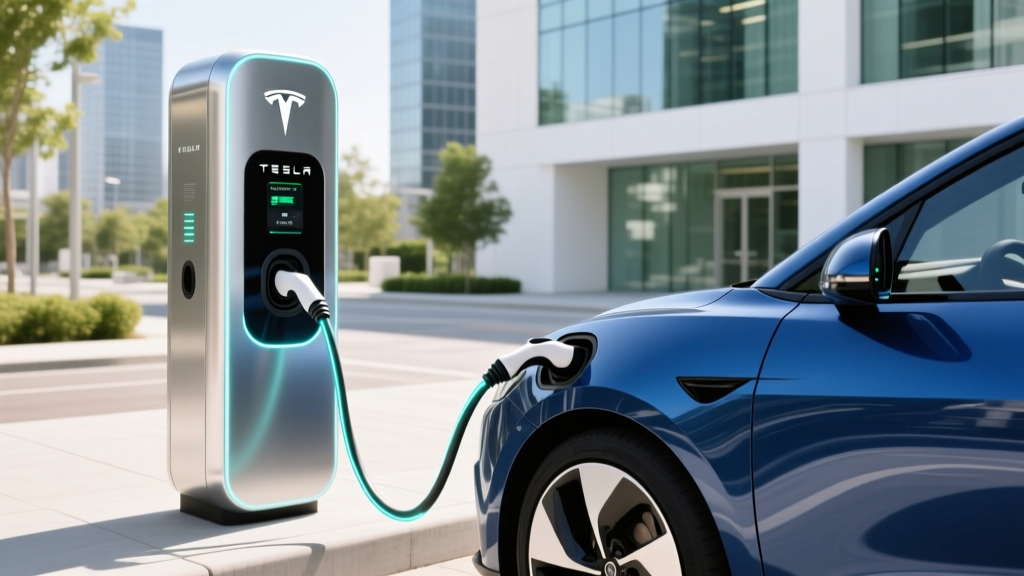
The Tesla Magic Dock is a built-in CCS1 adapter integrated into the handle and housing of select Tesla Supercharger stalls. It allows non-Tesla EVs equipped with a CCS1 charge port to plug in directly — no external dongle or adapter required. The dock physically locks the CCS connector into the Tesla Supercharger cable, then communicates with the vehicle to initiate a charging session via the Tesla app.
Tesla first piloted the Magic Dock at a handful of Supercharger stations in late 2022 and expanded it significantly through 2023 and 2024 as part of its agreement with the Biden administration to open 7,500 chargers (a mix of Superchargers and Destination Chargers) to non-Tesla EVs by the end of 2024. By early 2026, Magic Dock-equipped stalls are available at hundreds of Supercharger locations across the United States, though they still represent a fraction of Tesla's total 6,000+ station network.
How the Tesla Magic Dock Works: Step by Step
Using a Magic Dock-equipped Supercharger with a non-Tesla EV is straightforward but requires a few setup steps the first time:
- Download the Tesla app and create an account (no Tesla vehicle required).
- Add your non-Tesla EV to the app by entering the make, model, and year.
- Add a payment method — Tesla charges per kWh at Magic Dock stalls, and rates for non-Tesla vehicles are typically higher than Tesla-owner rates (more on pricing below).
- Locate a Magic Dock station using the Tesla app or in-app navigation. Stations with Magic Dock are labeled "Open to Non-Tesla EVs."
- Arrive at the stall, select the stall number in the app, and the Magic Dock will unlock — the CCS adapter slides out from the Supercharger handle housing.
- Plug in to your vehicle's CCS1 port. Charging begins automatically once the handshake completes.
- Monitor the session in the Tesla app. Unplug when finished and return the cable to the holster.
The entire process takes about 30 seconds once you're familiar with it. The first session may take a couple minutes as you set up your account and locate the correct stall.
Charging Speeds: What Non-Tesla EVs Can Expect
This is where reality diverges from marketing. The Magic Dock does not magically make every non-Tesla EV charge at Tesla's maximum Supercharger rate. Your actual charging speed depends on three factors:
- The Supercharger stall's maximum output — V2 stalls deliver up to 150 kW; V3 stalls deliver up to 250 kW; V4 stalls (newer deployments) can deliver up to 350 kW.
- Your vehicle's maximum DC fast-charge acceptance rate — a Hyundai Ioniq 5 can accept up to 240 kW; a Chevy Bolt EV maxes out at ~55 kW.
- The charge curve — peak kW is only sustained for a portion of the session. Most EVs taper significantly above 80% state of charge (SoC).
| Vehicle (Example) | Max DC Acceptance | Stall Type | Expected 10–80% Time | Notes |
|---|---|---|---|---|
| Hyundai Ioniq 5 (2026) | 240 kW | V3 (250 kW) | ~20–22 min | Strong charge curve; near peak speed sustained to ~60% SoC |
| Ford Mustang Mach-E (2026) | 150 kW | V3 (250 kW) | ~32–38 min | Slower taper; peaks briefly at 150 kW |
| VW ID.4 (2026) | 175 kW | V3 (250 kW) | ~28–34 min | Moderate curve; sustained ~130 kW through 50% SoC |
| Chevy Bolt EV/EUV | ~55 kW | Any | ~55–65 min | Charge-rate limited; not ideal for road-trip DC charging |
| BMW i4 eDrive40 | 205 kW | V3 (250 kW) | ~25–30 min | Good sustained rate to ~70% SoC |
Critical caveat for cold weather: If your EV's battery is not preconditioned before arriving at the charger, expect 10–80% times to increase by 20–40% in temperatures below 40°F. Most non-Tesla EVs do not automatically precondition for Supercharger navigation the way Tesla vehicles do, so manually initiating battery preconditioning (if your vehicle supports it) 15–20 minutes before arrival is essential.
Magic Dock Pricing: What Non-Tesla Owners Pay
Tesla charges non-Tesla EV owners a premium at Magic Dock-equipped stalls. As of early 2026, the price differential is typically $0.10–$0.15 per kWh higher than the rate for Tesla vehicles at the same station. Some locations also offer a "Membership" plan (~$12.99/month) that reduces the per-kWh rate for non-Tesla vehicles closer to the Tesla-owner price.
| Rate Type | Price Range (per kWh) | Notes |
|---|---|---|
| Tesla vehicle owner | $0.25–$0.36 | Varies by location and time of day |
| Non-Tesla (pay-as-you-go) | $0.38–$0.51 | Premium for Magic Dock access |
| Non-Tesla (Membership plan) | $0.28–$0.39 | $12.99/mo subscription reduces rate |
For a typical 60 kWh charging session (roughly 10–80% on a mid-size EV), the pay-as-you-go premium adds approximately $6–$9 per session compared to a Tesla owner. Over a year of road trips, that's a meaningful but not prohibitive cost. The Membership plan pays for itself after roughly 3–4 full sessions per month.
Compared to Electrify America, EVgo, or ChargePoint DC fast chargers, Magic Dock pricing is generally competitive or slightly lower than pay-as-you-go rates on those networks, which frequently range from $0.40–$0.56/kWh without a subscription.
Which Supercharger Stations Have the Magic Dock?
As of early 2026, Tesla has equipped several hundred Supercharger stations across the U.S. with Magic Dock stalls, but not every stall at a given station necessarily has one. Stations with Magic Dock are concentrated along major highway corridors and in states that required network access as a condition of NEVI (National Electric Vehicle Infrastructure) funding.
To find Magic Dock stations:
- Tesla app: The most reliable tool. Filter for "Open to Non-Tesla EVs" to see eligible locations.
- In-vehicle navigation: Some non-Tesla EVs with integrated charging apps (e.g., Ford's Plug & Charge system) may show Tesla stations, but the Tesla app remains the authoritative source.
- PlugShare / A Better Routeplanner: Third-party apps increasingly flag Magic Dock-equipped stations, but data may lag behind Tesla's live network status.
The NACS Transition: Magic Dock's Long-Term Future
The Magic Dock is best understood as a bridge technology. Starting in the 2025–2026 model years, nearly every major automaker selling EVs in North America has adopted the NACS charge port as standard:
- Ford — F-150 Lightning, Mustang Mach-E (2025+ models have native NACS)
- General Motors — All Ultium-based EVs (Cadillac Lyriq, Chevy Blazer EV, Equinox EV, Silverado EV) ship with NACS
- Rivian — R1T and R1S (2025+ models)
- Hyundai/Kia — 2026+ models transitioning to NACS
- BMW, Toyota, Subaru, Lucid, Volvo/Polestar — Committed to NACS adoption by 2025–2027
As native-NACS vehicles proliferate, the need for the Magic Dock will decline. Tesla has not announced an end date for Magic Dock deployment, but industry analysts expect it to remain in service through at least 2028–2029 to support the millions of CCS1-equipped EVs already on the road. For current CCS1 EV owners, the Magic Dock is a meaningful access upgrade today — but if you're shopping for a new EV in 2026, choosing a vehicle with a native NACS port gives you full, unrestricted Supercharger access without the adapter premium.
Pros and Cons of the Tesla Magic Dock
Pros
- Access to the most reliable DC fast-charging network in North America
- No external adapter to buy, carry, or lose
- Simple app-based activation — no RFID card or separate account needed
- Significantly expands road-trip route options for CCS1 EVs
- Competitive pricing compared to Electrify America and EVgo
- Supercharger stalls are well-maintained with high uptime rates
Cons
- Non-Tesla pricing premium of $0.10–$0.15/kWh
- Not available at all Supercharger stations — still a subset
- Cable may be too short for EVs with rear-mounted charge ports
- No automatic battery preconditioning for non-Tesla vehicles
- Requires Tesla app (some owners resist installing a competitor's app)
- Bridge technology — will become less relevant as NACS adoption grows
Who Benefits Most from the Tesla Magic Dock?
The Magic Dock is most valuable for three categories of EV owners:
1. Current CCS1 EV owners who road-trip frequently. If you own a 2022–2025 Hyundai Ioniq 5, Kia EV6, VW ID.4, Ford Mustang Mach-E, or BMW i4, the Magic Dock dramatically expands your fast-charging options on highway corridors where Electrify America or EVgo coverage is sparse. The reliability advantage of Superchargers is significant — J.D. Power's EV charging satisfaction studies consistently rank Tesla's network highest for uptime and ease of use.
2. Apartment dwellers and urban EV owners without home charging. If you rely entirely on public DC fast charging, access to the Supercharger network (even at a premium) provides a meaningful backup when your usual Electrify America or ChargePoint station is occupied or out of service.
3. Fleet and rideshare drivers operating CCS1 vehicles who need predictable, reliable charging during shifts. Supercharger uptime and charge-speed consistency reduce downtime compared to third-party networks.
If you're buying a new EV in 2026 and plan to keep it 5+ years, the better long-term strategy is to choose a vehicle with a native NACS port. But for the millions of CCS1 EVs already in driveways, the Magic Dock is a practical, here-today solution.
Frequently Asked Questions
Does the Tesla Magic Dock work with CHAdeMO vehicles?
No. The Magic Dock is a CCS1 adapter only. CHAdeMO-equipped vehicles (such as the older Nissan Leaf or Mitsubishi Outlander PHEV) cannot use the Magic Dock. CHAdeMO infrastructure is being phased out across North America, and Nissan has moved to CCS1 for the Ariya and future EVs.
Can I use the Magic Dock if my EV already has a NACS port?
You don't need to. Vehicles with native NACS ports plug directly into standard Tesla Supercharger cables without any adapter. The Magic Dock is specifically for CCS1 vehicles.
Is the Magic Dock available at every Supercharger station?
No. As of early 2026, Magic Dock stalls are available at several hundred stations, primarily along major interstate corridors and in states with NEVI-funded infrastructure requirements. Use the Tesla app to locate eligible stations.
Does the Magic Dock charge slower for non-Tesla EVs?
The Magic Dock itself does not throttle speeds. Your charging speed is limited by your vehicle's maximum DC acceptance rate and the Supercharger stall's output (V2: 150 kW, V3: 250 kW, V4: up to 350 kW). However, Tesla vehicles benefit from automatic battery preconditioning when navigating to a Supercharger, which non-Tesla EVs typically cannot do — resulting in slower initial charge rates in cold weather.
How much does it cost to charge a non-Tesla EV at a Magic Dock?
Expect to pay $0.38–$0.51/kWh on a pay-as-you-go basis, or $0.28–$0.39/kWh with Tesla's $12.99/month Membership plan. Rates vary by location and time of day. A typical 10–80% session for a mid-size EV costs approximately $22–$30 at pay-as-you-go rates.
Will Tesla eventually remove the Magic Dock?
Tesla has not announced a removal timeline. As native-NACS vehicles become the majority of new EV sales (expected by 2027–2028), Magic Dock utilization will likely decline. However, Tesla is expected to maintain the infrastructure through at least the end of the decade to support CCS1 vehicles still on the road.
Sources: Tesla Non-Tesla Supercharging Support, EPA Fuel Economy, J.D. Power EV Experience Study.