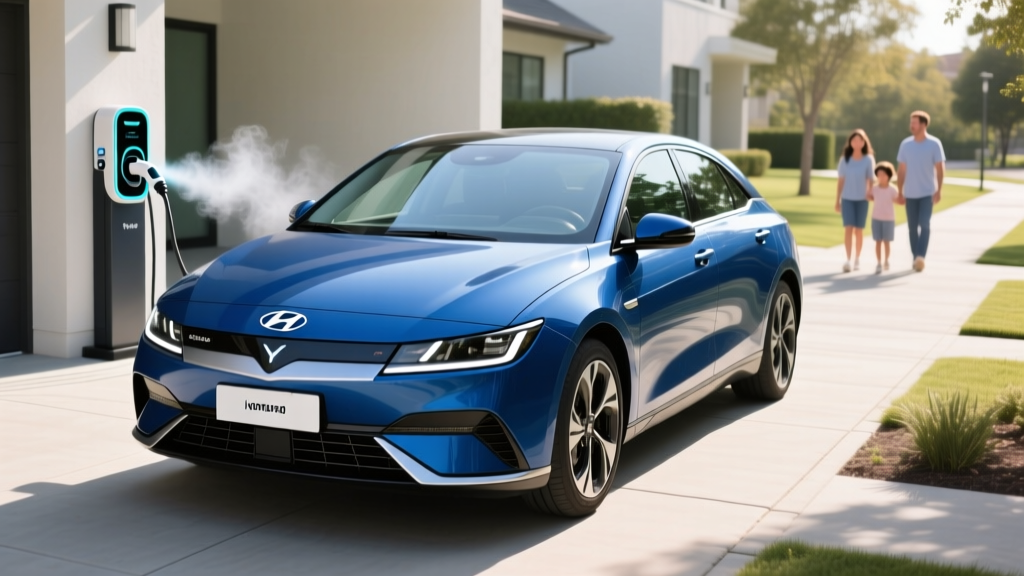
The three-row electric SUV segment is crowded, but the 2026 Hyundai Ioniq 9 SE arrives with a clear pitch: full-size family space, 800-volt fast charging, and a price that undercuts the Tesla Model X and Rivian R1S by a wide margin. As the base trim of Hyundai's flagship electric SUV, the SE strips away luxury frills while preserving the powertrain, battery, and charging hardware that make the Ioniq 9 compelling. We've spent time with the specs, cross-referenced EPA data on fueleconomy.gov, and mapped out real-world ownership economics so you can decide whether this is the right three-row EV for your garage.
Quick Verdict: Who the Ioniq 9 SE Is For
The 2026 Hyundai Ioniq 9 SE targets families who need three usable rows, a flat load floor for cargo, and DC fast charging that actually keeps up on road trips — without paying luxury-SUV premiums. It is not a luxury vehicle; the SE trim uses cloth upholstery and a simpler audio system. But the 800V E-GMP platform, standard heat pump, and Hyundai's 10-year powertrain warranty make it one of the most practical and financially defensible three-row EVs on the market. If your priority is max range and a plush interior, look at the SEL or Limited. If you want the best value-to-capability ratio in the lineup, the SE is the sweet spot.
Range, Battery, and Real-World Efficiency
The Ioniq 9 SE rides on Hyundai's E-GMP platform with a floor-mounted battery pack. For the 2026 model year, the standard-range SE is equipped with a 76.1 kWh usable lithium-ion battery (NMC chemistry), while the long-range SE variant steps up to a 110.3 kWh usable pack. Both use nickel-manganese-cobalt (NMC) cells optimized for energy density and sustained fast-charge performance.
- SE Standard Range (RWD): EPA-estimated 245 miles. Expect ~210–225 miles in mixed highway driving at 70 mph, and ~175–195 miles in sub-freezing winter conditions.
- SE Long Range (RWD): EPA-estimated 335 miles. Real-world highway: ~285–310 miles. Cold-weather (below 32°F): ~240–270 miles.
- SE Long Range (AWD): EPA-estimated 311 miles. Real-world highway: ~265–290 miles. Cold-weather: ~220–250 miles.
All figures assume moderate HVAC use and no preconditioning. Engaging the heat pump and battery preconditioning before DC fast charging recovers meaningful range and charge speed in cold weather.
Efficiency on the Long Range RWD model is rated at approximately 89 MPGe combined (about 38 kWh/100 mi), which is competitive for a vehicle of this size and weight. The AWD variant drops to roughly 83 MPGe combined (41 kWh/100 mi). For context, a similarly sized gas SUV like the Hyundai Palisade averages around 22 MPG combined — the Ioniq 9 SE cuts fueling cost per mile roughly in half at average US electricity rates.
| Trim / Drivetrain | Usable Battery (kWh) | Chemistry | EPA Range (mi) | MPGe (Combined) | kWh/100 mi |
|---|---|---|---|---|---|
| SE Standard Range RWD | 76.1 | NMC | 245 | 94 | 36 |
| SE Long Range RWD | 110.3 | NMC | 335 | 89 | 38 |
| SE Long Range AWD | 110.3 | NMC | 311 | 83 | 41 |
Charging Speed: DC Fast, Level 2, and the 800V Advantage
The Ioniq 9's headline engineering feature is its 800-volt electrical architecture, which allows substantially faster DC fast charging than the 400V systems used in most competitors. Here is what that looks like at the plug:
| Charging Level | Max Power (kW) | Time / Rate | Connector |
|---|---|---|---|
| Level 1 (120V household) | ~1.4 kW | ~3–4 mi/hr | J1772 / NACS adapter |
| Level 2 (240V home, 48A) | 10.9 kW | ~29 mi/hr (full charge in ~10 hr for LR) | J1772 / NACS |
| DC Fast Charge (800V capable) | 238 kW (peak) | 10–80% in ~24 min (Long Range) | CCS / NACS |
A few real-world caveats on that 24-minute claim: peak 238 kW is achieved only on a 350 kW-capable charger (such as Electrify America's latest stations) with battery preconditioning active and the pack between roughly 10–40% state of charge. Above 80% SoC, the charge curve tapers sharply — expect 80–100% to take an additional 18–22 minutes. On a 150 kW charger, the 10–80% time stretches to approximately 38–42 minutes. This is still faster than most three-row electric SUVs, which typically peak between 150–175 kW on 400V architectures.
For home Level 2 charging, a 48-amp hardwired wallbox on a 60-amp circuit delivers the full 10.9 kW, replenishing the Long Range battery from empty to full in roughly 10 hours. On a standard 32-amp Level 2 unit (7.7 kW), plan for about 14 hours — still sufficient for overnight top-ups if your daily driving is under 80 miles.
Performance and Drivetrain
The Ioniq 9 SE is not tuned for track duty, but it moves with authority for a vehicle that weighs over 5,400 pounds in Long Range AWD form.
| Variant | Drivetrain | Horsepower | Torque (lb-ft) | 0–60 mph |
|---|---|---|---|---|
| SE Standard Range RWD | Rear-Wheel Drive | 215 hp | 258 | 7.8 sec |
| SE Long Range RWD | Rear-Wheel Drive | 215 hp | 258 | 8.2 sec |
| SE Long Range AWD | Dual-Motor AWD | 338 hp | 446 | 5.7 sec |
The AWD model's 5.7-second 0–60 time makes it genuinely quick for a three-row SUV — comparable to a V6 BMW X5 and significantly faster than most gas-powered family haulers. The RWD models are adequate for merging and passing but feel more deliberate under full load. All trims include a heat pump as standard equipment, which preserves range in cold weather and improves cabin heating efficiency compared to resistive heater systems.
Regenerative braking offers multiple levels selectable via steering-wheel paddles, including an i-Pedal mode for one-pedal driving in city traffic. Towing capacity is rated at up to 4,400 pounds for AWD models with the factory tow package — enough for a small boat trailer or light camper, though heavy towing will cut range by 30–40%.
Interior, Cargo, and Family Practicality
The Ioniq 9 is Hyundai's largest electric SUV, and the dimensions reflect it. Three rows of seating are genuinely usable — not just marketing claims — with the following measurements:
- Front legroom: 41.7 inches
- Second-row legroom: 39.4 inches
- Third-row legroom: 32.1 inches (fits adults on shorter trips; best for children on long drives)
- Cargo behind third row: 15.9 cu ft (groceries and strollers fit)
- Cargo behind second row (third row folded): 44.7 cu ft
- Cargo behind front row (all rear rows folded): 87.4 cu ft (flat load floor)
- Frunk (front trunk): ~1.6 cu ft (enough for a charging cable bag and small essentials)
The SE trim uses durable cloth upholstery and a manually adjustable driver's seat (8-way), which keeps cost down but may disappoint buyers expecting power adjustment at this price point. The 12.3-inch digital instrument cluster and 12.3-inch touchscreen infotainment system are standard, running Hyundai's latest ccNC (Connected Car Navigation Cockpit) software with wireless Apple CarPlay and Android Auto, over-the-air updates, and Hyundai Digital Key 2 (phone-as-a-key via UWB/NFC).
Pricing, Trims, and Federal Tax Credit Eligibility
The 2026 Ioniq 9 SE starts at a base MSRP that positions it aggressively against both electric and gas three-row SUVs. Here is the pricing breakdown across the SE lineup:
| Trim | Base MSRP | Destination | Total Before Credits |
|---|---|---|---|
| SE Standard Range RWD | $53,400 | $1,495 | $54,895 |
| SE Long Range RWD | $58,900 | $1,495 | $60,395 |
| SE Long Range AWD | $62,400 | $1,495 | $63,895 |
Federal Tax Credit: Does the Ioniq 9 SE Qualify?
Under current IRS §30D rules, the Ioniq 9's eligibility for the full $7,500 federal tax credit depends on several factors that change periodically:
- MSRP Cap: The Ioniq 9 qualifies as an SUV under IRS vehicle-classification rules, so the MSRP cap is $80,000. All SE trims fall well below this threshold.
- Buyer Income Cap: Modified adjusted gross income must not exceed $300,000 (married filing jointly), $225,000 (head of household), or $150,000 (single filers).
- Battery Sourcing Requirements: The credit is split into two halves — $3,750 for critical-minerals sourcing and $3,750 for battery-component assembly. Hyundai has been working to localize battery production at its Georgia Meta Plant. As of the 2026 model year, Ioniq 9 models with US-assembled battery packs may qualify for one or both halves of the credit depending on current critical-minerals supply chain status. Verify the exact credit amount on the fueleconomy.gov tax credit lookup for the specific VIN before purchase.
- Point-of-Sale Transfer: Eligible buyers can transfer the credit to the dealer at purchase, reducing the out-of-pocket price immediately rather than waiting for a tax refund.
If the Ioniq 9 SE qualifies for the full $7,500 credit, the effective price of the Long Range RWD drops to approximately $52,895 — competitive with a loaded gas-powered Palisade Calligraphy and significantly less than any electric rival with comparable range and space.
Warranty, Safety, and Driver Assistance
Hyundai backs the Ioniq 9 with one of the strongest warranty packages in the industry:
- Battery warranty: 10 years / 100,000 miles (capacity retention threshold: 70% of original capacity)
- Powertrain warranty: 10 years / 100,000 miles
- New-vehicle limited warranty: 5 years / 60,000 miles
- Complimentary maintenance: 3 years / 36,000 miles
- Roadside assistance: 5 years / unlimited miles
The 10-year battery warranty is a significant ownership advantage over competitors offering 8-year/100,000-mile coverage. Hyundai's 70% capacity retention threshold is standard for the industry — if your battery degrades below 70% within the warranty period, Hyundai will repair or replace it.
On the safety front, the Ioniq 9 comes standard with Hyundai SmartSense, which includes:
- Forward collision-avoidance assist with pedestrian and cyclist detection
- Blind-spot collision-avoidance assist
- Rear cross-traffic collision-avoidance assist
- Lane-keeping assist and lane-following assist
- Highway Driving Assist 2 (HDA-2) — a Level 2 SAE driver-assist system combining adaptive cruise control with lane centering. The driver must remain engaged at all times.
- Remote Smart Parking Assist (available on higher trims; not standard on SE)
The Ioniq 9 is expected to earn an IIHS Top Safety Pick+ rating based on its structural design and standard active-safety suite, though final 2026 crash-test results should be confirmed on iihs.org once published.
How It Stacks Up Against Competitors
| Spec | Hyundai Ioniq 9 SE LR RWD | Kia EV9 S RWD | VW ID.4 Pro S (2-row)* | Tesla Model Y LR (2-row)* |
|---|---|---|---|---|
| EPA Range | 335 mi | 304 mi | 275 mi | 320 mi |
| Battery (kWh usable) | 110.3 | 100.0 | 82.0 | ~78.0 |
| DC Fast Charge (peak kW) | 238 kW | 210 kW | 175 kW | 250 kW |
| 10–80% Time | ~24 min | ~24 min | ~30 min | ~25 min |
| Third Row | Yes | Yes | No | Optional (tight) |
| Base MSRP | $58,900 | $54,900 | $43,995 | $48,990 |
| Battery Warranty | 10 yr / 100k mi | 10 yr / 100k mi | 8 yr / 100k mi | 8 yr / 120k mi |
*VW ID.4 and Tesla Model Y are two-row vehicles included for pricing context. Direct three-row EV competitors remain limited at this price point.
The Ioniq 9 SE's closest rival is the Kia EV9 (they share the E-GMP platform). The Ioniq 9 edges ahead on range and battery capacity, while the EV9 undercuts on price by about $4,000. Both offer 800V charging and Hyundai/Kia's excellent warranty. The Ioniq 9 wins for buyers who prioritize maximum range and slightly more refined aerodynamics; the EV9 appeals to those wanting a boxier design and lower entry cost.
- Class-leading EPA range (335 mi LR RWD) among three-row EV SUVs
- 800V fast-charging architecture — 10–80% in ~24 min at 350 kW stations
- 10-year / 100,000-mile battery and powertrain warranty
- Standard heat pump on all trims (many competitors charge extra)
- Genuinely usable third row with 32.1" legroom
- Competitive pricing after federal tax credit
- 4,400-lb towing capacity (AWD with tow package)
- SE trim lacks power-adjustable driver seat and leatherette upholstery
- Third row tight for adults on long trips (32.1" legroom)
- Small frunk (~1.6 cu ft) — not a meaningful storage area
- Long Range AWD pushes MSRP above $62k before incentives
- No LFP battery option (NMC only) — LFP may appeal to cost-sensitive buyers
- Federal tax credit eligibility depends on battery-sourcing rules subject to change
Ownership Costs: 5-Year Estimate
Here is a rough 5-year / 75,000-mile ownership cost comparison between the Ioniq 9 SE Long Range RWD and a comparable gas three-row SUV (Hyundai Palisade SEL AWD), assuming $0.14/kWh home electricity, $3.50/gallon gas, and average insurance premiums:
| Category | Ioniq 9 SE LR RWD | Palisade SEL AWD (Gas) |
|---|---|---|
| Purchase (after $7,500 credit) | $52,895 | $43,500 |
| Fuel / Electricity (75k mi) | $3,950 | $9,840 |
| Maintenance (est.) | $1,200 | $3,500 |
| Insurance (est. 5-yr total) | $9,500 | $7,800 |
| Estimated Depreciation | $18,500 | $16,200 |
| Total 5-Year Cost | $86,045 | $80,840 |
The Ioniq 9 costs more upfront and carries higher insurance premiums (typical for EVs), but fuel and maintenance savings are substantial. Over 5 years, the total cost gap narrows to roughly $5,200. Stretch ownership to 8–10 years and the EV breaks even or pulls ahead, especially if electricity rates stay low and gas prices rise. State and utility incentives (not modeled here) can further reduce the Ioniq 9's effective cost — check your local programs.
Frequently Asked Questions
What is the real-world range of the 2026 Hyundai Ioniq 9 SE?
The Long Range RWD model is EPA-rated at 335 miles. In real-world highway driving at 70 mph with moderate climate use, expect 285–310 miles. In cold weather (below freezing), plan for 240–270 miles. The AWD variant drops to roughly 265–290 miles highway and 220–250 miles in winter conditions.
How fast does the Ioniq 9 SE charge?
On a 350 kW DC fast charger with battery preconditioning, the Long Range model peaks at 238 kW and charges from 10–80% in approximately 24 minutes. On a 150 kW charger, expect 38–42 minutes for the same range. At home on a 48-amp Level 2 charger (10.9 kW), a full charge takes about 10 hours.
How much does the Ioniq 9 SE cost after tax credits?
The SE Long Range RWD starts at $60,395 including destination. If eligible for the full $7,500 federal tax credit under IRS §30D, the effective price drops to $52,895. Eligibility depends on buyer income, MSRP (all trims qualify), and battery-sourcing requirements — verify on fueleconomy.gov before purchasing.
Is the Ioniq 9 SE worth buying vs. the Kia EV9 or Tesla Model X?
Against the Kia EV9, the Ioniq 9 SE offers more range (335 vs. 304 mi) and a larger battery, at a ~$4,000 premium. Against the Tesla Model X, the Ioniq 9 is dramatically cheaper (the Model X starts above $80,000) while offering comparable range and more usable third-row space. The Ioniq 9 is the value pick for families who want maximum range without luxury pricing.
Does the 2026 Ioniq 9 SE qualify for the $7,500 federal EV tax credit?
It can, but eligibility is not guaranteed for every buyer or every VIN. The MSRP cap for SUVs is $80,000 (all SE trims qualify). Buyer income must fall under IRS thresholds. Battery-sourcing rules determine whether the credit is $3,750, $7,500, or $0 — Hyundai's Georgia battery plant improves sourcing compliance, but critical-minerals requirements may limit the full credit for some production batches. Always check the specific VIN on fueleconomy.gov and consult a tax professional.
Does the Ioniq 9 have self-driving capability?
No. The Ioniq 9's Highway Driving Assist 2 (HDA-2) is an SAE Level 2 driver-assist system. It provides adaptive cruise control and lane centering on divided highways, but the driver must remain fully attentive with hands on the wheel. It is not a self-driving system.