What Is Tesla Mad Max Mode?
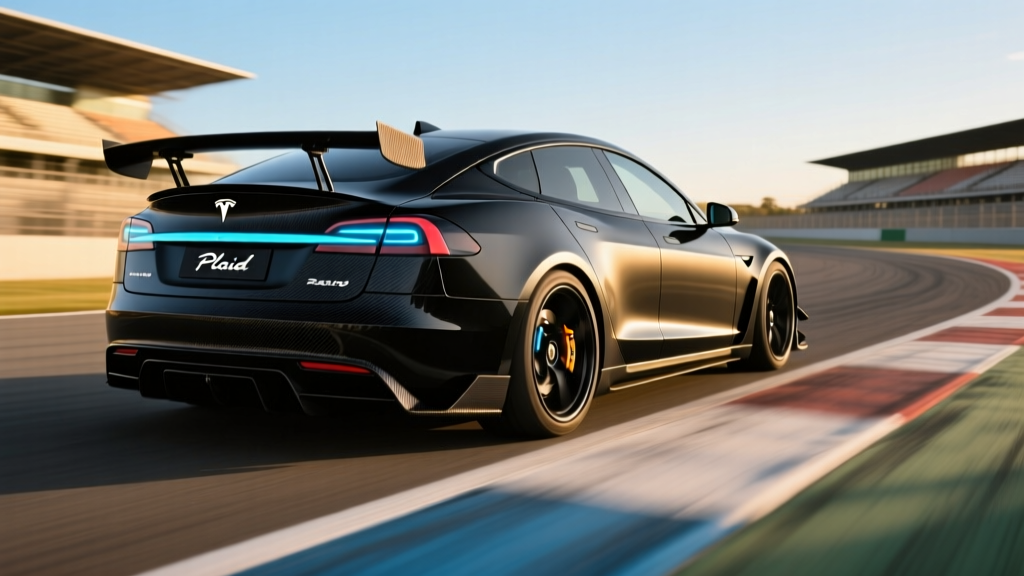
"Mad Max Mode" is Tesla's colloquial name for the maximum-acceleration launch setting available on the Model S Plaid. Officially called Drag Strip Mode (with Plaid mode as the top-tier performance preset), it conditions the battery to an optimal thermal window, stiffens the adaptive air suspension, and unlocks the full 1,020 horsepower from the tri-motor powertrain for the quickest possible 0–60 mph run. Enthusiasts and drag-racing owners dubbed it "Mad Max" because of the violent, sustained G-forces it produces — a nod to the relentless acceleration in the Mad Max film franchise.
Activating it requires several preconditions: the battery must be above 90% state of charge, the thermal management system must complete a preconditioning cycle (typically 10–30 minutes depending on ambient temperature), and the vehicle must be in a designated performance drive mode. Once engaged, the tri-motor torque-vectoring system can route power across all four wheels with millisecond precision, enabling the Model S Plaid's headline 1.99-second 0–60 mph time (with rollout subtracted, per Tesla's methodology).
But the Model S Plaid is far more than a straight-line drag weapon. This review covers the full ownership picture: real-world range, charging speed, daily practicality, tax-credit eligibility, and whether it still justifies its premium price against rivals like the Lucid Air Sapphire and Porsche Taycan Turbo GT.
Range, Battery, and Efficiency: EPA vs. Real World
Real-World Expectation: ~310–340 miles highway at 70 mph; ~260–290 miles in cold weather (below 32°F); ~350–380 miles mixed city driving with regen.
The 2026 Model S Plaid uses a ~100 kWh usable battery pack (approximately 100.8 kWh total capacity) built on NMC (nickel manganese cobalt) chemistry. Tesla has not switched the Model S line to LFP — the energy density of NMC remains necessary to hit the Plaid's performance and range targets simultaneously.
Efficiency on the EPA cycle is rated at 120 MPGe combined, translating to roughly 28 kWh per 100 miles. That figure is impressive for a 4,766-lb sedan producing over 1,000 hp, but it means the Plaid consumes noticeably more energy per mile than the Long Range variant (which achieves 405 miles EPA on a similar pack by using a dual-motor setup with less aggressive calibration).
In real-world highway testing at sustained 70–75 mph speeds, expect range to drop to the 310–340 mile band. Cold weather compounds this: at 20°F, the battery's internal resistance rises and cabin heating demands increase, typically cutting range by 20–30%. The Model S Plaid's standard heat pump mitigates some of this loss, but physics is physics — plan for roughly 260–290 miles in freezing conditions.
| Spec | Value |
|---|---|
| EPA Range | 396 miles (19" wheels) |
| Battery (usable) | ~100 kWh, NMC chemistry |
| Efficiency | 120 MPGe combined / 28 kWh/100 mi |
| Drivetrain | Tri-motor AWD (1 front, 2 rear) |
| Horsepower | 1,020 hp |
| 0–60 mph | 1.99 sec (with rollout) |
| Top Speed | 200 mph (with track package) |
| Max DC Charge Rate | 250 kW (peak) |
| 10–80% DC Time | ~28 minutes |
| Level 2 Home Charge | 11.5 kW (~44 mi/hr) |
| Cargo Volume | 28 cu ft (rear) + 3.1 cu ft (frunk) |
| Rear Legroom | 35.4 in |
| Base MSRP | $89,990 |
| Federal Tax Credit | Not eligible (MSRP exceeds $55K sedan cap) |
| Battery Warranty | 8 years / 150,000 miles |
Charging Speed: DC Fast Charging and Home Setup
The Model S Plaid charges at a peak rate of 250 kW on DC fast chargers via Tesla's proprietary NACS connector, which is now the North American standard. On a V3 or V4 Supercharger, the Plaid can add approximately 200 miles of range in 15 minutes under ideal conditions.
However, the charging curve tapers significantly above 50% SoC. The 10–80% charge takes approximately 28 minutes, with the bulk of the time spent in the 60–80% band where the rate drops to ~80–100 kW. This is standard behavior for NMC packs at high SoC to protect cell longevity, but it means your last 20% takes nearly as long as the first 60%.
| Charging Level | Power (kW) | Rate | 10–80% Time |
|---|---|---|---|
| Level 1 (120V) | ~1.4 kW | ~5 mi/hr | N/A (days) |
| Level 2 (240V, 48A) | 11.5 kW | ~44 mi/hr | ~8.5 hours |
| DC Fast (250 kW peak) | Up to 250 kW | Up to 1,000 mi/hr | ~28 minutes |
For home charging, the Model S Plaid's onboard charger accepts up to 11.5 kW on a 240V/48A Level 2 circuit. That requires a 60-amp dedicated breaker. A full overnight charge from 20% to 90% takes roughly 7–8 hours. Tesla's Wall Connector ($420) is the recommended home unit, though any NACS-compatible Level 2 station (or J1772 with the included adapter) will work. Installation costs vary widely: expect $800–$2,500 for a straightforward panel-to-garage run, but homes needing a 200-amp panel upgrade could see $3,000–$5,000 total.
One practical note for Plaid owners: preconditioning matters enormously. If you navigate to a Supercharger using the car's built-in navigation, the thermal management system will begin warming or cooling the battery en route, enabling faster charge acceptance on arrival. Skipping this step — for example, by driving to a charger without using Tesla navigation — can add 5–10 minutes to your charging session, especially in cold weather.
Performance and Driving Dynamics
The numbers are staggering and worth repeating: 1,020 horsepower, 1,050 lb-ft of torque, 1.99 seconds 0–60 mph. The tri-motor layout uses one permanent-magnet motor up front and two induction-type motors at the rear, enabling precise torque vectoring across the rear axle. This isn't just straight-line fury — the Plaid's torque vectoring actively rotates the car through corners, giving it handling capabilities that belie its 4,766-lb curb weight.
Mad Max Mode / Drag Strip Mode is the headline feature, but the Plaid also offers:
- Track Mode: Adjustable front/rear torque bias, cooling presets, and stability-control tuning for closed-course driving
- Adaptive air suspension: Automatic ride-height adjustment, with manual lowering for highway efficiency
- Carbon-ceramic brake package (optional, part of the Track Package): Essential for repeated high-speed stops on track, though unnecessary for street use
For daily driving, the Plaid is remarkably docile in its default Comfort mode. Regenerative braking provides smooth one-pedal driving, and the cabin isolation at highway speeds is among the best in the luxury EV segment. The yoke steering wheel remains controversial — it requires adaptation for low-speed maneuvers and roundabouts, though Tesla now offers a conventional round wheel as a no-cost option.
Interior, Technology, and Standout Features
The 2026 Model S interior received incremental refinements over the 2021 refresh. Materials quality has improved with ventilated front seats, a rear-seat touchscreen for climate and media control, and a 22-speaker audio system with active noise cancellation. The 17-inch center touchscreen runs Tesla's latest infotainment software, which includes:
- Full Steam-compatible gaming (Cyberpunk 2077, Cyber Rodeo, etc.) via AMD Ryzen processor
- Netflix, YouTube, and Twitch streaming while parked
- Over-the-air updates that regularly add features
- Dashcam and Sentry Mode with USB-C storage
Autopilot comes standard, providing adaptive cruise control, lane centering, and automatic emergency braking. Full Self-Driving (Supervised) remains a $8,000 option (or $99/month subscription). It is critical to understand that FSD is an SAE Level 2 driver-assistance system — it is not autonomous driving. The driver must remain fully engaged, hands on the wheel (or yoke), and eyes on the road at all times. Tesla's naming convention has drawn regulatory scrutiny, and buyers should evaluate FSD as an advanced convenience feature, not a replacement for an attentive driver.
Notable drawbacks include the absence of physical turn-signal stalks on yoke-equipped models (replaced by steering-wheel buttons), limited rear-seat headroom for passengers over 6'2", and the lack of Apple CarPlay or Android Auto — Tesla's ecosystem is closed.
Pricing, Trims, and Federal Tax Credit Eligibility
| Trim | MSRP | Federal §30D Credit | Effective Price |
|---|---|---|---|
| Model S Long Range | $74,990 | Not eligible | $74,990 |
| Model S Plaid | $89,990 | Not eligible | $89,990 |
The 2026 Model S Plaid starts at $89,990 (excluding destination). The Long Range variant is $74,990. Popular options include FSD ($8,000), the Carbon Ceramic Brake Package ($15,000, which also unlocks the 200-mph top speed), and premium paint colors ($1,500–$2,500). A fully optioned Plaid can approach $110,000.
Federal tax credit eligibility: The Model S does not qualify for the IRS §30D clean vehicle credit. Under current rules, sedans must have an MSRP at or below $55,000 to be eligible. Both the Long Range and Plaid trims far exceed this cap. Additionally, buyer income limits apply ($150K single / $300K joint filer AGI), and battery critical-mineral and component sourcing requirements must be met. Per IRS §30D guidelines, luxury EVs above the MSRP cap are categorically excluded regardless of buyer income or battery sourcing.
Some states offer their own EV rebates or tax credits that may apply — check your state's energy office or department of revenue for current programs. These vary widely and change frequently, so always verify with official state sources before relying on them in your purchase math.
Competitor Comparison: Model S Plaid vs. Lucid Air Sapphire vs. Porsche Taycan Turbo GT
| Spec | Tesla Model S Plaid | Lucid Air Sapphire | Porsche Taycan Turbo GT |
|---|---|---|---|
| Price | $89,990 | $249,000 | $230,000 |
| 0–60 mph | 1.99 sec | 1.89 sec | 2.1 sec |
| Horsepower | 1,020 hp | 1,234 hp | 1,019 hp |
| EPA Range | 396 mi | 427 mi | 269 mi |
| Max DC Charge | 250 kW | 300 kW | 320 kW |
| Supercharger Access | Native | NACS adapter | NACS adapter |
The Model S Plaid's most compelling advantage is value. At $89,990, it delivers supercar-rivaling acceleration at less than half the price of the Lucid Air Sapphire or Porsche Taycan Turbo GT. The Lucid wins on range and peak charge speed; the Porsche wins on track-day chassis balance and build quality prestige. But for raw acceleration per dollar, nothing in production today touches the Plaid.
Tesla's Supercharger network remains a decisive advantage for road-trippers. While competitors now have NACS adapters for Supercharger access, the native integration — automatic routing, preconditioning, payment, and charger-status reliability — gives Tesla owners a measurably smoother long-distance experience.
Pros
- 1.99-sec 0–60 mph at under $90K — unmatched performance value
- 396-mile EPA range exceeds most competitors
- Native Supercharger network with seamless integration
- Continuous OTA updates add features post-purchase
- Practical sedan with 28 cu ft cargo + frunk
- Tri-motor torque vectoring for track and street
Cons
- No federal tax credit (MSRP above $55K sedan cap)
- 250-kW peak charge rate lags 800V rivals (300–320 kW)
- Yoke steering polarizing; no physical stalks
- No Apple CarPlay / Android Auto
- Rear headroom tight for tall passengers
- FSD remains Level 2 — not autonomous despite the name
Who Should Buy the Model S Plaid?
Buy the Model S Plaid if: You want the fastest-accelerating production sedan under $100K, you road-trip frequently and value Supercharger access, you enjoy tech-forward interiors with gaming and streaming, and you don't need a federal tax credit to make the math work.
Consider alternatives if: You prioritize maximum DC charging speed (Lucid Air Grand Touring or Hyundai Ioniq 5 N), you want track-day durability over repeated hot laps (Porsche Taycan Turbo GT with its two-speed transmission and superior brake cooling), or you need a sub-$55K EV to capture the $7,500 federal credit.
Battery Warranty and Long-Term Ownership
Tesla covers the Model S Plaid's battery and drive unit for 8 years or 150,000 miles, whichever comes first, with a guaranteed minimum 70% capacity retention over that period. This is consistent with luxury EV industry norms. Real-world degradation data from high-mileage Model S owners suggests NMC packs typically lose 8–12% capacity over the first 100,000 miles, with the curve flattening significantly afterward.
For owners who frequently use Mad Max Mode / Drag Strip launches, thermal stress on the battery is higher than average. Tesla's thermal management system is robust, but repeated full-power launches without adequate cooldown intervals will accelerate degradation. The car's software will limit power output if battery temperatures exceed safe thresholds — a protective measure, not a defect.
Maintenance costs are low compared to ICE performance sedans: no oil changes, no transmission fluid, no spark plugs. Brake wear is minimal thanks to regenerative braking, though the Plaid's weight means tire replacement (21" Michelin Pilot Sport 4S or equivalent) runs $1,600–$2,400 per set. Insurance premiums for the Plaid are among the highest in the EV segment — expect $3,000–$5,000 annually depending on your driving record and location. Get quotes before purchasing.
Frequently Asked Questions
How do I activate Mad Max Mode on the Tesla Model S Plaid?
Mad Max Mode (officially Drag Strip Mode with Plaid preset) requires the battery to be above 90% SoC. Navigate to Controls > Pedals & Steering > Acceleration > Plaid, then enable Drag Strip Mode. The car will begin a battery preconditioning cycle that takes 10–30 minutes depending on ambient temperature. Once the car confirms readiness, you can perform a full-power launch. Never use this mode on public roads.
Does using Mad Max Mode damage the battery?
Occasional use within Tesla's prescribed parameters does not cause damage — the thermal management system actively protects the cells. However, frequent high-power launches do increase thermal cycling, which contributes to long-term degradation. The battery warranty covers capacity loss down to 70% over 8 years / 150,000 miles regardless of driving style, provided the vehicle hasn't been modified or abused beyond factory limits.
What is the real-world highway range of the Model S Plaid?
At sustained 70–75 mph in moderate temperatures (60–80°F), expect 310–340 miles. In cold weather (below 32°F), plan for 260–290 miles. City driving with frequent regenerative braking can return 350–380 miles. The EPA sticker of 396 miles is achievable under ideal mixed conditions but should not be your planning baseline for road trips.
Does the Model S Plaid qualify for any tax credits?
No. The federal §30D credit caps sedan eligibility at $55,000 MSRP. The Plaid's $89,990 price disqualifies it entirely. Some state-level incentives may apply depending on your jurisdiction — consult your state's official energy or revenue department for current programs.
Can I charge the Model S Plaid at non-Tesla chargers?
Yes. The Model S Plaid uses the NACS connector natively, which is now supported by Electrify America, EVgo, and other major networks (via CCS-to-NACS adapters or native NACS cables at newer stations). The included CCS adapter also allows charging at legacy CCS stations. For the best experience, Tesla's Supercharger network remains the most reliable option.
Is the Model S Plaid worth it over the Long Range?
If you want the 396-mile range, practical luxury, and don't need 1,020 hp, the Long Range at $74,990 saves $15,000 and delivers 3.1-sec 0–60 — still extraordinarily quick. The Plaid premium buys you the tri-motor system, Track Mode, Mad Max acceleration, and the carbon-ceramic brake option. For most buyers, the Long Range is the rational choice; the Plaid is for enthusiasts who want the ultimate Tesla sedan.