The Tesla Loyalty Question: Is the Model Y Still Worth It in 2026?
Tesla loyalty remains one of the strongest brand-retention phenomena in the auto industry. Despite an expanding field of credible EV competitors — from the Hyundai Ioniq 5 to the Ford Mustang Mach-E to the Chevrolet Blazer EV — a significant percentage of Tesla owners purchase another Tesla when their lease ends or their odometer climbs past 100,000 miles. The 2026 Tesla Model Y Long Range AWD sits at the center of that loyalty loop, and after spending significant time with one, the reasons become clearer, even if the picture isn't entirely flattering to the competition.
This isn't blind allegiance. Tesla's Supercharger network, over-the-air update cadence, and software integration create a switching cost that goes beyond the vehicle itself. But the Model Y also has to stand on its own as a product. Let's break down the 2026 model with the exact numbers that matter to current owners weighing a repurchase and first-time EV buyers considering the jump.
Range and Efficiency: EPA Numbers vs. What You'll Actually See
| Spec | Value |
|---|---|
| EPA Range | 320 miles |
| Battery (usable) | ~75 kWh, NMC chemistry |
| EPA Efficiency | 122 MPGe combined / 28 kWh/100 mi |
| Drivetrain | Dual-motor AWD |
| 0–60 mph | 4.8 seconds |
| Horsepower | 384 hp (combined) |
| Cargo (rear seats up) | 30.2 cu ft |
| Cargo (rear seats folded) | 72.0 cu ft |
| Rear Legroom | 37.7 inches |
| Base MSRP | $47,990 |
| Battery Warranty | 8 years / 120,000 miles (min 70% retention) |
The EPA rates the 2026 Model Y Long Range AWD at 320 miles. In mixed highway/city driving at 70°F, expect roughly 280–300 miles before needing a charge. Sustained highway driving at 75+ mph drops that to approximately 250–270 miles. In cold weather (below 32°F), range loss of 20–30% is typical without preconditioning — figure 220–250 miles. The Model Y's heat pump helps mitigate winter losses compared to resistive-heating EVs, but physics still wins in sub-freezing conditions.
The 75 kWh usable battery pack uses NMC (nickel manganese cobalt) chemistry, which prioritizes energy density over the cycle-life advantages of LFP (lithium iron phosphate). Tesla reserves LFP for the Standard Range RWD variant. For Long Range buyers who regularly charge to 90–100%, NMC degradation tends to be slightly higher over 5+ years, though Tesla's battery management system and thermal controls have kept real-world degradation modest — most owners report 90%+ State of Health at 60,000 miles based on fleet data aggregated by fueleconomy.gov and third-party telemetry studies.
Charging Speed: Supercharger Dominance and Home Setup
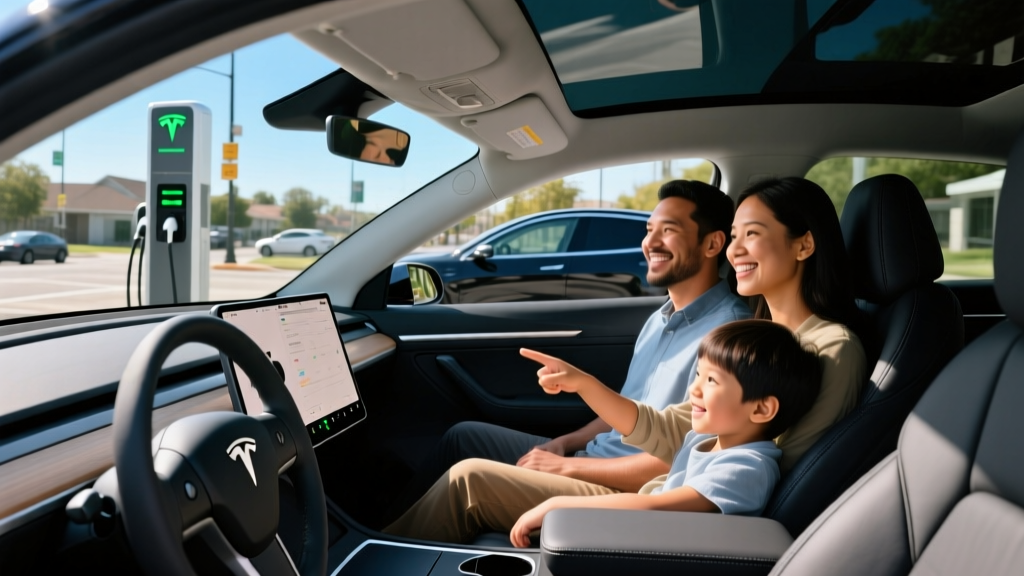
Charging infrastructure is arguably the single largest driver of Tesla loyalty. The Supercharger network — now open to NACS-equipped vehicles from other manufacturers — remains the most reliable DC fast-charging ecosystem in North America, with consistently high uptime and plug-and-charge simplicity that CCS networks like Electrify America and EVgo still struggle to match session-for-session.
| Charging Level | Power / Rate | Time / Miles Added |
|---|---|---|
| Level 1 (120V) | ~1.4 kW | ~3–4 miles per hour |
| Level 2 (240V, 48A) | 11.5 kW | ~37 miles per hour; full charge in ~8 hrs |
| DC Fast Charge (peak) | 250 kW (V3 Supercharger) | 10–80% in ~25 minutes |
| DC Fast Charge (V4) | Up to 250 kW (vehicle-limited) | Similar curve; infrastructure headroom for future OTA updates |
The Model Y's peak 250 kW charge rate is competitive but no longer class-leading. The Hyundai Ioniq 5 and Kia EV6, with their 800V architectures, can peak at 350 kW and achieve 10–80% in roughly 18 minutes on compatible chargers. The Model Y's charge curve is strong through 50% State of Charge, then tapers progressively — by 80%, you're pulling roughly 60–80 kW. This is normal for NMC packs with conservative thermal management, but it means the last 20% takes nearly as long as the first 60%.
For home charging, the Model Y's onboard charger accepts up to 11.5 kW on a 60-amp circuit (48 amps continuous). Most owners install a Tesla Wall Connector or a compatible Level 2 unit on a NEMA 14-50 outlet. A full overnight charge from 20% to 90% takes roughly 6–7 hours — more than sufficient for daily use. Installation costs for a dedicated 60A circuit typically run $800–$2,000 depending on panel proximity and local permitting, assuming your electrical panel has sufficient capacity. A 200-amp panel upgrade, if needed, adds $1,500–$3,000.
Performance, Ride Quality, and Daily Drivability
The dual-motor AWD powertrain delivers 384 combined horsepower and a 4.8-second 0–60 mph time. That's brisk by any measure and more than adequate for highway merging and passing. The instant torque delivery makes the Model Y feel quicker in city driving than the stopwatch suggests — there's no transmission lag, just linear, immediate acceleration.
Ride quality has improved with the Juniper refresh (introduced for the 2025 model year and carried into 2026). The updated suspension tuning reduces the crashiness over sharp impacts that plagued pre-2025 models, though the Model Y still rides firmer than a Ford Mach-E or Hyundai Ioniq 5. Road noise remains a weak point at highway speeds — Tesla doesn't use acoustic laminated glass on all windows, and tire noise is noticeable above 70 mph on coarse pavement.
Regenerative braking remains one-pedal-driving capable, with two settings (Standard and Low). The Standard mode is aggressive enough to eliminate brake-pedal use in most city and suburban driving, extending brake pad life significantly. Tesla's blended braking feel is among the smoothest in the EV segment — no jarring transitions between regen and friction braking.
Tech, Driver Assistance, and the Software Moat
Tesla's infotainment system is both its greatest strength and a point of frustration. The 15.4-inch center touchscreen handles virtually every vehicle function — climate, mirrors, glovebox, navigation, media — with responsive, smartphone-like performance. Wireless Apple CarPlay and Android Auto are still absent, which remains a dealbreaker for some buyers deeply invested in phone-based navigation and music ecosystems. Tesla's native navigation, however, is excellent, with real-time Supercharger routing, battery preconditioning for charging stops, and accurate range predictions.
Tesla's Autopilot (standard) and Full Self-Driving Supervised ($8,000 add-on or $99/month) are SAE Level 2 driver-assistance systems. The driver must remain fully engaged, hands on or near the wheel, and eyes on the road at all times. FSD Supervised can navigate intersections, handle stop signs, and manage highway lane changes, but it makes errors and requires constant supervision. It is not autonomous driving. Only Level 4 services like Waymo operate without a human driver.
Standard Autopilot includes Traffic-Aware Cruise Control and Autosteer (lane-centering on marked highways). It's competent for highway commuting and reduces fatigue on long trips. FSD Supervised adds city-street navigation, but real-world performance varies significantly by geography and road-marking quality. Many Tesla-loyal owners subscribe to FSD for the novelty and incremental improvement trajectory, but most acknowledge it's not yet a replacement for attentive driving.
Over-the-air (OTA) updates remain a Tesla differentiator. While competitors are beginning to offer OTA capability, Tesla's update cadence — adding features, refining UI, and occasionally unlocking performance — creates a sense of vehicle evolution that's hard to replicate with traditional dealer-based software updates. This is a genuine component of Tesla loyalty: the car you buy isn't the car you'll have in two years.
Pricing, Tax Credits, and the Total Cost Picture
| Trim | Base MSRP | Est. Federal Credit (§30D) | Effective Price |
|---|---|---|---|
| Long Range AWD | $47,990 | Up to $7,500* | ~$40,490 |
| Performance AWD | $52,490 | Up to $7,500* | ~$44,990 |
*Federal EV tax credit eligibility under IRS §30D depends on multiple factors:
- MSRP Cap: SUVs must be under $80,000 — both Model Y trims qualify.
- Buyer Income Cap: Modified AGI must not exceed $150,000 (single), $225,000 (head of household), or $300,000 (joint).
- Battery Sourcing: The $7,500 credit splits into two $3,750 halves — one for critical minerals sourcing, one for battery component manufacturing. Tesla has worked to qualify for the full $7,500, but sourcing requirements tighten annually. Verify current-year eligibility on the IRS Clean Vehicle Provisions page before purchasing.
- Point-of-Sale Transfer: As of 2024, the credit can be transferred to the dealer at purchase, reducing your out-of-pocket cost directly rather than waiting for a tax refund.
The total cost of ownership calculation also favors Tesla for many buyers. Insurance costs are higher than average for the segment (expect $200–$280/month depending on state and driving record), but home-charging electricity costs run roughly $0.04–$0.06 per mile at residential rates, compared to $0.12–$0.16 per mile for a comparable gas-powered SUV at $3.50/gallon. Over five years and 75,000 miles, fuel savings alone can offset $5,000–$8,000 of the purchase premium, and maintenance costs (no oil changes, minimal brake wear) add another $2,000–$3,000 in savings.
Competitive Landscape: Where the Model Y Wins and Loses
Pros
- Supercharger network reliability and seamless routing
- Best-in-class software and OTA update trajectory
- Strong real-world efficiency (28 kWh/100 mi)
- Spacious cargo area with practical liftback design
- Heat pump for better cold-weather range retention
- Full $7,500 federal tax credit eligibility (verify annually)
Cons
- No Apple CarPlay or Android Auto
- DC fast charging peaks at 250 kW — slower than 800V rivals
- Road noise at highway speeds
- FSD Supervised is expensive and still Level 2
- Minimalist interior lacks physical controls some buyers prefer
- Insurance premiums above segment average
The Model Y competes against a deepening field. The Hyundai Ioniq 5 charges faster (350 kW peak, ~18 min 10–80%), offers a more distinctive design, and includes CarPlay. The Ford Mustang Mach-E provides a more engaging driving experience and a traditional cockpit layout. The Chevrolet Blazer EV undercuts on price. Yet Tesla loyalty persists because the ecosystem — Supercharger, app, OTA updates, service infrastructure — creates a cohesive ownership experience that no single competitor fully replicates yet.
For buyers who prioritize charging convenience above all else, the Model Y remains the default. For those who value charging speed, interior refinement, or phone integration, the alternatives deserve serious test drives before committing to another Tesla.
Who Should Buy the 2026 Model Y?
- You rely on road-trip charging and want the most reliable DC fast-charging network
- You value OTA software evolution and tech-forward features
- You commute 30–60 miles daily and can charge at home overnight
- You need a practical family SUV with strong cargo space and efficiency
- You refuse to live without Apple CarPlay or Android Auto
- You want the fastest possible DC charging (look at Ioniq 5/EV6 with 800V)
- You prefer a traditional interior with physical buttons and gauges
- You rarely drive beyond 200 miles and want to minimize upfront cost (a PHEV may suffice)
Frequently Asked Questions
What is the real-world range of the 2026 Tesla Model Y?
The EPA rates it at 320 miles. Expect 280–300 miles in mixed driving, 250–270 on sustained highway trips, and 220–250 in freezing temperatures without preconditioning. Preconditioning the battery before departure recovers some cold-weather range.
How fast does the Model Y charge at home and on the road?
At home on a 240V Level 2 charger (48A), it adds roughly 37 miles per hour and fully charges overnight. On a V3 Supercharger, it peaks at 250 kW and charges 10–80% in approximately 25 minutes. The charge curve tapers significantly above 80%.
Does the 2026 Model Y qualify for the $7,500 federal EV tax credit?
The Model Y qualifies under the MSRP cap for SUVs ($80,000). However, buyer income limits ($150K single / $300K joint), battery-sourcing requirements, and annual rule changes all affect eligibility. Check the IRS §30D page and confirm with a tax professional before relying on the credit.
Is the Model Y worth buying over competitors like the Ioniq 5 or Mach-E?
If Supercharger access and software experience are your top priorities, yes. If you prioritize faster DC charging (Ioniq 5), CarPlay support, or a more traditional interior, the alternatives are compelling. The gap between Tesla and its competitors has narrowed significantly — loyalty should be based on current product merit, not habit.
How long will the Model Y battery last?
Tesla warranties the battery for 8 years or 120,000 miles, whichever comes first, with a minimum 70% capacity retention guarantee. Real-world fleet data suggests most Model Y packs retain 88–92% capacity at 100,000 miles with typical charging habits (avoiding consistent 100% charges and deep discharges). Full battery replacement, if needed out of warranty, currently costs approximately $12,000–$16,000 including labor.
What's the biggest reason for Tesla loyalty?
The integrated ecosystem: Supercharger reliability, OTA updates that add features over time, the Tesla app experience, and the lowest-friction ownership model in the EV space. Buyers who've experienced this ecosystem find switching to a competitor — even a good one — involves accepting tradeoffs in charging convenience and software polish that they'd rather not make.