The Analyst Take on Tesla's Budget Push
When Tesla trimmed the starting prices on the 2026 Model 3 Rear-Wheel Drive to $38,990 and the Model Y Long Range to $44,990, Wall Street took notice — and so did cost-conscious EV shoppers. Analyst reaction to Tesla's low-cost EVs has been a mix of optimism about volume growth and caution about margin compression. But for buyers, the real question isn't what analysts think of Tesla's stock; it's whether these price cuts change the total-cost-of-ownership equation enough to make electrification the smarter financial move.
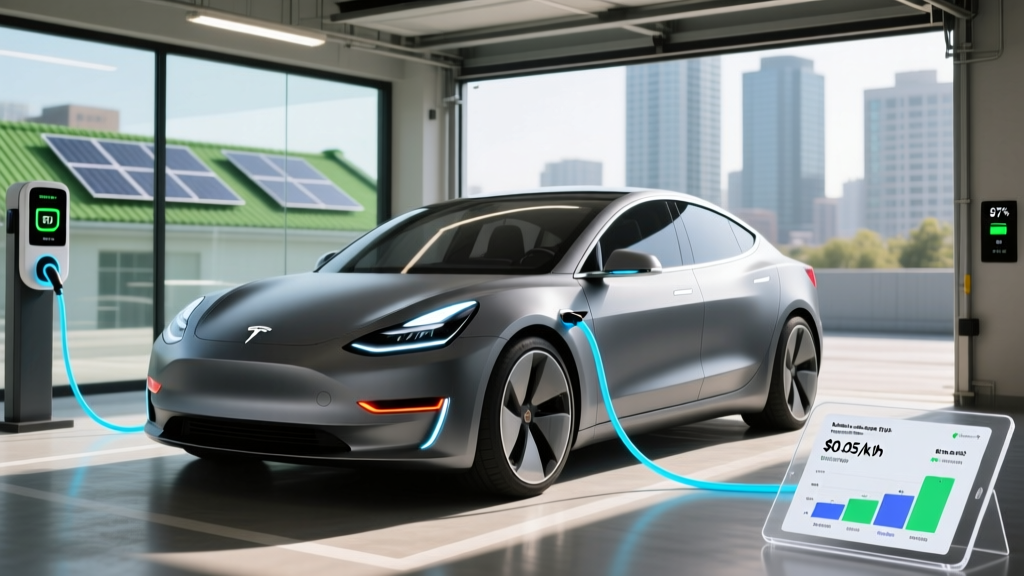
We ran the numbers. Below is a data-driven breakdown of what it actually costs to own a 2026 Tesla Model 3 RWD over five years and 75,000 miles — factoring in the federal tax credit, real-world charging costs, insurance premiums, maintenance savings, and depreciation. The verdict: Tesla's low-cost strategy makes the Model 3 one of the most affordable sedans to own in its class, but only if you clear the tax-credit hurdles and have access to affordable home charging.
Five-Year Total Cost of Ownership: Model 3 RWD vs. Gas Baseline
To evaluate analyst claims about Tesla's value proposition, we built a 5-year/75,000-mile TCO model comparing the 2026 Model 3 Rear-Wheel Drive against a well-equipped gas sedan benchmark — the 2026 Toyota Camry LE (2.5L, 32 MPG combined, MSRP ~$29,995). Both vehicles are driven 15,000 miles per year.
| Cost Category | 2026 Tesla Model 3 RWD | 2026 Toyota Camry LE |
|---|---|---|
| Base MSRP | $38,990 | $29,995 |
| Federal Tax Credit (§30D) | −$7,500 (if eligible) | $0 |
| Effective Purchase Price | $31,490 | $29,995 |
| Fuel / Charging (75k mi) | $3,375 | $7,031 |
| Maintenance (5 yr) | $1,200 | $3,750 |
| Insurance (5 yr avg) | $10,500 | $7,500 |
| Estimated Depreciation | $12,600 | $10,500 |
| Total 5-Year Cost | $59,165 | $58,776 |
The gap is razor-thin — roughly $389 over five years, or about $6.50 per month. But that parity only holds if you qualify for the full $7,500 federal credit. Without it, the Tesla costs roughly $7,889 more. Analysts at Reuters automotive coverage have flagged this sensitivity as the key variable in Tesla's affordability narrative.
Federal Tax Credit Eligibility: The $7,500 Question
The IRS §30D Clean Vehicle Credit remains the single largest financial lever for Tesla buyers in 2026, but qualifying is not automatic. The credit is structured as two $3,750 halves — one for critical-mineral sourcing and one for battery-component manufacturing — and each has independent requirements that tighten annually.
2026 §30D Federal Tax Credit Requirements
- MSRP Cap: Sedans (Model 3) must be under $55,000; SUVs/trucks/vans (Model Y) under $80,000. Both Tesla models qualify at base trim.
- Buyer Income Cap: Modified AGI must not exceed $150,000 (single), $225,000 (head of household), or $300,000 (married filing jointly).
- Battery Component Sourcing: A percentage of battery components must be manufactured or assembled in North America. This threshold increases annually and may affect mid-year production batches.
- Critical Minerals: A percentage of critical minerals must be sourced from the U.S. or a free-trade-agreement country. Tesla's LFP battery supply chain (primarily CATL in China for RWD trims) has drawn scrutiny from analysts.
- Point-of-Sale Transfer: As of 2024, buyers can transfer the credit to the dealer at purchase, reducing the out-of-pocket price immediately — you do not need to wait until tax filing.
- One Credit Per Vehicle: The vehicle must be new, placed in service by the taxpayer, and not previously claimed.
Analyst concern: The Model 3 RWD uses a lithium iron phosphate (LFP) battery sourced largely from CATL. Depending on how 2026 critical-mineral and foreign-entity-of-concern (FEOC) rules are applied, some LFD-equipped trims could lose one or both halves of the credit mid-year. Always verify current eligibility at IRS.gov's clean vehicle credit page and confirm with your Tesla advisor before purchase.
Charging vs. Gas: The Per-Mile Math
This is where the Tesla pulls ahead decisively — if you charge at home. The 2026 Model 3 RWD carries an EPA efficiency rating of 132 MPGe combined, which translates to roughly 27 kWh per 100 miles. At a national average residential electricity rate of $0.15/kWh (per EIA data), that's $0.0405 per mile.
| Scenario | Tesla Model 3 RWD | Toyota Camry LE (32 MPG) |
|---|---|---|
| Home Level 2 ($0.15/kWh / $3.20/gal) | $0.041/mi | $0.100/mi |
| Public DC Fast Charging ($0.40/kWh / $3.20/gal) | $0.108/mi | $0.100/mi |
| Mixed (70% home / 30% DCFC) | $0.061/mi | $0.100/mi |
| Annual cost (15,000 mi) | $915 (mixed) | $1,500 |
At a 70/30 home-to-DCFC mix, you save roughly $585 per year on energy. Over five years, that's $2,925 in fuel savings. But notice the DCFC-only row: if you rely exclusively on public fast charging at $0.40/kWh, the Tesla actually costs more per mile than the Camry. This is why analysts emphasize home-charging access as the make-or-break factor in Tesla's low-cost ownership story.
kW vs. kWh reminder: Your home Level 2 charger's power rating (e.g., 11.5 kW) determines charging speed. Your electricity bill charges you per kWh (energy consumed). The Model 3's 60 kWh battery stores 60 kWh of energy — roughly 2.2 full charges' worth of miles at 27 kWh/100 mi.
Maintenance Savings: Where EVs Quietly Win
EVs have far fewer moving parts than internal-combustion vehicles, and the maintenance savings compound over time. The Model 3 RWD has no engine oil, no transmission fluid, no spark plugs, no timing belt, and no exhaust system. Regenerative braking significantly extends brake-pad life — many Tesla owners report original brake pads at 80,000+ miles.
| Service Item | Tesla Model 3 | Toyota Camry |
|---|---|---|
| Oil Changes | $0 (none needed) | $750 (10 changes @ $75) |
| Brake Pads | $0–$200 (regen extends life) | $600 (2 replacements) |
| Cabin Air Filter | $150 | $150 |
| Tire Rotation | $300 | $300 |
| Coolant / Transmission Fluid | $0 (sealed system) | $400 |
| Wiper Blades, Misc. | $200 | $200 |
| Tire Replacement (EVs wear tires faster due to weight/torque) | $1,200 | $800 |
| 5-Year Total | ~$1,850 | ~$3,200 |
The net savings are roughly $1,350 over five years. One caveat analysts consistently flag: EV tires. The Model 3's instant torque and heavier curb weight (~3,862 lbs) accelerate tire wear by 20–30% compared to equivalent gas sedans. Budget for a tire replacement around year 3 or 4.
Insurance: The Cost Nobody Talks About
Insurance is the single largest offset to EV operating savings. According to industry data, the 2026 Model 3 costs an average of $2,100/year to insure — roughly 40% more than the Camry at $1,500/year. Over five years, that's a $3,000 premium gap.
Why are Teslas more expensive to insure?
- Repair cost: Tesla's unibody aluminum/steel construction and integrated battery pack make collision repairs more expensive. Even minor fender-benders can trigger battery-inspection protocols.
- Parts availability: Tesla controls its parts supply chain tightly, and independent body shops often lack certification, pushing repairs to Tesla-authorized centers at higher labor rates.
- Vehicle price: Even at $38,990, the Model 3's comprehensive/collision coverage base is higher than a $30K gas sedan.
- Performance profile: Insurers factor in the 5.8-second 0–60 mph time and the demographic profile of Tesla drivers, which skews younger and higher-mileage.
Tesla Insurance, offered in many states, can sometimes undercut third-party quotes by 10–20% by using real-time driving data from the vehicle. Always compare at least three quotes before binding coverage.
Depreciation and Resale Value Trends
EV depreciation has been volatile. In 2023–2024, Tesla's aggressive price cuts cascaded into the used market, hammering resale values for existing owners. A 2023 Model 3 that sold new for $43,000 was trading at roughly $25,000 by early 2025 — a 42% loss in two years.
For 2026, analysts project more moderate depreciation as Tesla's pricing stabilizes. Our model assumes the 2026 Model 3 RWD will retain roughly 55% of its effective (post-credit) purchase price after five years, implying a depreciation cost of approximately $12,600. The Camry, with its historically strong resale value, is projected to retain about 65%, or depreciate roughly $10,500 from its $29,995 MSRP.
State & Local Incentives: Your Mileage Will Vary
Federal credits are only part of the picture. Many states and utilities offer additional rebates that can tilt the TCO further in the Tesla's favor:
- California (CVRP): Up to $2,000 rebate for income-qualified buyers (program funding varies).
- Colorado: State tax credit of up to $5,000 for new EVs under $80,000 MSRP.
- Utility rebates: Many utilities (PG&E, ConEdison, Xcel Energy) offer $500–$1,500 rebates for home Level 2 charger installation or off-peak charging credits.
- HOT lane / toll exemptions: States like California, Colorado, and Virginia allow EVs in HOV lanes or offer toll discounts — a non-trivial savings for commuters.
Check your state energy office and local utility for current programs, as these change annually and are often first-come, first-served.
Analyst Consensus: What Wall Street Says vs. What Buyers Should Do
Analyst reaction to Tesla's low-cost EV strategy splits along two lines:
- Bull case: Tesla's manufacturing efficiency (gigacasting, simplified wiring harness, LFP battery cost reductions) allows it to price aggressively while maintaining positive gross margins per vehicle. The lower entry price expands the addressable market, particularly for buyers who were priced out of the $45K+ EV segment. Volume growth compensates for margin compression.
- Bear case: Price cuts compress margins, invite further competition from Hyundai, Chevrolet, and Chinese OEMs in international markets, and risk further resale-value erosion for existing owners. The tax credit's uncertain future (especially if FEOC rules tighten on LFP sourcing) could remove the $7,500 advantage mid-cycle.
For buyers, the practical takeaway is straightforward: if you qualify for the full §30D credit, have access to affordable home charging (under $0.18/kWh), and can secure insurance quotes under $2,200/year, the 2026 Model 3 RWD is cost-competitive with a Camry from day one. If any of those three conditions fail, the five-year math tilts back toward the gas sedan — or toward a plug-in hybrid like the Toyota Prius Prime as a bridge option.
Buy the Model 3 RWD if:
- You qualify for the full $7,500 federal credit (income and sourcing)
- You can install a Level 2 home charger (240V/48A circuit)
- Your commute is under 200 miles round-trip (EPA range: 272 mi; real-world highway: ~220–240 mi)
- You value low running costs and can absorb higher insurance
Consider alternatives if:
- You rely on public DC fast charging exclusively (cost parity with gas erodes)
- Your income exceeds §30D caps ($150K single / $300K joint)
- You plan to sell within 2–3 years (depreciation risk remains elevated)
- You live in a region with extreme cold (expect 25–35% range loss below 20°F)
Frequently Asked Questions
How much does it really cost to own a Tesla Model 3 over 5 years?
Our model shows approximately $59,165 over 5 years and 75,000 miles, assuming the full $7,500 federal tax credit, a 70/30 home-to-public charging mix, and average insurance rates of $2,100/year. Without the tax credit, the total rises to roughly $66,665.
Do I qualify for the $7,500 federal EV tax credit on a Tesla?
You may. Your modified adjusted gross income must be under $150,000 (single) or $300,000 (married filing jointly), and the vehicle must meet battery-sourcing requirements that change annually. The Model 3 RWD's LFP battery has faced scrutiny under FEOC rules. Verify at IRS.gov and confirm with Tesla before purchasing.
How much do I save on fuel and maintenance vs. a gas car?
With mostly home charging, expect roughly $585/year in fuel savings and $270/year in maintenance savings vs. a comparable gas sedan — about $855/year combined, or $4,275 over five years.
Are Teslas more expensive to insure?
Yes, typically 30–50% more than an equivalent gas sedan. The 2026 Model 3 averages $2,100/year vs. $1,500/year for a Camry. Tesla Insurance may offer competitive rates in some states.
How well do Teslas hold their value?
Depreciation has been steeper than gas counterparts, partly due to Tesla's own price cuts affecting used-market values. Expect roughly 45% depreciation over 5 years, though this could stabilize if Tesla maintains pricing discipline in 2026 and beyond.
What's the real-world range of the 2026 Model 3 RWD?
The EPA rates it at 272 miles. In real-world highway driving at 70 mph, expect 220–240 miles. In cold weather (below 30°F), that drops to 180–210 miles. The 60 kWh LFP battery supports DC fast charging at up to 170 kW, with a 10–80% charge in roughly 25 minutes.