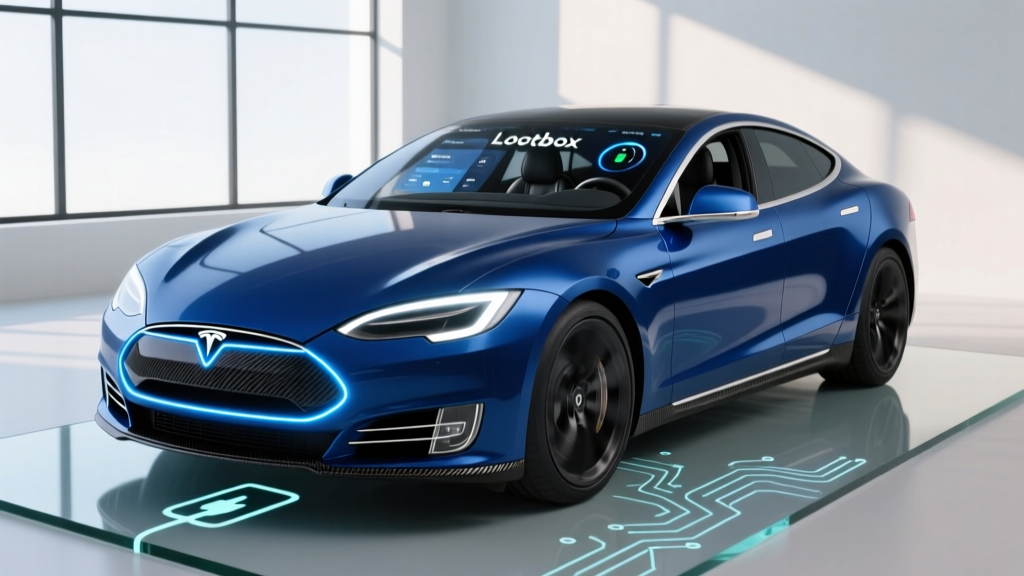
If you've spent any time on EV forums or Tesla owner communities, you've likely encountered the term "lootbox Tesla" — a tongue-in-cheek reference to Tesla's practice of selling randomized or surprise feature upgrades, limited-time software bundles, and performance unlocks that mimic the loot-box mechanics of video games. Unlike traditional automakers that lock features into fixed trim levels at the point of purchase, Tesla treats its vehicles as a software-defined platform where capabilities can be added, teased, or temporarily unlocked long after you've driven off the lot.
This model is unique in the auto industry and deeply polarizing. Some owners love the gamified experience and the ability to incrementally upgrade their cars. Others view it as nickel-and-diming on features that should have been included at purchase. In this guide, we'll break down exactly what the Tesla "lootbox" ecosystem looks like in 2026, how it intersects with the actual hardware specs of current Tesla models, and whether any of these software add-ons move the needle on ownership value.
What Does 'Lootbox Tesla' Actually Mean?
The term "lootbox Tesla" isn't an official Tesla product or trim. It's a community-coined phrase describing several overlapping Tesla practices:
- Acceleration Boost: A $2,000 over-the-air (OTA) purchase that shaves roughly 0.5–1.0 seconds off a Dual Motor Model 3 or Model Y's 0–60 mph time.
- Full Self-Driving (Supervised): Tesla's Level 2 driver-assistance suite, currently priced at $8,000 as a one-time purchase or $99/month in 2026 — a feature that has been repeatedly "coming soon" to full capability.
- Seasonal and limited-time feature drops: Tesla occasionally unlocks cosmetic features (light shows, holiday themes, Sentry Mode variations) or trial access to FSD for limited periods, sometimes randomly assigned to vehicles.
- Hardware-gated surprises: Some vehicles ship with hardware (e.g., heated rear seats, rear-seat heaters) that is software-locked and later offered as a paid unlock — a practice that drew significant community backlash in prior years.
Together, these practices create an ownership experience where your car's capabilities can change — for a price — well after purchase, much like opening a lootbox in a game to see what you get.
2026 Tesla Lineup: Core Hardware Specs
Before evaluating whether Tesla's software add-ons are worthwhile, you need to understand what you're getting in the base vehicle. Below is a spec snapshot of Tesla's highest-volume models as of early 2026 — the Model 3 and Model Y — since these are the vehicles most commonly discussed in the "lootbox" context.
| Spec | Model 3 Long Range AWD | Model Y Long Range AWD |
|---|---|---|
| EPA Range | 341 miles | 320 miles |
| Battery (usable) | ~75 kWh, NMC (LFP on RWD) | ~75 kWh, NMC |
| Drivetrain | Dual Motor AWD | Dual Motor AWD |
| Horsepower | ~346 hp | ~384 hp |
| 0–60 mph | 4.2 sec (3.7 with Boost) | 4.8 sec (4.3 with Boost) |
| Max DC Fast Charge | 250 kW | 250 kW |
| 10–80% DC Time | ~25 min | ~27 min |
| Level 2 Home Rate | 11.5 kW (~44 mi/hr) | 11.5 kW (~44 mi/hr) |
| Efficiency | 132 MPGe / 25 kWh/100mi | 122 MPGe / 28 kWh/100mi |
| Cargo Volume | 23 cu ft (trunk + frunk) | 76 cu ft (rear seats folded) |
| Rear Legroom | 35.2 in | 41.6 in |
| Base MSRP | $47,740 | $49,630 |
| Battery Warranty | 8 yr / 120,000 mi | 8 yr / 120,000 mi |
Source: fueleconomy.gov and Tesla's official specification pages. Specs reflect 2026 model year. RWD trims use LFP (lithium iron phosphate) chemistry with slightly lower range but better cycle life and the ability to charge to 100% daily without degradation concerns.
Real-World Range vs. EPA Sticker
EPA: 341 mi (Model 3 LR) / 320 mi (Model Y LR)
Expect in practice: 280–310 miles on a highway road trip at 70–75 mph. In freezing temperatures (below 32°F), plan for 220–260 miles before needing a charge stop. Tesla's heat pump helps, but cold-weather range loss of 20–30% is consistent across all EVs. City driving with regenerative braking recovers more energy, often matching or slightly exceeding EPA figures.
Breaking Down the Tesla 'Lootbox' Add-Ons
Acceleration Boost ($2,000)
This is perhaps the most straightforward "lootbox" item. Available as an OTA purchase for Dual Motor Model 3 and Model Y owners, Acceleration Boost reduces 0–60 mph times by approximately 0.5 seconds. It doesn't change top speed or add horsepower in a traditional sense — it adjusts the torque delivery curve and power output mapping.
Is it worth it? For most drivers, the stock 4.2–4.8 second 0–60 is already firmly in sports-car territory. The Boost is a novelty for enthusiasts but offers no practical daily-driving benefit. It also does not affect efficiency, range, or charging speed.
Full Self-Driving Supervised ($8,000 or $99/mo)
FSD (Supervised) remains Tesla's most controversial offering. Despite the name, it is a SAE Level 2 driver-assistance system — meaning the driver must remain fully attentive, hands on or near the wheel, and ready to intervene at any moment. It is not autonomous driving.
SAE Automation Level: Level 2
Tesla FSD (Supervised) is classified as SAE Level 2. The vehicle can manage steering, acceleration, and braking in many scenarios, but the human driver is responsible for monitoring the environment and must intervene immediately when the system encounters a situation it cannot handle. This is fundamentally different from Level 4 robotaxis like Waymo, which operate without a human driver in geofenced areas.
FSD includes features like Navigate on Autopilot (highway on-ramp to off-ramp), Auto Lane Change, Autopark, Summon, and Traffic Light and Stop Sign Control. In 2026, Tesla has expanded its neural-net-based vision system, but real-world reliability remains inconsistent — particularly in construction zones, unmapped areas, and adverse weather.
Is it worth it? For $99/month, it's a reasonable trial for frequent highway commuters who want to reduce fatigue. As an $8,000 upfront purchase, the value proposition is weak unless you drive extensively on controlled-access highways. Competitors like GM's Super Cruise and Ford's BlueCruise offer comparable hands-free Level 2 driving on pre-mapped highways without the $8,000 price tag.
Randomized and Seasonal Feature Drops
Tesla periodically pushes OTA updates that include new features — some free, some behind a paywall. Examples from recent years include:
- Light Show customization (free)
- Joe Mode (reduced chime volume — free)
- Dashcam improvements (free)
- Heated seat unlocks for vehicles with dormant hardware (previously paid, now mostly included)
- Limited-time FSD trials (randomly assigned, 30-day access)
- Holiday-themed UI and Easter eggs (free)
These are the items most directly analogous to gaming "lootboxes" — you don't always know what's coming, and some features are randomized in distribution. For most owners, these are minor quality-of-life additions rather than transformative upgrades.
Charging Speed and Infrastructure: What You Need to Know
Tesla's Supercharger network remains the gold standard for public DC fast charging in the US. With over 20,000 Supercharger stalls across North America, Tesla owners have a significant reliability advantage over CCS-connector vehicles relying on Electrify America or EVgo networks.
| Charging Level | Power (kW) | Speed (miles/hour) | Notes |
|---|---|---|---|
| Level 1 (120V) | ~1.4 kW | ~3–5 mi/hr | Emergency/trickle only |
| Level 2 (240V, 48A) | 11.5 kW | ~44 mi/hr | Full overnight charge in ~7–8 hrs |
| DC Fast (V3 Supercharger) | Up to 250 kW | ~1,000 mi/hr (peak) | 10–80% in ~25 min; tapers above 80% |
| DC Fast (V4 Supercharger) | Up to 325 kW* | ~1,200 mi/hr (peak) | *Current Model 3/Y capped at 250 kW by onboard architecture |
Key insight: The 250 kW peak is not sustained across the full charging session. Tesla's charge curve peaks around 10–30% State of Charge (SoC) and progressively tapers. From 50–80%, expect roughly 100–150 kW average. From 80–100%, speeds drop below 50 kW — which is why road-trip strategy focuses on 10–80% charges rather than filling to full.
Important for 2026: Tesla has opened its Supercharger network to non-Tesla EVs via the NACS (North American Charging Standard) connector. If you own a non-Tesla EV with a NACS port or adapter, you can now access most Supercharger stalls. For Tesla owners, this means slightly more congestion at popular stations but also validates Tesla's connector as the de facto North American standard.
Pricing, Trims, and Federal Tax Credit Eligibility
| Model / Trim | Base MSRP | §30D Credit Eligible? | Effective Price (with credit) |
|---|---|---|---|
| Model 3 RWD | $38,990 | Yes — up to $7,500 | ~$31,490* |
| Model 3 Long Range AWD | $47,740 | Yes — up to $7,500 | ~$40,240* |
| Model 3 Performance | $54,990 | Yes — up to $7,500 | ~$47,490* |
| Model Y Long Range AWD | $49,630 | Yes — up to $7,500 | ~$42,130* |
| Model Y Performance | $54,490 | Yes — up to $7,500 | ~$46,990* |
*Effective price assumes full $7,500 §30D credit eligibility. Actual credit depends on buyer income, battery component and critical mineral sourcing requirements, and MSRP caps. Tesla offers point-of-sale transfer of the credit at most dealerships, reducing the purchase price at delivery.
IRS §30D Federal EV Tax Credit Requirements (2026)
- Income caps: AGI ≤ $150,000 (single), $225,000 (head of household), $300,000 (married filing jointly)
- MSRP caps: ≤ $55,000 for sedans (Model 3); ≤ $80,000 for SUVs/trucks (Model Y, Cybertruck)
- Battery sourcing: Must meet escalating critical mineral and battery component requirements per IRS guidance. Sourcing rules tighten annually — verify eligibility at purchase.
- Point-of-sale transfer: Eligible buyers can transfer the credit to the dealer, reducing the purchase price at delivery rather than waiting for a tax refund.
Consult a tax professional for your specific situation. Rules are subject to legislative change.
Who Should Buy a Tesla (and Who Should Look Elsewhere)?
Choose Tesla If:
- You have reliable home Level 2 charging access and want the lowest-friction road-trip experience via the Supercharger network.
- You value OTA software updates and the ability to add features post-purchase.
- You want class-leading efficiency (kWh/100mi) and proven battery longevity.
- You're comfortable with a minimalist interior and touchscreen-centric controls.
Look Elsewhere If:
- You want physical buttons, a traditional instrument cluster, or Apple CarPlay/Android Auto (Tesla does not support either).
- You need a hands-free Level 2 system that works without constant steering-wheel torque monitoring (GM Super Cruise and Ford BlueCruise use driver-facing cameras for attention monitoring, allowing true hands-off on mapped highways).
- You're uncomfortable with Tesla's post-purchase monetization model and prefer all-inclusive trim packaging from legacy automakers.
- You want a dedicated EV service center nearby — Tesla service availability varies significantly by region.
Tesla vs. Key Competitors: Quick Comparison
| Attribute | Tesla Model Y LR | Hyundai Ioniq 5 AWD | Ford Mach-E ER AWD |
|---|---|---|---|
| EPA Range | 320 mi | 290 mi | 312 mi |
| Max DC Charge | 250 kW | 240 kW (10–80% ~18 min) | 150 kW |
| 0–60 mph | 4.8 sec | 5.1 sec | 5.1 sec |
| Cargo (seats folded) | 76 cu ft | 59 cu ft | 59 cu ft |
| Connector | NACS (native) | NACS (2025+ models) | NACS (2025+ models) |
| Driver Assist | Autopilot / FSD (L2) | Highway Driving Assist 2 | BlueCruise (L2, hands-free) |
| Base MSRP (AWD) | $49,630 | $50,100 | $51,875 |
Sources: fueleconomy.gov, manufacturer press sites. All figures reflect 2026 model year AWD/Long Range trims.
The Model Y leads in cargo space and Supercharger convenience. The Ioniq 5 charges faster in real-world 10–80% sessions thanks to its 800V architecture. The Mach-E's BlueCruise offers a more relaxed hands-free highway experience on approved roads. All three qualify for the §30D credit under current rules.
Pros and Cons
Pros
- Best-in-class Supercharger network reliability and coverage
- Industry-leading energy efficiency (kWh/100mi)
- Continuous OTA updates add features post-purchase
- Strong resale value relative to non-Tesla EVs
- Spacious Model Y cargo area (76 cu ft)
- Excellent battery warranty (8 yr / 120,000 mi)
Cons
- No Apple CarPlay or Android Auto support
- Touchscreen-only controls frustrate some drivers
- FSD ($8,000) remains Level 2 — not autonomous
- Post-purchase paid unlocks feel like nickel-and-diming
- Service center availability is uneven outside major metros
- Build quality inconsistencies still reported by some owners
Frequently Asked Questions
What is the real-world range of the Tesla Model Y?
The EPA rates the 2026 Model Y Long Range AWD at 320 miles. In real-world highway driving at 70–75 mph, expect 270–295 miles. In sub-freezing weather, that drops to 220–260 miles. City driving with regenerative braking can match or slightly exceed the EPA estimate.
How fast does a Tesla charge at home and on the road?
On a Level 2 home charger (240V, 48A), Tesla's onboard charger accepts up to 11.5 kW, adding roughly 44 miles of range per hour — a full charge takes about 7–8 hours. On a V3 Supercharger, peak DC fast-charge speed is 250 kW, with a 10–80% session taking approximately 25–27 minutes. Charging slows significantly above 80% SoC to protect battery health.
How much does a Tesla cost after the federal tax credit?
A 2026 Model 3 RWD starts at $38,990 and drops to approximately $31,490 with the full $7,500 §30D credit. A Model Y Long Range starts at $49,630 and drops to ~$42,130. Eligibility depends on buyer income (AGI caps), vehicle MSRP limits, and battery sourcing requirements. Verify your eligibility on IRS.gov before purchasing.
Is a Tesla worth buying vs. competitors in 2026?
If Supercharger access and software features are priorities, Tesla remains hard to beat. However, the Hyundai Ioniq 5 charges faster, the Ford Mach-E offers hands-free BlueCruise, and the Chevrolet Equinox EV undercuts on price. The gap between Tesla and legacy competitors has narrowed significantly — test-drive multiple options before deciding.
Does Tesla FSD make the car self-driving?
No. Full Self-Driving (Supervised) is an SAE Level 2 driver-assistance system. You must remain attentive, monitor the road, and be prepared to take over at any moment. It is not Level 4 autonomous driving like Waymo. The "Full Self-Driving" name is aspirational marketing, not a description of current capability.
What is the Tesla battery warranty?
Tesla covers the battery and drive unit for 8 years or 120,000 miles (whichever comes first) on Model 3 and Model Y Long Range/Performance trims, with a minimum 70% capacity retention guarantee. The RWD Model 3 with LFP battery is covered for 8 years or 100,000 miles. Out-of-warranty battery replacement costs range from approximately $12,000 to $16,000 depending on the pack.
Are Tesla's paid software unlocks (the 'lootbox' features) worth it?
Acceleration Boost ($2,000) is a fun but non-essential upgrade. FSD ($8,000 or $99/mo) is worth trying via the monthly subscription for highway-heavy commuters but is not worth the upfront purchase for most drivers in its current Level 2 state. Seasonal feature drops are generally free and cosmetic. Evaluate each add-on on its individual merit rather than as a bundle.