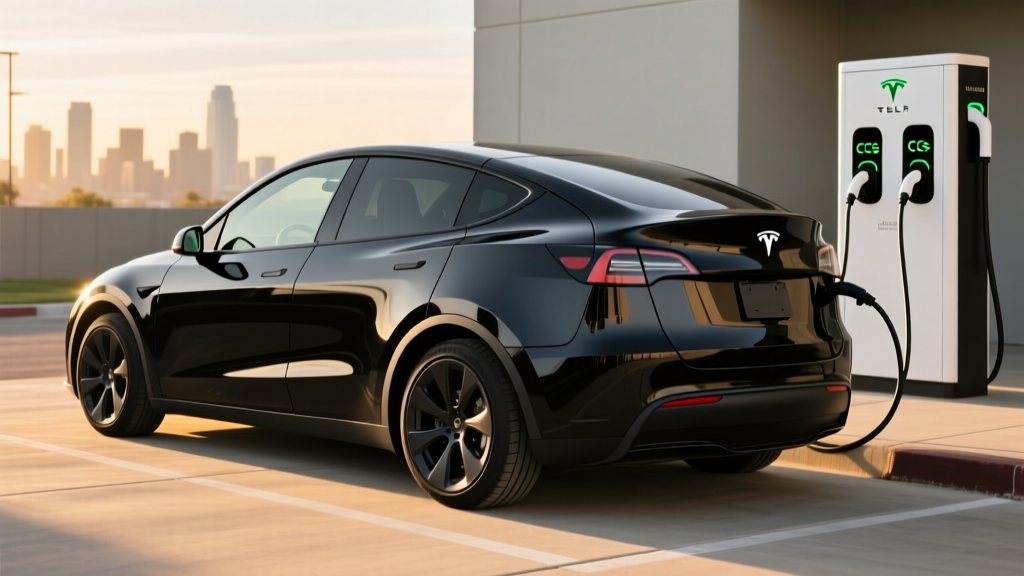
If you have been watching Tesla's monthly offers, the 2026 Tesla leasing program looks compelling on paper: low monthly payments, access to the Supercharger network, and the ability to swap into a newer model every 24 to 36 months. But leasing an EV is fundamentally different from leasing a gas car. Battery degradation, residual values, charging access, and federal tax credit pass-through all change the math. This review dissects the Tesla Model Y — the brand's best-seller and the most commonly leased Tesla — to help you decide whether the 2026 lease deal or a purchase makes more financial sense.
2026 Tesla Model Y: Quick Verdict
The 2026 Model Y (refreshed for the 2025 model year and carried forward) remains the default electric crossover for American buyers who want a practical daily driver with access to the largest fast-charging network in North America. With an EPA-estimated 320 miles of range on the Long Range AWD trim, a spacious 76 cu-ft cargo area, and DC fast-charging up to 250 kW, it covers most use cases without compromise. The Tesla leasing program prices the Long Range AWD around $599/month with $4,500 due at signing for a 36-month term (pricing varies by region and credit tier). But buyers who plan to keep the vehicle beyond three years, drive more than 10,000 miles annually, or want to capture the full $7,500 federal tax credit will usually save more by purchasing.
| Spec | Value |
|---|---|
| EPA Range | 320 miles |
| Battery (usable) | ~75 kWh, NMC (nickel manganese cobalt) |
| Max DC Fast Charge | 250 kW peak (V3 Supercharger) |
| 10–80% DC Charge Time | ~27 minutes |
| Level 2 Home Charge Rate | 11.5 kW (~44 miles/hr) |
| 0–60 mph | 4.8 seconds |
| Horsepower | 384 hp (dual-motor AWD) |
| Efficiency | 122 MPGe combined / 28 kWh/100 mi |
| Cargo Volume | 76 cu ft (rear seats folded) |
| Rear Legroom | 41.6 inches |
| Battery Warranty | 8 years / 120,000 miles (70% capacity retention) |
| Base MSRP (Long Range AWD) | $46,630 (before incentives) |
Real-World Range: What the EPA Sticker Doesn't Tell You
EPA Estimate: 320 miles (Long Range AWD, 19-inch wheels)
Real-World Expectation: 265–290 miles on mixed highway driving at 70–75 mph; 210–240 miles in freezing temperatures (below 32°F) with cabin heat active.
The 2026 Model Y Long Range uses an NMC battery pack with approximately 75 kWh of usable capacity. On paper, 320 miles is competitive with the Hyundai Ioniq 5 (305 mi) and ahead of the Ford Mustang Mach-E Extended Range (312 mi). But EPA testing includes generous city-cycle weighting and mild temperatures.
In real-world highway testing at sustained 70–75 mph speeds, expect to see roughly 265–290 miles before hitting 10% state of charge. The Model Y's heat pump — standard on all 2026 trims — mitigates cold-weather losses compared to older resistance-heater EVs, but you will still lose 20–30% of range in sub-freezing conditions. Plan for 210–240 miles in winter if you live in the upper Midwest or Northeast.
Efficiency is rated at 122 MPGe combined (28 kWh per 100 miles) per fueleconomy.gov. That translates to roughly $0.04–$0.06 per mile on residential electricity at $0.16/kWh — a fraction of a comparable gas crossover at $0.12–$0.15/mile.
Charging Speed: Supercharger Access Is the Lease's Hidden Asset
Tesla's Supercharger network remains the most reliable DC fast-charging ecosystem in North America, with over 6,000 V3 and V4 stalls across the U.S. For lessees, this is arguably the program's biggest advantage: you get seamless plug-and-charge access without juggling multiple charging apps.
| Charging Level | Power (kW) | Speed (miles added/hr) | Notes |
|---|---|---|---|
| Level 1 (120V outlet) | ~1.4 kW | ~5 mi/hr | Emergency/trickle only |
| Level 2 (240V home) | 11.5 kW | ~44 mi/hr | Full charge in ~7 hours |
| DC Fast (V3 Supercharger) | 250 kW peak | ~1,000 mi/hr (peak) | 10–80% in ~27 min |
| DC Fast (V4 Supercharger) | 250+ kW | Varies | Rolling out through 2026 |
| CCS Adapter (EA, etc.) | Up to 150 kW | ~600 mi/hr (peak) | Non-Tesla networks via adapter |
The Model Y's charge curve is typical for NMC chemistry: it sustains peak 250 kW from roughly 10–30% state of charge, then tapers progressively. From 10–80%, expect about 27 minutes at a V3 Supercharger. Above 80%, charging slows dramatically to protect battery health — adding the final 20% can take as long as the first 70%. For road trips, plan stops around the 10–80% sweet spot.
At home, a Wall Connector on a 60-amp circuit delivers 11.5 kW, adding roughly 44 miles of range per hour. Most owners who charge overnight wake up to a full battery every morning. Installation typically runs $800–$2,000 depending on panel capacity and conduit distance — a cost worth factoring into your lease decision.
Tesla Leasing Program Pricing vs. Buying: The Real Math
The 2026 Tesla leasing program for the Model Y Long Range AWD is typically structured as a 36-month lease with 10,000 miles per year. Representative pricing (subject to credit approval and regional variation):
| Cost Factor | 36-Month Lease | Purchase (Financed) |
|---|---|---|
| Base MSRP | $46,630 | $46,630 |
| Due at Signing | ~$4,500 (first mo. + fees) | ~$5,000–$7,500 (down payment) |
| Monthly Payment | ~$599/mo | ~$620/mo (60-mo, 5.5% APR) |
| Federal Tax Credit (§30D) | Tesla retains; may reduce lease cost | $7,500 point-of-sale (if eligible) |
| Effective Monthly (after credit) | ~$599/mo (credit factored in) | ~$495/mo (credit applied to price) |
| Total 36-Month Cost | ~$26,064 | ~$22,820 (first 36 months) |
| Vehicle at End of Term | Return or buy at residual (~$27,000) | You own it (equity after 36 mo.) |
Federal Tax Credit (§30D) — How It Works for Leases
Under current IRS rules, the $7,500 federal EV tax credit under §30D applies to the buyer of a qualifying new clean vehicle. In a traditional purchase, you (the buyer) claim the credit as a point-of-sale reduction or on your tax return, subject to:
- MSRP cap: SUVs/crossovers must be under $80,000
- Income cap: Modified AGI ≤ $150,000 (single) / $300,000 (joint)
- Battery sourcing: Critical minerals and battery components must meet phased domestic-content thresholds
In a lease, however, the lessor (Tesla Finance) is technically the buyer. Tesla receives the $7,500 credit and may — but is not legally required to — pass the savings through as a lower capitalized cost (i.e., a lower monthly payment). Tesla's current leasing program does factor the credit into lease pricing, which is why the advertised monthly payments appear competitive. But you forfeit direct control of the credit and cannot claim it on your own tax return.
If you qualify for the full $7,500 credit on a purchase, buying typically saves you $3,000–$5,000 more over three years than leasing, even before accounting for equity at trade-in time.
Performance, Interior, and Daily Livability
The 2026 Model Y Long Range AWD produces 384 horsepower from its dual-motor setup, launching to 60 mph in 4.8 seconds. That is brisk for a family crossover — quicker than a Toyota RAV4 Prime and comparable to a BMW X3 M40i. The single-speed reduction gear means acceleration is linear and instant, with no shift shock.
Inside, the minimalist cabin centers on a 15.4-inch touchscreen that handles everything from climate control to navigation. The refreshed Model Y (post-2025 update) adds ventilated front seats, ambient lighting, a rear-seat touchscreen, and improved sound insulation. Rear legroom measures 41.6 inches — generous for two adults, tight for three across on longer trips.
Cargo capacity is a standout: 76 cubic feet with the rear seats folded, rivaling midsize SUVs like the Honda CR-V. The front trunk (frunk) adds 4.1 cu ft for charging cables or a small bag. For families, the Model Y fits two child seats with room to spare in the cargo area for a double stroller.
Driver Assistance: Autopilot and FSD (Supervised)
SAE Automation Level: Level 2 — The driver must remain fully engaged, hands on or near the wheel, eyes on the road at all times. This is not self-driving.
Basic Autopilot (traffic-aware cruise control + lane centering) is standard. Full Self-Driving (Supervised) remains an $8,000 add-on or $99/month subscription. FSD handles on-ramps, lane changes, and some city intersections, but requires constant supervision. NHTSA continues to investigate Autopilot/FSD crash incidents, and Tesla's own documentation makes clear the driver bears full responsibility.
Who Should Lease vs. Buy the Model Y?
Choose the Tesla Leasing Program if:
- You want a new EV every 2–3 years without resale hassle
- You drive under 10,000 miles/year (excess mileage fees are ~$0.20/mi)
- You do not qualify for the §30D credit (income above cap) and want Tesla to absorb it
- You want to test EV ownership before committing long-term
Choose to Purchase if:
- You qualify for the full $7,500 federal credit (and possibly state incentives)
- You drive more than 10,000 miles/year
- You plan to keep the vehicle 5+ years (battery warranty covers 8 yr/120,000 mi)
- You want to build equity and avoid lease-end disposition fees
Pros and Cons of the 2026 Model Y Lease
Pros
- Access to the Supercharger network — still the gold standard for reliability
- Low monthly payment with $7,500 credit baked in
- 320 miles EPA range covers most commutes and regional trips
- Class-leading cargo space (76 cu ft) and strong 0–60 performance
- Over-the-air updates keep software current through the lease term
Cons
- You do not directly claim the federal tax credit — Tesla does
- 10,000 mi/yr limit is restrictive for high-mileage commuters
- No lease-end purchase option at below-market residual in some states
- Insurance costs run 15–25% higher than comparable gas crossovers
- FSD (Supervised) remains Level 2 — not autonomous despite the name
Frequently Asked Questions
What is the real-world range of the 2026 Tesla Model Y?
The EPA rates the Long Range AWD at 320 miles. In real-world highway driving at 70–75 mph, expect 265–290 miles. In freezing weather, plan for 210–240 miles due to battery and cabin heating demands.
How fast does the Model Y charge at home and on the road?
On a Level 2 home charger (11.5 kW), the Model Y adds about 44 miles per hour, reaching a full charge in roughly 7 hours. On a V3 Supercharger (250 kW peak), it charges from 10–80% in approximately 27 minutes.
Does the Tesla Model Y qualify for the federal EV tax credit?
Yes, the Model Y qualifies for up to $7,500 under IRS §30D, subject to buyer income caps ($150K single / $300K joint), the $80,000 MSRP cap for SUVs, and battery-sourcing requirements. In a lease, Tesla receives the credit and typically passes it through as a lower monthly payment.
How much does the Model Y cost after tax credits if I buy?
The Long Range AWD starts at $46,630. If you qualify for the full $7,500 point-of-sale credit, your effective price drops to $39,130 before state incentives, dealer fees, and destination charges.
Is the Model Y worth leasing vs. competitors like the Ioniq 5 or Mach-E?
The Model Y wins on Supercharger access, cargo space, and software. The Hyundai Ioniq 5 charges faster on 800V architecture (10–80% in ~18 min) and offers a more distinctive design. The Ford Mach-E provides a more traditional cockpit layout. If Supercharger reliability is your top priority, the Tesla lease is hard to beat; if charging speed or interior style matters more, compare carefully.
What happens at the end of a Tesla lease?
You can return the vehicle (subject to excess wear and mileage charges) or, in most states, purchase it at the predetermined residual value. Tesla does not currently offer a lease-extension program, so plan your next vehicle at least 60 days before lease-end.