The refreshed Tesla Model Y — internally codenamed "Juniper" — arrived for the 2025 model year with a redesigned exterior, reworked suspension, ventilated seats, and a quieter cabin. Now settling into its second year on sale, the 2026 Tesla Juniper Model Y remains the best-selling electric vehicle in the United States and one of the most-searched EVs among buyers cross-shopping the Hyundai Ioniq 5, Ford Mustang Mach-E, and Kia EV6. This review breaks down every number that matters: real-world range, charging curves, pricing after federal tax credits, and the ownership trade-offs that spec sheets alone won't tell you.
2026 Juniper Model Y at a Glance: Full Spec Sheet
| Spec | Long Range AWD | Performance AWD | Standard Range RWD* |
|---|---|---|---|
| EPA Range | 320 mi | 295 mi | ~280 mi (est.) |
| Battery (usable) | ~75 kWh (NMC) | ~75 kWh (NMC) | ~60 kWh (LFP est.) |
| Drivetrain | Dual-motor AWD | Dual-motor AWD | Single-motor RWD |
| Horsepower | 384 hp | 456 hp | 295 hp |
| 0–60 mph | 4.8 sec | 3.5 sec | 5.8 sec (est.) |
| Peak DC Charge Rate | 250 kW | 250 kW | ~170 kW (est.) |
| 10–80% DCFC Time | ~25 min | ~25 min | ~30 min (est.) |
| Level 2 Rate (11.5 kW) | ~44 mi/hr | ~44 mi/hr | ~44 mi/hr |
| MPGe (combined) | 111 MPGe | 104 MPGe | ~115 MPGe (est.) |
| Efficiency | 30 kWh/100 mi | 32 kWh/100 mi | ~29 kWh/100 mi (est.) |
| Cargo (rear seats up) | 30.2 cu ft | 30.2 cu ft | 30.2 cu ft |
| Cargo (seats folded) | 72.1 cu ft | 72.1 cu ft | 72.1 cu ft |
| Base MSRP | $46,630 | $51,630 | $44,990 (est.) |
| Battery Warranty | 8 yr / 120,000 mi | 8 yr / 120,000 mi | 8 yr / 100,000 mi |
*Standard Range RWD availability and specs are estimated based on prior-year Tesla patterns and may vary by market and production batch. Always confirm with Tesla's configurator before ordering.
Real-World Range: What the EPA Sticker Doesn't Tell You
Tesla's efficiency advantage is real but not magic. The Juniper's improved aerodynamics (drag coefficient reportedly around 0.22 Cd) and heat pump — now standard across trims — help preserve range in cold weather compared to the pre-refresh Model Y. The heat pump scavenges waste heat from the drivetrain and cabin, reducing the resistive heating penalty that older EVs suffered.
For a 300-mile highway road trip in 40°F weather, you'll likely arrive with 30–50 miles of buffer if you leave at 100%. That's comfortable but requires planning. On fueleconomy.gov, the Long Range AWD is listed at 111 MPGe combined — competitive with the Hyundai Ioniq 5 (114 MPGe) and better than the Ford Mustang Mach-E Extended Range (101 MPGe).
Charging Speed: DC Fast Charging and Home Level 2
| Charging Level | Power / Voltage | Speed (miles added per hour) | Notes |
|---|---|---|---|
| Level 1 (120V household) | ~1.4 kW | ~3–5 mi/hr | Emergency/trickle only; ~65+ hours for full charge |
| Level 2 (240V, 48A) | 11.5 kW | ~44 mi/hr | Full charge in ~7–8 hours; recommended daily setup |
| DC Fast Charge (Tesla Supercharger V3/V4) | Up to 250 kW | Up to ~1,000 mi/hr peak | 10–80% in ~25 min; tapers sharply above 80% |
| DC Fast Charge (CCS adapter, non-Tesla networks) | Up to 250 kW | Up to ~1,000 mi/hr peak | Requires Tesla CCS adapter ($175); Electrify America, EVgo compatible |
The Juniper Model Y still uses Tesla's proprietary NACS connector natively and retains access to the Supercharger network — now exceeding 6,000 stalls in North America. With the CCS adapter, you can also use Electrify America, EVgo, and ChargePoint DC fast chargers, though you'll often find those networks less reliable than Superchargers in practice.
Charging curve reality: The 250 kW peak rate applies only between roughly 10–30% State of Charge (SoC). From 30–60%, expect a sustained 150–180 kW. Above 60%, the curve tapers progressively: 80–100 kW around 70%, and below 50 kW past 85%. This is why Tesla's navigation system routes you to arrive at Superchargers at low SoC — it maximizes time in the peak-power window. Planning a road trip? Budget 20–25 minutes per stop for a 10–80% charge, not the 15 minutes some marketing materials imply.
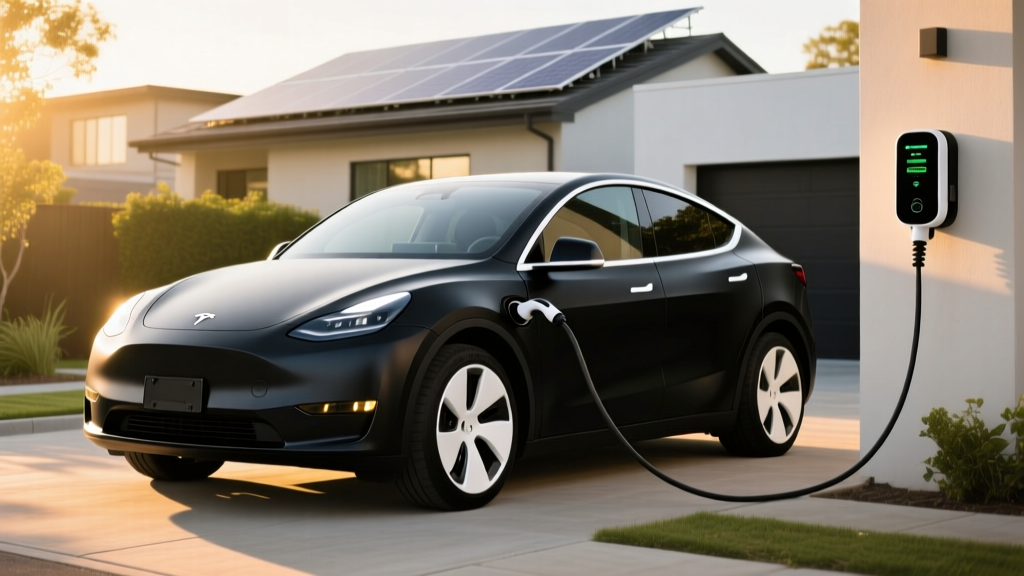
For home charging, a Tesla Wall Connector on a 60-amp circuit delivers the full 11.5 kW (48 amps continuous). That translates to roughly 44 miles of range per hour of charging, or a full overnight replenishment for virtually any daily commute. Installation costs typically run $800–$2,000 depending on panel proximity and local permit fees — a worthwhile investment that pays for itself within the first year of ownership versus public charging.
Performance and Driving Dynamics
The Long Range AWD pairs dual permanent-magnet motors producing a combined 384 horsepower and 360 lb-ft of torque. The 0–60 mph sprint takes 4.8 seconds — brisk for a family crossover and more than adequate for highway merging. The Performance trim bumps output to 456 hp and drops the 0–60 to 3.5 seconds, which is genuinely sports-car territory.
The Juniper refresh brought meaningful chassis improvements. Tesla retuned the suspension with new bushings, revised damping, and acoustic laminated glass on all windows. The result is a noticeably quieter and more compliant ride than the pre-2025 Model Y. Road noise at 70 mph is substantially reduced, and the formerly harsh impact over sharp bumps has been softened without sacrificing cornering composure.
Regenerative braking remains strong and adjustable. In "Hold" mode, the Model Y delivers near one-pedal driving, though unlike some competitors it no longer offers a low-regen coasting mode in the settings — a point of contention for drivers transitioning from ICE vehicles. The Juniper's brake pedal feel has improved, with a more linear transition between regen and friction braking.
Pricing, Trims, and Federal Tax Credit Eligibility
| Trim | Base MSRP | Destination | As-Tested (typical) | §30D Credit Eligible? |
|---|---|---|---|---|
| Standard Range RWD | $44,990 (est.) | $1,390 | $46,380–$48,500 | Likely (under $55K SUV cap) |
| Long Range AWD | $46,630 | $1,390 | $48,020–$52,000 | Yes (under $55K SUV cap) |
| Performance AWD | $51,630 | $1,390 | $53,020–$56,000 | Yes (under $55K SUV cap) |
The 2026 Model Y qualifies for the IRS §30D federal tax credit — up to $7,500 — provided you meet all eligibility requirements. As of 2026, the key rules are:
- MSRP cap: The vehicle must have an MSRP at or below $55,000 for SUVs (the Model Y is classified as an SUV by the IRS). The Long Range AWD at $46,630 clears this easily. The Performance trim at $51,630 also qualifies, though adding high-cost options like FSD can push the effective price above the cap — confirm your build's MSRP classification.
- Buyer income limits: Modified adjusted gross income (MAGI) must not exceed $150,000 (single), $225,000 (head of household), or $300,000 (joint filers).
- Battery sourcing: A percentage of critical minerals and battery components must be sourced from the U.S. or FTA partners. Tesla's domestic battery production (including cells from the Nevada Gigafactory) has kept the Model Y compliant, but sourcing rules tighten annually. Always verify current eligibility on fueleconomy.gov before purchasing.
- Point-of-sale transfer: You can elect to transfer the credit to the dealer at purchase, reducing your out-of-pocket cost by $7,500 at the time of sale rather than waiting for a tax refund.
After the full $7,500 credit, the Long Range AWD effectively costs around $39,130 (before state incentives), placing it in direct competition with the Ioniq 5 and Mach-E on price while offering more cargo space and Supercharger access.
Tech, Interior, and Driver Assistance
The Juniper interior is a significant step up in material quality. Ventilated front seats are now standard, the ambient lighting strip runs across the dash and doors, and the 15.4-inch center touchscreen handles virtually all vehicle controls. A rear 8-inch touchscreen for passengers controls climate, seat heaters, and media — a welcome addition for families.
Tesla's infotainment remains fast and responsive, with native Spotify, Netflix, YouTube, and a built-in web browser. Wireless phone charging has been upgraded to 15W with active cooling. However, the absence of Apple CarPlay and Android Auto continues to frustrate some buyers — Tesla's ecosystem is entirely proprietary.
The Juniper Model Y includes Tesla's basic Autopilot (Traffic-Aware Cruise Control and Autosteer) standard. FSD (Supervised) remains a $8,000 one-time purchase or $99/month subscription and adds Navigate on Autopilot, Auto Lane Change, Autopark, and Smart Summon. FSD capability is improving incrementally through over-the-air updates but remains a personal preference — many owners find basic Autopilot sufficient for highway commuting and decline the upgrade.
Standard safety equipment includes automatic emergency braking, blind-spot monitoring, lane departure warning, and 360-degree cameras. The Model Y continues to earn top marks from both NHTSA (5-star overall) and IIHS (Top Safety Pick+ for qualifying build dates).
Who Should Buy the Juniper Model Y — And Who Should Look Elsewhere
Pros
- Best-in-class Supercharger network access
- 320-mile EPA range covers most road trips with one stop
- Strong efficiency (30 kWh/100 mi) keeps charging costs low
- 72.1 cu ft cargo space with seats folded — class-leading
- Quiet, refined ride vs. pre-refresh Model Y
- Over-the-air updates continuously add features
- Eligible for full $7,500 federal tax credit
Cons
- No Apple CarPlay or Android Auto
- Touchscreen-only controls frustrate some drivers
- Regen-only braking mode; no adjustable coast setting
- FSD purchase price ($8,000) is steep for Level 2 assist
- Insurance premiums run 15–25% above segment average
- Build quality improving but still inconsistent panel gaps reported
- CCS adapter required for non-Tesla DC fast chargers
Decision Framework
Choose the Juniper Model Y if: You value Supercharger network reliability for road trips, need maximum cargo space in a compact EV crossover, and want the longest proven range in this price segment. Ideal for families, frequent road-trippers, and commuters with home Level 2 charging.
Look at competitors if: You insist on Apple CarPlay/Android Auto (Ioniq 5, EV6), prefer traditional physical controls (Mach-E), want a more engaging driving experience on back roads (Ioniq 5 N), or need faster 350 kW peak charging capability (Ioniq 5/EV6 on 800V architecture).
Frequently Asked Questions
What is the real-world range of the 2026 Tesla Juniper Model Y?
The Long Range AWD is EPA-rated at 320 miles. In real-world mixed driving at moderate temperatures, expect 280–300 miles. Highway driving at 75+ mph drops that to 250–270 miles, and freezing winter conditions can reduce range by 20–30%, yielding 220–255 miles. The heat pump helps but doesn't eliminate cold-weather losses.
How fast does the Juniper Model Y charge at home and on the road?
On a Level 2 home charger (11.5 kW / 48A), the Model Y adds about 44 miles of range per hour, fully charging overnight in 7–8 hours. On a Tesla V3/V4 Supercharger, it peaks at 250 kW and charges from 10–80% in approximately 25 minutes, though the rate tapers significantly above 60% SoC.
Does the 2026 Model Y qualify for the $7,500 federal EV tax credit?
Yes, as of early 2026, the Model Y qualifies for the full $7,500 §30D credit, provided your income is within IRS limits ($150K single / $300K joint) and the vehicle's MSRP stays under the $55,000 SUV cap. You can transfer the credit at point of sale to reduce your purchase price immediately. Always verify current eligibility on fueleconomy.gov, as battery sourcing rules tighten annually.
Is the Juniper Model Y worth buying over the Ioniq 5 or Mach-E?
The Model Y wins on cargo space (72.1 cu ft vs. 56–60 for rivals), Supercharger network reliability, and software ecosystem. The Hyundai Ioniq 5 charges faster on 800V architecture (10–80% in ~18 min at 350 kW chargers) and offers CarPlay. The Mach-E provides more traditional controls and a sportier feel. If road-trip charging convenience is your top priority, the Model Y's Supercharger advantage remains decisive.
What's the biggest complaint from Model Y owners?
The most common frustrations are the lack of Apple CarPlay/Android Auto, reliance on touchscreen for basic controls (glovebox, mirror adjustment, wiper settings), and insurance costs that run 15–25% higher than comparable ICE crossovers. Panel gap inconsistency has improved with the Juniper refresh but still appears on some builds.
How long will the Juniper Model Y battery last?
Tesla warrants the Long Range battery for 8 years or 120,000 miles (whichever comes first) with a minimum 70% capacity retention. Historical data from high-mileage Model 3/Y fleets suggests NMC batteries retain 85–90% capacity at 100,000 miles under normal charging habits. Avoiding routine 100% charges and frequent Supercharging can extend long-term battery health. Full battery replacement, if ever needed out of warranty, currently costs approximately $12,000–$16,000.