What Tesla Inverters Actually Do (And Why They Matter)
When EV shoppers research powertrains, they obsess over battery size and motor horsepower. But the component sitting between the battery pack and the electric motor — the inverter — is arguably the most critical piece of power electronics in any Tesla. Without it, the DC energy stored in your battery pack is useless to the AC induction or permanent-magnet motors that actually turn the wheels.
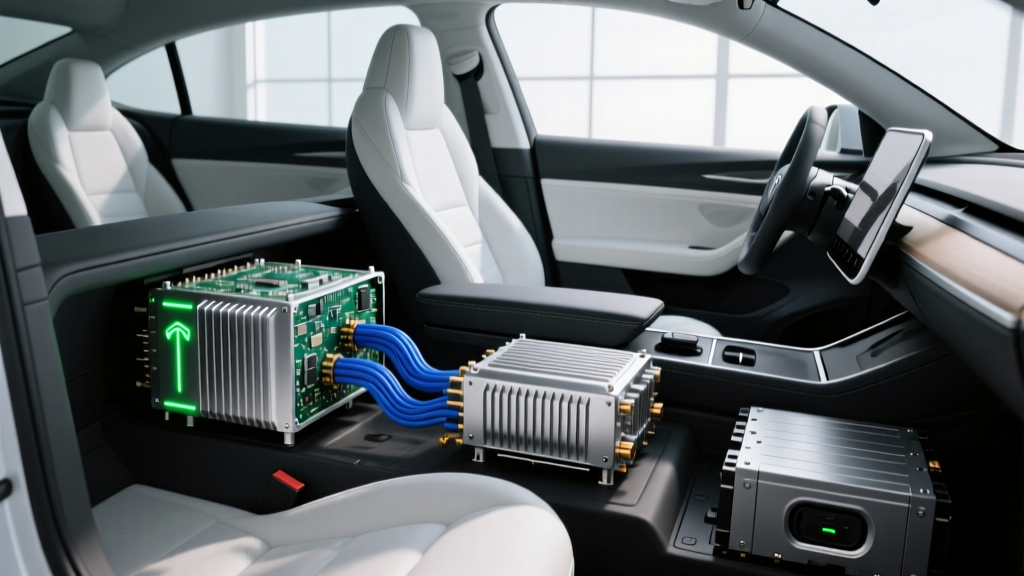
Tesla inverters convert high-voltage DC from the battery into precisely timed three-phase AC waveforms that drive the motors. They also handle regenerative braking, converting AC back into DC to recharge the pack when you lift off the accelerator. In the 2026 Model 3 and Model Y, Tesla uses silicon carbide (SiC) MOSFET-based inverters — a technology that reduces switching losses, improves thermal efficiency, and enables the industry-leading energy consumption figures these vehicles achieve.
This article breaks down how Tesla's inverter architecture works in the current Model 3 (Highland refresh) and Model Y (Juniper refresh), and pairs that technical explanation with the full ownership specs you need: real-world range, charging speeds, pricing, tax credit eligibility, and how these vehicles stack up against the competition.
Tesla's Silicon Carbide Inverter: The Technical Edge
Traditional EV inverters use silicon-based IGBT (insulated-gate bipolar transistor) switches. Tesla was among the first automakers to adopt silicon carbide MOSFETs at scale, starting with the Model 3 in 2017 and continuing through the 2026 lineup. The advantages are measurable:
- Lower switching losses: SiC transistors switch on and off faster with less energy wasted as heat, directly improving miles per kWh.
- Higher thermal tolerance: SiC devices operate efficiently at higher temperatures, reducing the cooling load on the thermal management system.
- Smaller packaging: The inverter module in a 2026 Model 3 is compact enough to integrate directly into the drive unit housing, reducing weight and cable runs.
- Better regen efficiency: During regenerative braking, the inverter rectifies AC motor output back to DC with minimal loss, which is why Tesla's one-pedal driving recovers energy so effectively.
The rear motor inverter in a 2026 Model 3 Long Range handles up to approximately 600 volts DC input from the NMC battery pack and outputs variable-frequency, variable-voltage three-phase AC to the permanent-magnet synchronous reluctance motor (PMSRM). The front motor inverter (on AWD models) operates similarly but manages the induction motor used for efficiency coasting and torque supplementation.
Tesla's inverter firmware also controls torque vectoring, traction management, and the seamless transitions between drive and regen modes — all processed in milliseconds. This integration is a major reason Tesla vehicles consistently achieve efficiency figures that competitors struggle to match.
2026 Tesla Model 3: Full Specs With Inverter Context
The 2026 Model 3 continues the Highland platform introduced for the 2024 model year, with the same SiC inverter architecture carried forward. Here are the numbers that matter:
| Spec | RWD (Standard Range) | Long Range AWD | Performance AWD |
|---|---|---|---|
| EPA Range | 272 miles | 341 miles | 315 miles |
| Battery (usable) | ~57.5 kWh (LFP) | ~75 kWh (NMC) | ~75 kWh (NMC) |
| Drivetrain | RWD, single motor | AWD, dual motor | AWD, dual motor |
| Horsepower | 271 hp | 346 hp | 510 hp |
| 0–60 mph | 5.8 sec | 4.2 sec | 2.9 sec |
| MPGe (combined) | 132 MPGe | 131 MPGe | 119 MPGe |
| Efficiency | 25 kWh/100mi | 26 kWh/100mi | 29 kWh/100mi |
| Max DC Fast Charge | 170 kW | 250 kW | 250 kW |
| 10–80% DCFC Time | ~25 min | ~18 min | ~18 min |
| Level 2 Charge Rate | 11.5 kW (~44 mi/hr) | 11.5 kW (~44 mi/hr) | 11.5 kW (~44 mi/hr) |
| Cargo Volume | 23 cu ft (rear trunk + frunk combined) | ||
| Rear Legroom | 35.3 inches | ||
| Base MSRP | $38,990 | $47,740 | $54,990 |
2026 Tesla Model Y: Inverter & Powertrain Specs
The refreshed Model Y (Juniper platform) carries over the same SiC inverter technology but pairs it with a taller, heavier vehicle optimized for crossover utility. The inverter must handle higher current loads due to the Model Y's greater mass, which slightly reduces efficiency compared to the Model 3.
| Spec | Long Range AWD | Performance AWD |
|---|---|---|
| EPA Range | 320 miles | 285 miles |
| Battery (usable) | ~75 kWh (NMC) | ~75 kWh (NMC) |
| Drivetrain | AWD, dual motor | AWD, dual motor |
| Horsepower | 384 hp | 456 hp |
| 0–60 mph | 4.8 sec | 3.5 sec |
| MPGe (combined) | 122 MPGe | 111 MPGe |
| Max DC Fast Charge | 250 kW | 250 kW |
| 10–80% DCFC Time | ~20 min | ~20 min |
| Level 2 Charge Rate | 11.5 kW (~37 mi/hr) | 11.5 kW (~37 mi/hr) |
| Cargo Volume | 76 cu ft (rear seats folded), 30 cu ft behind rear seats | |
| Rear Legroom | 41.6 inches | |
| Base MSRP | $44,990 | $52,490 |
The Model Y's inverter is tuned for the additional load of towing (up to 3,500 lbs on Long Range), which requires sustained high-current output. Tesla's thermal management system — which includes a heat pump standard on all 2026 models — keeps the inverter and battery within optimal temperature ranges even during prolonged highway towing or repeated hard acceleration.
Charging Speed: What the Inverter Enables
The inverter doesn't directly control DC fast charging (that's handled by the onboard BMS and external charger), but it is central to Level 2 AC charging. When you plug into a home wall connector or public AC station, the vehicle's onboard charger converts AC grid power to DC, and the inverter's control systems help manage battery acceptance rates.
| Charging Level | Power (kW) | Miles Added per Hour | Notes |
|---|---|---|---|
| Level 1 (120V outlet) | ~1.4 kW | ~3–5 mi/hr | Emergency/trickle only |
| Level 2 (240V, 48A Wall Connector) | 11.5 kW | 37–44 mi/hr | Full overnight charge in 7–9 hours |
| DC Fast Charge (V3 Supercharger) | Up to 250 kW | Up to ~1,000 mi/hr peak | 10–80% in 18–25 min depending on trim |
| DC Fast Charge (V4 Supercharger) | Up to 250 kW (vehicle-limited) | Similar to V3 | 2026 Model 3/Y are capped at 250 kW acceptance |
A critical note on charging curves: the 250 kW peak on Long Range and Performance models is sustained only between roughly 10–40% state of charge. Above 50%, the rate tapers progressively, dropping to ~100 kW by 70% and ~50 kW by 85%. This is managed by the battery management system communicating with the inverter's thermal controls to protect cell longevity. If you arrive at a Supercharger with a cold battery, preconditioning (automatic when navigating to a Supercharger) warms the pack to optimize acceptance rate — without it, your first 10 minutes of charging will be significantly slower.
Pricing, Tax Credits, and Total Cost
Tesla's pricing has shifted multiple times, but as of early 2026, here's where the lineup stands — and how the federal tax credit factors in under current IRS §30D rules:
| Model/Trim | Base MSRP | §30D Credit Eligibility | Effective Price (if eligible) |
|---|---|---|---|
| Model 3 RWD | $38,990 | Up to $7,500 (subject to battery sourcing + income caps) | ~$31,490 |
| Model 3 Long Range AWD | $47,740 | Up to $7,500 (subject to battery sourcing + income caps) | ~$40,240 |
| Model 3 Performance | $54,990 | Eligible — under $55,000 MSRP cap for sedans | ~$47,490 |
| Model Y Long Range | $44,990 | Up to $7,500 (subject to battery sourcing + income caps) | ~$37,490 |
| Model Y Performance | $52,490 | Eligible — under $80,000 MSRP cap for SUVs/trucks | ~$44,990 |
Critical §30D caveats: The full $7,500 credit requires the vehicle's battery to meet both critical-mineral sourcing (≥25% from US or FTA partners in 2026) and battery-component manufacturing (≥100% from US/FTA in 2026) thresholds. Tesla has worked to localize its supply chain, but the exact credit amount can vary by production batch. Additionally, buyer income must not exceed $150,000 (single) / $300,000 (joint) modified AGI. The credit can be transferred to the dealer at point of sale as an instant rebate. Always verify current eligibility on IRS.gov before purchasing.
Pros and Cons: Tesla's Inverter-Driven Package
Pros
- Class-leading efficiency (25–29 kWh/100mi) thanks to SiC inverter optimization
- Supercharger network access — still the most reliable DCFC ecosystem in the US
- Over-the-air updates continuously refine inverter tuning and regen behavior
- Heat pump standard on all trims — minimizes cold-weather range loss vs. resistive heating
- Strong resale value relative to most EV competitors
- Model Y offers best-in-class cargo space for an electric crossover
Cons
- No physical stalks or buttons — turn signals and wiper controls on steering wheel are divisive
- Model 3 rear seat legroom (35.3") trails competitors like the Hyundai Ioniq 6
- Build quality consistency still lags legacy automakers in panel gaps and trim alignment
- FSD (Supervised) remains a Level 2 system requiring full driver attention — not autonomous
- 250 kW peak DCFC cap means slower charging than Hyundai/Kia's 800V architectures (350 kW)
- Insurance premiums for Teslas run 15–30% above segment average in most states
Who Should Buy a 2026 Tesla (And Who Shouldn't)
Best for: Tech-forward commuters who want maximum efficiency per kWh, access to the Supercharger network for road trips, and minimal home charging hassle. The Model 3 RWD at ~$31,490 after the federal credit is one of the most affordable premium EVs on the market. The Model Y Long Range suits families needing cargo space and all-weather AWD capability.
Consider alternatives if: You prioritize ride comfort and cabin quietness (the Hyundai Ioniq 6 and BMW i4 are notably quieter), you want faster peak charging (Hyundai/Kia 800V platforms hit 350 kW), or you prefer a traditional dealership experience with in-person service. The Model 3's minimalist interior and screen-dependent controls are not for everyone.
Frequently Asked Questions
What is the real-world range of the 2026 Tesla Model 3 Long Range?
EPA-rated at 341 miles, but real-world highway driving at 70–75 mph typically yields 280–300 miles. In winter conditions below freezing, expect 220–250 miles on a full charge. The LFP battery in the RWD model degrades more slowly over time but offers only 272 EPA miles to begin with due to its smaller 57.5 kWh pack.
How fast does a Tesla charge at home and on the road?
On a 240V Level 2 Tesla Wall Connector (48A), the Model 3 and Model Y add approximately 37–44 miles of range per hour, fully charging overnight in 7–9 hours. On a V3 or V4 Supercharger, the Long Range and Performance trims peak at 250 kW, achieving a 10–80% charge in roughly 18–20 minutes. The RWD model peaks at 170 kW, taking about 25 minutes for the same 10–80% session.
Does the 2026 Tesla Model 3 qualify for the federal EV tax credit?
Yes, all current Model 3 and Model Y trims are listed as eligible on the IRS clean vehicle credit list, subject to the buyer's modified AGI not exceeding $150,000 (single) or $300,000 (joint), and the vehicle meeting battery-sourcing requirements. The credit can be up to $7,500 and is transferable at point of sale. Verify your specific eligibility on IRS.gov before purchase, as sourcing rules tighten annually.
How do Tesla's SiC inverters compare to competitors?
Tesla pioneered mass-production SiC inverters in 2017. By 2026, competitors like Hyundai, BMW, and Lucid also use SiC technology, but Tesla's vertical integration — designing the inverter, motor, battery pack, and control software in-house — gives it a system-level efficiency advantage. The result is visible in EPA efficiency data, where Tesla models consistently rank at or near the top of their segments in kWh/100mi.
Is Tesla's Autopilot or FSD self-driving?
No. Both Autopilot and FSD (Supervised) are SAE Level 2 driver-assistance systems. They can manage steering, acceleration, and braking on highways and some city streets, but the driver must remain fully attentive, keep hands on the wheel, and be prepared to take over instantly. Only Level 4 robotaxi services like Waymo operate without a driver in the loop. Tesla's camera-only approach is capable in many scenarios but has known limitations in construction zones, adverse weather, and edge-case scenarios that NHTSA continues to monitor.
What's the warranty coverage on Tesla's battery and drive unit?
The 2026 Model 3 and Model Y battery and drive unit (which includes the inverter) are covered by an 8-year / 120,000-mile warranty (Long Range and Performance) or 8-year / 100,000-mile warranty (RWD), with a guaranteed minimum 70% capacity retention threshold. If your battery degrades below 70% of its original capacity within that period, Tesla will repair or replace it at no cost. The inverter is part of the drive unit assembly and is covered under the same warranty terms.