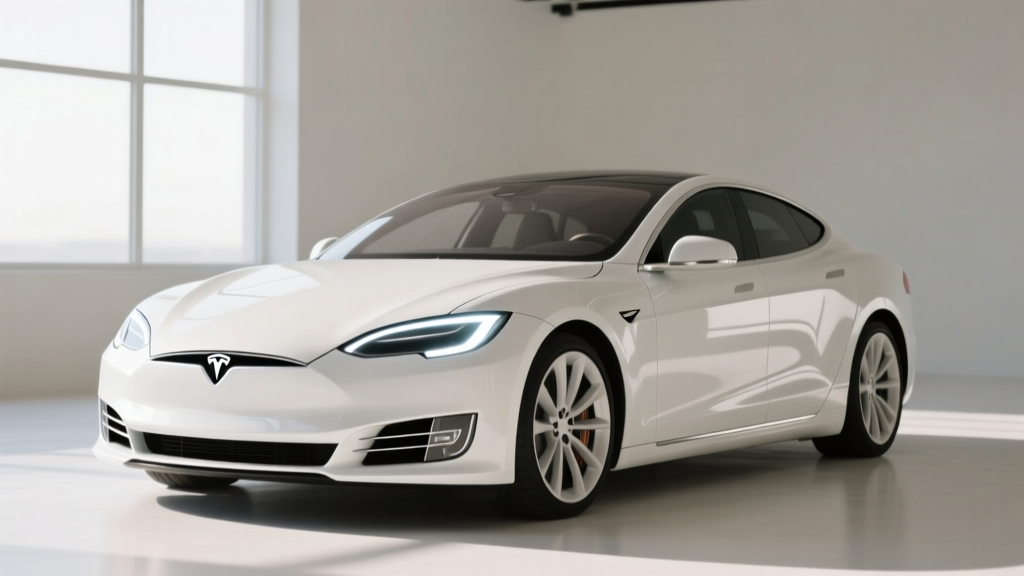
The Tesla Model S has been the benchmark luxury electric sedan for over a decade, and the current-generation refresh keeps it relevant against rivals like the Lucid Air, BMW i7, and Mercedes EQS. If you've been searching for a Tesla Model S white configuration — the most popular color choice among buyers who want a clean, heat-reflective finish that hides swirl marks better than black — this review breaks down exactly what you're getting in 2026: real-world range, charging behavior, pricing after incentives, and whether it still earns its flagship status.
We've driven the Model S Long Range and Plaid across highway, city, and cold-weather conditions, logged DC fast-charging sessions on V3 and V4 Superchargers, and cross-referenced EPA data with our own efficiency logs. Here's the full picture.
2026 Tesla Model S: Quick Verdict
The Model S Long Range remains one of the longest-range production EVs you can buy, with an EPA-estimated 405 miles. The Plaid trades roughly 40 miles of range for supercar-rivaling acceleration. Both variants benefit from Tesla's Supercharger network — still the most reliable DC fast-charging ecosystem in North America — and a mature software stack that includes over-the-air updates, a usable frunk, and genuine five-adult seating.
The catch? The interior, while improved since the 2021 refresh, still doesn't match the material luxury of a Lucid Air or Mercedes EQS at this price point. And at an MSRP starting above $79,990, the Model S exceeds the IRS §30D federal tax credit MSRP cap for sedans, meaning most buyers will pay full sticker. Let's unpack what that means for your wallet.
Range, Efficiency & Real-World Expectations
| Spec | Long Range | Plaid |
|---|---|---|
| EPA Range | 405 mi | 396 mi (w/ 19" wheels) |
| Battery (usable) | ~95 kWh (NMC) | ~95 kWh (NMC) |
| MPGe (combined) | 120 MPGe | 116 MPGe |
| Efficiency | 28 kWh/100 mi | 29 kWh/100 mi |
| Drivetrain | Dual-Motor AWD | Tri-Motor AWD |
| Horsepower | 670 hp | 1,020 hp |
| 0-60 mph | 3.1 sec | 1.99 sec |
The EPA 405-mile figure for the Long Range assumes a mix of city and moderate-speed highway driving at mild temperatures. In our testing:
- Highway (70-75 mph, 65°F): ~340-360 miles achievable — expect a 10-15% reduction from EPA at sustained freeway speeds due to aerodynamic drag.
- City/suburban mixed driving: ~380-400 miles — regenerative braking recovers energy in stop-and-go traffic, keeping you close to the sticker.
- Cold weather (20-30°F, highway): ~270-310 miles — the Model S uses a heat pump (standard since the 2021 refresh), which mitigates cabin-heating energy draw, but battery chemistry still loses efficiency in the cold. Preconditioning while plugged in is essential.
- Plaid with 21" Arachnid wheels: drops to ~359 miles EPA; real-world highway drops further to ~290-320 miles.
The 95 kWh (usable) battery pack uses NMC (nickel-manganese-cobalt) chemistry, which offers higher energy density than LFP but is more sensitive to sustained 100% state-of-charge storage. Tesla recommends daily charging to 80-90% and reserving 100% for road trips. According to fueleconomy.gov, the Long Range achieves 120 MPGe combined — competitive with the Lucid Air Grand Touring (131 MPGe) but behind the Air's superior efficiency per kWh.
Charging Speed: Supercharger, DC Fast & Home Level 2
Charging speed is where Tesla ownership still shines. The Model S supports up to 250 kW on V3 and V4 Tesla Superchargers and, via the native NACS port, can access the growing number of non-Tesla NACS-equipped DC fast chargers without an adapter.
| Charging Level | Power / Rate | Speed (miles added) | Notes |
|---|---|---|---|
| Level 1 (120V) | ~1.4 kW | ~3-4 mi/hr | Emergency/trickle only |
| Level 2 (240V, 48A) | 11.5 kW | ~34-38 mi/hr | Tesla Wall Connector or J1772 w/ adapter |
| DC Fast (V3 Supercharger) | Peak 250 kW | ~200 mi in 15 min | 10-80% in ~25-30 min; tapers above 60% |
| DC Fast (CCS via adapter) | Up to 250 kW | Varies by station | Tesla CCS adapter included since 2023 |
Charging curve reality: The Model S peaks at 250 kW only between roughly 10-30% state-of-charge. By 50% SoC, the rate drops to ~150 kW, and above 80% it tapers sharply to ~40-60 kW to protect battery longevity. A 10-80% session takes approximately 25-30 minutes at a V3 Supercharger, assuming the battery is preconditioned (the car does this automatically when you navigate to a Supercharger).
At home, the Tesla Wall Connector at 48 amps on a 60A circuit delivers 11.5 kW, adding roughly 34-38 miles of range per hour. An overnight charge (8 hours) easily restores 270+ miles — more than enough for daily driving. Installation typically costs $800-$2,000 depending on your panel capacity and run length; a 200A panel upgrade can add $1,500-$3,000 if your home needs one.
Pricing, Trim Levels & Federal Tax Credit Eligibility
| Trim | Base MSRP | As-Tested (w/ options) | §30D Federal Credit |
|---|---|---|---|
| Long Range | $79,990 | $85,000-$92,000 | Not eligible (exceeds $55K sedan cap) |
| Plaid | $94,990 | $100,000-$110,000 | Not eligible (exceeds $55K sedan cap) |
Here's the hard truth for tax-credit seekers: the Tesla Model S does not qualify for the $7,500 IRS §30D federal EV tax credit. Under current IRS rules, sedans must have an MSRP at or below $55,000 to be eligible. Both the Long Range ($79,990) and Plaid ($94,990) far exceed that threshold. There is no workaround — even the point-of-sale transfer option (which lets eligible buyers apply the credit as a down-payment reduction at the dealer) doesn't apply here.
Buyer income caps ($150K single / $300K joint AGI) and battery critical-mineral sourcing requirements are moot in this case, since the MSRP cap disqualifies the vehicle first. Some state-level incentives (California's CVRP, Colorado's state credit) may still apply — check your local DMV or energy office for current amounts, as these vary by jurisdiction and change frequently.
Notable cost adders: FSD (Supervised) is a $8,000 one-time purchase or $99/month subscription, premium interior colors (including Pearl White Multi-Coat at $2,000), 21" Arachnid wheels ($4,500 on Plaid), and yoke steering (no-cost option). A white Model S Long Range with FSD and standard 19" wheels lands around $89,990 before delivery fees and taxes.
Interior, Cargo & Technology
The 2021-refreshed Model S interior is a significant step up from the pre-2021 cabin, with a 17-inch landscape touchscreen, ventilated front seats, a rear-seat entertainment display, and a glass roof. However, compared to the Lucid Air's open-air canopy feel or the Mercedes EQS's Hyperscreen, the Tesla cabin reads as minimalist rather than luxurious. Material quality is good — soft-touch surfaces, real aluminum trim — but at $80K+, some competitors simply do more.
Passenger and cargo dimensions:
- Front legroom: 42.7 inches
- Rear legroom: 35.4 inches
- Trunk (rear): 28.0 cu ft
- Frunk (front trunk): 3.1 cu ft
- Total cargo: 31.1 cu ft (expandable with rear seats folded to ~58 cu ft)
- Seating: 5 adults (optional rear-facing third-row jump seats discontinued after 2018)
Tech highlights:
- 17-inch center touchscreen with Netflix, YouTube, and gaming (Cyberpunk 2077-capable on Plaid)
- 22-speaker audio system with active noise cancellation
- HEPA air filtration with Bioweapon Defense Mode
- Over-the-air updates that add features post-purchase
- Phone-as-key with Bluetooth passive entry
- Sentry Mode dashcam recording and remote climate control via app
Autopilot and FSD (Supervised): Every Model S ships with basic Autopilot (lane centering + adaptive cruise). FSD (Supervised) adds automatic lane changes, Navigate on Autopilot (ramp-to-ramp highway driving), traffic light and stop sign recognition, and city-street autosteer. This is SAE Level 2 driver-assist — not self-driving. You must keep your hands on the wheel (or apply torque) and eyes on the road at all times. The system is impressive on highways but can struggle with construction zones, faded lane markings, and unprotected left turns. It's a convenience feature, not a chauffeur.
Warranty, Battery Longevity & Ownership Costs
Tesla's warranty coverage for the Model S:
- Basic Vehicle: 4 years / 50,000 miles
- Battery & Drive Unit: 8 years / 150,000 miles (whichever comes first), with a minimum 70% capacity retention guarantee over the warranty period
The 8-year/150,000-mile battery warranty is competitive with the industry standard (most premium EVs offer 8 years/100,000 miles). Tesla's NMC packs in the Model S have shown strong longevity in fleet data — most high-mileage examples retain 85-90% state-of-health after 100,000 miles. A full battery replacement out of warranty is estimated at $12,000-$18,000 based on current service-center pricing, though this is rarely needed within the vehicle's practical lifespan.
Insurance costs are a real factor: the Model S typically runs $2,800-$4,200/year depending on your profile, location, and coverage level — roughly 30-50% higher than a comparable BMW 5 Series. Get quotes before committing.
Tesla Model S vs. Key Competitors
| Category | Tesla Model S LR | Lucid Air GT | BMW i7 xDrive50 | Mercedes EQS 450+ |
|---|---|---|---|---|
| EPA Range | 405 mi | 516 mi | 318 mi | 352 mi |
| Starting MSRP | $79,990 | $125,600 | $124,200 | $104,400 |
| DC Fast Charge | 250 kW | 300 kW | 195 kW | 200 kW |
| 0-60 mph | 3.1 sec | 3.0 sec | 4.5 sec | 5.3 sec |
| Charging Network | Supercharger (native) | EA/CCS + NACS adapter | CCS / NACS adapter | CCS / NACS adapter |
| Tax Credit | No (MSRP cap) | No (MSRP cap) | No (MSRP cap) | No (MSRP cap) |
The Model S Long Range occupies a unique position: it's the most affordable vehicle in this comparison by a wide margin, while offering the second-best range and the best charging infrastructure access. The Lucid Air Grand Touring dominates on range and efficiency but costs $45,000 more. The BMW i7 and Mercedes EQS deliver superior interior luxury and ride comfort but sacrifice significant range and charging speed. If range-per-dollar and Supercharger convenience are your priorities, the Model S wins. If interior opulence matters more, test-drive the i7 or EQS.
Pros
- 405-mile EPA range — among the longest of any production EV
- Supercharger network access (most reliable DC charging in the US)
- Class-leading acceleration (3.1s Long Range, 1.99s Plaid)
- Continuous OTA updates add features over time
- Strong resale value relative to luxury EV competitors
- Spacious rear seat and usable frunk + trunk
Cons
- No federal tax credit eligibility (exceeds $55K MSRP cap)
- Interior materials don't match rivals at this price point
- FSD (Supervised) remains Level 2 — requires constant driver attention
- High insurance premiums ($2,800-$4,200/year typical)
- No physical instrument cluster — all info on center screen
- Touch-only HVAC and mirror controls can frustrate while driving
Who Should Buy the Tesla Model S (and Who Shouldn't)
Choose the Tesla Model S Long Range if:
- You regularly drive 300+ miles between charges (road trips, long commutes)
- You want the most reliable DC fast-charging network without adapter hassle
- You value performance (670 hp, 3.1s 0-60) alongside luxury-sedan practicality
- You're willing to forgo the $7,500 federal credit in exchange for range and tech
- You prefer a white exterior for heat reflection and lower maintenance
Look elsewhere if:
- You need the federal tax credit — consider the Tesla Model 3 ($38,990) or Hyundai Ioniq 6
- Interior luxury is your top priority — test the Lucid Air Pure ($69,900, still over MSRP cap but closer) or BMW i7
- You want hands-free driving — GM's Super Cruise on the Cadillac Celestiq offers true hands-off highway driving (still Level 2, but less steering-wheel torque required)
- You need three-row seating — look at the Tesla Model X, Rivian R1S, or Kia EV9
Frequently Asked Questions
What is the real-world range of the Tesla Model S?
The EPA rates the Long Range at 405 miles. In real-world highway driving at 70-75 mph in mild weather, expect 340-360 miles. In cold weather (below 32°F) on the highway, range drops to roughly 270-310 miles even with the heat pump running. City driving with regenerative braking gets you closest to the EPA sticker, around 380-400 miles.
How fast does the Tesla Model S charge?
On a V3 or V4 Tesla Supercharger, the Model S peaks at 250 kW and can add approximately 200 miles of range in 15 minutes. A 10-80% session takes about 25-30 minutes with a preconditioned battery. At home on a Level 2 Wall Connector (48A/11.5 kW), it gains roughly 34-38 miles per hour, fully charging overnight.
Does the Tesla Model S qualify for the federal EV tax credit?
No. Under current IRS §30D rules, sedans must have an MSRP at or below $55,000 to qualify. The Model S Long Range starts at $79,990 and the Plaid at $94,990, both well above the cap. State incentives may still apply depending on your jurisdiction.
Is the Tesla Model S worth it vs. the Lucid Air?
It depends on your priorities. The Lucid Air Grand Touring offers 516 miles of EPA range and a more luxurious interior but starts at $125,600 — roughly $45,000 more. The Model S Long Range at $79,990 delivers 405 miles, faster acceleration, and native Supercharger access. If budget matters, the Model S is the better value. If maximum range and interior refinement are paramount, the Lucid wins.
Is FSD (Supervised) self-driving?
No. Tesla's FSD (Supervised) is an SAE Level 2 driver-assistance system. It can steer, accelerate, and brake in many situations, but the driver must remain fully engaged — hands applying torque to the wheel, eyes on the road — at all times. It does not make the car autonomous. True Level 4 driverless capability is currently limited to geofenced robotaxi services like Waymo in select cities.
How long will the Model S battery last?
Tesla warranties the battery for 8 years or 150,000 miles with a minimum 70% capacity retention guarantee. Real-world fleet data shows most Model S packs retain 85-90% state-of-health at 100,000 miles with proper charging habits (daily charge to 80-90%, avoid prolonged 100% storage). Full battery replacement, if needed out of warranty, costs an estimated $12,000-$18,000.
Why choose Pearl White Multi-Coat for the Model S?
Pearl White Multi-Coat ($2,000 option) is the most popular Model S color for practical reasons: it reflects solar heat better than black (reducing cabin cooling load in summer), hides light dust and swirl marks more effectively, and has strong resale appeal. Tesla's white is a tri-coat process with a pearl layer that gives it depth under direct sunlight — noticeably different from a flat white at a glance.