Quick Verdict: Are Tesla Interiors Finally Premium Enough?
For years, "Tesla interiors" was shorthand for spartan cabins, panel-gap lottery, and a single screen doing too much. The 2026 Model 3 Highlandand and refreshed Model 5 Juniper) have substantially closed that gap — acoustic glass, ventilated seats, ambient lighting, and a rear touchscreen are now standard. But Tesla's minimalist philosophy still demands compromises: no physical stalks, no instrument cluster, and limited storage cubbies. If you're cross-shopping a BMW i4, Hyundai Ioniq 6, or Ford Mustang Mach-E, the cabin experience matters as much as the powertrain. Here's exactly what you get inside a 2026 Tesla, paired with the range, charging, and pricing data you need to decide.
2026 Tesla Model 3: Interior, Range, and Specs at a Glance
The refreshed Model 3 (internally "Highland") carries over into 2026 with minor trim updates. It remains Tesla's entry sedan and the volume benchmark for compact electric sedans.
| Spec | RWD Long Range | Long Range AWD | Performance |
|---|---|---|---|
| EPA Range | 363 mi | 346 mi | 315 mi |
| Battery (usable) | ~79 kWh (NMC) | ~79 kWh (NMC) | ~79 kWh (NMC) |
| Efficiency | 132 MPGe / 25 kWh/100mi | 127 MPGe | 119 MPGe |
| Peak DC Charge | 250 kW | 250 kW | 250 kW |
| 10–80% DC Time | ~27 min | ~27 min | ~27 min |
| Level 2 Home Rate | 11.5 kW (~44 mi/hr) | 11.5 kW | 11.5 kW |
| 0–60 mph | 5.8 s | 4.2 s | 2.9 s |
| Horsepower | 271 hp | 346 hp | 510 hp |
| Drivetrain | RWD | Dual-Motor AWD | Dual-Motor AWD |
| Base MSRP | $38,990 | $44,990 | $52,990 |
2026 Tesla Model Y: The Family Crossover Interior
The Juniper-refreshed Model Y arrived for the 2025 model year and carries into 2026 unchanged. It's Tesla's bestseller globally, and its interior improvements mirror the Model 3's — with more room to exploit.
| Spec | Long Range RWD | Long Range AWD | Performance |
|---|---|---|---|
| EPA Range | 320 mi | 308 mi | 285 mi |
| Battery (usable) | ~78 kWh (NMC) | ~78 kWh (NMC) | ~78 kWh (NMC) |
| Peak DC Charge | 250 kW | 250 kW | 250 kW |
| 10–80% DC Time | ~27 min | ~27 min | ~27 min |
| 0–60 mph | 5.8 s | 4.6 s | 3.5 s |
| Horsepower | 295 hp | 384 hp | 510 hp |
| Cargo (rear seats up) | 30.2 cu ft (76.2 cu ft folded) | ||
| Base MSRP | $44,990 | $47,990 | $53,990 |
According to fueleconomy.gov, the Model Y Long Range AWD returns 119 MPGe combined. For an SUV-shaped crossover with AWD and 384 hp, that efficiency is class-leading — the Ioniq 5 AWD trails at 110 MPGe, and the Mach-E Extended Range AWD at 101 MPGe.
Inside the Cabin: What "Tesla Interiors" Actually Means in 2026
Materials and Build Quality
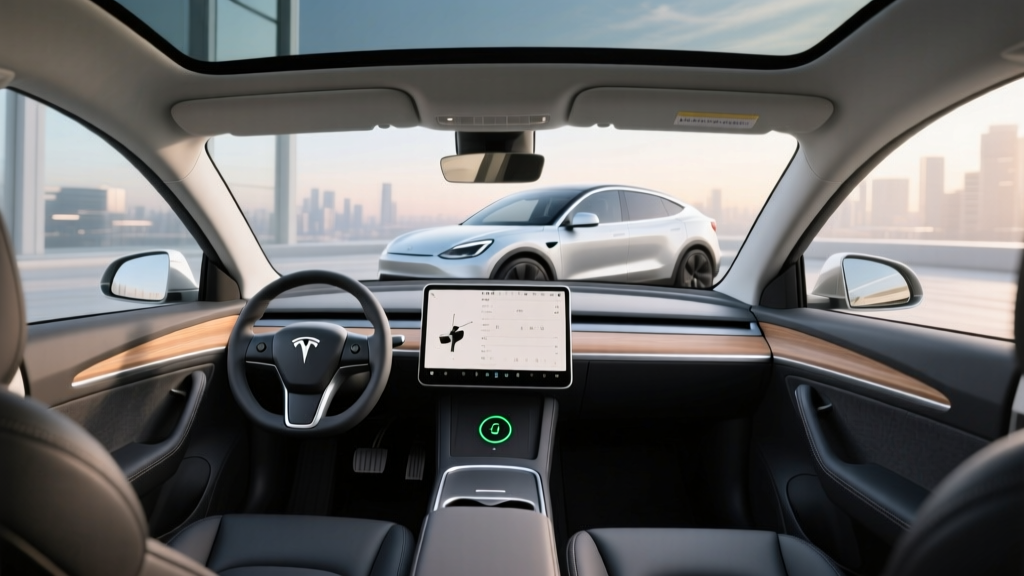
The Highlandand/Juniper refreshes replaced the old hard-plastic door cards with woven textile inserts, added acoustic laminated glass on all four windows, and upgraded seat foam. Panel gaps on 2026 Fremont and Shanghai builds are measurably tighter than 2022–2023 cars, though still a step below BMW or Mercedes fitment. Soft-touch surfaces now cover most touchpoints, but the lower dash and center console still use harder plastics that competitors pad more generously.
The Screen Situation
Model 3: one 15.4-inch front touchscreen plus an 8-inch rear touchscreen for climate, media, and ventilation controls. Model Y: same layout. There is no head-up display and no traditional instrument cluster — speed, range, and navigation live on the left third of the main screen. Turn-signal arrows on the steering wheel (replacing the stalks on the Model 3) remain a love-it-or-leave-it ergonomic choice; the Model Y Juniper retains a traditional turn-signal stalk, which most buyers prefer.
Seating and Space
Model 3 front legroom measures 42.4 inches, rear legroom 35.3 inches — adequate for adults on short trips but tight for six-footers behind tall drivers. The Model Y solves this: 41.8 inches front, 41.6 inches rear. Both cars get ventilated front seats standard (a 2024 addition), heated rear seats, and a panoramic glass roof with a new power sunshade on the Juniper Model Y.
Cargo Practicality
The Model 3's 23 cu ft trunk (64 cu ft folded) is sedan-competitive but loses to hatchback rivals. The Model Y's 30.2 cu ft with seats up, expandable to 76.2 cu ft, is genuinely SUV-class — enough for a family road trip's luggage plus a stroller. The frunk adds roughly 4 cu ft on both models, useful for charging cables and groceries.
Charging Speed: Home and DC Fast Charging
| Level | Power | Miles Added per Hour | Notes |
|---|---|---|---|
| Level 1 (120V) | ~1.4 kW | ~4–5 mi/hr | Emergency/top-up only |
| Level 2 (240V, 48A) | 11.5 kW | ~44 mi/hr | Full charge overnight (~8 hrs) |
| DC Fast (V3 Supercharger) | Peak 250 kW | ~175 mi in 15 min | Tapers above 60% SoC |
| DC Fast (V4 Supercharger) | Up to 325 kW | ~200 mi in 15 min | Model 3/Y peak limited to ~250 kW currently |
Tesla's 400-volt architecture means the Model 3 and Y can't match the 800V Hyundai Ioniq 5's 350 kW peak, but the Supercharger network's reliability — consistently 95%+ uptime per Tesla's own data — often beats faster-charging rivals stuck with less dependable networks. At home, a 48-amp Wall Connector on a 60-amp circuit delivers a full overnight charge. Budget $500–$1,500 for installation depending on panel proximity; older homes may need a $2,000–$4,000 panel upgrade.
Pricing, Tax Credits, and What You Actually Pay
| Model / Trim | MSRP | §30D Credit* | Effective Price |
|---|---|---|---|
| Model 3 RWD | $38,990 | Up to $7,500 | ~$31,490 |
| Model 3 Long Range AWD | $44,990 | Up to $7,500 | ~$37,490 |
| Model Y Long Range AWD | $47,990 | Up to $7,500 | ~$40,490 |
| Model Y Performance | $53,990 | Up to $7,500 | ~$46,490 |
*Per IRS §30D rules, the full $7,500 credit requires the buyer to meet income caps ($150K single / $300K joint MAGI), the vehicle MSRP must be ≤$55,000 for sedans or ≤$80,000 for SUVs/trucks (Model Y qualifies as an SUV), and battery critical-mineral + component sourcing thresholds must be met. Tesla's North American battery sourcing currently qualifies most trims for the full amount, but rules tighten annually — confirm on the IRS site or with a tax professional before purchase. The credit is available as a point-of-sale transfer to the dealer, reducing your out-of-pocket at delivery.
Tesla Interiors vs. the Competition
- Class-leading Supercharger network access (17,000+ NA stalls)
- Best-in-class software, OTA updates, and app integration
- Ventilated seats + rear screen standard (not optional)
- Lowest cost per mile of any AWD EV in the segment
- Strongest resale value among EVs (per Kelley Blue Book)
- BMW i4: physical controls, HUD, superior sound insulation
- Hyundai Ioniq 5/6: 800V charging (10–80% in 18 min), V2L
- Ford Mach-E: more conventional ergonomics, BlueCruise hands-free
- Volvo EX40: Scandinavian materials, Google built-in
Who Should Buy a 2026 Tesla (And Who Shouldn't)
Choose the Model 3 if: you commute solo or as a couple, want maximum range per dollar (363 mi EPA on the Long Range RWD), and prioritize Supercharger access for road trips over cabin luxury.
Choose the Model Y if: you have kids, need 76+ cu ft of cargo space, or want optional 7-seat configuration (small third row, best for children).
Look elsewhere if: you demand physical climate knobs, a head-up display, or hands-free Level 2 driving (GM Super Cruise and Ford BlueCruise permit hands-off on mapped highways; Tesla's Autopilot and FSD Supervised require hands-on engagement at all times — both remain SAE Level 2 systems).
Warranty Coverage
Tesla covers the battery and drive unit for 8 years / 120,000 miles (Long Range and Performance) or 8 years / 100,000 miles (RWD), with a 70% capacity retention threshold. The basic vehicle warranty is 4 years / 50,000 miles — shorter than Hyundai's 5/60K or Genesis's 5/60K, and a genuine consideration for second-owners.
Frequently Asked Questions
What is the real-world range of the 2026 Tesla Model 3?
The Model 3 Long Range RWD is EPA-rated at 363 miles. In real-world highway driving at 70 mph, expect 300–320 miles. In cold weather (below 30°F), plan on 230–260 miles. The heat pump mitigates but does not eliminate winter range loss.
How fast does a Tesla charge at home and on the road?
At home on a 48-amp Level 2 charger, both the Model 3 and Model Y add about 44 miles per hour, reaching a full charge in roughly 8 hours. On a V3 Supercharger, 10–80% takes about 27 minutes with peak power of 250 kW. The charge curve tapers significantly above 60% SoC — the last 20% can take as long as the first 60%.
Do the 2026 Model 3 and Model Y qualify for the $7,500 federal tax credit?
Yes, most trims currently qualify for up to $7,500 under IRS §30D, provided the buyer meets income caps ($150K single / $300K joint), the vehicle MSRP is within limits ($55K sedan / $80K SUV — Model Y is classified as an SUV), and battery sourcing requirements are met. The credit can be transferred at point of sale. Verify current eligibility at irs.gov before purchasing, as sourcing rules tighten each year.
Is the Tesla Model Y worth it over the Hyundai Ioniq 5 or Ford Mach-E?
For range-per-dollar, Supercharger reliability, and software polish, the Model Y wins. For faster DC charging (800V architecture), more conventional ergonomics, and hands-free highway driving (BlueCruise), the Ioniq 5 and Mach-E are compelling. Test-drive both — the cabin experience, not the spec sheet, usually decides this comparison.
What are the biggest pros and cons of Tesla interiors in 2026?
Pros: minimalist aesthetic with improved materials, standard ventilated seats, acoustic glass, excellent infotainment and OTA updates, generous cargo space (Model Y). Cons: no physical stalks on Model 3, no head-up display, no instrument cluster, limited small-item storage, lower-dash plastics still feel budget-tier, no Apple CarPlay/Android Auto.
Does Tesla offer a warranty that covers battery degradation?
Yes. Tesla's battery warranty guarantees 70% capacity retention for 8 years / 120,000 miles on Long Range and Performance trims, or 8 years / 100,000 miles on RWD. If your battery drops below 70% State of Health within that window, Tesla will repair or replace it at no cost. Out-of-warranty replacement currently runs $12,000–$16,000 depending on pack size.