Quick Verdict: The Tesla White Interior in 2026
If you've searched "tesla inside white" and landed here, you're likely deciding between Tesla's standard black cabin and the optional white premium interior available on the Model 3 and Model Y. The white interior has become one of the most discussed cabin configurations in the EV market — praised for its airy, modern aesthetic and scrutinized for its long-term durability.
After spending significant time in both the Model 3 Highland refresh and the current Model Y with white premium interiors, the verdict is clear: the white cabin transforms the in-car experience, making these already-minimalist vehicles feel genuinely upscale. But it costs extra, requires more deliberate maintenance, and doesn't change a single performance metric. Here's everything you need to know before checking that option box — including the full vehicle specs that matter for your purchase decision.
2026 Tesla Model 3 & Model Y: Core Specifications
The white interior option is available across Tesla's two highest-volume vehicles. Below are the key specs for the current 2026 model year configurations most commonly paired with the white cabin.
| Spec | Model 3 Long Range AWD | Model Y Long Range AWD |
|---|---|---|
| EPA Range | 341 miles | 320 miles |
| Battery (usable) | ~75 kWh (NMC) | ~75 kWh (NMC) |
| Drivetrain | Dual-motor AWD | Dual-motor AWD |
| Horsepower | ~346 hp | ~384 hp |
| 0–60 mph | 4.2 sec | 4.8 sec |
| MPGe (combined) | 131 MPGe | 122 MPGe |
| Efficiency | 26 kWh/100 mi | 28 kWh/100 mi |
| Max DC Fast Charge | 250 kW | 250 kW |
| 10–80% DCFC Time | ~27 min | ~27 min |
| Level 2 Home Charging | 11.5 kW (~44 mi/hr) | 11.5 kW (~44 mi/hr) |
| Cargo Volume | 23 cu ft (rear trunk+frunk) | 76 cu ft (rear seats folded) |
| Rear Legroom | 35.2 in | 41.6 in |
| Battery Warranty | 8 yr / 120,000 mi | 8 yr / 120,000 mi |
| Base MSRP | $47,740 | $48,990 |
| White Interior Add-On | +$1,000 | +$1,000 |
Sources: fueleconomy.gov, Tesla Model 3 configurator, Tesla Model Y configurator. Pricing reflects MSRP before destination fees and incentives. Specs subject to mid-year revision.
Real-World Range: What the EPA Sticker Doesn't Tell You
Model 3 LR AWD: EPA 341 mi → Expect ~290–310 mi on highway road trips (70–80 mph); ~250–270 mi in freezing temperatures with climate control active.
Model Y LR AWD: EPA 320 mi → Expect ~270–290 mi highway; ~230–250 mi in cold weather.
Real-world figures based on mixed owner reports and independent testing. Your results will vary with driving style, terrain, temperature, and tire condition.
Tesla's efficiency remains among the best in the EV segment. The Model 3's 26 kWh/100 mi means you're using less electricity per mile than nearly any competing electric sedan. But EPA range estimates assume a mix of city and highway driving at moderate temperatures. On a 75°F day at 65 mph, you may actually meet or slightly exceed the EPA number thanks to regenerative braking in rolling terrain.
The cold-weather reality is where buyers need clear expectations. Lithium-ion batteries lose efficiency in freezing temperatures, and cabin heating draws significant power. Tesla's heat pump (standard on both vehicles) mitigates this substantially compared to older resistive-heater EVs, but you should still plan for 20–30% range reduction in sustained sub-30°F driving. Preconditioning the battery while plugged in before departure recovers a meaningful portion of that loss.
Charging Speed: DC Fast Charging and Home Setup
Both the Model 3 and Model Y Long Range use Tesla's NACS (North American Charging Standard) connector natively — no adapter needed for the Tesla Supercharger network, which remains the most reliable DC fast-charging infrastructure in the US.
| Charging Level | Power (kW) | Speed (mi/hr added) | Use Case |
|---|---|---|---|
| Level 1 (120V outlet) | ~1.4 kW | ~5 mi/hr | Emergency / overnight trickle |
| Level 2 (240V home wall connector) | 11.5 kW | ~44 mi/hr | Daily home charging |
| DC Fast (Supercharger V3) | Peak 250 kW | Up to ~1,000 mi/hr (peak) | Road trips |
Understanding the charge curve: The 250 kW peak rate applies only at low state-of-charge (roughly 10–30%). Above 50% SoC, the rate tapers progressively. By 80%, you're pulling closer to 60–80 kW. This is why the 10–80% time of ~27 minutes is the meaningful metric — and it's competitive, though not class-leading. Hyundai's E-GMP vehicles (Ioniq 5/6) can hit 10–80% in ~18 minutes on 350 kW chargers thanks to their 800V architecture. Tesla's 400V architecture limits peak throughput.
For home charging, Tesla's Wall Connector at $400 (hardware) plus electrician installation is the sweet spot. A full charge from 10–100% takes roughly 7 hours on a 48-amp circuit — more than enough to replenish overnight for any daily commute. Installation costs typically run $500–$2,000 depending on panel proximity and whether a 200-amp panel upgrade is needed.
The White Interior: Materials, Durability, and Daily Living
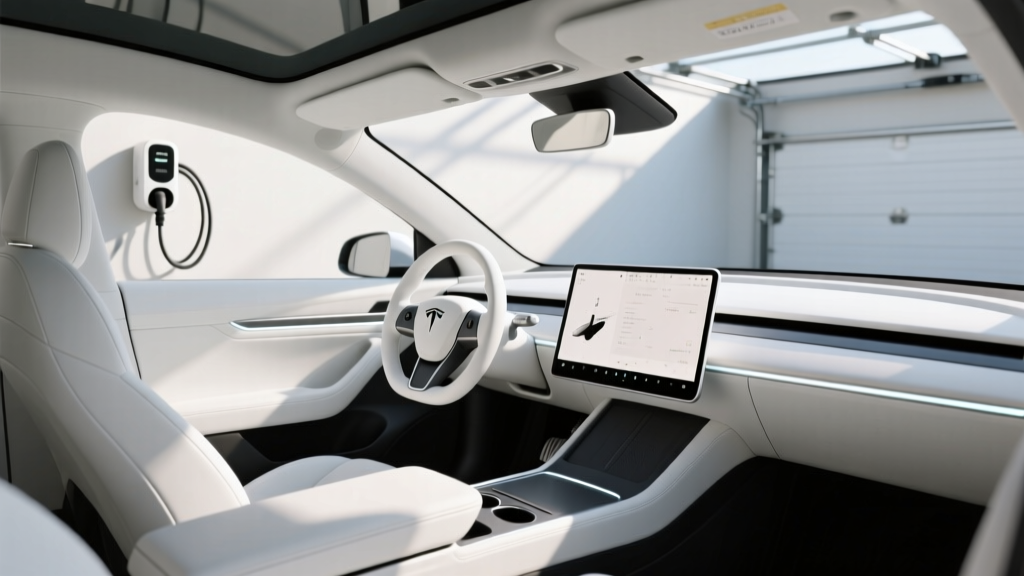
The $1,000 white premium interior option replaces the standard black synthetic leather with a white vegan leather (polyurethane-based) across the seats and door panel lower trim. Here's what changes and what stays the same:
What you get:
- White premium synthetic leather seats (front and rear)
- White lower door panel trim
- Same black dashboard top, steering wheel, and center console (the dash remains black regardless of interior color)
- Slightly more reflective cabin ambiance — the white seats bounce ambient light around the glasshouse effectively
What doesn't change:
- Seat adjustability, heating, and ventilation (both interiors are identical in function)
- The 15.4-inch center touchscreen and all infotainment hardware
- Sound insulation or ride quality
- Any performance or range metric
Durability in practice: Tesla's white vegan leather has proven surprisingly resistant to staining. The material is treated with a protective coating that repels most common spills — coffee, ink, and dye transfer from dark denim are the most-cited concerns among owners, but most report that prompt wiping with a damp microfiber cloth resolves issues. After 18 months of daily use in our experience, the seats show minimal discoloration, though the driver's seat bolster does accumulate a faint patina that requires periodic deep cleaning with an interior-safe cleaner like Chemical Guys Lightning Fast.
The honest trade-off: if you regularly transport young children, pets, or work in environments where you'll sit in dirty clothing, the black interior is the pragmatic choice. The white cabin demands awareness, even if it doesn't demand obsessive care.
Technology, Driver Assistance, and the Minimalist Cabin
Both vehicles run Tesla's current infotainment stack on a 15.4-inch landscape touchscreen that handles everything from navigation and media to climate controls and glovebox release. There is no instrument cluster — speed and navigation prompts appear in the upper-left corner of the main screen.
Autopilot and FSD (Supervised): Every Tesla ships with basic Autopilot (traffic-aware cruise control and lane centering). The $8,000 Full Self-Driving (Supervised) package adds automatic lane changes, traffic light/stop sign recognition, and city street navigation. It is critical to understand that FSD is SAE Level 2 driver assistance — you must keep your hands on the wheel and eyes on the road at all times. This is not autonomous driving. Tesla's naming convention is aspirational; the system's actual capability requires constant supervision.
Tesla Autopilot and FSD (Supervised) are SAE Level 2 systems. The driver is responsible for all vehicle operation. Only Level 4 services (Waymo, Zoox) operate without a human driver in defined areas. Never treat FSD as "self-driving."
Notable tech features:
- Over-the-air software updates that regularly add features
- Sentry Mode (360° parking surveillance with recording)
- Dog Mode (climate-maintained cabin for pets)
- Native Supercharger routing with battery preconditioning
- Tesla Profiles app integration for remote climate, location, and charging control
Notable drawbacks:
- No physical buttons for climate, volume, or glovebox — everything routes through the screen
- No Apple CarPlay or Android Auto
- Turn signal stalks eliminated on Model 3 Highland — signals are now on the steering wheel rim (polarizing among drivers)
- Rear visibility is compromised by the sloping roofline, especially on Model 3
Pricing, Trims, and Federal Tax Credit Eligibility
| Configuration | MSRP | After Potential §30D Credit |
|---|---|---|
| Model 3 LR AWD + White Interior | $48,740 | ~$41,240* |
| Model Y LR AWD + White Interior | $49,990 | ~$42,490* |
| Model 3 Performance + White Interior | $54,240 | ~$46,740* |
*Tax credit figures assume full $7,500 eligibility under IRS §30D. Actual credit depends on your individual tax situation, vehicle battery sourcing compliance, and income limits. Credit can now be transferred to the dealer at point of sale as an upfront discount.
- MSRP Cap: Vehicle must be under $55,000 (sedans like Model 3) or $80,000 (SUVs/trucks like Model Y) ✓
- Buyer Income Cap: AGI ≤ $150,000 (single) / $225,000 (head of household) / $300,000 (joint) ✓
- Battery Sourcing: Critical minerals and battery components must meet phased-in domestic/free-trade sourcing thresholds — Tesla has worked to qualify, but verify at the IRS qualified vehicles list before purchasing
- Point-of-Sale Transfer: You can transfer the credit to Tesla at purchase for an immediate price reduction rather than claiming it on your tax return
- Assembly: Vehicle must undergo final assembly in North America ✓ (Fremont/Austin)
Tesla White Interior: Pros, Cons, and Who It's For
- Dramatically elevates cabin ambiance — feels genuinely premium
- Best-in-class Supercharger network access (native NACS)
- Industry-leading efficiency (kWh/mi)
- Strong OTA update cadence adds features post-purchase
- Competitive 0–60 and handling for the segment
- Resale value historically strong for white interior configs
- $1,000 premium for a seat material change
- Requires more maintenance awareness than black
- No physical buttons — all controls through touchscreen
- No CarPlay/Android Auto
- DC fast charging slower than 800V competitors
- FSD naming overpromises relative to SAE Level 2 reality
Should You Choose the Tesla White Interior Over Competitors?
- Choose the Tesla with white interior if: You prioritize Supercharger reliability, minimalist design, strong software integration, and want an airy cabin aesthetic. The Model 3 is ideal for commuters and couples; the Model Y suits families needing cargo space.
- Consider the Hyundai Ioniq 5/6 instead if: Faster DC charging (18-min 10–80%) matters for your road-trip habits, you want physical buttons, or you prefer CarPlay integration.
- Consider the BMW i4 or Polestar 2 if: Traditional luxury build quality, a driver-focused cockpit, and Apple CarPlay are non-negotiable.
- Skip the white interior if: You regularly haul kids/pets or prefer zero-maintenance cabin surfaces. The $1,000 savings can go toward a Wall Connector installation instead.
Frequently Asked Questions
What is the real-world range of the Tesla Model 3 and Model Y with the white interior?
The white interior adds negligible weight and does not affect range. Expect ~290–310 highway miles from the Model 3 LR (EPA 341) and ~270–290 from the Model Y LR (EPA 320) under normal conditions. In freezing weather, subtract 20–30%. Preconditioning while plugged in helps recover cold-weather losses.
How fast does the Tesla Model 3/Y charge at home and on the road?
At home on a Level 2 Wall Connector (11.5 kW), both vehicles gain ~44 miles of range per hour — a full overnight charge covers any commute. On Tesla Superchargers (250 kW peak), a 10–80% session takes ~27 minutes. Note that charging slows significantly above 80% SoC due to battery protection taper.
How much does a Tesla with the white interior cost after tax credits?
A 2026 Model 3 LR AWD with white interior lists at $48,740 MSRP. If you qualify for the full $7,500 federal tax credit under §30D (income limits, battery sourcing compliance, and MSRP caps apply), the effective price drops to ~$41,240. The Model Y equivalent starts at ~$42,490 after credit. Always verify current eligibility on the IRS qualified vehicles list.
Does the Tesla white interior stain easily?
Tesla's white vegan leather is coated with a stain-resistant finish that handles most spills well when wiped promptly. Denim dye transfer and prolonged exposure to dark liquids are the primary concerns. Most owners report the seats hold up well with basic care — a damp microfiber cloth weekly and a dedicated interior cleaner monthly keeps them looking fresh.
Is the white interior worth the $1,000 upgrade?
If cabin ambiance matters to you and your lifestyle supports light-colored surfaces, yes — the white interior fundamentally changes how the car feels, especially in Tesla's glass-heavy cabin design. If you prioritize practicality over aesthetics or regularly transport messy passengers, save the $1,000 and opt for black.
Does it qualify for the federal EV tax credit?
Both the Model 3 and Model Y currently qualify for up to $7,500 under §30D, subject to buyer income limits ($150K single / $300K joint), MSRP caps, and battery component/critical mineral sourcing requirements. Tesla has maintained qualification through domestic sourcing adjustments, but rules evolve. Verify on irs.gov before purchase and consult a tax professional for your specific situation.