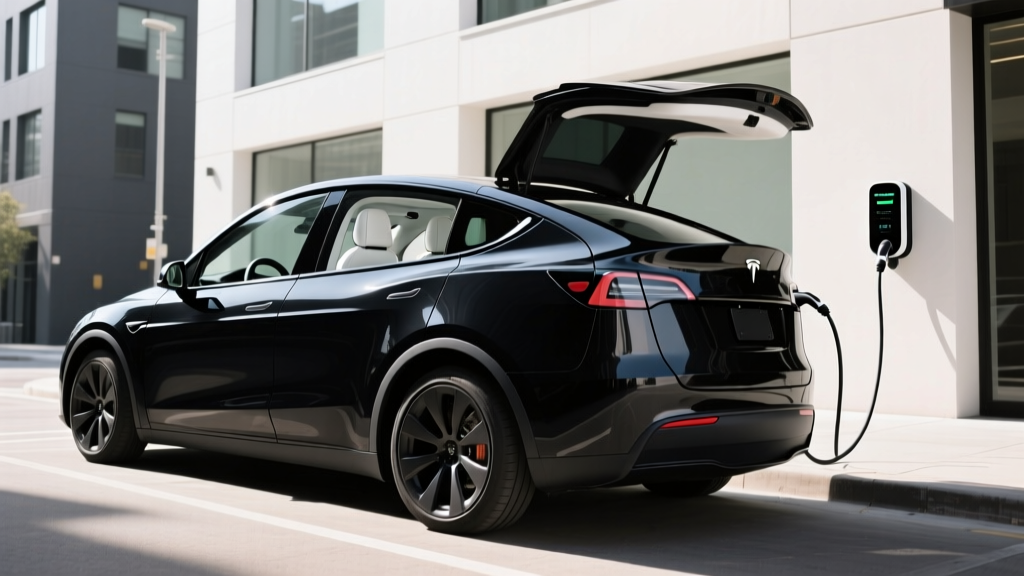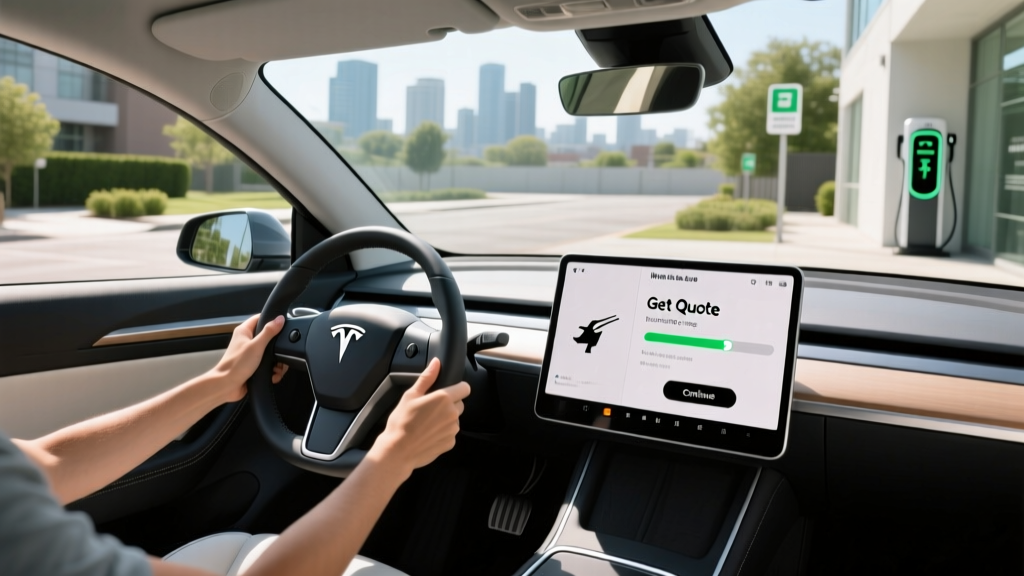
If you just took delivery of a new Tesla — or you're shopping for one and weighing ownership costs — you've probably heard that Tesla offers its own insurance product directly through the Tesla app. The promise is simple: usage-based premiums calculated from your actual driving behavior, activated in minutes without a phone call. But how does it actually work, which models qualify, and what does the vehicle you're insuring actually deliver in the real world?
This guide walks you through exactly how to get Tesla Insurance on the app in 2026, then pairs it with a comprehensive review of the vehicle most buyers are insuring this way: the 2026 Tesla Model Y Long Range AWD. You'll get the exact EPA range, charging speeds, battery chemistry, pricing, tax-credit status, and real-world ownership data you need to make an informed decision.
How to Get Tesla Insurance on the App: Step-by-Step
Tesla Insurance is available in most U.S. states as of 2026, though availability and underwriting rules vary by jurisdiction. The process is designed to take under ten minutes if your Tesla account is set up and the vehicle is already linked. Here's the exact sequence:
- Open the Tesla app on your iOS or Android device and ensure you're logged into the account tied to your vehicle's VIN.
- Navigate to your vehicle profile — tap the car icon or vehicle name at the top of the home screen.
- Locate the "Insurance" card in the services menu. If Tesla Insurance is available in your state, you'll see a prompt to request a quote.
- Enter required details: driver license numbers for all listed drivers, current address, and desired coverage levels (liability limits, comprehensive, collision deductibles).
- Review your Safety Score (if enrolled in the Safety Score program). Tesla uses real-time driving data — forward collision warnings, hard braking, aggressive turning, forced autopilot disengagements, and daily mileage — to calculate a monthly premium. Higher Safety Scores (90+) generally yield lower rates.
- Accept the quote and bind coverage. You can set a start date to align with your delivery or current policy expiration. Payment is handled through the Tesla app using a linked card or bank account.
- Download your ID cards directly from the app under the Insurance section. Most states accept digital proof of insurance.
Key caveat: Not every state offers Tesla's Safety Score-based insurance. In some states, Tesla provides a fixed-rate product underwritten by a partner carrier. Check your state's department of insurance or Tesla's state-availability page for specifics. Tesla Insurance is regulated at the state level, and premium calculation methods differ.
2026 Tesla Model Y Long Range AWD: Core Specs
The Model Y remains Tesla's volume leader in 2026, and it's the vehicle most frequently insured through the app. Below is the spec sheet for the Long Range AWD — the trim most buyers choose for its balance of range, performance, and price.
| Spec | Value |
|---|---|
| EPA Estimated Range | 320 miles |
| Battery Capacity (usable) | ~75 kWh (NMC chemistry) |
| Drivetrain | Dual-Motor AWD |
| Horsepower | 384 hp (combined) |
| 0–60 mph | 4.8 seconds |
| Peak DC Fast Charge | 250 kW (V3 Supercharger) |
| 10–80% DC Charge Time | ~25 minutes |
| Level 2 Home Charging | 11.5 kW (~44 miles/hr) |
| MPGe (combined) | 117 MPGe |
| Efficiency | 29 kWh/100 mi |
| Cargo Volume (rear seats up) | 30.2 cu ft |
| Cargo Volume (rear seats folded) | 72.1 cu ft |
| Rear Legroom | 38.4 inches |
| Battery & Drive Unit Warranty | 8 years / 120,000 miles |
| Base MSRP | $46,630 |
Sources: EPA fueleconomy.gov, Tesla Model Y specs.
Real-World Range: What the EPA Number Doesn't Tell You
Real-World Highway (70 mph, moderate temps): ~265–285 miles
Real-World Highway (cold weather, below 32°F): ~220–250 miles
City / Suburban Mixed Driving: ~290–310 miles
The Model Y Long Range AWD's 320-mile EPA figure is measured under a blended cycle that includes low-speed city driving where regenerative braking recovers significant energy. On sustained highway trips at 70–75 mph, expect to use roughly 28–31 kWh/100 mi depending on elevation, wind, and temperature — which translates to 265–285 miles before you'd want to stop at a charger.
Cold weather compounds the loss. Lithium-ion NMC batteries experience increased internal resistance below freezing, and cabin heating draws heavily from the pack even with the Model Y's standard heat pump. In sub-32°F highway driving, a 25–30% range reduction is typical. If your winter commute is 120 miles round-trip, you'll still make it — but a 250-mile winter road trip will require at least one Supercharger stop.
The heat pump (standard on all 2026 Model Y trims) is a meaningful advantage here. Older EVs without heat pumps can lose 40%+ of range in extreme cold. Tesla's system scavenges waste heat from the drivetrain and battery to warm the cabin, keeping losses closer to 25% in typical winter conditions.
Charging Speed: Supercharger Network and Home Setup
| Charging Level | Power | Miles Added per Hour | Notes |
|---|---|---|---|
| Level 1 (120V outlet) | ~1.4 kW | ~4–5 mi/hr | Emergency/trickle only |
| Level 2 (240V, 48A) | 11.5 kW | ~44 mi/hr | Full overnight charge in ~7 hrs |
| DC Fast (V3 Supercharger) | Up to 250 kW peak | ~1,000 mi/hr at peak | 10–80% in ~25 min |
| DC Fast (V4 Supercharger) | Up to 250 kW | Similar to V3 | Newer stalls; CCS adapter not needed |
Charging curve reality: The 250 kW peak only holds between roughly 10–30% State of Charge. Above 50%, the rate tapers to ~100 kW, and above 80% it drops below 40 kW. This is why Tesla (and every other manufacturer) quotes 10–80% times rather than 0–100%. On a road trip, the optimal strategy is to arrive at a Supercharger near 10–15% SoC and leave at 80% — you'll spend about 25 minutes plugged in and add roughly 220 miles of range.
For home Level 2 charging, Tesla's Wall Connector ($420 for the unit) on a 60-amp circuit delivers the full 11.5 kW / 48 amps. Most owners who drive 30–50 miles daily only need to plug in every 2–3 nights. Installation cost for a dedicated 60A circuit typically runs $500–$1,800 depending on panel proximity and local permitting — factor this into your first-year ownership budget.
The Model Y uses Tesla's NACS (North American Charging Standard) connector natively. As of 2026, most non-Tesla DC fast-charging networks (Electrify America, EVgo, ChargePoint) have added NACS cables or offer adapters, and Tesla Superchargers now welcome non-Tesla EVs at many locations. The ecosystem has converged significantly.
Pricing, Trims, and Federal Tax Credit Eligibility
| Trim | Base MSRP | Est. Price After §30D Credit* |
|---|---|---|
| Long Range AWD | $46,630 | ~$39,130 |
| Performance AWD | $51,630 | ~$44,130 |
*Assumes full $7,500 federal tax credit. Actual eligibility depends on buyer income, vehicle MSRP cap compliance, and battery critical-mineral sourcing requirements under IRS §30D rules. Consult a tax professional.
§30D Eligibility Checklist for the 2026 Model Y:
- MSRP Cap: The Model Y qualifies as an SUV under IRS vehicle-class definitions, so the MSRP cap is $80,000. All trims clear this easily.
- Buyer Income Cap: Modified AGI must not exceed $150,000 (single), $225,000 (head of household), or $300,000 (joint filers).
- Battery Sourcing: The Model Y's battery pack must meet critical-mineral and battery-component sourcing thresholds that tighten annually. Tesla has shifted significant supply-chain sourcing to qualifying partners, but confirm current-year eligibility on the IRS qualified-vehicle list before purchase.
- Point-of-Sale Transfer: As of 2024 and continuing in 2026, you can transfer the credit to the dealer at purchase, reducing your out-of-pocket cost by up to $7,500 at the point of sale rather than waiting to claim it on your tax return.
The Performance trim adds a ~$5,000 premium for a 3.5-second 0–60 time, 21-inch Überturbine wheels, performance brakes, and a slightly lower EPA range (~285 miles). For most buyers, the Long Range AWD at ~$39,130 after the credit is the value sweet spot.
Tech, Driver Assistance, and Insurance Implications
The Model Y's tech stack is the reason Tesla Insurance exists as a product. The vehicle's sensor suite and data pipeline feed directly into the Safety Score system that determines your premium.
Standard Autopilot (included) provides lane-keeping, adaptive cruise control, and automatic emergency braking. This is an SAE Level 2 driver-assistance system — meaning the driver must remain fully attentive, keep hands on the wheel, and be prepared to take over at any moment. It is not self-driving.
Full Self-Driving (Supervised) remains an $8,000 add-on (or $99/month subscription) in 2026. It enhances Autopilot with city-street navigation and intersection handling but still requires the driver to monitor and intervene.
The infotainment system runs on a 15.4-inch center touchscreen with no physical instrument cluster. Navigation, media, climate, and vehicle settings all route through this screen. The 2026 refresh (introduced for the "Juniper" update) added ventilated front seats, ambient lighting, a rear-seat touchscreen, power-folding second row, and improved cabin noise isolation — addressing the most common complaints from the prior generation.
How this ties to insurance: Tesla's Safety Score algorithm monitors five metrics — forward collision warning sensitivity, hard braking events, aggressive turning, forced Autopilot disengagements, and daily miles driven. Drivers who maintain a Safety Score above 90 typically see premiums 20–40% lower than comparable traditional insurance quotes. Aggressive drivers or those with frequent hard-braking events may actually pay more than a standard policy. If your driving style is moderate and predictable, Tesla Insurance through the app is likely a genuine savings.
Who the Model Y Suits Best (and Who Should Look Elsewhere)
Ideal for:
- Daily commuters driving 30–80 miles round-trip with home Level 2 charging — you'll rarely visit a public charger.
- Small families needing 30+ cu ft of cargo space and easy car-seat access via wide rear doors.
- Tech-forward buyers who want over-the-air updates, app-based climate preconditioning, and integrated insurance.
- Road-trippers who value the Supercharger network's reliability and density across the U.S. interstate system.
Consider alternatives if:
- You need three-row seating — the Model Y's optional third row is extremely tight and best suited to small children only. Look at the Kia EV9 or Tesla Model X instead.
- You tow frequently — the Model Y's 3,500-lb towing capacity is adequate for a small trailer but not a boat or camper. The Ford F-150 Lightning or Rivian R1S handle heavier loads.
- You lack home charging access and your area has sparse public DC fast-charging infrastructure. Any EV is harder to own without reliable overnight charging.
Pros
- 320-mile EPA range covers most daily needs with margin
- 250 kW Supercharger access; 10–80% in ~25 min
- Class-leading Supercharger network reliability
- Integrated insurance via app with usage-based pricing
- Strong efficiency: 29 kWh/100 mi (117 MPGe)
- Juniper refresh: quieter cabin, ventilated seats, rear screen
- Over-the-air updates add features post-purchase
Cons
- Real-world highway range drops to ~265–285 mi
- Cold-weather range loss of 25–30% (even with heat pump)
- No physical buttons — all controls on touchscreen
- Insurance Safety Score penalizes aggressive driving
- Rear visibility limited by sloping roofline
- $8,000 FSD add-on still requires full driver attention
- Insurance not available in every U.S. state
2026 Model Y vs. Key Competitors: Is It Still the Default?
| Vehicle | EPA Range | 10–80% DC Charge | Base MSRP | Max DC kW |
|---|---|---|---|---|
| Tesla Model Y LR AWD | 320 mi | ~25 min | $46,630 | 250 kW |
| Hyundai Ioniq 5 Long Range AWD | 290 mi | ~18 min | $47,500 | 350 kW (800V) |
| Ford Mustang Mach-E Extended Range AWD | 312 mi | ~35 min | $48,995 | 150 kW |
| Kia EV6 GT-Line AWD | 282 mi | ~18 min | $48,500 | 350 kW (800V) |
The Model Y's advantage in 2026 is less about any single spec and more about the ecosystem: Supercharger access, integrated insurance, app-based ownership, and Tesla's OTA update cadence. The Hyundai Ioniq 5 and Kia EV6 charge faster on compatible 350 kW chargers thanks to their 800-volt architecture, but those chargers are less common than V3 Superchargers in many regions.
The Mach-E offers a more traditional driving feel and physical controls, which appeals to buyers transitioning from gas vehicles. But its slower DC charging and smaller service network are trade-offs.
If the Supercharger network, Tesla Insurance savings, and the app-centric ownership experience matter to you, the Model Y remains the most cohesive package. If faster DC charging on non-Tesla networks and a more conventional interior layout are priorities, the Ioniq 5 is a compelling alternative.
Frequently Asked Questions
Can I get Tesla Insurance before taking delivery?
Yes. Once your vehicle's VIN is assigned and linked to your Tesla account (usually a few days before delivery), the Insurance card appears in the app. You can bind coverage with a future effective date matching your delivery day.
Does Tesla Insurance cost less than traditional insurers?
It depends on your driving behavior. Tesla's Safety Score-based pricing rewards smooth, low-mileage drivers with premiums often 20–40% below market averages. However, drivers with frequent hard-braking events, high mileage, or forced Autopilot disengagements may find traditional insurers cheaper. Always get a comparison quote from at least one traditional carrier before committing.
What happens if my Safety Score drops mid-policy?
Tesla Insurance recalculates premiums monthly based on the preceding 30 days of driving data. If your score drops, your next month's premium increases. Conversely, improving your score reduces it. There's no long-term lock-in penalty — the system is designed to be responsive.
Is the 2026 Model Y eligible for the full $7,500 federal tax credit?
The Model Y qualifies under the SUV MSRP cap ($80,000), and Tesla has worked to meet critical-mineral sourcing requirements. However, eligibility depends on your income (AGI caps apply), the specific vehicle's battery component sourcing in the current tax year, and whether you've reached the per-buyer credit limit. Always verify on the IRS clean vehicle credit page and consult a tax professional before relying on the credit.
Does the Model Y battery degrade significantly over time?
Tesla's NMC battery pack is warranted for 8 years or 120,000 miles, whichever comes first, with a minimum 70% capacity retention threshold. Real-world data from high-mileage Tesla owners suggests typical degradation of 8–12% over the first 100,000 miles, with the curve flattening significantly after the initial break-in period. To maximize longevity, Tesla recommends daily charging to 80% for NMC packs and reserving 100% charges for road trips.
What's the real cost to charge a Model Y at home?
At the U.S. average residential electricity rate of ~$0.17/kWh (2026), fully charging the 75 kWh usable pack costs roughly $12.75 for 320 miles of range — about $0.04 per mile. Compare that to a 25 MPG gas vehicle at $3.40/gallon: $0.136 per mile. Over 15,000 annual miles, that's a fuel savings of approximately $1,440 per year, or $7,200 over five years. Your actual savings depend on local electricity rates and whether you have access to time-of-use pricing or solar.