If you've searched "Tesla inside" you're likely trying to answer one of two questions: what is the cabin actually like to sit in, and how does Tesla's minimalist interior stack up against rivals in 2026? After spending extended time in the current-generation Model 3 Highland refresh and the Juniper-updated Model Y, we can give you a data-backed answer that goes well beyond the marketing renderings.
Tesla's interior philosophy remains polarizing — a single central screen, no traditional instrument cluster, and a design language that prioritizes aerodynamic efficiency and manufacturing simplicity over button-heavy dashboards. But beneath the minimalism lies a cabin that has improved materially in materials quality, noise isolation, and software sophistication. Here's everything you need to know about what's inside a Tesla in 2026, paired with the hard numbers on range, charging, and pricing that matter for your purchase decision.
What's Inside a Tesla: The 2026 Cabin Experience
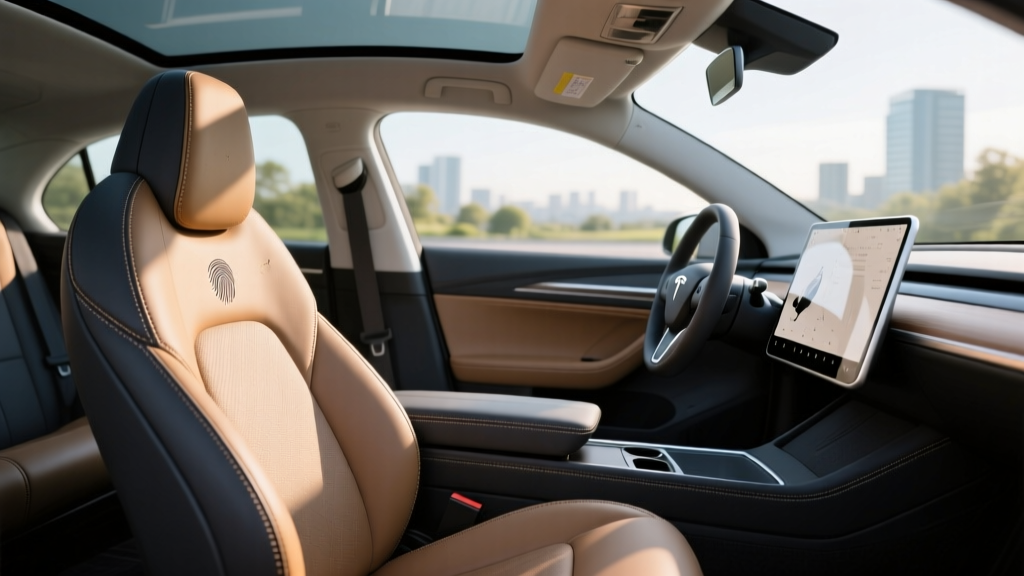
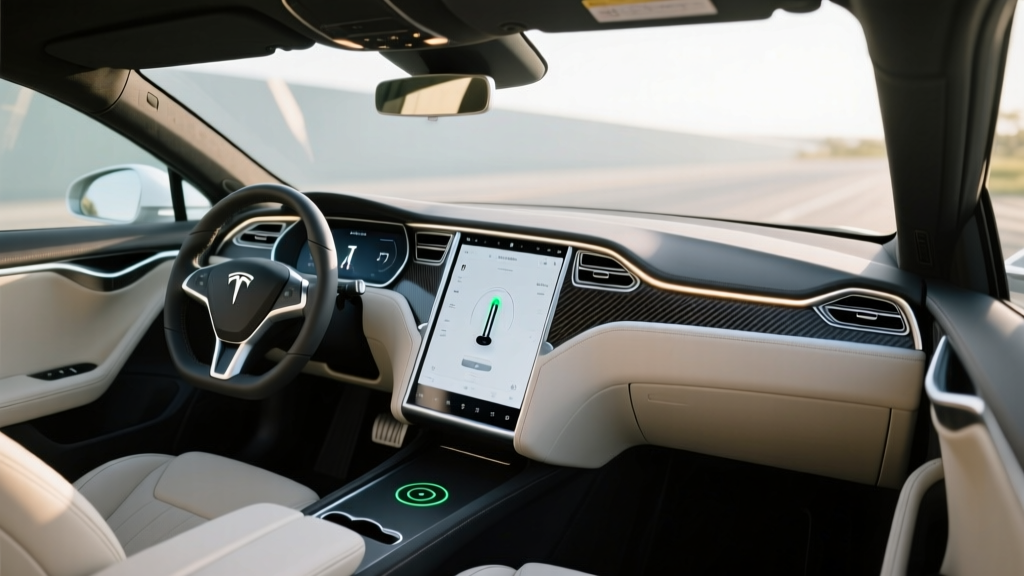
The current Model 3 (Highland generation) and Model Y (Juniper refresh) share Tesla's latest interior architecture. The centerpiece is a 15.4-inch central touchscreen that controls virtually every vehicle function — climate, mirrors, glovebox, driving modes, and entertainment. There is no head-up display, no traditional gauge cluster, and no physical buttons for HVAC or volume (though a steering wheel scroll wheel handles volume and media).
Material quality in the 2026 Model 3 and Model Y represents a significant step up from pre-2023 Teslas. Soft-touch materials cover the dashboard upper, door panels feature fabric and vegan leather inserts, and ambient lighting strips run along the dashboard and doors. The seats use Tesla's synthetic leather, which has improved in breathability and bolster support. Panel gaps — historically a Tesla complaint — have tightened considerably at both the Fremont and Shanghai factories.
The rear seat in the Model 3 offers 35.3 inches of legroom, adequate for adults on shorter trips but tight for six-foot passengers behind a tall driver. The Model Y provides more generous rear space with 40.5 inches of legroom and a higher hip point, making it the clear choice for families. Both vehicles include a rear-seat touchscreen (8 inches in the Model 3 Highland, integrated into the rear center console armrest) for climate and entertainment control.
Range, Battery & Efficiency: Model 3 vs. Model Y
The most important number inside any EV is how far it goes on a charge. Here's how the 2026 Tesla lineup stacks up according to EPA estimates on fueleconomy.gov:
| Model | Trim | EPA Range | Battery (kWh) | Chemistry | MPGe (Combined) | kWh/100mi |
|---|---|---|---|---|---|---|
| Model 3 | RWD | 272 mi | ~60 kWh (usable) | LFP | 132 MPGe | 25 |
| Model 3 | Long Range AWD | 341 mi | ~75 kWh (usable) | NMC | 132 MPGe | 25 |
| Model 3 | Performance | 315 mi | ~75 kWh (usable) | NMC | 119 MPGe | 28 |
| Model Y | Long Range AWD | 320 mi | ~75 kWh (usable) | NMC | 122 MPGe | 27 |
| Model Y | Performance | 293 mi | ~75 kWh (usable) | NMC | 111 MPGe | 30 |
How Fast Does a Tesla Charge?
Charging speed is where Tesla's Supercharger network advantage becomes tangible. Both the Model 3 and Model Y support the NACS (North American Charging Standard) connector natively — no adapter needed at Tesla Superchargers.
| Charging Level | Power (kW) | Speed | Notes |
|---|---|---|---|
| Level 1 (120V household) | ~1.4 kW | ~4-5 mi/hr | Emergency/trickle only |
| Level 2 (240V home, 48A) | 11.5 kW | ~37-44 mi/hr | Full charge overnight (~8-9 hrs) |
| DC Fast (Supercharger V3) | Peak 250 kW | 10-80% in ~25 min | Curve tapers significantly above 60% |
| DC Fast (Supercharger V4) | Peak 250-350 kW* | 10-80% in ~20 min* | *Model-dependent; current vehicles limited to ~250 kW |
A critical detail many buyers miss: peak kW is not sustained kW. The Model 3 Long Range hits 250 kW only between roughly 10-30% state of charge (SoC). By 50% SoC, the rate drops to approximately 150 kW, and above 80% it falls below 50 kW. This charge-curve taper is why Tesla quotes 10-80% times rather than 0-100%. For road trips, plan to charge in the 10-80% window and skip the slow top-off unless you need those final miles.
For home charging, a Tesla Wall Connector on a 60-amp circuit delivers 48 amps (11.5 kW), adding roughly 37-44 miles of range per hour of charging. A typical overnight session (8 hours) fully replenishes even a depleted Long Range battery. Installation costs vary widely — expect $800-$2,000 for a standard install if your electrical panel has capacity, or $2,500-$5,000+ if a panel upgrade to 200A is needed.
Performance: 0-60 Times and Powertrain Specs
Tesla's dual-motor all-wheel-drive powertrains deliver performance that would cost significantly more in a gasoline vehicle:
- Model 3 RWD: 283 hp, 0-60 mph in 5.8 seconds, single rear motor
- Model 3 Long Range AWD: ~384 hp combined, 0-60 mph in 4.2 seconds, dual motor
- Model 3 Performance: ~510 hp combined, 0-60 mph in 2.9 seconds, dual motor with track-oriented tuning
- Model Y Long Range AWD: ~384 hp combined, 0-60 mph in 4.8 seconds, dual motor
- Model Y Performance: ~510 hp combined, 0-60 mph in 3.5 seconds, dual motor
All models feature regenerative braking with one-pedal driving capability. The heat pump is standard across the lineup, improving cabin heating efficiency in cold weather and reducing the range penalty that older resistance-heater EVs suffered.
2026 Pricing and Federal Tax Credit Eligibility
Here's where the math gets specific — and where many buyers make errors. Federal tax credit eligibility under IRS §30D rules depends on three factors: your taxable income, the vehicle's MSRP, and battery component/mineral sourcing requirements.
| Model | Base MSRP (2026) | MSRP Cap Met? | Est. Credit | Effective Price* |
|---|---|---|---|---|
| Model 3 RWD | ~$38,990 | Yes (sedan cap: $55,000) | Up to $7,500** | ~$31,490 |
| Model 3 Long Range | ~$45,240 | Yes | Up to $7,500** | ~$37,740 |
| Model 3 Performance | ~$52,990 | Yes | Up to $7,500** | ~$45,490 |
| Model Y Long Range | ~$46,630 | Yes (SUV cap: $80,000) | Up to $7,500** | ~$39,130 |
| Model Y Performance | ~$51,490 | Yes | Up to $7,500** | ~$43,990 |
*Effective price assumes full $7,500 credit eligibility. **Credit amount depends on battery sourcing compliance — currently $3,750 for meeting critical minerals requirements and $3,750 for battery component requirements. Tesla's sourcing compliance has fluctuated; verify current status at purchase. Income caps: $150,000 single / $225,000 head of household / $300,000 joint filers (modified AGI). The credit can be transferred to the dealer at point of sale as an upfront discount.
- Buyer income below caps (single: $150K, joint: $300K MAGI)
- Vehicle MSRP under $55,000 (sedans) or $80,000 (SUVs/trucks)
- Battery critical minerals sourced from FTA countries (partial $3,750)
- Battery components manufactured/assembled in North America (partial $3,750)
- Vehicle assembled in North America
- Point-of-sale transfer available — reduces purchase price at delivery
Interior Tech, Autopilot & Smart Features
Inside the Tesla cabin, software is the differentiator. The infotainment system runs on Tesla's proprietary OS with no Apple CarPlay or Android Auto — a dealbreaker for some, a non-issue for Tesla loyalists who prefer the native interface. Key tech features include:
- Navigation with real-time Supercharger routing — the car plans charging stops and preconditions the battery automatically
- Over-the-air updates — new features, UI improvements, and efficiency tweaks delivered wirelessly
- Tesla Theater — Netflix, YouTube, Disney+, and gaming while parked
- Dashcam and Sentry Mode — 360-degree camera recording with USB storage
- Phone-as-key — Bluetooth-based entry with no fob needed
- Bioweapon Defense Mode — HEPA filtration system (Model Y standard, Model 3 available)
FSD (Supervised) costs $8,000 as a one-time purchase or $99/month as a subscription. In practice, it excels on highways and has improved significantly in urban environments, but it still requires active supervision and occasional intervention. Buyers should test it thoroughly before committing to the purchase price.
Cargo Space and Practicality
Tesla's skateboard platform enables both a rear trunk and a front trunk (frunk), providing more total storage than comparable sedans and crossovers:
- Model 3: 23 cu ft total cargo (trunk + frunk), rear seats fold 60/40
- Model Y: 72 cu ft behind front seats (seats folded), 30 cu ft behind second row, plus frunk
- Model Y (7-seat option): Third row is best suited for children under 5'4"; reduces cargo to ~12 cu ft behind third row
For families, the Model Y's liftback design and higher cargo floor make loading strollers, groceries, and luggage significantly easier than the Model 3's sedan trunk opening. Towing capacity is 3,500 lbs for the Model Y (Long Range and Performance) — adequate for a small trailer or pair of jet skis, but not for heavy boat or camper towing.
Warranty Coverage
Tesla's warranty structure is competitive with the EV market:
- Basic Vehicle: 4 years / 50,000 miles (whichever comes first)
- Battery & Drive Unit (RWD/LFP): 8 years / 100,000 miles, minimum 70% capacity retention
- Battery & Drive Unit (Long Range/Performance/NMC): 8 years / 120,000 miles, minimum 70% capacity retention
The 70% retention threshold is standard across the industry. In practice, Tesla's NMC batteries typically retain 85-90% capacity at 100,000 miles based on fleet data, while LFP batteries show even slower degradation and can be charged to 100% regularly without harm. Battery replacement out of warranty currently costs approximately $12,000-$16,000 depending on the pack — a number expected to decrease as battery costs continue falling.
Pros, Cons & Who Should Buy
- Access to the Tesla Supercharger network — still the most reliable DC fast-charging network in North America
- Industry-leading software: OTA updates, navigation, trip planning, and entertainment
- Strong efficiency (25-30 kWh/100mi) maximizes range per kWh
- LFP battery option (RWD trims) allows daily 100% charging with minimal degradation
- Competitive pricing after tax credits — Model 3 RWD under $32K with full credit
- Improving build quality and cabin materials in Highland/Juniper generations
- No Apple CarPlay or Android Auto — a significant drawback for smartphone-reliant drivers
- Minimalist interior lacks physical controls for mirrors, HVAC vents, and glovebox (screen-only)
- Rear-seat space in Model 3 is tight for tall adults
- FSD (Supervised) remains Level 2 — expensive for what it delivers vs. the promise
- Insurance costs are 20-40% higher than comparable non-Tesla vehicles in many markets
- Service center wait times can be long in high-demand metro areas
- Choose the Model 3 RWD if: You're a commuter with home charging who wants the lowest entry price and can charge to 100% daily (LFP battery). Ideal for solo drivers or couples.
- Choose the Model 3 Long Range if: You take regular road trips of 250+ miles and want maximum range with dual-motor AWD for snow/rain.
- Choose the Model Y Long Range if: You have a family, need easy cargo access, or want an SUV ride height. The most versatile Tesla for the money.
- Choose the Model 3/Y Performance if: Track capability and sub-3.5-second 0-60 times matter more than range maximization.
- Look elsewhere if: You require CarPlay/Android Auto, prefer physical buttons, need a third row for adults, or want Level 4 autonomous capability.
How Does Tesla Compare to Key Competitors?
The Tesla Model 3 and Model Y face stiff competition in 2026. The Hyundai Ioniq 5 and Kia EV6 offer comparable range (305-310 mi), 800V architecture for faster DC charging (10-80% in ~18 min), and physical controls. The Ford Mustang Mach-E provides a more traditional crossover feel with CarPlay support. The BMW i4 delivers a premium sedan experience with superior build quality at a higher price point.
Tesla's advantages remain the Supercharger network, software ecosystem, and price-to-range ratio. Its vulnerabilities are the lack of CarPlay, the touchscreen-only control philosophy, and service accessibility in some regions. According to IIHS ratings, both the Model 3 and Model Y have earned Top Safety Pick+ designations, addressing earlier concerns about crash-test performance.
Frequently Asked Questions
What is the real-world range of a Tesla?
Expect 85-90% of EPA-rated range in mixed highway driving at moderate temperatures. The Model 3 Long Range (341 mi EPA) delivers approximately 290-310 miles in real-world conditions at 65-70 mph. Cold weather (below freezing) reduces range by an additional 15-25% due to battery chemistry limitations and cabin heating demands, even with the heat pump.
How fast does a Tesla charge at home and on the road?
At home on a Level 2 Tesla Wall Connector (11.5 kW / 48A), you'll add 37-44 miles per hour, fully charging overnight in 7-9 hours. On DC fast charging (Supercharger V3), the Model 3/Y peaks at 250 kW and charges 10-80% in approximately 25 minutes, though the rate tapers significantly above 60% SoC.
How much does a Tesla cost after the federal tax credit?
The 2026 Model 3 RWD starts at approximately $38,990 MSRP. With the full $7,500 federal tax credit (if you meet income caps and the vehicle meets sourcing requirements), the effective price drops to roughly $31,490. The Model Y Long Range at ~$46,630 MSRP becomes approximately $39,130 after credit. Always verify current sourcing compliance and your personal income eligibility at the point of purchase.
Is a Tesla worth buying vs. Hyundai, Kia, or Ford EVs?
If Supercharger access, software integration, and price-per-mile-of-range are your priorities, Tesla remains the benchmark. If you prefer physical controls, CarPlay/Android Auto, or faster peak DC charging (800V platforms like the Ioniq 5), competitors offer compelling alternatives. Test drive both before deciding.
Does Tesla qualify for the $7,500 federal EV tax credit?
Tesla vehicles assembled in North America meet the assembly requirement. However, the full $7,500 credit depends on battery component and critical mineral sourcing rules that have shifted periodically. As of early 2026, verify current eligibility on IRS.gov or confirm with your Tesla advisor at purchase. The credit can be applied as a point-of-sale reduction.
What are the biggest drawbacks of Tesla's interior?
The absence of Apple CarPlay/Android Auto is the most-cited complaint. The all-touchscreen control scheme (including mirror adjustment and HVAC vent direction) frustrates some drivers. Rear-seat comfort in the Model 3 is adequate but not generous. And while build quality has improved, some competitors still surpass Tesla in panel consistency and material richness at similar price points.