The Texas-Built Tesla Lineup: What Gigafactory Texas Means for Buyers
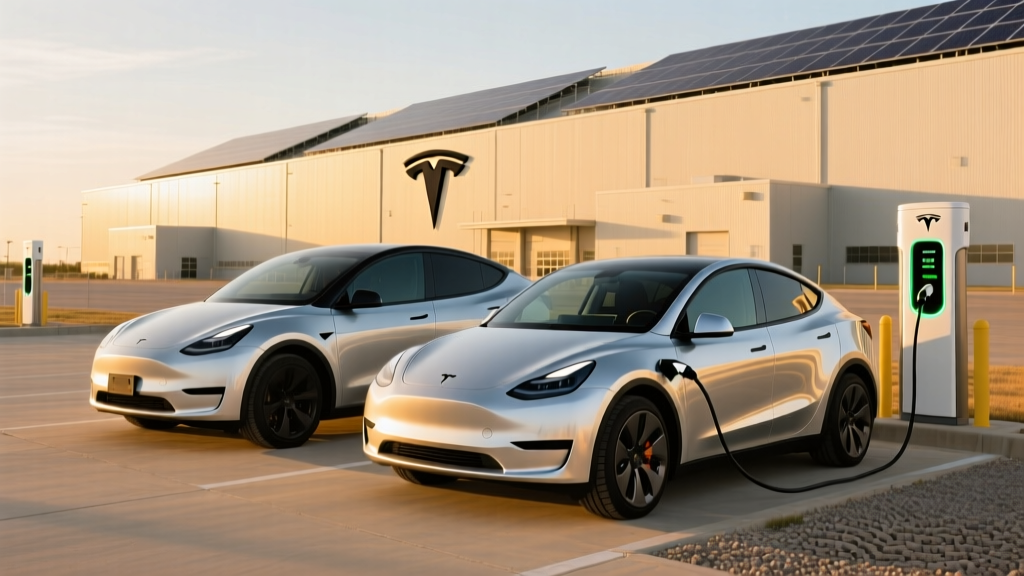
Since Gigafactory Texas in Austin began production, it has become the primary U.S. manufacturing hub for Tesla's highest-volume vehicles. For buyers researching Tesla in Texas, the practical question isn't just where the car is assembled — it's how Austin-built Model Y and Model 3 variants perform in real-world conditions, what they cost after federal incentives, and whether the local Supercharger infrastructure supports daily driving and road trips across the state's vast distances.
This guide profiles the current Tesla models built at Giga Texas, with exact EPA figures, battery chemistry details, charging curves, and a breakdown of 2026 federal tax credit eligibility under IRS §30D rules.
Model Y: The Texas-Built Best-Seller
The Model Y Long Range AWD and Performance variants continue to be produced at Giga Texas and remain Tesla's most popular offering. The 2026 Model Y benefits from incremental efficiency improvements and Tesla's structural battery pack architecture, which integrates the battery into the vehicle chassis for improved rigidity and slightly lower manufacturing cost.
| Specification | Long Range AWD | Performance |
|---|---|---|
| EPA Range | 320 miles | 295 miles |
| Battery (usable) | ~75 kWh (NMC) | ~75 kWh (NMC) |
| Drivetrain | Dual Motor AWD | Dual Motor AWD |
| Horsepower | 384 hp | 456 hp |
| 0–60 mph | 4.8 seconds | 3.5 seconds |
| Efficiency | 122 MPGe / 28 kWh/100mi | 111 MPGe / 30 kWh/100mi |
| Cargo (rear seats up) | 30.2 cu ft | 30.2 cu ft |
| Cargo (rear seats folded) | 72.1 cu ft | 72.1 cu ft |
| Base MSRP | $44,990 | $48,990 |
Model 3: The Austin-Produced Sedan Option
The refreshed Model 3 (internally known as "Highland" and subsequent revisions) is also assembled at Giga Texas. The Long Range RWD and AWD variants offer sedan efficiency with competitive range at a lower entry price than the Model Y.
| Specification | Long Range RWD | Long Range AWD |
|---|---|---|
| EPA Range | 363 miles | 346 miles |
| Battery (usable) | ~75 kWh (NMC) | ~75 kWh (NMC) |
| Drivetrain | Rear-Wheel Drive | Dual Motor AWD |
| Horsepower | 271 hp | 346 hp |
| 0–60 mph | 5.8 seconds | 4.2 seconds |
| Efficiency | 132 MPGe / 26 kWh/100mi | 125 MPGe / 27 kWh/100mi |
| Trunk + Frunk | 23.0 cu ft total | 23.0 cu ft total |
| Rear Legroom | 35.2 inches | 35.2 inches |
| Base MSRP | $39,990 | $44,990 |
Charging Speed: DC Fast Charging and Home Level 2
Charging infrastructure is where Tesla's Texas presence is strongest. The state has over 130 Supercharger stations as of early 2026, with dense coverage along I-35, I-10, I-45, and I-20 corridors. Both the Model Y and Model 3 support Tesla's peak DC fast-charging architecture.
| Charging Method | Power / Rate | Speed / Time |
|---|---|---|
| DC Fast Charge (V3 Supercharger) | Peak 250 kW | 10–80% in ~25 min (adds ~170 mi in 15 min) |
| DC Fast Charge (V4 Supercharger) | Peak 250–350 kW* | 10–80% in ~20 min (model-dependent) |
| Level 2 Home (Tesla Wall Connector) | 11.5 kW (48A) | ~37 miles of range per hour |
| Level 2 Home (40A circuit) | 9.6 kW | ~30 miles of range per hour |
| Level 1 (120V outlet) | ~1.4 kW | ~3–5 miles of range per hour |
*V4 Supercharger peak rates depend on vehicle architecture. Current Model Y and Model 3 peak around 250 kW; future 800V architectures will unlock higher rates.
Charging curve reality: Both the Model Y and Model 3 sustain peak charging rates only up to approximately 50–55% State of Charge. Above 80%, charging slows dramatically to protect battery longevity — a 5–90% session at a V3 Supercharger takes roughly 40–45 minutes, not the 25 minutes a 10–80% session requires. For Texas road trips, plan stops around the 10–80% window to minimize time at the charger.
2026 Federal Tax Credit Eligibility (§30D Rules)
The federal EV tax credit under IRS §30D remains a decisive factor for Tesla buyers. Because Tesla vehicles are assembled in Austin, Texas (a U.S. plant), they clear the final-assembly requirement. However, eligibility depends on multiple factors that change periodically.
| Model / Trim | Base MSRP | Max §30D Credit | Effective Price (if eligible) |
|---|---|---|---|
| Model 3 Long Range RWD | $39,990 | Up to $7,500 | ~$32,490 |
| Model 3 Long Range AWD | $44,990 | Up to $7,500 | ~$37,490 |
| Model Y Long Range AWD | $44,990 | Up to $7,500 | ~$37,490 |
| Model Y Performance | $48,990 | Up to $7,500 | ~$41,490 |
Critical eligibility requirements for 2026:
- MSRP caps: Vans, SUVs, and pickups (Model Y qualifies as an SUV) must have an MSRP at or below $80,000. Sedans (Model 3) must be at or below $55,000. All current Tesla trims clear these caps.
- Income limits: Modified Adjusted Gross Income (MAGI) must not exceed $150,000 (single), $225,000 (head of household), or $300,000 (married filing jointly).
- Battery sourcing: A percentage of critical minerals and battery components must be sourced from the U.S. or free-trade-agreement countries. These thresholds increase annually. Tesla has been progressively reshoring its supply chain, but the exact credit amount ($3,750 for minerals, $3,750 for components) varies by build date and sourcing compliance.
- Point-of-sale transfer: As of 2024, buyers can transfer the credit to the dealer at purchase, reducing the upfront cost rather than waiting for a tax refund. Tesla participates in this program.
Always verify current eligibility on irs.gov or through Tesla's checkout page, which displays the applicable credit for your specific configuration and delivery date. Battery sourcing rules are subject to change, and a vehicle eligible in January may have different eligibility by mid-year.
Battery Chemistry, Warranty, and Long-Term Ownership
Tesla's Giga Texas vehicles primarily use NMC (nickel manganese cobalt) battery chemistry in Long Range and Performance trims, chosen for its higher energy density compared to LFP (lithium iron phosphate). Some Standard Range variants have used LFP in prior model years, which offers longer cycle life but lower energy density and reduced cold-weather performance.
| Coverage | Model 3 | Model Y |
|---|---|---|
| Battery Warranty | 8 years / 120,000 miles (Long Range) | 8 years / 120,000 miles |
| Minimum Capacity Retention | 70% | 70% |
| Drive Unit Warranty | 8 years / 120,000 miles | 8 years / 120,000 miles |
| Basic Vehicle Warranty | 4 years / 50,000 miles | 4 years / 50,000 miles |
Real-world degradation data from Tesla's fleet indicates that NMC batteries typically lose 5–8% capacity in the first 50,000 miles, then degrade more slowly. Most owners report retaining 90%+ capacity at 100,000 miles. The 70% retention threshold in the warranty is a floor — not an expectation. For context, a Model Y with 120,000 miles and 85% battery health would still deliver roughly 272 miles of range from its original 320-mile EPA rating.
Driver Assistance: Autopilot and FSD (Supervised)
Every Tesla ships with Basic Autopilot, which includes Traffic-Aware Cruise Control and Autosteer (lane-centering). This is an SAE Level 2 driver-assistance system — the driver must remain engaged, hands on or near the wheel, and eyes on the road at all times.
Full Self-Driving (Supervised) costs $8,000 as a one-time purchase or $99/month as a subscription (pricing as of early 2026). Its value depends on your commute: drivers with long highway stretches or complex urban navigation may benefit, while those with simple commutes may find Basic Autopilot sufficient. FSD capability continues to improve via over-the-air updates, but it remains a supervised system with known limitations in construction zones, unmapped roads, and severe weather.
Tech, Interior, and Daily Livability
Tesla's minimalist interior approach polarizes buyers. The 15.4-inch center touchscreen handles nearly all vehicle controls — there are no physical buttons for climate, media, or glovebox release. The 2026 Model Y refresh ("Juniper") brought improved acoustic glass, ventilated front seats, ambient lighting, and a rear-seat touchscreen, addressing common complaints about cabin noise and rear-passenger comfort.
Standout features:
- Over-the-air software updates that add features post-purchase
- Tesla Supercharger network reliability (consistently rated highest among DC fast-charging networks)
- Sentry Mode dashcam recording and remote monitoring via the Tesla app
- Heat pump HVAC standard on all trims (improves cold-weather range and cabin heating efficiency)
- Frunk (front trunk) on Model 3; Model Y has minimal front storage
Notable drawbacks:
- No Apple CarPlay or Android Auto — Tesla's native infotainment only
- Turn signal stalks removed on recent builds (steering-wheel-mounted buttons instead, which frustrates some drivers)
- Panel gap quality, while improved, still trails legacy luxury automakers
- Limited service center density outside major Texas metros — mobile service handles minor issues, but body repair can involve long wait times
Pros
- Best-in-class Supercharger network with 130+ Texas stations
- Excellent real-world efficiency (26–30 kWh/100mi)
- Strong federal tax credit eligibility (U.S.-assembled)
- OTA updates continuously improve the vehicle
- Spacious cargo area (Model Y: 72 cu ft seats-down)
Cons
- No smartphone integration (CarPlay/Android Auto)
- Steep FSD price for a Level 2 system
- Service access limited outside Houston, Dallas, Austin, San Antonio
- Insurance premiums 15–25% higher than comparable ICE vehicles
- Minimalist interior isn't for everyone
Who Should Buy a Texas-Built Tesla?
Choose the Model Y if: You need crossover cargo space for a family, want AWD for occasional Hill Country or Panhandle weather, and prioritize the most mature public charging network for road trips across Texas's 268,596 square miles.
Choose the Model 3 Long Range RWD if: You commute long distances on I-35 or I-45, want the maximum possible range per dollar, and don't need the ride height or cargo volume of a crossover. The 363-mile EPA rating is genuinely exceptional for the price.
Look elsewhere if: You need Apple CarPlay, prefer physical buttons, live far from a Tesla service center, or want a true Level 4 autonomous experience (no consumer vehicle offers this as of 2026). For buyers who tow frequently, neither the Model 3 nor Model Y is ideal — consider the Rivian R1S, Ford F-150 Lightning, or Tesla's own Cybertruck for serious towing duty.
Frequently Asked Questions
What is the real-world range of a Tesla in Texas heat?
In sustained 95–105°F summer temperatures common across Texas, expect 5–10% range reduction compared to EPA estimates due to battery cooling demands and air conditioning. A Model Y Long Range rated at 320 miles EPA will typically deliver 280–300 miles in peak summer highway driving. Preconditioning the battery while plugged in mitigates some of this loss.
How fast does a Tesla charge at a Texas Supercharger?
At a V3 Supercharger (250 kW peak), both the Model Y and Model 3 charge from 10–80% in approximately 25 minutes under ideal conditions. The charge curve tapers significantly above 80% — a 10–90% session takes roughly 40 minutes. V4 Superchargers with higher peak rates are rolling out but current Model Y/3 architecture caps around 250 kW.
Does Tesla in Texas qualify for the $7,500 federal tax credit?
Yes — with caveats. Both the Model Y and Model 3 built at Giga Texas qualify for up to $7,500 under IRS §30D, provided the buyer meets income limits ($150K single / $300K joint), the vehicle MSRP is under the cap ($80K for SUVs, $55K for sedans), and battery sourcing requirements are met for that specific build. The credit can be applied at point of sale. Always verify on irs.gov before purchasing.
Is Tesla worth buying vs. competitors like the Hyundai Ioniq 5 or Ford Mustang Mach-E?
Tesla's advantages are the Supercharger network, software ecosystem, and efficiency. The Hyundai Ioniq 5 charges faster on compatible 350 kW chargers (10–80% in ~18 minutes with 800V architecture) and offers Apple CarPlay. The Ford Mustang Mach-E provides a more traditional interior with physical controls. If charging network reliability and software updates are your top priorities, Tesla wins. If you prefer CarPlay, physical buttons, or faster peak charging on non-Tesla networks, competitors are strong alternatives.
How much does home charging cost vs. gas in Texas?
At the Texas residential average of ~$0.13/kWh, fully charging a Model Y's 75 kWh battery costs roughly $9.75 for 320 miles of range — approximately $0.03 per mile. A comparable gas SUV at 25 MPG with fuel at $3.00/gallon costs $0.12 per mile. Over 15,000 miles annually, that's roughly $1,350 in fuel savings. Time-of-use plans from Texas utilities (Oncor, CenterPoint) can reduce costs further by charging overnight at off-peak rates.
What is Tesla's warranty coverage on the battery?
Tesla warrants the Model Y and Model 3 Long Range battery for 8 years or 120,000 miles, whichever comes first, with a minimum 70% capacity retention guarantee. This means if your battery degrades below 70% of its original capacity within the warranty period, Tesla will repair or replace it at no cost. Real-world data suggests most batteries retain 85–92% capacity at 100,000 miles.