If you've ever watched your EV's range estimator drop like a stone on a freezing January morning, you already know that climate control is one of the biggest variables in electric-vehicle ownership. Unlike a gas car that dumps waste engine heat into the cabin for free, an EV must generate warmth electrically — and how it does that makes a measurable difference in how far you can drive. Tesla's HVAC system, particularly its integrated heat pump architecture introduced with the Model Y and later retrofitted into refreshed Model 3 and Model S/X platforms, is widely regarded as one of the most efficient thermal-management systems in the EV industry. But what does that actually mean for your commute, your road trip, and your electricity bill?
This review examines the Tesla HVAC system across the current 2025–2026 Model Y and Model 3 lineup, covering the engineering behind the octovalve and heat pump, real-world range impact in cold and hot climates, cabin comfort metrics, and how Tesla's thermal stack compares to competitor systems from Hyundai, BMW, and Rivian.
Why Tesla's HVAC System Matters for Range
In a battery-electric vehicle, every kilowatt-hour diverted to heating or cooling the cabin is a kilowatt-hour that isn't turning the wheels. At highway speeds in moderate weather, an EV's drivetrain might consume 25–30 kWh per 100 miles. Turn on the cabin heater in 20°F weather, and that number can spike by 30–50% if the system relies on resistive (PTC) heating. A heat pump, by contrast, moves thermal energy rather than generating it from scratch, typically achieving a coefficient of performance (COP) between 2.0 and 4.0 — meaning it delivers 2–4 units of heat for every 1 unit of electricity consumed.
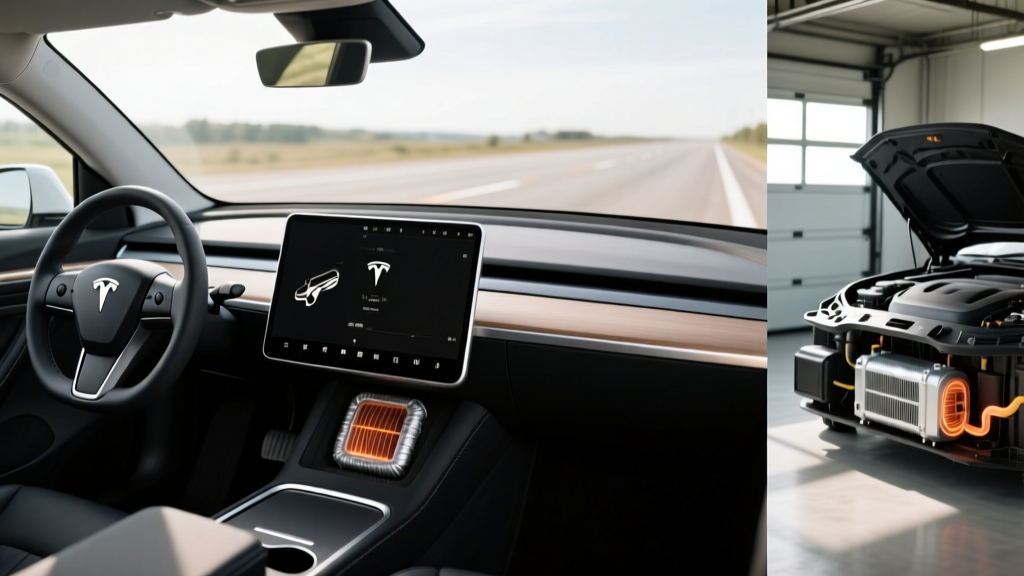
Tesla introduced its first automotive heat pump in the 2020 Model Y, paired with a component Tesla calls the "octovalve" — an eight-port refrigerant manifold that intelligently routes heat between the battery pack, drive motors, power electronics, and cabin. This integrated approach means the system can scavenge waste heat from the motors and inverter during driving and redirect it to warm the battery or the cabin, dramatically reducing the electrical load compared to a standalone PTC heater.
Tesla HVAC Architecture: Heat Pump, Octovalve, and Thermal Integration
The Tesla HVAC system is not just a cabin air conditioner bolted to a battery. It is a fully integrated thermal-management loop that treats the entire vehicle as a single thermodynamic system. Here are the core components:
- Heat pump (R-1234yf refrigerant): Extracts ambient heat from outside air (even at sub-zero temperatures) and waste heat from the powertrain to warm the cabin and battery. COP ranges from ~2.0 in extreme cold to ~4.0 in mild conditions.
- Octovalve: An eight-port rotary valve that manages refrigerant and coolant flow paths between the cabin evaporator/condenser, battery chiller, motor cooling loop, and ambient heat exchanger. It enables up to a dozen distinct thermal routing modes.
- PTC resistive heater (backup): A high-voltage positive-temperature-coefficient heater that supplements the heat pump during extreme cold starts (below ~10°F) when the heat pump's COP drops and rapid cabin warming is needed.
- Battery thermal management: Liquid-cooled/heated plate beneath the battery pack maintains optimal cell temperature (roughly 70–95°F) for charging speed, longevity, and efficiency.
- Cabin HEPA filtration (Bioweapon Defense Mode): Available on Model Y and Model S/X, this oversized HEPA filter pressurizes the cabin and filters particulates down to PM2.5 — a unique HVAC feature few competitors match.
The key advantage of this architecture is simultaneous multi-zone thermal management. On a cold morning, the system can pre-warm the battery using waste heat from the motors while also heating the cabin via the heat pump — all without resorting to energy-hungry resistive heating. According to Tesla's engineering disclosures, the heat pump system can reduce cabin-heating energy consumption by roughly 30% compared to the older PTC-only systems used in pre-2021 Model 3 vehicles.
Real-World Range Impact: Cold Weather, Hot Weather, and Highway Driving
The EPA range sticker on a Tesla tells you what the vehicle achieves in standardized laboratory testing at moderate temperatures with the climate system set to a baseline level. Real-world HVAC usage changes that picture significantly.
EPA estimated range: 320 miles
Real-world highway (70 mph, 65°F, AC on low): ~270–290 miles
Real-world highway (70 mph, 30°F, heat pump active): ~230–255 miles
Real-world highway (70 mph, 10°F, heat pump + PTC supplement): ~195–220 miles
City driving (mixed stops, 40°F, cabin at 70°F): ~280–300 miles (regen braking recovers energy lost to stops)
These numbers are based on aggregated owner data, third-party cold-weather testing from outlets like fueleconomy.gov, and independent EV range tests. The heat pump's contribution is most visible in the 20–40°F range, where it maintains a COP above 2.5 and keeps range loss to roughly 20–25%. Below 10°F, the heat pump's efficiency drops, the PTC backup kicks in, and range loss approaches 35–40% — still better than the 45–50% losses seen in EVs without heat pumps, but a meaningful hit for long-distance winter drivers.
For the Model 3 Long Range (EPA 341 miles), the pattern is similar but slightly less pronounced due to the sedan's lower drag coefficient (Cd 0.219 vs. Model Y's 0.23). Expect roughly 250–270 highway miles at 30°F and 290–310 at 65°F.
Spec Table: Tesla Model Y and Model 3 HVAC & Vehicle Specs (2025–2026)
| Specification | Model Y Long Range AWD | Model 3 Long Range AWD | Model 3 RWD |
|---|---|---|---|
| EPA Range | 320 mi | 341 mi | 272 mi |
| Battery Capacity (usable) | ~75 kWh (NMC) | ~75 kWh (NMC) | ~57.5 kWh (LFP) |
| Battery Chemistry | NMC (nickel manganese cobalt) | NMC | LFP (lithium iron phosphate) |
| Heat Pump | Yes (with octovalve) | Yes (with octovalve) | Yes (with octovalve) |
| Max DC Fast Charge | 250 kW | 250 kW | 170 kW |
| 10–80% DC Charge Time | ~27 min | ~27 min | ~30 min |
| Level 2 Home Charge Rate | 11.5 kW (~44 mi/hr) | 11.5 kW (~44 mi/hr) | 7.6 kW (~30 mi/hr) |
| 0–60 mph | 4.8 sec | 4.2 sec | 5.8 sec |
| Horsepower | 384 hp | 346 hp | 271 hp |
| Drivetrain | Dual-motor AWD | Dual-motor AWD | Single-motor RWD |
| MPGe (combined) | 111 MPGe | 131 MPGe | 132 MPGe |
| kWh/100 mi | 30 kWh | 26 kWh | 25 kWh |
| Cargo Volume | 76 cu ft (rear seats folded) | 23 cu ft trunk + frunk | 23 cu ft trunk + frunk |
| Rear Legroom | 41.6 in | 35.2 in | 35.2 in |
| Base MSRP | $48,590 | $47,740 | $38,990 |
| Battery Warranty | 8 yr / 120,000 mi | 8 yr / 120,000 mi | 8 yr / 100,000 mi |
Charging Speed and Battery Preconditioning: The HVAC Connection
Tesla's HVAC system plays a critical role in DC fast charging performance — a factor many buyers overlook. Lithium-ion cells accept charge fastest when warm (ideally 85–95°F). When you navigate to a Supercharger, the Tesla HVAC system automatically begins preconditioning the battery, using the heat pump and, if needed, waste heat from the drive motors to raise the pack temperature before you arrive.
| Charging Method | Power (kW) | Miles Added per Hour | Notes |
|---|---|---|---|
| Level 1 (120V household) | ~1.2 kW | ~3–5 mi/hr | Emergency/trickle only |
| Level 2 (240V home, Wall Connector) | 7.6–11.5 kW | 30–44 mi/hr | Full overnight charge |
| DC Fast Charge (Supercharger V3) | Up to 250 kW | ~1,000 mi/hr at peak | 10–80% in ~27 min; tapers above 80% |
| DC Fast Charge (Supercharger V4) | Up to 350 kW (future) | Higher rates expected | Currently limited rollout; Model Y/3 may not support full V4 speeds |
Without preconditioning, a cold battery (below 50°F) arriving at a Supercharger might initially accept only 30–50 kW, gradually ramping up as the cells warm — adding 10–15 minutes to your charge session. Tesla's navigation-triggered preconditioning largely eliminates this penalty, and the heat pump makes the warming process more energy-efficient than resistive-only systems. This is one area where Tesla's integrated approach provides a tangible real-world advantage over EVs that require manual preconditioning activation.
Cabin Comfort and HVAC Features: What It's Like to Live With
Beyond efficiency metrics, the Tesla HVAC system's day-to-day usability is defined by a few standout features and some notable quirks:
Standout features:
- Instant cabin heating: The heat pump + PTC combo delivers warm air within 30–60 seconds of activation — noticeably faster than most EV heat-pump systems that rely solely on the compressor.
- Camp Mode and Dog Mode: HVAC maintains a set cabin temperature while parked, drawing from the traction battery. Dog Mode displays a cabin-temp message on the touchscreen for passersby.
- Scheduled preconditioning: Set a departure time and the car pre-heats or pre-cools the cabin and battery while still plugged in, preserving range.
- Bioweapon Defense Mode: HEPA filtration pressurizes the cabin against outside pollutants — genuinely useful during wildfire smoke events.
- App-based climate control: Full HVAC activation from your phone, including seat heaters and steering wheel heater.
Notable drawbacks:
- No physical climate controls: All HVAC adjustments route through the 15.4-inch touchscreen. Adjusting fan speed or temperature while driving requires taking your eyes off the road — a persistent complaint from reviewers and owners.
- Rear-seat vent limitations: The Model 3's rear HVAC vents are small and low-mounted. Rear passengers in extreme cold may notice slower warm-up compared to the front seats.
- No dedicated dehumidify mode: In humid climates, the system handles dehumidification through standard AC operation, but there's no standalone dry mode as some competitors offer.
Federal Tax Credit, Pricing, and Ownership Cost
Understanding what you'll actually pay for a Tesla requires navigating the IRS §30D Clean Vehicle Credit, which offers up to $7,500 — but with significant eligibility requirements that change based on battery sourcing, buyer income, and MSRP caps.
| Trim | Base MSRP | MSRP Cap (§30D) | Income Cap (MAGI) | Est. Credit | Effective Price |
|---|---|---|---|---|---|
| Model 3 RWD | $38,990 | $55,000 (sedan) | $150K single / $300K joint | Up to $7,500* | ~$31,490* |
| Model 3 Long Range AWD | $47,740 | $55,000 (sedan) | $150K single / $300K joint | Up to $7,500* | ~$40,240* |
| Model Y Long Range AWD | $48,590 | $80,000 (SUV) | $150K single / $300K joint | Up to $7,500* | ~$41,090* |
*Credit eligibility depends on battery component and critical-mineral sourcing requirements under §30D. As of 2025–2026, Tesla's US-built vehicles with North American-sourced battery components have qualified for the full $7,500 for eligible buyers. The credit can be transferred to the dealer as a point-of-sale discount. Verify current eligibility at fueleconomy.gov before purchasing. Rules are subject to change.
On the ownership-cost side, the HVAC system's efficiency translates directly into lower per-mile energy costs. A Model 3 Long Range consuming 26 kWh/100 mi at the national average electricity rate of $0.16/kWh costs roughly $4.16 per 100 miles to drive. A comparable gas sedan at 30 MPG and $3.40/gallon costs $11.33 per 100 miles. Over 15,000 annual miles, that's an annual fuel savings of approximately $1,075 — and the heat pump's cold-weather efficiency helps preserve that advantage even in northern climates where EV energy consumption rises in winter.
Tesla HVAC vs. Competitor Thermal-Management Systems
Tesla is not the only automaker using a heat pump, but its integrated octovalve approach is distinct. Here's how it compares:
- Hyundai/Kia (E-GMP platform — Ioniq 5, EV6): Uses a heat pump with a multi-way valve, but the system is less tightly integrated with the battery thermal loop. Cold-weather range loss is typically 25–35% at 30°F — slightly worse than Tesla's 20–25% in similar conditions. However, Hyundai's system supports faster 800V DC charging (10–80% in ~18 min at 350 kW).
- BMW iX / i4: Heat pump is standard. BMW's system is efficient but adds weight and complexity. Real-world cold-weather range loss is comparable to Tesla (~25% at 30°F).
- Rivian R1S/R1T: Uses a heat pump with resistive backup. Cold-weather range loss has been measured at 30–40% in extreme cold — partly due to the larger cabin volume and less aerodynamic profile of the SUV/truck body.
- Ford Mustang Mach-E: Heat pump available on extended-range trims. Efficiency is competitive but Ford's preconditioning system historically required more manual activation than Tesla's navigation-triggered approach.
Tesla's advantage lies in the software integration — the HVAC system, battery management, and navigation all communicate to optimize thermal routing automatically. You rarely need to think about preconditioning; the car does it when it knows you're heading to a charger or have a scheduled departure.
Who Is the Tesla HVAC System Best For?
Choose Tesla if:
- You live in a cold climate (upper Midwest, Northeast, Mountain West) where heat-pump efficiency directly impacts winter usability
- You road-trip frequently and rely on DC fast charging — preconditioning integration saves real time
- You value app-based remote climate control and scheduled preconditioning as daily conveniences
- You want HEPA-level cabin air filtration for allergy or wildfire-smoke protection
Look elsewhere if:
- You prefer physical buttons and knobs for climate adjustment while driving
- You need maximum rear-seat passenger comfort in extreme cold (larger SUVs with dedicated rear zones may serve better)
- You prioritize the absolute fastest DC charging speeds (Hyundai/Kia 800V platforms charge faster)
Pros and Cons
Pros
- Best-in-class cold-weather range retention (~20–25% loss at 30°F)
- Integrated battery preconditioning for faster DC charging
- Instant cabin heat (30–60 seconds to warm air)
- Bioweapon Defense Mode HEPA filtration
- Scheduled departure preconditioning preserves range
- Low overall energy consumption (26–30 kWh/100 mi)
Cons
- No physical climate controls — touchscreen-only operation
- Rear-seat HVAC in Model 3 is underpowered for extreme cold
- Heat pump noise audible at low speeds in very cold weather
- PTC backup engagement below 10°F increases energy draw
- No standalone dehumidify mode
Frequently Asked Questions
What is the real-world range of a Tesla with the HVAC running in winter?
For the Model Y Long Range AWD (EPA 320 mi), expect roughly 230–255 miles of highway range at 30°F with the heat pump maintaining a 70°F cabin. Below 10°F, range drops to approximately 195–220 miles as the PTC heater supplements the heat pump. City range is somewhat better due to regenerative braking recapturing energy during stops.
How fast does a Tesla charge at home and on DC fast chargers?
On a Level 2 home charger (Tesla Wall Connector at 11.5 kW / 48A), a Model Y Long Range adds about 44 miles of range per hour, achieving a full charge in roughly 7–8 hours. On a V3 Supercharger (250 kW DC), the 10–80% charge takes approximately 27 minutes, though the charge curve tapers significantly above 80% — going from 80–100% can add another 15–20 minutes.
How much does a Tesla cost after federal tax credits?
A Model 3 RWD at $38,990 MSRP can drop to roughly $31,490 with the full $7,500 §30D credit, assuming you meet income caps ($150K single / $300K joint MAGI), the vehicle's battery components meet critical-mineral and North American sourcing requirements, and you elect the point-of-sale transfer. A Model Y Long Range at $48,590 can fall to ~$41,090 under the same conditions. Always verify current eligibility at irs.gov and fueleconomy.gov before purchasing.
Is Tesla's HVAC system better than competitors'?
Tesla's integrated heat pump and octovalve system is among the most efficient in the industry, particularly for cold-weather range retention and automatic battery preconditioning. Hyundai/Kia's E-GMP platform offers faster DC charging but slightly higher cold-weather range loss. BMW's system is comparable in efficiency. The biggest differentiator is Tesla's software integration — the car automatically manages thermal preconditioning based on navigation and scheduling, requiring minimal driver input.
Does the Tesla HVAC system affect battery longevity?
Indirectly, yes — in a positive way. The HVAC system's battery thermal management keeps cells within their optimal temperature range (70–95°F) during driving, charging, and while parked. This reduces thermal stress and slows degradation. Tesla's battery warranty covers 8 years / 120,000 miles (Long Range) or 8 years / 100,000 miles (RWD) with at least 70% capacity retention. Real-world data suggests Tesla packs typically retain 85–90% capacity at 100,000 miles.
Does Tesla's HVAC system qualify the vehicle for the federal EV tax credit?
The HVAC system itself is not a separate credit item. The §30D credit applies to the entire vehicle based on battery sourcing, MSRP caps ($55K for sedans, $80K for SUVs), and buyer income limits. As of 2025–2026, eligible Tesla Model 3 and Model Y configurations built at Giga Nevada and Giga Texas with qualifying battery components have met the requirements for the full $7,500 credit. Check the latest sourcing determinations at fueleconomy.gov.