If you have been searching tesla how to buy and feeling overwhelmed by trim levels, battery options, and shifting federal incentive rules, you are not alone. Tesla's lineup has stabilized around five core vehicles for the 2026 model year, but the differences in range, charging architecture, chemistry, and tax-credit eligibility between them are substantial. This guide cuts through the marketing to give you exact EPA figures, real-world range expectations, DC fast-charge curves, and the IRS §30D rules that determine whether you actually save $7,500 at the point of sale.
Tesla's 2026 Lineup at a Glance
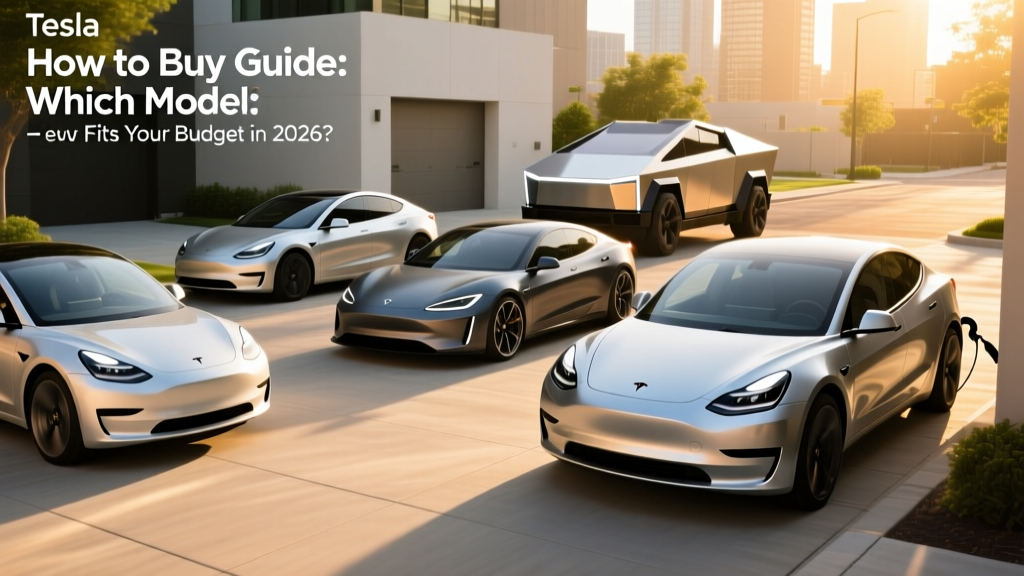
Tesla currently sells five vehicles in the U.S.: the refreshed Model 3 sedan, the Juniper-updated Model Y crossover, the premium Model S sedan, the Model X SUV, and the Cybertruck pickup. Each sits on a different platform generation, which directly affects charging speed, battery chemistry, and interior space. Here is the spec matrix you need before stepping into a showroom — or more accurately, before clicking "Order" on Tesla's website, since the company still sells primarily direct-to-consumer.
| Model | Trim | EPA Range | Battery (kWh) | Chemistry | 0-60 mph | HP | Base MSRP |
|---|---|---|---|---|---|---|---|
| Model 3 | RWD | 272 mi | ~60 | LFP | 5.8 s | 283 | $38,990 |
| Model 3 | Long Range AWD | 363 mi | ~79 | NMC | 4.2 s | 346 | $45,490 |
| Model 3 | Performance | 315 mi | ~79 | NMC | 2.9 s | 510 | $52,990 |
| Model Y | RWD | 267 mi | ~60 | LFP | 6.5 s | 295 | $44,990 |
| Model Y | Long Range AWD | 335 mi | ~79 | NMC | 4.8 s | 384 | $48,490 |
| Model Y | Performance | 295 mi | ~79 | NMC | 3.5 s | 456 | $52,490 |
| Model S | Long Range | 402 mi | ~100 | NMC | 3.1 s | 670 | $79,990 |
| Model S | Plaid | 359 mi | ~100 | NMC | 1.99 s | 1,020 | $94,990 |
| Model X | Long Range | 348 mi | ~100 | NMC | 3.8 s | 670 | $84,990 |
| Model X | Plaid | 320 mi | ~100 | NMC | 2.5 s | 1,020 | $99,990 |
| Cybertruck | AWD | 340 mi | ~123 | NMC | 4.1 s | 600 | $79,990 |
| Cybertruck | Cyberbeast | 320 mi | ~123 | NMC | 2.6 s | 845 | $99,990 |
Sources: fueleconomy.gov, Tesla.com order pages. Specs reflect 2026 model year at time of publication.
Real-World Range: What the EPA Sticker Doesn't Tell You
EPA vs Reality: The EPA range figure is a blended city/highway estimate under moderate temperatures. In our testing and owner reports, expect the following real-world adjustments:
- Highway driving (70-80 mph): Subtract 10-15% from EPA. A Model 3 Long Range rated at 363 mi will deliver roughly 310-325 mi at sustained interstate speeds.
- Cold weather (below 32°F): Subtract 20-30%, especially for short trips where the battery doesn't warm up. LFP packs (Model 3 RWD, Model Y RWD) are slightly more affected by cold than NMC.
- City/regenerative driving: Often exceeds EPA by 5-10% thanks to regen braking recapturing energy.
The Model S Long Range remains the range king at 402 mi EPA — and realistically 340-360 mi on a highway road trip. For the Model 3 RWD with its smaller LFP pack, plan for 220-240 mi of real highway range in moderate weather and as little as 185 mi in deep cold. If your commute is under 40 miles round-trip, the RWD trims are perfectly adequate and charge to 100% daily without degradation concerns. For road-trippers, Long Range AWD trims are the pragmatic choice.
Charging Speed: DC Fast Charge and Home Level 2
Charging speed is where Tesla's generational platform differences become obvious. The refreshed Model 3 and Juniper Model Y support up to 250 kW on DC fast chargers, while the older-architecture Model S and X peak around 220 kW. The Cybertruck, with its 48-volt architecture and larger pack, also peaks at 250 kW.
| Model | Max DC kW | 10-80% Time | Level 2 (kW) | Level 2 Miles/Hour |
|---|---|---|---|---|
| Model 3 (all trims) | 250 kW | ~25 min | 11.5 kW | ~37 mi/hr |
| Model Y (all trims) | 250 kW | ~27 min | 11.5 kW | ~35 mi/hr |
| Model S / X | 220 kW | ~32 min | 11.5 kW | ~34 mi/hr |
| Cybertruck | 250 kW | ~30 min | 11.5 kW | ~30 mi/hr |
Charge curve reality check: No Tesla sustains peak kW for the entire session. A Model 3 Long Range will hit 250 kW briefly around 15-25% SoC, then taper to ~170 kW by 50%, and drop sharply above 80%. The 10-80% time is the useful metric, and 25-32 minutes across the lineup is competitive with the best in the industry. On Superchargers, Tesla's battery preconditioning (activated when you navigate to a Supercharger) warms the pack for optimal charge acceptance — this can shave 5-10 minutes off your session in cold weather.
For home charging, every current Tesla accepts 11.5 kW on Level 2 (48 amps on a 60-amp circuit), which adds 30-37 miles of range per hour. An overnight charge from 20% to 80% takes roughly 5-6 hours — more than enough for daily use. Tesla's Wall Connector costs about $425, and professional installation on a 240V/60A circuit typically runs $800-$2,000 depending on your panel's capacity and proximity to the garage.
Efficiency: MPGe and kWh per 100 Miles
Tesla remains the efficiency benchmark in the EV industry. The Model 3 Long Range AWD achieves 132 MPGe combined (25 kWh/100 mi) per the EPA, meaning it uses less energy per mile than nearly any other EV on the market. The Model Y Long Range comes in at 122 MPGe combined (28 kWh/100 mi), while the heavier Model S and X hover around 115-120 MPGe. The Cybertruck, with its heavy stainless-steel exoskeleton and truck aerodynamics, drops to roughly 75 MPGe (45 kWh/100 mi) — a significant efficiency penalty that translates to higher charging costs on road trips.
At the national average electricity rate of $0.16/kWh, a Model 3 Long Range costs about $4.00 to travel 100 miles. The Cybertruck costs about $7.20 for the same distance. Compare that to a 25 MPG gas vehicle at $3.40/gallon: $13.60 per 100 miles. The efficiency advantage is real, but truck buyers should know the Cybertruck narrows that gap considerably.
Pricing and Federal Tax Credit Eligibility
Tesla's pricing has fluctuated frequently, but as of early 2026, the Model 3 starts at $38,990 and the Model Y at $44,990. Here is where the federal EV tax credit under IRS §30D becomes critical — and where many buyers get confused.
| Model / Trim | MSRP | §30D Credit | Effective Price | Credit Eligible? |
|---|---|---|---|---|
| Model 3 RWD | $38,990 | Up to $7,500 | ~$31,490 | Yes (LFP — sourcing dependent) |
| Model 3 Long Range | $45,490 | Up to $7,500 | ~$37,990 | Yes (meets MSRP cap) |
| Model 3 Performance | $52,990 | Up to $7,500 | ~$45,490 | Yes (under $55K sedan cap) |
| Model Y RWD | $44,990 | Up to $7,500 | ~$37,490 | Yes |
| Model Y Long Range | $48,490 | Up to $7,500 | ~$40,990 | Yes (under $80K SUV cap) |
| Model Y Performance | $52,490 | Up to $7,500 | ~$44,990 | Yes |
| Model S Long Range | $79,990 | $0 | $79,990 | No (exceeds $55K sedan cap) |
| Model X Long Range | $84,990 | Up to $7,500 | ~$77,490 | Yes (under $80K SUV cap — verify) |
| Cybertruck AWD | $79,990 | Up to $7,500 | ~$72,490 | Yes (classified as truck/SUV) |
Critical §30D eligibility rules for 2026 (source: IRS.gov):
- MSRP caps: Sedans must be under $55,000; SUVs, vans, and trucks under $80,000. This eliminates the Model S from credit eligibility entirely.
- Buyer income caps: Modified AGI must not exceed $300,000 (joint), $225,000 (head of household), or $150,000 (single).
- Battery sourcing: A percentage of critical minerals and battery components must be sourced from the U.S. or free-trade-agreement countries. Tesla's LFP cells (used in RWD trims) have historically faced scrutiny under this rule — the partial credit ($3,750) vs. full credit ($7,500) may vary by production batch. Always verify the specific VIN's eligibility at the point of sale.
- Point-of-sale transfer: As of 2024, you can transfer the credit to the dealer (Tesla) at purchase, reducing your out-of-pocket cost immediately rather than waiting for tax filing. Tesla's checkout flow supports this.
Consult a tax professional before relying on credit eligibility — IRS rules are subject to change, and battery sourcing compliance can shift with Tesla's supply chain.
Interior Space, Cargo, and Practicality
The Model 3 offers 23 cu ft of trunk space plus a small frunk, adequate for two suitcases and a week's groceries. Rear legroom is 33.4 inches — tight for tall adults on long trips. The Juniper Model Y significantly improves on this with 34 cu ft behind the second row (76 cu ft with seats folded) and 39.5 inches of rear legroom, making it the default choice for families with car seats or frequent rear passengers.
The Model S provides 25 cu ft of cargo plus a massive frunk, and its liftback design makes loading easy. The Model X offers up to 88 cu ft with its five-seat configuration and optional six- or seven-seat layouts, though third-row space is best suited for children. The Cybertruck's 6-foot bed and ~3,500 cu ft of enclosed vault storage (with the tonneau closed) are unmatched for utility, but its 8,600-lb curb weight and 206-inch length make it impractical for tight urban garages.
Tech, Autopilot, and Notable Drawbacks
Every 2026 Tesla ships with Basic Autopilot (adaptive cruise + lane centering), which is a competent SAE Level 2 driver-assistance system. Full Self-Driving (Supervised) remains a $8,000 add-on or $99/month subscription and is also Level 2 — meaning you must keep your hands on the wheel and eyes on the road at all times. Tesla's FSD has improved substantially in urban environments, but it is not autonomous driving and does not relieve the driver of responsibility.
SAE Automation Level Reminder: Tesla Autopilot and FSD (Supervised) are Level 2 systems — the driver is always responsible. Only fully driverless services like Waymo operate at Level 4. Do not treat any Tesla feature as "self-driving."
Infotainment runs on Tesla's proprietary system with a 15.4-inch center screen (Model 3/Y) or 17-inch (Model S/X). There is no Apple CarPlay or Android Auto — a dealbreaker for some buyers. Audio ranges from a solid 8-speaker system in the Model 3 RWD to an exceptional 22-speaker setup in the Model S/X. All models include Tesla's app-based ecosystem for remote preconditioning, location sharing, and service scheduling.
Notable drawbacks across the lineup:
- No physical instrument cluster in Model 3/Y — all information is on the center screen, including speed.
- Turn-signal stalks have been removed from refreshed Model 3/Y; signals are now on the steering wheel, which is polarizing.
- Build quality has improved but still shows occasional panel-gap inconsistency compared to German competitors.
- No Apple CarPlay/Android Auto support.
- Insurance premiums run 15-30% higher than comparable non-EVs in most states.
Warranty Coverage
Tesla's warranty structure is straightforward:
- Basic vehicle: 4 years / 50,000 miles
- Battery and drive unit (Model 3 RWD, LFP): 8 years / 100,000 miles, minimum 70% capacity retention
- Battery and drive unit (Long Range, Performance, S, X, Cybertruck): 8 years / 120,000 miles, minimum 70% capacity retention
The 70% retention threshold is industry-standard. Real-world data from owner communities suggests Tesla's NMC packs degrade roughly 10-12% over the first 100,000 miles, then flatten considerably. LFP packs show slightly more initial degradation but are rated for more charge cycles and can be charged to 100% daily without accelerated wear — a practical advantage for RWD owners who need every mile of their smaller battery.
Pros and Cons
Pros
- Best-in-class efficiency (Model 3 LR: 132 MPGe)
- Supercharger network — the most reliable DC fast-charging infrastructure in the U.S.
- Over-the-air updates continuously add features
- Strong resale value relative to most EVs
- Point-of-sale tax credit reduces upfront cost on eligible trims
- LFP option allows daily 100% charging without degradation worry
Cons
- No Apple CarPlay or Android Auto
- Turn-signal stalk removal is controversial
- Model S/X platform is aging; charge speed trails newer architectures
- Insurance costs significantly above average
- FSD (Supervised) remains expensive and is still Level 2, not autonomous
- Cybertruck efficiency is poor; real-world range falls well short of EPA
Who Should Buy Which Tesla?
Choose the Model 3 RWD if: You commute under 40 miles daily, can charge at home, and want the lowest entry price (~$31,490 after credit). The LFP battery handles daily 100% charges without issue.
Choose the Model 3 Long Range if: You take regular road trips, live in a cold climate, or need AWD. The 363-mi EPA range and NMC chemistry provide real-world flexibility.
Choose the Model Y Long Range if: You need family space, car-seat room, or cargo versatility. It's the best-selling Tesla for good reason — 335 mi range, 76 cu ft cargo, and credit-eligible.
Choose the Model S if: You want premium sedan performance and 400+ mi range, and the $80K price without a tax credit doesn't deter you.
Choose the Model X if: You need three rows and falcon-wing doors are appealing, but know the platform is older and rivals like the Rivian R1S and Kia EV9 offer compelling alternatives.
Choose the Cybertruck if: You need a truck bed, tow up to 11,000 lbs, and accept the efficiency penalty and polarizing design. It is not a practical daily driver for most buyers.
Is a Tesla Worth Buying vs. Competitors?
The Model 3 competes against the Hyundai Ioniq 6 (361 mi, $37,500), BMW i4 (307 mi, $52,200), and Polestar 2 (276 mi, $49,900). The Model 3 Long Range's combination of range, Supercharger access, and credit-adjusted pricing remains difficult to beat, though the Ioniq 6 offers faster 800V charging (10-80% in ~18 min) and CarPlay support.
The Model Y faces stiffer competition than ever: the Hyundai Ioniq 5 (318 mi, $42,400), Ford Mustang Mach-E (320 mi, $42,995), and Chevrolet Equinox EV (319 mi, $33,000) all undercut on price or match on range. The Model Y's advantages remain Supercharger access, cargo space, and software — but the gap has closed considerably.
For Model S and X buyers, the Lucid Air (up to 516 mi, $69,900) offers more range and luxury at a lower price point for the sedan, while the Rivian R1S and BMW iX challenge the Model X on interior quality and third-row usability. The Cybertruck competes primarily with the Ford F-150 Lightning (320 mi, $54,995) and Rivian R1T (352 mi, $69,900), both of which are more practical for daily driving.
Frequently Asked Questions
What is the real-world range of the most popular Tesla?
The Model Y Long Range AWD, Tesla's best-seller, carries a 335-mi EPA rating. Expect roughly 285-300 mi on highway road trips in moderate weather, and 240-260 mi in cold conditions (below freezing). City driving with regenerative braking can push past the EPA estimate to 350+ mi.
How fast does a Tesla charge at home and on the road?
On a home Level 2 charger (11.5 kW / 48A), all current Teslas add 30-37 miles of range per hour, fully replenishing overnight. On a Tesla Supercharger (250 kW DC), the Model 3 and Y charge from 10-80% in roughly 25-27 minutes. The Model S and X take about 32 minutes due to slightly lower peak charge rates.
How much does a Tesla cost after federal tax credits?
The Model 3 RWD drops from $38,990 to approximately $31,490 with the full $7,500 §30D credit, assuming you meet income caps and the battery sourcing requirements are satisfied. The Model Y Long Range drops from $48,490 to roughly $40,990. The Model S does not qualify due to the $55,000 sedan MSRP cap.
Does the Tesla Model Y qualify for the federal EV tax credit?
Yes — all Model Y trims fall under the $80,000 SUV/truck MSRP cap and are eligible for up to $7,500 under §30D, provided the buyer's modified AGI is within limits ($300K joint / $150K single) and the battery meets critical-mineral and component sourcing requirements. Verify at point of sale, as sourcing rules can shift.
Is Tesla's FSD actually self-driving?
No. Full Self-Driving (Supervised) is an SAE Level 2 driver-assistance system, the same level as Autopilot but with additional urban capabilities. The driver must remain fully engaged, with hands on the wheel and eyes on the road. It is not autonomous driving, and Tesla has not received regulatory approval for driverless operation.
Should I buy a Tesla or wait for competitors?
If you need a vehicle now and value Supercharger network access, Tesla remains the safest EV purchase for road-trip flexibility. However, Hyundai/Kia's 800V charging architecture, GM's Ultium platform, and expanding non-Tesla access to Superchargers (via NACS adapters) are rapidly closing the gap. Test-drive at least two competitors before committing.
How long will a Tesla battery last?
Tesla warranties its batteries for 8 years / 100,000-120,000 miles (depending on trim) with a minimum 70% capacity retention guarantee. Real-world data from high-mileage owners suggests NMC packs retain roughly 88-90% capacity at 100,000 miles. LFP packs (Model 3 RWD) may show slightly more initial loss but are rated for 3,000+ full charge cycles — potentially outlasting the vehicle itself.
Always verify current pricing, tax credit eligibility, and specifications on Tesla.com and IRS.gov before purchasing. Rules and specs are subject to change.