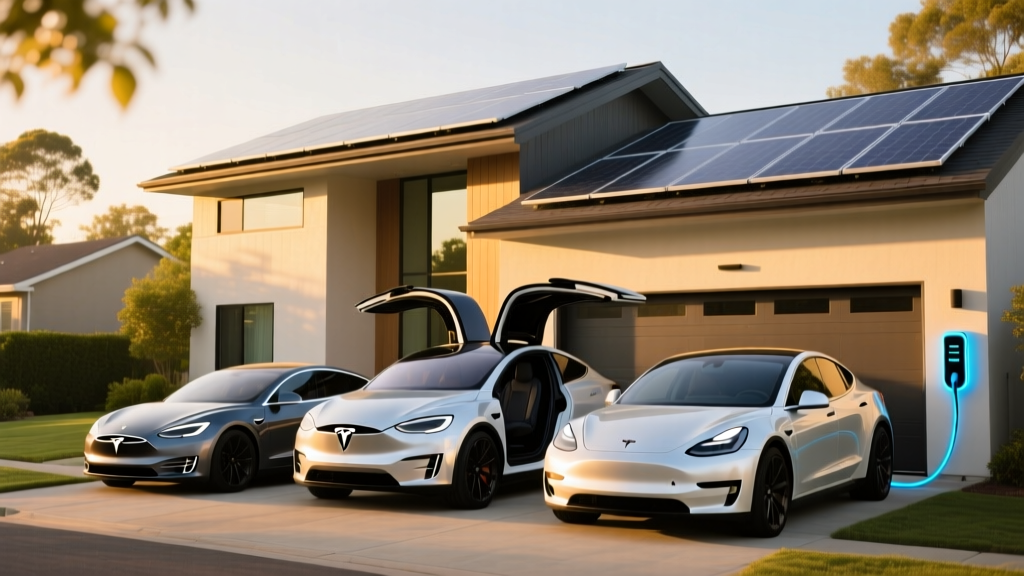
Searching for Tesla houses for sale means you are likely already invested in the Tesla energy ecosystem — Solar Roof panels, Powerwall home batteries, and the Wall Connector charging infrastructure that makes these homes uniquely EV-ready. But pairing the right Tesla vehicle with your solar-equipped property requires more than brand loyalty. It demands a hard look at range, charging speeds, battery chemistry, utility rate arbitrage, and current federal tax credit eligibility.
In this guide, we profile the three most relevant Tesla EVs for solar-home owners in the 2026 model year, with exact specs, real-world range data, and ownership economics that matter when your "fuel" comes from your own roof.
Why Tesla Homes Demand a Tesla-Specific EV Strategy
Tesla homes — properties equipped with Tesla Solar Roof or solar panels plus one or more Powerwall units — create a unique EV ownership scenario. You are not just charging a car; you are integrating a vehicle into a managed home energy system. The Tesla app unifies solar production, Powerwall charge state, and vehicle charging into a single dashboard, enabling features like:
- Solar-self-consumption optimization: Schedule vehicle charging to coincide with peak solar production hours (typically 10 AM – 3 PM), maximizing the percentage of your driving energy that comes from your own panels.
- Time-of-use (TOU) arbitrage: Charge the Powerwall from solar during the day, then discharge it to charge your EV overnight when grid rates peak — or charge the EV directly from Powerwall during off-peak hours.
- Backup priority: During outages, the system can prioritize Powerwall reserves for home loads vs. vehicle charging, a setting configurable in the Tesla app.
These features work with any EV using a Wall Connector, but the unified software experience is exclusive to Tesla vehicles. That integration is the primary reason Tesla-home buyers overwhelmingly choose Tesla vehicles — and why the spec details below matter.
2026 Tesla Model Y Long Range: The Default Solar-Home SUV
| Spec | Value |
|---|---|
| EPA Range | 320 miles |
| Battery Capacity | ~78 kWh usable (NMC chemistry) |
| Max DC Fast Charge | 250 kW peak (V3 Supercharger) |
| 10–80% DC Charge Time | ~27 minutes |
| Level 2 Charge Rate | 11.5 kW (44 mi/hr via Wall Connector) |
| 0–60 mph | 4.8 seconds |
| Horsepower | 384 hp (dual motor AWD) |
| Efficiency | 122 MPGe combined / 28 kWh/100 mi |
| Cargo Volume | 76 cu ft (rear seats folded) |
| Base MSRP | $44,990 |
| Battery Warranty | 8 years / 120,000 miles |
The Model Y Long Range remains the highest-volume Tesla for a reason: it balances range, cargo space, and efficiency in a package that works for families, commuters, and road-trippers alike. For Tesla-home owners specifically, the 78 kWh NMC battery is large enough to absorb a full day of excess solar production in most climates, while the 11.5 kW Level 2 charge rate means a full overnight charge from a single Powerwall (13.5 kWh) is not feasible — but a partial top-up is easily managed.
For solar self-consumption, the Model Y's efficiency of 28 kWh/100 mi means a typical 8 kW residential solar array producing ~32 kWh/day can add roughly 114 miles of range daily — enough for most commutes without ever touching the grid.
2026 Tesla Model 3 Long Range: The Efficiency Champion
| Spec | Value |
|---|---|
| EPA Range | 363 miles |
| Battery Capacity | ~79 kWh usable (NMC chemistry) |
| Max DC Fast Charge | 250 kW peak |
| 10–80% DC Charge Time | ~25 minutes |
| Level 2 Charge Rate | 11.5 kW (48 mi/hr via Wall Connector) |
| 0–60 mph | 5.8 seconds |
| Horsepower | 271 hp (single motor RWD) |
| Efficiency | 132 MPGe combined / 25 kWh/100 mi |
| Cargo Volume | 23 cu ft (trunk + frunk) |
| Base MSRP | $42,490 |
| Battery Warranty | 8 years / 120,000 miles |
If your Tesla home is a smaller property — a townhouse with a 5–6 kW solar array, for example — the Model 3 Long Range is the mathematically optimal pairing. At 25 kWh/100 mi, it extracts more miles per kilowatt-hour of solar production than any other Tesla. A 6 kW array producing ~24 kWh/day adds approximately 96 miles of range daily, covering the vast majority of American commutes.
The tradeoff vs. the Model Y is cargo space (23 vs. 76 cu ft) and ground clearance (5.5 vs. 6.6 inches). For couples without large cargo needs, the Model 3 is the smarter solar-home companion.
2026 Tesla Model X Long Range: The Family Hauler
| Spec | Value |
|---|---|
| EPA Range | 335 miles |
| Battery Capacity | ~100 kWh usable (NMC chemistry) |
| Max DC Fast Charge | 250 kW peak |
| 10–80% DC Charge Time | ~32 minutes |
| Level 2 Charge Rate | 11.5 kW (35 mi/hr via Wall Connector) |
| 0–60 mph | 3.8 seconds |
| Horsepower | 670 hp (dual motor AWD) |
| Efficiency | 102 MPGe combined / 33 kWh/100 mi |
| Cargo Volume | 88 cu ft (rear seats folded, 5-seat config) |
| Base MSRP | $79,990 |
| Battery Warranty | 8 years / 150,000 miles |
The Model X demands a larger solar array to be a practical solar-home pairing. At 33 kWh/100 mi, a 10 kW array producing ~40 kWh/day adds only about 121 miles of range. For families who need three rows, falcon-wing rear doors for easy car-seat loading, and 5,000-lb towing capacity, it is the only Tesla that fits — but budget for a larger solar installation or accept regular grid supplementation.
Charging Your Tesla From a Solar Home: What You Need to Know
Every Tesla sold since 2022 ships with a NACS (North American Charging Standard) port, the same connector used by the Tesla Supercharger network. For home charging at a Tesla-equipped property, the Tesla Wall Connector is the default choice:
| Vehicle | Max Level 2 kW | Miles Added/Hour | Full Charge Time (0–100%) |
|---|---|---|---|
| Model 3 Long Range | 11.5 kW | 48 mi/hr | ~7 hours |
| Model Y Long Range | 11.5 kW | 44 mi/hr | ~7 hours |
| Model X Long Range | 11.5 kW | 35 mi/hr | ~9 hours |
The Wall Connector requires a 60-amp dedicated circuit (48-amp continuous draw) for the full 11.5 kW rate. Most Tesla homes are pre-wired for this, but verify your electrical panel has capacity — a 200-amp main panel is typically sufficient for solar + Powerwall + EV charging, but older homes may need a panel upgrade ($1,500–$3,000).
Solar-charging tip: Use the Tesla app's "Charge on Solar" feature (available for homes with Solar Roof or panels + Powerwall) to automatically route excess solar production to your vehicle. This requires no manual scheduling — the system monitors real-time solar export and ramps vehicle charging to absorb it.
Federal Tax Credit Eligibility (IRS §30D) for 2026
The federal EV tax credit under IRS §30D remains a critical factor in Tesla purchase economics. Here is how the three models stack up for the 2026 tax year:
| Requirement | Model 3 LR | Model Y LR | Model X LR |
|---|---|---|---|
| MSRP Cap (SUVs: $80K; Sedans: $55K) | $42,490 ✓ | $44,990 ✓ | $79,990 ✓ |
| Buyer Income Cap (Married: $300K) | Varies by buyer | Varies by buyer | Varies by buyer |
| Battery Sourcing (Critical Minerals + Assembly) | Partial — up to $3,750 | Partial — up to $3,750 | Partial — up to $3,750 |
| Point-of-Sale Transfer | Yes | Yes | Yes |
| Estimated Max Credit | $3,750 | $3,750 | $3,750 |
Key caveats: As of 2026, Tesla's U.S.-built vehicles meet the North American final-assembly requirement, but critical-mineral and battery-component sourcing rules limit the credit to $3,750 (half the maximum $7,500) for most trims. Income caps apply: modified AGI must not exceed $300,000 (married filing jointly), $225,000 (head of household), or $150,000 (single). The credit can be transferred to the dealer at point of sale as an upfront price reduction. Consult a tax professional and verify current rules at IRS.gov before purchasing.
Tesla Model 3 vs. Model Y vs. Model X: Which Fits Your Solar Home?
Model 3 Long Range — Pros
- Best efficiency (25 kWh/100 mi) — most miles per solar kWh
- 363-mile EPA range — longest of any current Tesla
- Lowest MSRP in the lineup
- Excellent cold-weather range retention
Model 3 Long Range — Cons
- Limited cargo space (23 cu ft)
- RWD only — less confident in snow/ice
- Tighter rear seat for tall passengers
Model Y Long Range — Pros
- 76 cu ft cargo — SUV practicality
- AWD standard — all-weather capability
- Strong resale value and Supercharger access
- Ideal family size for most households
Model Y Long Range — Cons
- 32-mile range penalty vs. Model 3
- Higher energy consumption per mile
- Ride quality firmer than some competitors
Choose the Model Y LR if: You need AWD, cargo flexibility, and family seating — and your solar array is 8 kW or larger to offset the higher energy consumption.
Choose the Model X LR if: You need three rows, 5,000-lb towing, and have a 10+ kW solar array. Accept higher energy costs per mile.
Autopilot, FSD, and Smart-Home Integration
All 2026 Teslas include Basic Autopilot (traffic-aware cruise control + lane centering) at no extra cost. FSD (Supervised), currently a $8,000 add-on or $99/month subscription, adds automatic lane changes, Navigate on Autopilot (highway on/off-ramp handling), and traffic-light/stop-sign recognition. While impressive, FSD still requires driver supervision and is not a substitute for attention.
For Tesla-home owners, the more relevant "smart" feature is the Tesla app's energy dashboard, which displays real-time solar production, Powerwall state of charge, vehicle charge level, and home energy consumption in a single view. This unified ecosystem is the strongest argument for keeping your vehicle and home within the Tesla brand.
Frequently Asked Questions
What is the real-world range of a Tesla when charged from solar?
Range is determined by the vehicle, not the charging source. A Model 3 LR charged from solar delivers the same 310–330 real-world highway miles as one charged from the grid. Solar charging affects cost and carbon intensity, not range.
How fast does a Tesla charge at home with a Wall Connector?
At 11.5 kW on a 60-amp circuit, expect 35–48 miles of range added per hour depending on the model. A full 0–100% charge takes 7–9 hours. Most solar-home owners charge partially each day rather than from empty.
How much does a Tesla cost after federal tax credits in 2026?
With the estimated $3,750 partial credit, the Model 3 LR drops to approximately $38,740, the Model Y LR to $41,240, and the Model X LR to $76,240 — before any state incentives. Verify your income eligibility and the vehicle's current sourcing status at IRS.gov.
Is it worth buying a Tesla vs. a non-Tesla EV for a solar home?
If your home already has Tesla solar + Powerwall, the unified app experience and Charge on Solar feature provide genuine convenience. However, vehicles like the Hyundai Ioniq 5 or Chevrolet Equinox EV charge just as efficiently on a Wall Connector (using the included J1772-to-NACS adapter or native NACS on newer models). The Tesla ecosystem advantage is software integration, not charging exclusivity.
Does a Tesla qualify for the full $7,500 federal EV tax credit?
As of 2026, most Tesla models qualify for $3,750 (half credit) due to partial compliance with critical-mineral and battery-component sourcing requirements under §30D. The full $7,500 requires meeting both the critical-minerals and battery-component thresholds, which Tesla has not fully achieved for all trims. Rules change — always verify at IRS.gov.
Can I charge a non-Tesla EV at a Tesla home with a Wall Connector?
Yes. The Tesla Wall Connector uses the NACS plug, which is now standard on all new Teslas and is being adopted by Ford, GM, Rivian, and others. For non-NACS vehicles (older CCS-equipped models), a NACS-to-CCS adapter is required.