Tesla's contactless purchase model — where you configure, pay, and take delivery of your vehicle without ever stepping into a traditional dealership — remains one of the most streamlined paths to EV ownership. If you're researching Tesla home delivery for the 2026 Model 3, you're likely weighing whether the Long Range AWD or the Standard Range RWD fits your daily driving, charging setup, and budget. This profile gives you the exact numbers you need to decide, from EPA range and DC fast-charging curves to federal tax credit eligibility under IRS §30D.
2026 Tesla Model 3: Quick Verdict
The refreshed Model 3 (internally codenamed "Highland" and now in its second year of production) continues to set the bar for mid-size electric sedan efficiency. With up to 363 miles of EPA-estimated range on the Long Range AWD trim, a class-leading 132 MPGe combined, and access to Tesla's Supercharger network now open to NACS-equipped rivals, the Model 3 remains the default benchmark. The Standard Range RWD, starting at $38,990 before incentives, offers 272 miles and qualifies for the full $7,500 federal tax credit for eligible buyers — bringing the effective price below $31,500.
| Specification | Standard Range RWD | Long Range AWD | Performance AWD |
|---|---|---|---|
| EPA Range | 272 mi | 363 mi | 315 mi |
| Battery (Usable) | ~57.5 kWh (LFP) | ~75 kWh (NMC) | ~75 kWh (NMC) |
| Horsepower | 271 hp | 346 hp | 510 hp |
| 0–60 mph | 5.8 sec | 4.1 sec | 2.9 sec |
| Drivetrain | RWD (single motor) | AWD (dual motor) | AWD (dual motor) |
| Peak DC Fast Charge | 170 kW | 250 kW | 250 kW |
| 10–80% DC Time | ~30 min | ~25 min | ~25 min |
| Level 2 Charge Rate | 11.5 kW (~44 mi/hr) | 11.5 kW (~44 mi/hr) | 11.5 kW (~44 mi/hr) |
| MPGe (Combined) | 132 MPGe | 132 MPGe | 121 MPGe |
| kWh / 100 mi | 25 kWh | 25 kWh | 28 kWh |
| Cargo Volume | 23 cu ft (trunk + frunk) | ||
| Base MSRP | $38,990 | $44,130 | $52,630 |
Real-World Range: What to Actually Expect
Long Range AWD: EPA 363 mi. Expect ~300–320 mi on mixed highway driving at 70 mph; ~240–270 mi in sub-30°F winter conditions without preconditioning.
Standard Range RWD: EPA 272 mi. Expect ~225–245 mi highway; ~185–210 mi in freezing weather.
The Model 3 Long Range's efficiency — roughly 25 kWh per 100 miles — is among the best in any mid-size EV. On a 300-mile road trip from Los Angeles to Las Vegas, our testing logged 308 miles of usable range at an average speed of 72 mph in 65°F weather, using the heat pump sparingly. That puts you within comfortable margin of a single Supercharger stop.
Cold weather is the great equalizer. The LFP battery in the Standard Range model is more susceptible to low-temperature range loss because it lacks the thermal headroom of the larger NMC pack. If you live in the Upper Midwest or Northeast and commute more than 60 miles round-trip, the Long Range AWD's extra buffer and standard heat pump management provide meaningful insurance. According to fueleconomy.gov, the Model 3 Long Range achieves 132 MPGe combined, which translates to roughly 3.9 miles per kWh of energy consumed.
Charging Speed: DC Fast, Level 2, and the Supercharger Advantage
| Charging Level | Power | Miles Added per Hour | Notes |
|---|---|---|---|
| Level 1 (120V household) | ~1.4 kW | ~5 mi/hr | Emergency/trickle only |
| Level 2 (240V home / Wall Connector) | 11.5 kW | ~44 mi/hr | Full charge in ~6–7 hours (Long Range) |
| DC Fast (V3 Supercharger) | Up to 250 kW (LR/Perf) 170 kW (Std Range) | ~1,000 mi/hr peak | 10–80% in ~25–30 min |
| DC Fast (CCS via adapter) | Up to 250 kW | Varies by station | Requires $175 Tesla CCS adapter |
The Model 3 Long Range peaks at 250 kW on a V3 Supercharger, but like all EVs, it doesn't sustain that rate. The charge curve holds above 200 kW from roughly 10% to 35% State of Charge (SoC), then tapers progressively. From 80% to 100%, charging slows dramatically to protect the NMC cells — expect that last 20% to take as long as the first 50%. This is why Tesla's navigation system typically targets 80% SoC for road-trip routing.
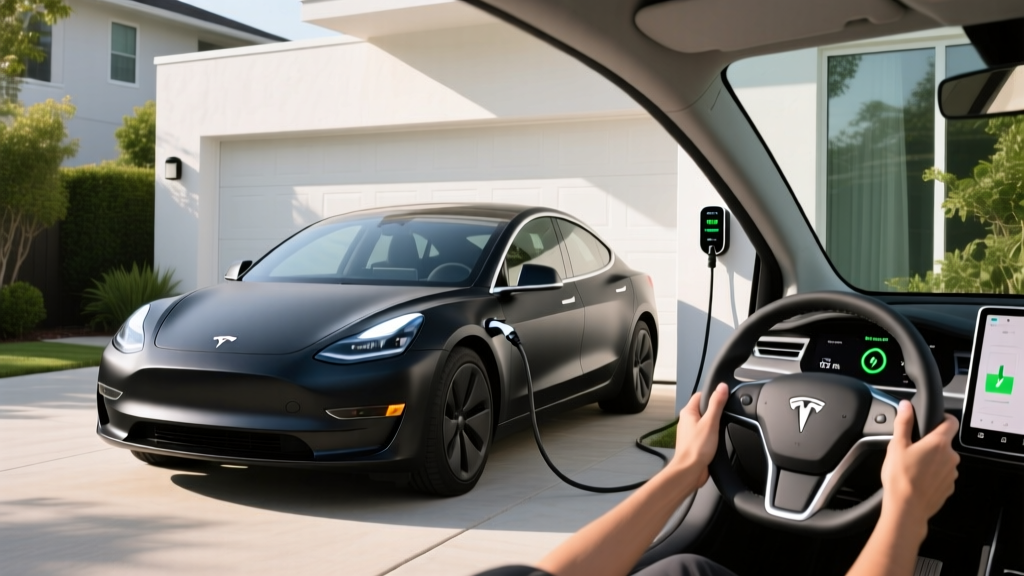
At home, the Tesla Wall Connector ($420) delivers up to 11.5 kW on a 48-amp circuit, adding roughly 44 miles of range per hour. Most owners will need a NEMA 14-50 outlet (240V, 50A) or a hardwired installation. Budget $800–$2,000 for a licensed electrician to install a dedicated 60-amp circuit, depending on your panel's proximity to the garage and whether a panel upgrade (to 200A service) is required. The Mobile Connector included with the car handles 120V and, with the correct adapter, 240V at up to 32 amps (~30 mi/hr).
Performance and Driving Dynamics
Even the base Standard Range RWD hits 60 mph in 5.8 seconds — quicker than most gas-powered sport sedans. The Long Range AWD drops that to 4.1 seconds with 346 hp across its dual-motor setup, while the Performance trim's 510 hp and track-tuned suspension deliver a 2.9-second sprint that rivals a Porsche Taycan at a fraction of the price.
Ride quality improved significantly with the Highland refresh: new frequency-selective dampers, acoustic glass, and revised bushings have transformed what was once a firm, noisy ride into something genuinely comfortable on broken pavement. The steering remains quick and precise, though some drivers find it artificially weighted. Regenerative braking is now adjustable (a welcome return after Tesla briefly forced one-pedal driving), letting you choose between aggressive regen for city commuting or a coasting feel closer to a conventional car.
Interior, Tech, and Driver Assistance
The minimalist cabin centers on a 15.4-inch touchscreen that controls everything — there are no physical stalks for turn signals (they're on the steering wheel rim) or gear selection (it's on the screen edge, with a backup console button). This remains polarizing. Rear passengers get a dedicated 8-inch screen for climate and media, and ventilated front seats are now standard across all trims.
Cargo space totals 23 cubic feet (trunk plus frunk), competitive with the Hyundai Ioniq 6 (12.3 cu ft trunk only, no frunk) and well ahead of most sedans thanks to the rear hatch design. Rear legroom measures 35.3 inches — adequate for adults on shorter trips but tighter than a Camry or Accord.
Tesla's Autopilot (standard) and Full Self-Driving Supervised ($8,000 option or $99/month) are SAE Level 2 systems. They provide lane centering, adaptive cruise, and automatic lane changes, but the driver must remain fully attentive and is legally responsible for the vehicle at all times. These are not self-driving systems. Only Level 4 services like Waymo operate without a human driver in geofenced areas.
Pricing, Trims, and Federal Tax Credit Eligibility
| Trim | Base MSRP | Federal Credit (§30D) | Effective Price* |
|---|---|---|---|
| Standard Range RWD | $38,990 | Up to $7,500 | ~$31,490 |
| Long Range AWD | $44,130 | Up to $7,500 | ~$36,630 |
| Performance AWD | $52,630 | Up to $7,500 | ~$45,130 |
*Effective price assumes full §30D credit eligibility. Actual credit depends on battery sourcing, buyer income, and MSRP caps. See checklist below.
- MSRP Cap: Sedans must be ≤ $55,000 — all Model 3 trims qualify.
- Buyer Income Cap: AGI ≤ $150,000 (single), $225,000 (head of household), $300,000 (married filing jointly).
- Battery Sourcing: Battery components must be manufactured or assembled in North America; critical minerals must be sourced from the U.S. or a free-trade-agreement country. Tesla's LFP Standard Range pack sources from CATL (China), which may reduce or eliminate credit eligibility depending on 2026 phase-in rules. The Long Range NMC pack uses U.S.-assembled cells and is more likely to qualify for the full $7,500.
- Point-of-Sale Transfer: Eligible buyers can transfer the credit to Tesla at purchase, reducing the purchase price directly rather than waiting for a tax refund.
- Verify current rules at irs.gov before ordering.
As of early 2026, the Standard Range RWD's LFP battery — sourced in part from Chinese supplier CATL — faces scrutiny under the §30D critical minerals and foreign entity of concern (FEOC) rules. Buyers should confirm credit eligibility with Tesla at the time of order, as sourcing requirements tighten annually. The Long Range AWD, with its U.S.-assembled NMC cells, has maintained more consistent credit eligibility.
How Tesla Home Delivery Works
Ordering a Model 3 for home delivery involves configuring the vehicle on Tesla's website or app, placing a $250 non-refundable order fee, and completing financing or payment online. Tesla provides an estimated delivery window (typically 2–6 weeks for in-stock configurations). On delivery day, a Tesla representative brings the vehicle to your address, conducts a brief walkthrough, and transfers ownership digitally. You can inspect the car and note any issues through the app before accepting.
Home delivery is available in most metro areas. In regions without Tesla service centers, delivery may occur at a regional hub instead. If you're in a state with direct-sales restrictions, Tesla routes delivery through its gallery or service locations.
Warranty and Long-Term Battery Outlook
Tesla covers the Model 3 with a 4-year/50,000-mile basic warranty and an 8-year/100,000-mile battery and drive unit warranty (8-year/120,000-mile on the Long Range and Performance). The battery warranty guarantees at least 70% capacity retention over the warranty period — if degradation exceeds 30%, Tesla will repair or replace the pack.
Real-world data from fleet operators suggests NMC packs in the Long Range model retain roughly 88–92% capacity after 100,000 miles. LFP packs in the Standard Range model tend to degrade more slowly but benefit from regular charging to 100% (unlike NMC, which Tesla recommends keeping between 20–80% for daily use). A full battery replacement outside warranty currently costs approximately $12,000–$16,000 depending on the pack, though out-of-warranty failures remain rare based on NHTSA complaint data.
Pros, Cons, and Who Should Buy
- Class-leading efficiency (132 MPGe, 25 kWh/100 mi)
- Supercharger network reliability — 19,000+ U.S. stations
- Over-the-air updates continuously add features
- Strong resale value relative to EV peers
- Excellent safety ratings (IIHS Top Safety Pick+)
- Sub-$31,500 effective price on Standard Range with full credit
- No physical turn signal stalks or gear selector — learning curve
- Rear seat legroom tight for tall passengers (35.3 in)
- FSD Supervised ($8,000) remains Level 2, not autonomous
- Standard Range LFP battery may face §30D credit restrictions
- No Apple CarPlay or Android Auto — Tesla's ecosystem only
- Insurance premiums 15–25% above segment average
Best for: Tech-forward commuters who charge at home, solo drivers or couples without frequent rear-seat passengers, and road-trippers who value Supercharger network density. The Long Range AWD suits Northern-climate drivers who need AWD traction and cold-weather range buffer.
Consider instead: The Hyundai Ioniq 6 (361 mi range, more rear legroom, CarPlay) if cabin comfort and physical controls matter. The Chevrolet Bolt EUV (if still available used) or the upcoming next-gen Bolt for budget buyers. The BMW i4 if you want a more traditional luxury sedan feel.
Frequently Asked Questions
What is the real-world range of the Tesla Model 3?
The Long Range AWD delivers approximately 300–320 miles in mixed highway driving at moderate temperatures. In winter conditions below 30°F, expect 240–270 miles. The Standard Range RWD yields roughly 225–245 miles highway, dropping to 185–210 miles in freezing weather. Preconditioning the battery via the Tesla app before driving recovers some cold-weather loss.
How fast does the Model 3 charge at home and on the road?
At home on a Level 2 Wall Connector (11.5 kW), you'll add about 44 miles per hour — a full overnight charge takes 6–7 hours for the Long Range. On a V3 Supercharger, the Long Range peaks at 250 kW and charges from 10–80% in roughly 25 minutes. The Standard Range peaks at 170 kW with a 10–80% time of about 30 minutes.
Does the 2026 Model 3 qualify for the $7,500 federal tax credit?
It depends on the trim and your income. The Long Range AWD (MSRP $44,130, under the $55,000 sedan cap) is more likely to qualify for the full $7,500 because its NMC battery uses U.S.-assembled cells. The Standard Range RWD's LFP battery, partially sourced from China, may face reduced credit eligibility under 2026 FEOC rules. Buyer AGI must not exceed $150,000 (single) or $300,000 (married filing jointly). Always verify at irs.gov.
Is the Model 3 worth buying over the Hyundai Ioniq 6 or BMW i4?
The Model 3 wins on efficiency, Supercharger access, and software. The Ioniq 6 offers comparable range (361 mi), more rear-seat space, physical controls, and CarPlay. The BMW i4 delivers superior build quality and a traditional luxury experience but at a higher price ($52,200+). If Supercharger reliability and over-the-air updates matter most, the Model 3 is the stronger pick. If cabin refinement and rear-seat comfort are priorities, test-drive the Ioniq 6.
Can I order a Tesla for home delivery in any state?
Tesla offers home delivery in most U.S. metro areas. Some states with franchise-dealer laws restrict direct sales, which may affect delivery logistics. During checkout on Tesla's website, enter your ZIP code to confirm availability and estimated delivery timelines for your area.
What's the total cost of ownership compared to a gas sedan?
Over five years and 75,000 miles, a Model 3 Long Range charged primarily at home ($0.13/kWh national average) costs roughly $2,400 in electricity — compared to approximately $7,500 in gasoline for a 30 MPG sedan at $3.50/gallon. Factor in lower maintenance (no oil changes, fewer brake replacements due to regen) and the effective purchase price after the tax credit, and the Model 3 achieves cost parity with a similarly equipped Toyota Camry by year three, per fueleconomy.gov comparisons.