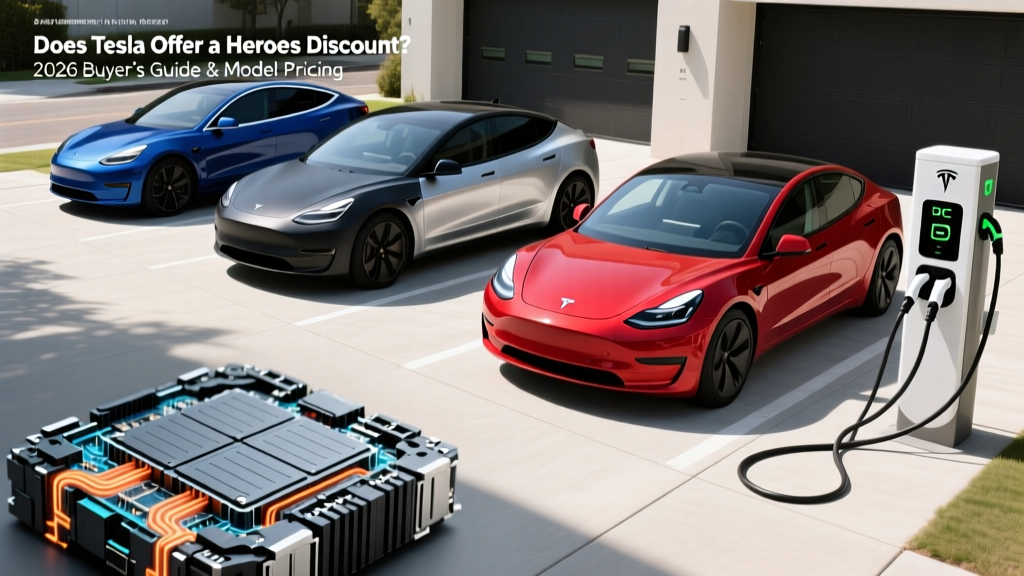
If you've searched for a Tesla heroes discount, you're not alone. Thousands of first responders, military members, teachers, and healthcare workers look for ways to save on Tesla vehicles each year. Unlike Ford, GM, or Honda, however, Tesla does not operate a traditional "heroes" or "military appreciation" discount program. Instead, the automaker relies on a fixed-price, direct-to-consumer sales model that eliminates negotiation but also eliminates most occupation-based rebates.
That doesn't mean savings are impossible. Between federal tax credits, state utility rebates, Tesla's referral program, and strategic trim selection, qualified buyers can still shave thousands off a new Tesla in 2026. Below, we'll walk through exactly what's available, what isn't, and how to structure a purchase for maximum savings — using the 2026 Tesla Model Y as our reference vehicle since it remains Tesla's highest-volume seller and the one most discount-seekers are researching.
The Truth About a Tesla Heroes Discount in 2026
Tesla has never offered a standing heroes discount — a term typically used by legacy automakers to describe military, first-responder, teacher, or healthcare-worker rebates ranging from $500 to $2,000. Tesla's sales philosophy is built on price transparency: every customer pays the same MSRP, whether they're a retired veteran or a first-time buyer walking into a showroom.
Here's what Tesla does not have:
- No military or veteran discount (active duty, reserve, retired, or dependent)
- No first-responder rebate (police, fire, EMS)
- No teacher or healthcare-worker appreciation program
- No dealer-negotiated pricing (Tesla sells direct, so there's no dealer to ask)
What can lower your effective price:
- The §30D federal EV tax credit (up to $7,500, now transferable at point of sale)
- State and local incentives (varies widely — check AFDC's incentive database)
- Utility company rebates for home charger installation or off-peak charging
- Tesla's referral/loyalty benefits (when active)
- Employer-based EV benefits (some large employers and unions negotiate fleet or member pricing)
2026 Tesla Model Y: Reference Pricing and Key Specs
Since the Model Y is the Tesla most "heroes discount" searchers are evaluating, here is a full spec profile for the 2026 model year (post-refresh "Juniper" platform).
| Spec | Long Range AWD | Performance |
|---|---|---|
| EPA Range | 320 miles | 285 miles |
| Battery Capacity (usable) | ~78 kWh (NMC) | ~78 kWh (NMC) |
| Drivetrain | Dual-Motor AWD | Dual-Motor AWD |
| Horsepower | 384 hp | 510 hp |
| 0–60 mph | 4.8 sec | 3.5 sec |
| Peak DC Fast Charge | 250 kW | 250 kW |
| 10–80% DC Fast Charge | ~25 min | ~25 min |
| Level 2 Home Charge (11.5 kW) | ~44 mi/hr | ~44 mi/hr |
| MPGe (combined) | 111 MPGe | 102 MPGe |
| Efficiency | 28 kWh/100 mi | 31 kWh/100 mi |
| Cargo Volume (rear seats up) | 30.2 cu ft | 30.2 cu ft |
| Cargo Volume (rear seats down) | 72.1 cu ft | 72.1 cu ft |
| Rear Legroom | 41.6 in | 41.6 in |
| Base MSRP | $46,630 | $51,630 |
| Battery Warranty | 8 yr / 120,000 mi | 8 yr / 120,000 mi |
Charging Speed: DC Fast, Level 2, and What It Means Daily
| Charging Level | Power (kW) | Miles Added per Hour | Typical Use Case |
|---|---|---|---|
| Level 1 (120V household) | ~1.4 kW | ~4–5 mi/hr | Overnight trickle, emergency top-up |
| Level 2 (240V, 48A Wall Connector) | 11.5 kW | ~44 mi/hr | Daily home charging — full overnight |
| DC Fast (Supercharger V3/V4) | Peak 250 kW | ~162 mi in 15 min | Road trips, rapid top-up |
Tesla's 250 kW peak charge rate applies only when the battery is preconditioned (warm) and at a low state of charge (below ~30%). The charge curve tapers significantly above 80% — a 10–80% session takes roughly 25 minutes, but 80–100% can add another 20–25 minutes. For daily driving, charge to 80% on NMC batteries (which the Model Y uses) to preserve long-term battery health. Reserve 100% charges for road trips.
Home charging on a Tesla Wall Connector (48 amps, 11.5 kW) is the ownership sweet spot. Expect to pay $800–$1,500 for a professional installation if your electrical panel has capacity. A panel upgrade to 200A can add $1,500–$3,000. Always consult a licensed electrician for final specs.
Federal Tax Credit: The Real "Discount" Available to Most Buyers
Since Tesla doesn't offer a heroes discount, the IRS §30D federal EV tax credit is the most impactful price reduction available. For 2026, the credit remains up to $7,500 for qualifying new EVs, and crucially, it can now be transferred at the point of sale — meaning it acts like an instant discount on your purchase price rather than a credit you wait to claim at tax time.
| Trim | Base MSRP | §30D Credit (max) | Effective Price* |
|---|---|---|---|
| Long Range AWD | $46,630 | Up to $7,500 | From ~$39,130 |
| Performance | $51,630 | Up to $7,500 | From ~$44,130 |
*Effective price assumes full credit eligibility. Actual credit may be $3,750 or $7,500 depending on battery-component and critical-mineral sourcing requirements, which evolve annually.
§30D Eligibility Checklist (2026 rules):
- MSRP Cap: SUVs, vans, and trucks (including Model Y, classified as an SUV) must be ≤ $80,000. Sedans ≤ $55,000.
- Buyer Income Cap: Modified AGI ≤ $300,000 (joint), $225,000 (head of household), $150,000 (individual).
- Battery Sourcing: Two halves — $3,750 for battery-component manufacturing in North America, $3,750 for critical minerals from FTA-partner nations. Both must be met for the full $7,500.
- Final Assembly: Must occur in North America (Model Y: Fremont, CA and Austin, TX — qualifies).
- Point-of-Sale Transfer: You can elect to transfer the credit to Tesla at purchase, reducing your out-of-pocket cost immediately. You must still meet income requirements and file IRS Form 8936.
Tesla's website lists current credit eligibility per model. As of early 2026, the Model Y qualifies for the full $7,500, but always verify at purchase time — sourcing requirements tighten each year. Consult a tax professional for personal eligibility.
Tech, Driver Assistance, and What You're Actually Getting
The 2026 Model Y (Juniper) brought meaningful upgrades over the pre-2025 model:
- Ventilated front seats and ambient lighting across all trims
- Power-folding second row for improved cargo flexibility
- Quieter cabin via acoustic glass and improved insulation
- 15.4-inch front touchscreen with a rear-seat entertainment display
- Standard Basic Autopilot (SAE Level 2 driver assistance — lane centering and adaptive cruise)
Full Self-Driving (Supervised) remains an $8,000 add-on (or $99/month subscription). It adds automatic lane changes, traffic-light recognition, and city-street navigation, but driver engagement is non-negotiable. For most buyers, the included Basic Autopilot is sufficient for highway commuting.
Pros and Cons: The Honest Scorecard
✓ Pros
- Best-in-class Supercharger network access (17,000+ stalls in North America)
- Industry-leading efficiency (28 kWh/100 mi is exceptional for an AWD SUV)
- Strong real-world range — 320 mi EPA translates well in mild climates
- Over-the-air updates continually add features post-purchase
- Massive cargo space (72.1 cu ft) with a usable front trunk (frunk)
- Full $7,500 federal tax credit eligibility (as of early 2026)
✗ Cons
- No heroes, military, or occupation-based discount available
- Turn-signal stalks removed — signals on steering wheel (polarizing)
- FSD is expensive ($8,000) and still requires full driver supervision
- No Apple CarPlay or Android Auto — Tesla's ecosystem only
- Insurance costs can run 20–40% higher than comparable ICE SUVs
- NMC battery requires 80% daily charge limit for longevity (unlike LFP-equipped Model 3 RWD)
Who Should Buy the Model Y — and Who Should Look Elsewhere?
Best for: Daily commuters with home charging access, small-to-mid-size families needing cargo flexibility, and road-trippers who value the Supercharger network. The 320-mile range and 25-minute fast-charge sessions make it one of the most practical EVs for mixed-use ownership.
Consider alternatives if:
- You need three rows — look at the Kia EV9 or Rivian R1S
- You want CarPlay/Android Auto — the Hyundai Ioniq 5 or Ford Mustang Mach-E offer both
- You want a heroes discount from a legacy brand — Ford, GM, Hyundai, and Honda all offer military/first-responder programs ($500–$1,000)
- Budget is under $35K after credits — the Chevrolet Equinox EV or base Model 3 RWD (with LFP battery) may fit better
Frequently Asked Questions
Does Tesla offer any military or first-responder discount?
No. Tesla does not have a heroes discount, military rebate, or first-responder program. All buyers pay the same fixed MSRP. Savings come from federal/state incentives, not manufacturer occupation rebates.
What is the real-world range of the 2026 Model Y?
The EPA rates the Long Range AWD at 320 miles. Real-world highway driving at 70–75 mph yields approximately 260–280 miles in mild weather. In freezing conditions, expect 220–250 miles. Preconditioning and moderate speeds help maximize range.
How fast does the Model Y charge at home and on the road?
On a Level 2 Tesla Wall Connector (11.5 kW / 48A), the Model Y gains ~44 miles per hour of charging — enough for a full overnight charge. On a V3 or V4 Supercharger, it peaks at 250 kW and charges from 10–80% in roughly 25 minutes when the battery is preconditioned.
How much does the Model Y cost after the federal tax credit?
The Long Range AWD starts at $46,630. With the full $7,500 §30D credit (transferred at point of sale), the effective price drops to approximately $39,130 before destination fees, state incentives, or options. Eligibility depends on income caps, MSRP limits, and battery-sourcing rules — verify current status on Tesla's website and with a tax professional.
Is the Model Y worth it vs. the Hyundai Ioniq 5 or Ford Mustang Mach-E?
The Model Y wins on efficiency (28 kWh/100 mi vs. ~30–34 for rivals), Supercharger access, and cargo volume. The Ioniq 5 charges faster (10–80% in ~18 min on 350 kW chargers) and offers CarPlay. The Mach-E provides a more traditional driving feel and legacy-dealer service. Choose based on your priorities: charging network and efficiency (Tesla), faster DC charging and infotainment (Hyundai), or dealer proximity and driving dynamics (Ford).
Does the Model Y qualify for the federal EV tax credit?
Yes — as of early 2026, the Model Y qualifies for the full $7,500 §30D credit, assuming you meet income thresholds ($150K individual / $300K joint) and the vehicle's battery sourcing meets current-year requirements. The credit can be transferred at point of sale. Always confirm eligibility at purchase via IRS.gov and Tesla's checkout page.