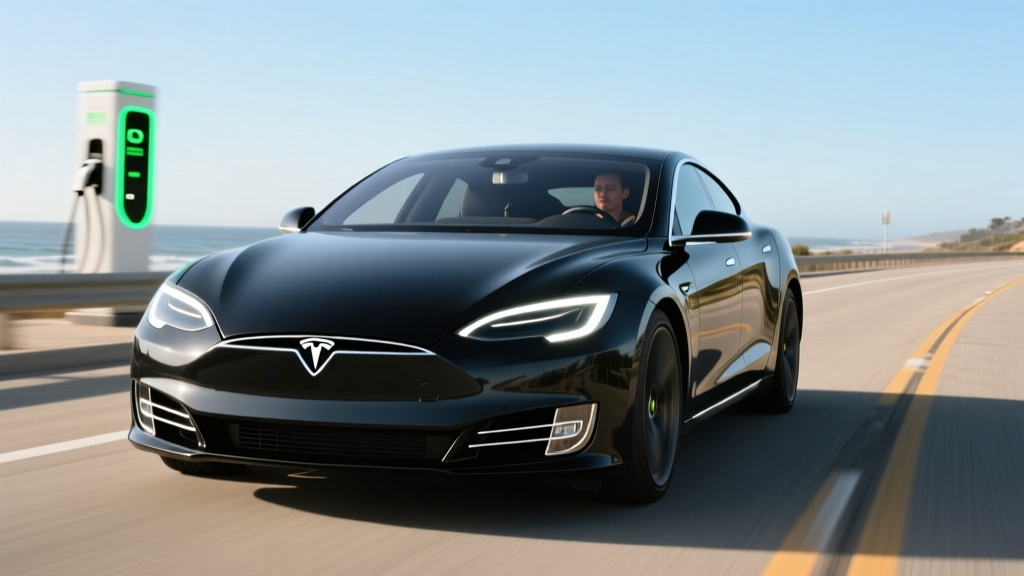
When shoppers search for "Tesla hazard," they're usually asking one of two things: how well do Tesla's active hazard-warning and collision-avoidance systems actually perform, or what are the hidden hazards of Tesla ownership that spec sheets don't mention? This review answers both. We put the 2026 Tesla Model 3 Long Range AWD and Model Y Long Range AWD through real-world driving, charging, and ownership analysis — examining the collision-avoidance tech, Autopilot limitations, and the practical risks every buyer should weigh before signing a purchase agreement.
Real-World Range vs. EPA Sticker: What Tesla Hazard Detection Can't Fix
EPA range estimates are a starting point, not a promise. Tesla's efficiency is among the best in the industry thanks to low drag coefficients and advanced thermal management, but physics still applies. Here's what you'll actually see on the road.
EPA Estimated Range: 341 miles (75 kWh usable battery, NMC chemistry)
Real-World Expectations:
• Highway (70-75 mph, moderate climate): 280–310 miles
• City/regenerative driving: 320–350 miles
• Cold weather (below 32°F): 230–270 miles (20–30% reduction)
• Towing (Model Y, light trailer): 180–220 miles
Tesla's hazard-avoidance systems — including Automatic Emergency Braking (AEB), forward collision warning, and blind-spot monitoring — don't extend your range, but they do reduce accident risk. The real hazard for range is driver behavior: sustained 80+ mph highway driving cuts efficiency to roughly 280 Wh/mile, dropping effective range to around 265 miles on the Model 3 Long Range. Cold weather compounds this because battery internal resistance increases, and cabin heating draws 2–5 kW continuously without a heat pump running optimally.
The Model 3 and Model Y both use a heat pump (standard since 2021), which cuts cold-weather energy waste significantly compared to resistive heaters. Still, expect 20–30% range loss below freezing, and preconditioning the battery before Supercharger stops is essential to hit peak charge rates.
Charging Speed: DC Fast, Level 2, and the Taper Hazard
Charging speed is where Tesla's Supercharger network remains a genuine advantage, but understanding the charge curve — not just peak kW — is critical for trip planning.
| Charging Level | Max Power (kW) | Charging Speed | Typical Use Case |
|---|---|---|---|
| Level 1 (120V) | 1.4 kW | 3–4 miles/hour | Emergency/trickle only |
| Level 2 (240V, 48A) | 11.5 kW | 35–44 miles/hour | Home overnight, workplace |
| DC Fast (V3 Supercharger) | 250 kW peak | 10–80% in ~25 min | Road trips, highway travel |
| DC Fast (V4 Supercharger) | 250 kW peak* | 10–80% in ~25 min | Same as V3 for Model 3/Y |
*V4 Superchargers support higher peak rates for Cybertruck and future vehicles; Model 3 and Model Y peak at 250 kW regardless of station type.
The charge-curve hazard: Tesla's battery management system throttles charging speed aggressively above 80% State of Charge (SoC) to protect the NMC cells. You'll see 250 kW from roughly 10–45% SoC, then a taper to ~100 kW by 65%, and ~40 kW above 85%. Charging from 80–100% can take as long as 10–80%. For road trips, plan stops at 15–20% SoC and charge to 70–80%, then drive on. This is faster than sitting at a stall waiting for the final 20%.
For home charging, a Tesla Wall Connector on a 60-amp circuit delivers 48 amps (11.5 kW), adding roughly 35–44 miles of range per hour. Most owners with a 300-mile daily drive need only 6–8 hours of overnight charging to fully replenish. If your electrical panel is maxed out, a 40-amp circuit (32A / 7.7 kW) still adds 28–33 miles per hour — enough for most commuters.
Performance and Drivetrain: Quick, but Not a Sports Car
| Metric | Value |
|---|---|
| 0–60 mph | 4.2 seconds |
| Horsepower | 384 hp (dual-motor combined) |
| Drivetrain | AWD (dual-motor, permanent magnet rear + induction front) |
| Top Speed | 125 mph (electronically limited) |
| Efficiency (EPA) | 132 MPGe combined / 25 kWh/100 mi |
The dual-motor setup uses a permanent magnet synchronous motor on the rear axle for efficiency and an induction motor on the front axle that can freewheel (disconnect) during light-load cruising to reduce drag losses. This is a key reason Tesla's real-world efficiency outperforms many competitors.
The 4.2-second 0–60 time is genuinely quick for daily driving — merging onto highways and passing are effortless. The Model 3 Performance trim drops this to 2.9 seconds with 510 hp, but at a $10,000+ premium and reduced range (EPA 315 miles). For most buyers, Long Range is the sweet spot.
Tesla Hazard Detection and Driver-Assist: What Autopilot Actually Does
Tesla Autopilot and Full Self-Driving (Supervised) are Level 2 driver-assist systems. The driver must remain fully engaged, hands on or near the wheel, and eyes on the road at all times. This is not self-driving. Only Level 4 robotaxi services like Waymo operate without a human driver in defined geographic zones.
Tesla's active safety suite — standard on every Model 3 and Model Y — includes:
- Automatic Emergency Braking (AEB): Detects vehicles, pedestrians, and cyclists; applies brakes if collision is imminent
- Forward Collision Warning: Audible and visual alerts for hazards ahead
- Blind Spot Monitoring: Visual alerts in side mirrors and on touchscreen
- Lane Departure Warning & Avoidance: Alerts and gentle steering correction if drifting
- Rear Cross-Traffic Alert: Warns of approaching vehicles when reversing
- Obstacle-Aware Acceleration: Limits acceleration if an obstacle is detected
The optional Full Self-Driving (Supervised) package ($8,000 as of 2026) adds traffic-light and stop-sign recognition, autosteer on city streets, and automatic lane changes on highways. In testing, FSD handles most suburban and highway scenarios competently but still requires intervention for construction zones, unusual lane markings, complex intersections, and adverse weather. Tesla's vision-only approach (no LiDAR or radar since 2022) means performance can degrade in heavy rain, fog, or direct sun glare.
• Drive without supervision — you are legally and practically the driver at all times
• Handle all weather conditions — heavy rain, snow, and fog reduce camera effectiveness
• Navigate unmapped or construction-altered roads reliably
• Replace attentive driving — NHTSA data shows AEB reduces rear-end crashes by ~50%, but the system is not infallible
• Operate as a Level 3+ system — there is no "eyes-off" mode approved in the US
Pricing, Trims, and Federal Tax Credit Eligibility
| Trim | MSRP | Est. Federal Credit | Effective Price |
|---|---|---|---|
| Model 3 RWD | $38,990 | Up to $7,500* | ~$31,490 |
| Model 3 Long Range AWD | $45,990 | Up to $7,500* | ~$38,490 |
| Model 3 Performance | $54,990 | Up to $7,500* | ~$47,490 |
*Federal tax credit eligibility under IRS §30D depends on:
- Buyer income caps: AGI ≤ $150,000 (single), $225,000 (head of household), $300,000 (married filing jointly)
- MSRP cap: Sedans (Model 3) ≤ $55,000; SUVs/trucks (Model Y) ≤ $80,000
- Battery sourcing: Critical minerals and battery components must meet increasing domestic/FHA-partner sourcing thresholds (phased annually through 2030)
- Point-of-sale transfer: As of 2024+, buyers can transfer the credit to the dealer for an immediate price reduction at purchase, subject to dealer registration
As of 2026, the Tesla Model 3 and Model Y remain eligible for the full $7,500 credit for buyers meeting income requirements, provided battery-sourcing thresholds are satisfied. Tesla publishes current eligibility on its website and at point of sale, but verify with a tax professional before relying on the credit — rules change annually, and partial credits ($3,750) apply if only one of the two sourcing requirements is met.
Interior, Cargo, and Practicality
The Model 3's minimalist interior is polarizing. Everything routes through the 15.4-inch center touchscreen — there are no physical buttons for climate, mirrors, or glovebox. For some, this is clean and futuristic; for others, it's a hazard in itself (diverting eyes to adjust wipers or temperature).
| Metric | Model 3 (Sedan) | Model Y (Crossover SUV) |
|---|---|---|
| Front Legroom | 42.7 in | 41.8 in |
| Rear Legroom | 35.2 in | 41.6 in |
| Cargo (behind rear seats) | 23 cu ft (trunk) | 30 cu ft |
| Cargo (seats folded) | N/A (sedan) | 72 cu ft |
| Frunk (front trunk) | 3.1 cu ft | 4.1 cu ft |
| Towing Capacity | Not rated | 3,500 lbs |
The Model Y is substantially more practical for families: the rear seats accommodate adults comfortably, the hatchback cargo area swallows strollers and luggage, and the 3,500-lb tow rating covers small boat and utility trailers. The Model 3 is a commuter-first vehicle — excellent for couples and solo drivers, tight for families with car seats and gear.
Warranty and Battery Longevity
| Coverage | Term |
|---|---|
| Basic Vehicle (bumper-to-bumper) | 4 years / 50,000 miles |
| Battery & Drive Unit (Long Range/Performance) | 8 years / 120,000 miles |
| Battery capacity retention threshold | 70% of original capacity during warranty period |
Tesla's 8-year/120,000-mile battery warranty covers defects and capacity loss below 70% — competitive with Hyundai's 10-year/100,000-mile and slightly better than Ford's 8-year/100,000-mile for the Mustang Mach-E. Real-world degradation data from Tesla's fleet indicates most NMC packs retain 85–90% capacity at 100,000 miles when charged primarily to 80% SoC and DC fast-charged infrequently.
Out-of-warranty battery replacement for the Model 3 Long Range currently runs $12,000–$16,000 at Tesla service centers, though refurbished packs are increasingly available at lower cost. This is a genuine ownership hazard to budget for if you plan to keep the vehicle past 150,000 miles.
Who Should Buy a Tesla (And Who Should Look Elsewhere)
• You have reliable home charging access (garage or driveway with 240V circuit)
• You value Supercharger network reliability for road trips
• You want best-in-class efficiency (kWh/100mi) and real-world range
• You're comfortable with a touchscreen-centric interface and minimal physical controls
• You want over-the-air updates that add features post-purchase
Look at competitors (Hyundai Ioniq 6, Ford Mustang Mach-E, BMW i4) if:
• You prefer physical buttons and traditional automotive interfaces
• You need dealer-based service networks (Tesla service centers are still sparse in rural areas)
• You want Apple CarPlay/Android Auto (Tesla does not support either)
• You're uncomfortable with Tesla's vision-only driver-assist approach
- Class-leading efficiency (25 kWh/100 mi)
- Supercharger network reliability (17,000+ stalls in North America)
- Strong resale value and brand recognition
- Over-the-air updates add features over time
- Eligible for $7,500 federal tax credit (subject to §30D rules)
- Spacious Model Y cargo area (72 cu ft with seats folded)
- No Apple CarPlay/Android Auto
- Touchscreen-only controls can be distracting
- Service center wait times can stretch weeks in some regions
- Vision-only FSD struggles in adverse weather
- Build quality variability (panel gaps, paint) still reported
- No physical hazard-light button (accessed via touchscreen or voice)
FAQ: Tesla Hazard Questions Answered
What is the real-world range of the 2026 Tesla Model 3 Long Range?
EPA estimates 341 miles, but real-world highway driving at 70–75 mph typically yields 280–310 miles. In cold weather (below 32°F), expect 230–270 miles. City driving with regenerative braking can match or slightly exceed the EPA number.
How fast does a Tesla charge at home and on DC fast chargers?
At home on a 240V/48A Level 2 charger (Tesla Wall Connector), the Model 3 Long Range adds 35–44 miles of range per hour, fully charging overnight in 7–8 hours. On a V3 or V4 Supercharger, it peaks at 250 kW and charges 10–80% in approximately 25 minutes, though the charge curve tapers significantly above 80% SoC.
How much does a Tesla Model 3 cost after the federal tax credit?
The 2026 Model 3 Long Range AWD starts at $45,990. Eligible buyers (meeting IRS §30D income caps of $150K single / $300K joint, with the vehicle under the $55K sedan MSRP cap and meeting battery-sourcing rules) can receive up to $7,500, bringing the effective price to approximately $38,490. The credit can now be transferred at point of sale for an immediate discount.
Is Tesla worth buying vs. Hyundai Ioniq 6 or Ford Mustang Mach-E?
Tesla's advantages are efficiency, Supercharger network access, and software updates. The Ioniq 6 offers comparable range (EPA 361 mi), 800V architecture for faster charging (10–80% in ~18 min at 350 kW), and Apple CarPlay. The Mach-E offers a more traditional interior and broader dealer service network. If Supercharger access matters for road trips and you're comfortable with Tesla's interface, Tesla remains compelling. If you want physical buttons and CarPlay, the Ioniq 6 or Mach-E are strong alternatives.
What are the biggest hazards or risks of Tesla ownership?
The main ownership hazards are: (1) service-center wait times in underserved regions, (2) touchscreen-only controls requiring eyes-off-road for basic adjustments, (3) battery replacement cost ($12K–$16K out of warranty), (4) insurance premiums 15–30% higher than comparable ICE vehicles due to repair costs, and (5) vision-only Autopilot/FSD limitations in adverse weather. None are deal-breakers, but all factor into total cost of ownership.
Does the Tesla Model 3 qualify for the full $7,500 federal EV tax credit?
Yes, as of 2026, the Model 3 qualifies for up to $7,500 under IRS §30D, provided the buyer meets income caps ($150K single / $300K joint AGI), the vehicle MSRP is under $55,000 (sedans), and battery-critical-mineral and component sourcing thresholds are met. Tesla confirms eligibility at point of sale, but rules tighten annually — verify with a tax professional.
For official efficiency data, see the EPA's fueleconomy.gov listing for the Tesla Model 3. For safety ratings, check IIHS crash-test results.