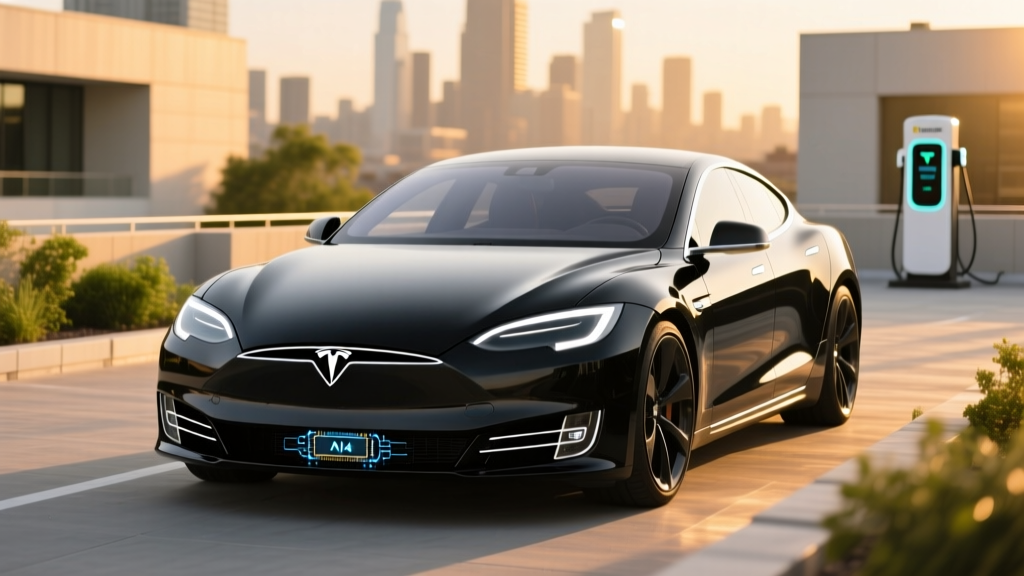
If you've shopped for a new Tesla in the last two years, you've likely encountered the term Tesla Hardware 4 (now officially branded AI4 by Tesla). Unlike a battery upgrade or a new paint color, HW4 is a fundamental overhaul of the vehicle's compute and sensor architecture — the nervous system that powers Autopilot, FSD (Supervised), and active safety features. But what does it actually do for you as a buyer in 2026, and does it affect range, charging, or everyday ownership?
This profile breaks down Tesla Hardware 4 through the lens of a real EV owner: what's changed on the spec sheet, what's changed behind the wheel, and whether HW4 should factor into your purchase decision across the Model Y, Model 3, Model S, and Model X lineup.
What Is Tesla Hardware 4 (AI4)?
Hardware 4 is Tesla's fourth-generation onboard computer and sensor suite, succeeding Hardware 3 (HW3/AI3) that shipped from 2019 through early 2023. Tesla CEO Elon Musk rebranded the platform as AI4 in 2024 to align with the company's broader artificial intelligence nomenclature, but the community and third-party sources still widely use "Hardware 4."
The key upgrades in HW4 include:
- Higher-resolution cameras: Front-facing cameras upgraded from 1.2 megapixels to approximately 5 megapixels, with improved low-light performance and wider fields of view.
- Redesigned camera placement: New fender camera housings, a repositioned cabin camera, and updated lens coatings to reduce glare and water spotting.
- More powerful compute: Tesla's custom FSD chip is upgraded with higher inference throughput — Tesla claims roughly 2–3× the processing capability of HW3, enabling more complex neural network models for FSD (Supervised).
- Removal of legacy sensors: HW4 vehicles ship without ultrasonic sensors (USS) or radar, relying entirely on Tesla Vision (camera-only perception). This transition began with HW3 vehicles in late 2022 but is fully standardized on HW4.
- 4D radar integration (select vehicles): Some 2025–2026 Model S and Model X builds have been spotted with a high-resolution 4D imaging radar as a supplemental sensor, though Tesla has not officially confirmed this across all trims.
Which Tesla Models Have Hardware 4?
As of the 2026 model year, every new Tesla sold in the United States ships with Hardware 4. The rollout timeline was:
| Model | HW4 Production Start | Current Status (2026) |
|---|---|---|
| Model S | March 2023 | All new builds HW4 |
| Model X | March 2023 | All new builds HW4 |
| Model 3 (Highland) | October 2023 (Fremont) | All new builds HW4 |
| Model Y (Juniper) | January 2025 (refresh) | All new builds HW4 |
| Cybertruck | November 2023 (launch) | HW4 from day one |
If you're buying a used Tesla from 2023 or earlier, verify the hardware version in the vehicle's Software menu — some 2023 cars were built with HW3 as Tesla transitioned production lines.
Real-World Range & Efficiency: Does HW4 Change Anything?
Hardware 4 itself does not directly alter EPA range — that's a function of battery chemistry, motor efficiency, weight, and aerodynamics. However, HW4's more efficient compute chip draws marginally less parasitic power, and the camera-only sensor suite eliminates the energy draw of radar and ultrasonic modules. In practice, this translates to a negligible difference of perhaps 1–2 miles of range compared to an identical HW3 vehicle.
Here's how the current 2026 Tesla lineup shapes up for range and efficiency, using the EPA's fueleconomy.gov data:
| Model / Trim | Battery (kWh, est. usable) | Chemistry | EPA Range | MPGe (combined) | kWh/100 mi |
|---|---|---|---|---|---|
| Model 3 RWD | 57.5 | LFP | 272 mi | 132 | 25 |
| Model 3 Long Range AWD | 75 | NMC | 341 mi | 132 | 25 |
| Model 3 Performance | 75 | NMC | 315 mi | 121 | 28 |
| Model Y Long Range AWD | 75 | NMC | 320 mi | 122 | 28 |
| Model Y Performance | 75 | NMC | 298 mi | 117 | 29 |
| Model S Long Range | 95 | NMC | 402 mi | 124 | 27 |
| Model X Long Range | 95 | NMC | 335 mi | 109 | 31 |
- Highway-only at 75 mph: Expect 85–90% of EPA range (e.g., Model Y LR: ~272–288 mi actual).
- Cold weather (below 32°F): Range drops 20–30% depending on cabin heating use and whether you precondition. LFP packs (Model 3 RWD) are especially sensitive to cold charging speeds.
- City/regenerative driving: You may match or slightly exceed EPA, especially in stop-and-go traffic where regen recaptures energy.
Charging Speed: DC Fast Charge & Home Level 2
Hardware 4 doesn't alter the physical charging hardware — that's determined by the onboard charger and battery management system. But HW4's improved thermal modeling can marginally optimize battery preconditioning for Supercharger sessions, potentially shaving a minute or two off a 10–80% session in cold conditions.
| Model | Peak DC Fast Charge (kW) | 10–80% Time (min) | Level 2 Home Rate (kW) | Level 2 Miles/Hour |
|---|---|---|---|---|
| Model 3 RWD (LFP) | 170 kW | ~25 | 11.5 kW (48A) | ~37 mi/hr |
| Model 3 Long Range / Perf | 250 kW | ~18 | 11.5 kW (48A) | ~37 mi/hr |
| Model Y Long Range / Perf | 250 kW | ~20 | 11.5 kW (48A) | ~37 mi/hr |
| Model S / X | 250 kW | ~22 | 11.5 kW (48A) | ~34 mi/hr |
Charging curve reality: The "250 kW peak" figure only holds between roughly 10–30% state of charge. Above 50%, the rate tapers significantly — by 80%, you're typically at 60–80 kW. This is why Tesla (and all automakers) quote 10–80% times rather than 0–100%. For LFP batteries in the Model 3 RWD, Tesla recommends charging to 100% regularly to maintain battery calibration, unlike NMC packs where daily charging to 80% is preferred for longevity.
FSD (Supervised) on Hardware 4: What's Different?
This is where HW4 matters most. The upgraded cameras and compute enable Tesla to run more sophisticated neural networks for its FSD (Supervised) software. In practical terms, owners and reviewers have noted:
- Smoother lane changes: Higher-resolution camera feeds give the perception stack more data to judge gap distances, resulting in fewer aborted lane changes.
- Better low-light and rain performance: The improved sensor sensitivity reduces phantom braking events in dawn/dusk conditions and heavy rain — a known issue with HW3 cameras.
- Faster end-to-end inference: Tesla's 2025–2026 FSD versions (v13.x and v14.x) use an end-to-end neural network architecture that benefits from HW4's additional compute headroom, reducing latency in complex intersections.
- Cabin camera monitoring: HW4's updated interior camera provides more reliable driver-attention monitoring, reducing false "hands on wheel" warnings.
- It does not make the vehicle autonomous. You are the driver and liable for all driving decisions.
- It does not handle all construction zones, unmapped roads, or severe weather reliably.
- It does not replace the need for auto insurance — and some insurers charge higher premiums for FSD-equipped vehicles.
- FSD capability does not transfer to a new owner if you sell the vehicle (as of current Tesla policy).
As of 2026, FSD (Supervised) costs $8,000 as a one-time purchase or $99/month as a subscription. Tesla periodically offers free trial periods (typically 30 days) on new vehicle deliveries.
Performance & Specs: 2026 Tesla Lineup at a Glance
| Spec | Model 3 LR AWD | Model Y LR AWD | Model S LR |
|---|---|---|---|
| Drivetrain | Dual Motor AWD | Dual Motor AWD | Dual Motor AWD |
| Horsepower | ~384 hp | ~384 hp | ~670 hp |
| 0–60 mph | 4.2 sec | 4.8 sec | 3.1 sec |
| Top Speed | 125 mph | 125 mph | 155 mph |
| Cargo Volume | 23 cu ft (trunk+frunk) | 76 cu ft (seats folded) | 28 cu ft (trunk+frunk) |
| Rear Legroom | 35.3 in | 41.6 in | 35.4 in |
| Towing Capacity | Not rated | 3,500 lbs | Not rated |
Pricing, Tax Credits & Ownership Cost
| Model / Trim | Base MSRP (2026) | Est. §30D Credit | Effective Price |
|---|---|---|---|
| Model 3 RWD | $38,990 | $3,750* | ~$35,240 |
| Model 3 Long Range AWD | $45,990 | $7,500* | ~$38,490 |
| Model Y Long Range AWD | $46,990 | $7,500* | ~$39,490 |
| Model S Long Range | $79,990 | $0 (over MSRP cap) | $79,990 |
| Model X Long Range | $84,990 | $0 (over MSRP cap) | $84,990 |
*Federal §30D tax credit amounts are estimates based on 2026 IRS rules. Eligibility depends on buyer income limits (AGI caps: $150K single / $300K joint), battery critical-mineral and component sourcing requirements, and MSRP caps ($55,000 for sedans, $80,000 for SUVs/trucks). The credit can now be transferred to the dealer as a point-of-sale discount. Always verify current eligibility at IRS.gov and consult a tax professional.
Warranty: All 2026 Teslas include a 4-year/50,000-mile basic vehicle warranty and an 8-year battery and drive unit warranty. The battery warranty covers capacity retention above 70% — for Model 3/Y this is 8 years/100,000 miles; for Model S/X it's 8 years/150,000 miles.
Pros & Cons of Hardware 4 Teslas
Pros
- Best-in-class Supercharger network access (17,000+ stalls in North America)
- FSD (Supervised) improving rapidly with HW4's compute headroom
- Over-the-air updates continuously add features post-purchase
- Excellent efficiency (kWh/100 mi) across the lineup
- Strong resale value relative to most EV competitors
- Model 3/Y eligible for up to $7,500 federal credit (subject to sourcing rules)
Cons
- No ultrasonic sensors — parking near obstacles relies on camera estimation (less precise at low speeds)
- FSD is an expensive add-on ($8,000) that doesn't transfer at resale
- Minimalist interior lacks physical controls for climate, mirrors, and glovebox (all screen-based)
- Insurance premiums often 15–25% higher than comparable non-Tesla EVs
- Model S/X exceed MSRP caps for federal tax credit
- Service center wait times remain long in many metro areas
Is a Tesla Hardware 4 Vehicle Worth It vs. Competitors?
If you're cross-shopping a HW4 Tesla against the Hyundai Ioniq 5, Ford Mustang Mach-E, BMW i4, or Chevrolet Equinox EV, the decision comes down to three factors:
Choose Tesla HW4 if: You prioritize access to the Supercharger network (still the most reliable DC fast-charging ecosystem in North America), want the most advanced driver-assist system available to consumers (with the caveat that it's Level 2, not autonomous), and value over-the-air feature updates that keep the car current years after purchase.
Choose a competitor if: You prefer physical buttons and a more traditional interior layout, want ultrasonic parking sensors for tight garage maneuvers, need a lower insurance cost, or find a better deal after incentives on models like the Ioniq 5 (which supports 800V charging at up to 350 kW) or the Equinox EV (starting under $35,000 with full credit eligibility).
Frequently Asked Questions
Can I upgrade my Hardware 3 Tesla to Hardware 4?
No. Tesla has confirmed that HW4 requires different wiring harnesses, camera mounts, and compute hardware that cannot be retrofitted to HW3 vehicles. Tesla previously offered free HW2-to-HW3 upgrades for early FSD purchasers, but no such program exists for HW3-to-HW4. If you want HW4, you'll need to purchase a vehicle built with it.
Does Hardware 4 improve range or charging speed?
Not meaningfully. Range and charging speed are determined by battery chemistry, pack size, motor type, and the onboard charger — none of which changed with HW4. Any range difference is negligible (1–2 miles at most from reduced parasitic draw). HW4's improvements are in perception and compute for driver-assist features.
Is Tesla's camera-only approach (no radar/USS) safe?
Tesla vehicles with Tesla Vision have maintained strong safety ratings from NHTSA (5-star overall) and the IIHS (Top Safety Pick+ on Model 3 and Model Y). However, the lack of ultrasonic sensors means the car estimates distances to nearby objects using camera data, which can be less precise than sonar at very low speeds (parking). Some owners report occasional "phantom" proximity warnings in tight spaces.
Does FSD (Supervised) make my Tesla self-driving?
No. FSD (Supervised) is an SAE Level 2 system. You must remain the active driver — monitoring the road, keeping hands available, and ready to intervene instantly. The "Supervised" label in the product name reflects this. True self-driving (Level 4) is currently only available through commercial robotaxi services like Waymo in limited geofenced areas.
What's the real-world range of a Model Y Long Range with HW4?
The EPA rates it at 320 miles. In real-world highway driving at 70–75 mph in moderate temperatures, expect 272–290 miles. In cold weather (below freezing), that drops to 220–255 miles depending on whether you precondition the battery and use seat heaters vs. cabin heat. For road trips, plan Supercharger stops at roughly 200-mile intervals for comfort and to stay in the fast-charging portion of the battery curve.
Which 2026 Teslas qualify for the $7,500 federal tax credit?
As of 2026, the Model 3 Long Range AWD and Model Y Long Range AWD typically qualify for the full $7,500 credit, while the Model 3 RWD may qualify for $3,750 (depending on battery mineral sourcing in that production batch). Model S and Model X exceed the MSRP cap ($55K sedans / $80K SUVs) and are ineligible. Always verify current eligibility on fueleconomy.gov and consult your tax advisor, as sourcing requirements can shift quarterly.