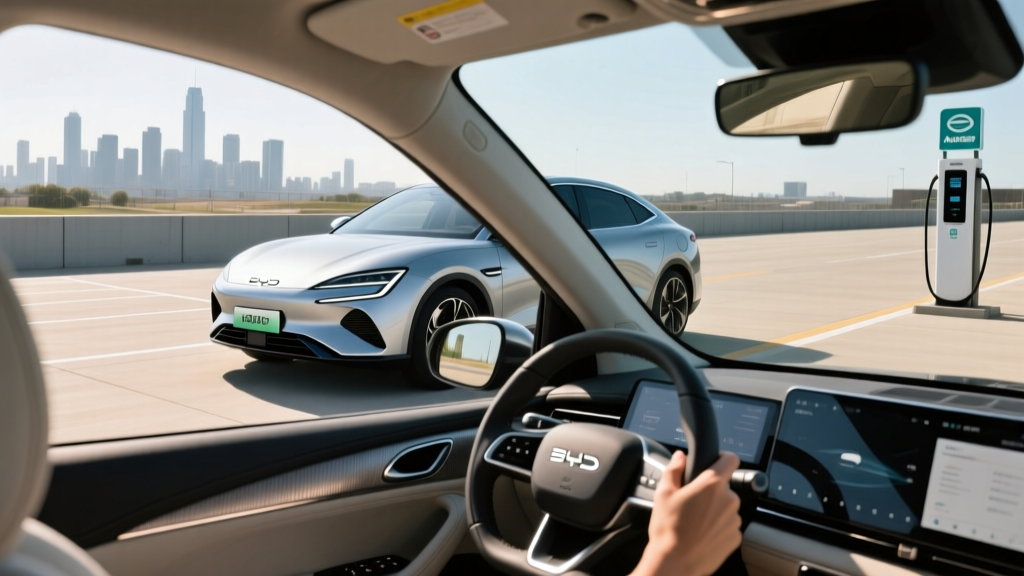
If you follow global EV news, you've seen the headlines: BYD has overtaken Tesla as the world's best-selling electric-vehicle brand, with models ranging from a $10,000 city car to a luxury SUV rivaling a Porsche Cayenne. Yet walk into any American dealership or browse any US EV configurator, and you won't find a single BYD badge. The question — why doesn't BYD sell in the USA — has no single answer. It's a tangle of 100% tariffs, national-security concerns, battery-sourcing legislation, and a geopolitical climate that shows no sign of thawing in 2026.
This isn't a review of a car you can test-drive. It's a buyer-focused breakdown of the regulatory, economic, and political walls keeping BYD out of the US market, what vehicles American shoppers are missing, and what realistic pathways (if any) exist for BYD to eventually reach US driveways.
The Tariff Wall: 100% Duty on Chinese EVs
The most direct answer to why BYD doesn't sell in the USA is simple math. In May 2024, the Biden administration finalized a tariff increase on Chinese-made electric vehicles from 25% to 100% under Section 301 of the Trade Act. That tariff remains fully in effect through 2026 and has been reinforced by additional trade actions under the subsequent administration.
A 100% tariff doesn't just make BYD vehicles more expensive — it obliterates the entire value proposition that makes them competitive. Here's what that looks like in practice:
| BYD Model | China Price (approx. USD) | US Landed Cost with 100% Tariff | US Competitor Benchmark |
|---|---|---|---|
| Dolphin (compact hatchback) | $14,000 | ~$28,000+ (before shipping, dealer markup) | Chevy Bolt EV: ~$28,000 |
| Atto 3 / Yuan Plus (compact SUV) | $19,000 | ~$38,000+ | Hyundai Kona Electric: ~$34,000 |
| Seal (mid-size sedan) | $25,000 | ~$50,000+ | Tesla Model 3: ~$40,000 |
| Han (flagship sedan) | $33,000 | ~$66,000+ | BMW i5: ~$67,000 |
| Tang (3-row SUV) | $35,000 | ~$70,000+ | Kia EV9: ~$55,000 |
Once you add ocean freight (currently $2,000–$4,000 per vehicle from China), US dealership network costs, compliance modifications, and dealer margins, BYD's price advantage evaporates entirely. A BYD Seal that competes with a Tesla Model 3 on specs in Europe would cost more than a BMW i5 by the time it reached an American showroom.
National Security and Data Privacy Concerns
Tariffs are only half the story. The US government has raised escalating concerns about connected vehicles manufactured by Chinese companies. Modern EVs are data-gathering platforms — they collect GPS location data, cabin camera footage, voice assistant recordings, driving behavior telemetry, and smartphone integration data.
In September 2024, the Department of Commerce proposed a ban on the sale or import of connected vehicles containing hardware or software from China or Russia, with full enforcement targeted for the 2027 model year. BYD, as a Chinese-headquartered company with deep ties to the Chinese state (it received substantial government subsidies during its growth phase), would face near-impossible compliance hurdles under this rule.
The Federal Tax Credit Barrier (IRS §30D)
Even if BYD could clear the tariff and data-privacy hurdles, the federal EV tax credit under IRS §30D presents another structural wall. The credit — up to $7,500 for qualifying new EVs — requires:
- Battery component sourcing: A percentage of battery components must be manufactured or assembled in North America (phasing up annually through 2029).
- Critical mineral sourcing: A percentage of critical minerals must be sourced from the US or a free-trade-agreement partner.
- Foreign Entity of Concern (FEOC) exclusion: Starting in 2024 for battery components and 2025 for critical minerals, any vehicle with battery materials sourced from a FEOC — which includes Chinese companies — is automatically disqualified from the credit.
- MSRP caps: $55,000 for sedans; $80,000 for SUVs, vans, and trucks.
- Buyer income caps: $150,000 single / $300,000 joint adjusted gross income.
BYD is vertically integrated: it manufactures its own batteries (the famous Blade Battery), sources its own lithium and other critical minerals largely from Chinese supply chains, and produces its own semiconductors. Under the FEOC rules, every single BYD vehicle would be ineligible for the $7,500 credit, putting it at a severe disadvantage against competitors like Hyundai, Tesla, and Ford whose vehicles can qualify.
What US Buyers Are Missing: BYD's Global Lineup
To understand why this question keeps coming up, you need to see what BYD offers in markets where it does sell — Europe, Southeast Asia, Australia, Latin America, and the Middle East. Here are the specs of models that American shoppers frequently ask about:
| Model | Battery (kWh) | Chemistry | WLTP Range | Max DC Charge (kW) | 10–80% Time | 0–62 mph | HP |
|---|---|---|---|---|---|---|---|
| Dolphin | 60.4 kWh | LFP (Blade) | 265 mi (WLTP) | 88 kW | ~29 min | 7.0 sec | 201 hp |
| Atto 3 (Yuan Plus) | 60.5 kWh | LFP (Blade) | 260 mi (WLTP) | 88 kW | ~29 min | 7.3 sec | 201 hp |
| Seal | 82.5 kWh | LFP (Blade) | 354 mi (WLTP) | 150 kW | ~26 min | 3.8 sec (AWD) | 523 hp (AWD) |
| Han EV | 85.4 kWh | LFP (Blade) | 320 mi (WLTP) | 120 kW | ~32 min | 7.9 sec | 241 hp |
| Tang EV | 108.8 kWh | LFP (Blade) | 330 mi (WLTP) | 170 kW | ~30 min | 4.4 sec (AWD) | 509 hp (AWD) |
| Seal U (compact SUV) | 87.0 kWh | LFP (Blade) | 310 mi (WLTP) | 140 kW | ~28 min | 5.9 sec (AWD) | 308 hp (AWD) |
The Blade Battery: What Makes BYD's Tech Stand Out
BYD's most compelling technology asset is its Blade Battery, a lithium iron phosphate (LFP) cell in a long, thin form factor that BYD claims passes nail-penetration tests without thermal runaway — a significant safety advantage over conventional NMC cells.
| Factor | LFP (BYD Blade) | NMC (Typical) |
|---|---|---|
| Thermal stability | Excellent — resists thermal runaway | Moderate — requires robust cooling |
| Cycle life | 3,000–5,000+ cycles | 1,000–2,000 cycles |
| Energy density | Lower (~150 Wh/kg cell-level) | Higher (~250 Wh/kg cell-level) |
| Cold-weather performance | Good, slightly better than NMC | Moderate degradation in cold |
| Cost | Lower (no cobalt, nickel) | Higher (cobalt, nickel required) |
| SoC estimation accuracy | Flat voltage curve makes estimation harder | Easier to estimate state of charge |
| Recommended daily charge | 100% OK (no degradation concern) | 80% recommended for daily use |
The Blade Battery's structural integration — where the cells themselves serve as structural members of the vehicle chassis — reduces weight and increases torsional rigidity. Tesla has adopted a similar cell-to-chassis approach with its 4680 cells, but BYD was first to market at scale with LFP in this configuration.
BYD backs its batteries with an 8-year/100,000-mile warranty (whichever comes first) in most markets, with a capacity retention threshold of 70%. This is comparable to the industry-standard warranty offered by Hyundai, Kia, and Tesla in the US market.
Where BYD Actually Sells — and How It's Doing
BYD's absence from the US stands in sharp contrast to its aggressive global expansion. In 2025, BYD sold over 4 million new-energy vehicles globally (including BEVs and PHEVs). Key markets include:
- China: Dominant market share, with over 35% of the NEV market.
- Europe: Rapid expansion into Germany, UK, France, Norway, and others. The Atto 3, Dolphin, and Seal are all available, though sales have been slower than expected due to brand unfamiliarity and EU anti-subsidy investigations.
- Southeast Asia: Market leader in Thailand; expanding rapidly in Indonesia, Malaysia, and the Philippines.
- Australia/New Zealand: Strong growth; Atto 3 is a top-selling EV.
- Latin America: Building a factory in Brazil (opened 2025), with strong sales in Mexico and Colombia.
- Middle East: Active in UAE and Saudi Arabia.
Notably, BYD is also building a passenger-vehicle factory in Mexico, which has sparked US political concern that Mexican-assembled BYD vehicles could circumvent tariffs under the USMCA trade agreement. However, US lawmakers have preemptively signaled that any such vehicles would face additional legislative barriers.
Could BYD Ever Enter the US Market?
Three theoretical pathways exist, though none are imminent:
1. US or FTA-Country Manufacturing
If BYD built a factory in the US (or potentially a country with a free-trade agreement), it could avoid the Section 301 tariff on Chinese-made vehicles. However, the connected-vehicle hardware/software ban and FEOC battery-sourcing rules would still apply. BYD would need to fundamentally restructure its supply chain — the same vertical integration that gives it cost advantages in China would become a liability in the US.
2. Political Thaw
A dramatic shift in US-China trade relations could reduce tariffs or relax data-security rules. Given the bipartisan consensus on China trade policy as of 2026, this scenario is extremely unlikely in the near term.
3. Commercial Vehicles or Non-Connected Products
BYD does sell electric buses and commercial trucks globally, and some BYD electric buses operate in US transit fleets (though these face their own political headwinds). A commercial-only entry avoids some consumer-data concerns but doesn't help US car buyers.
What US EV Buyers Should Consider Instead
If BYD's value proposition — affordable LFP-battery EVs with strong build quality — appeals to you, here are the closest US-market alternatives in 2026:
| BYD Model | US Alternative | EPA Range | Starting MSRP | Tax Credit Eligible? |
|---|---|---|---|---|
| Dolphin | Chevrolet Bolt EV | 259 mi | ~$28,000 | Yes (full $7,500) |
| Atto 3 | Hyundai Kona Electric | 261 mi | ~$34,000 | Partial (varies by sourcing) |
| Seal | Tesla Model 3 | 341 mi (LR AWD) | ~$40,000 | Partial (varies by trim) |
| Han | Hyundai Ioniq 6 | 361 mi (SE LR) | ~$38,000 | Partial (varies by trim) |
| Tang | Kia EV9 | 304 mi (LR RWD) | ~$55,000 | Yes (full $7,500, assembled in GA) |
- Choose a US-market LFP vehicle (Tesla Model 3 RWD, some Ford Mustang Mach-E trims) if you want the Blade Battery's key benefit — long cycle life and daily 100% charging — without waiting for BYD.
- Choose a Bolt EV or Kona Electric if BYD's affordability is what drew you in; both undercut $35,000 and qualify for at least partial federal credits.
- Don't wait for BYD — there is no announced timeline, legal pathway, or political momentum for BYD passenger vehicles to enter the US market before 2028 at the earliest, and likely not before 2030.
Frequently Asked Questions
Why doesn't BYD sell in the USA?
Three compounding barriers: a 100% tariff on Chinese-made EVs (Section 301), proposed Commerce Department bans on Chinese connected-vehicle hardware and software, and federal tax credit (IRS §30D) rules that disqualify vehicles with battery components or critical minerals from Foreign Entities of Concern — which includes Chinese companies like BYD.
Does BYD plan to sell cars in the US?
BYD has not announced any US passenger-vehicle launch timeline. While BYD has expressed long-term global ambitions, company executives have acknowledged that the US market is not a near-term priority due to the regulatory and tariff environment.
Can I import a BYD vehicle to the US myself?
Practically, no. Any vehicle imported to the US must meet NHTSA safety standards (FMVSS), EPA emissions certification, and DOT compliance. BYD vehicles are not homologated for the US market, and the 100% tariff would apply to individual imports as well. The cost and legal complexity make this infeasible.
Is BYD's Blade Battery really safer than other EV batteries?
BYD's Blade Battery (LFP chemistry in a structural cell format) has demonstrated strong performance in nail-penetration and crush tests without thermal runaway, which is a genuine safety advantage over many NMC cells. However, independent third-party crash and fire data from NHTSA or IIHS is not yet available for BYD vehicles since they aren't sold in the US.
Will BYD ever build a factory in the US or Mexico?
BYD is building a factory in Mexico (production started 2025) aimed at the Latin American market. A US factory has not been announced, and even a Mexican factory would face additional legislative barriers to exporting vehicles to the US under current political conditions.
What's the best US alternative to a BYD vehicle?
For affordable compact EVs, the Chevrolet Bolt EV (~$28,000, 259 mi EPA, full $7,500 tax credit) is the closest US-market equivalent to a BYD Dolphin. For mid-size sedans, the Tesla Model 3 and Hyundai Ioniq 6 offer comparable range and tech. For three-row SUVs, the Kia EV9 (assembled in Georgia, qualifies for the full credit) competes with the BYD Tang.