Can H-1B Visa Holders Buy a Tesla and Claim the Federal Tax Credit?
If you're in the U.S. on an H-1B visa and considering a Tesla, you're asking the right questions: Which model fits your budget? Does the federal EV tax credit apply to non-permanent residents? And what does real-world ownership actually cost? This guide addresses the intersection of Tesla's 2026 lineup and the specific financial considerations H-1B professionals face — from §30D tax credit eligibility to total cost of ownership.
The short answer: H-1B visa holders who owe U.S. federal income tax can generally claim the EV tax credit, provided they meet IRS income caps, the vehicle meets MSRP and battery-sourcing requirements, and they use the point-of-sale transfer option or claim it on their tax return. Let's break down exactly how this works with Tesla's current models.
2026 Tesla Lineup: Specs at a Glance
| Spec | Model 3 RWD | Model Y Long Range AWD | Model S Dual Motor |
|---|---|---|---|
| EPA Range | 341 mi | 320 mi | 402 mi |
| Battery (usable) | ~60 kWh (LFP) | ~75 kWh (NMC) | ~95 kWh (NMC) |
| 0-60 mph | 5.8 sec | 4.8 sec | 3.1 sec |
| Horsepower | 283 hp | 384 hp | 670 hp |
| Drivetrain | RWD | Dual-Motor AWD | Dual-Motor AWD |
| MPGe (combined) | 132 MPGe | 117 MPGe | 120 MPGe |
| Efficiency | 25 kWh/100mi | 29 kWh/100mi | 28 kWh/100mi |
| Max DC Fast Charge | 170 kW | 250 kW | 250 kW |
| 10-80% DC Time | ~25 min | ~22 min | ~27 min |
| Level 2 Home Rate | 11.5 kW (~44 mi/hr) | 11.5 kW (~44 mi/hr) | 11.5 kW (~44 mi/hr) |
| Base MSRP | $38,990 | $48,990 | $79,990 |
| Cargo Volume | 23 cu ft (trunk+frunk) | 76 cu ft (rear folded) | 28 cu ft (rear trunk) |
| Rear Legroom | 35.2 in | 37.0 in | 35.4 in |
Real-World Range: What the EPA Sticker Doesn't Tell You
The EPA estimates are tested under controlled conditions. In practice:
- Highway driving (70-80 mph): Expect 15-20% less than EPA. A Model 3 RWD rated at 341 mi will deliver ~270-290 mi on a flat interstate at 75 mph.
- Cold weather (below 32°F): Range drops 20-30% due to battery heating demands and cabin HVAC. The same Model 3 may show ~240 mi in January in Chicago.
- City/commuter driving with regen: Often matches or exceeds EPA thanks to regenerative braking recapturing energy in stop-and-go traffic.
Tesla's heat pump (standard on all 2026 models) significantly reduces cold-weather HVAC energy draw compared to resistive heaters — a meaningful advantage in northern states.
The Model 3's LFP (lithium iron phosphate) battery chemistry deserves a note: LFP cells tolerate regular 100% charging without the degradation concerns of NMC packs. Tesla recommends charging LFP-equipped Model 3 RWDs to 100% at least weekly for accurate state-of-charge calibration. This means you get full usable capacity daily — effectively narrowing the real-world gap with the EPA sticker for commuters who charge at home nightly.
Charging Speed: DC Fast Charging and Home Setup
| Charging Level | Power | Miles Added per Hour | Typical Use Case |
|---|---|---|---|
| Level 1 (120V household) | ~1.4 kW | ~5 mi/hr | Emergency/overnight trickle |
| Level 2 (240V home wall connector) | 11.5 kW | ~44 mi/hr | Daily home charging |
| DC Fast Charge (Supercharger V3) | Up to 250 kW | ~1,000 mi/hr (peak) | Road trips; 10-80% in ~22 min |
Understanding kW vs kWh: kW (kilowatts) measures power — how fast energy flows into the battery. kWh (kilowatt-hours) measures energy capacity — how much the battery holds. A 250 kW charger fills a 75 kWh battery faster than a 150 kW charger, but the charge curve tapers significantly above 80% state-of-charge to protect cell longevity.
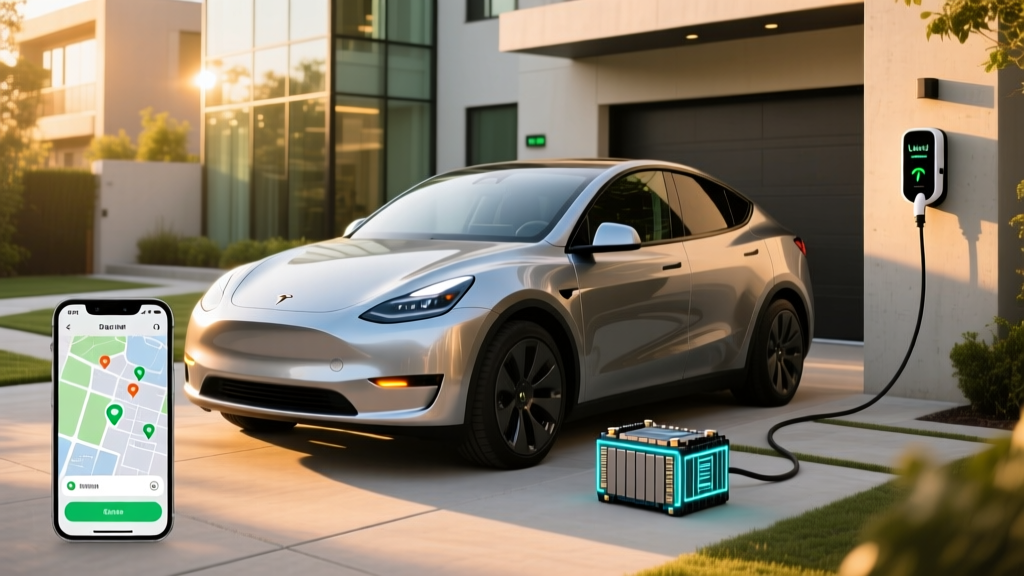
Tesla's Supercharger network remains the most reliable public DC fast-charging ecosystem in the U.S., with over 6,500 V3/V4 stalls nationwide. For H-1B professionals who rent apartments without home-charging access, Supercharger proximity to your workplace or grocery route becomes a practical daily consideration. Use Tesla's in-car navigation or the app to locate stalls; preconditioning the battery en route to a Supercharger shaves 3-5 minutes off your charge session by warming cells to optimal temperature.
Home Level 2 installation cost typically runs $500-$1,500 for the Tesla Wall Connector unit plus $800-$2,500 for electrician labor (depending on panel proximity and whether a 60A circuit is available). Apartment dwellers should check whether their building offers shared EV charging or negotiate a Level 2 install with their landlord.
Federal EV Tax Credit: H-1B Visa Holder Eligibility Explained
This is the core question for H-1B professionals. Under IRS §30D rules, the federal clean vehicle credit is available to taxpayers — not exclusively to citizens or permanent residents. If you file a U.S. federal income tax return (Form 1040) and have sufficient tax liability, you can claim the credit.
- Filing status & income caps: AGI must not exceed $150,000 (single), $225,000 (head of household), or $300,000 (married filing jointly)
- MSRP caps: Vehicle must be under $55,000 (sedans like Model 3) or $80,000 (SUVs/trucks like Model Y)
- Battery sourcing: Critical minerals and battery components must meet phased-in percentages from U.S. or FTA-partner countries
- Tax liability: Credit is non-refundable — you must owe at least $7,500 in federal tax to claim the full amount (unless using point-of-sale transfer)
- Point-of-sale transfer: As of 2024, you can transfer the credit to the dealer at purchase, reducing your purchase price upfront regardless of tax liability
- H-1B specific: No citizenship or green card requirement — your SSN/ITIN and U.S. tax filing status qualify you
| Model / Trim | Base MSRP | Under MSRP Cap? | Max Credit | Effective Price |
|---|---|---|---|---|
| Model 3 RWD | $38,990 | Yes ($55K sedan cap) | Up to $7,500* | ~$31,490 |
| Model 3 Long Range AWD | $45,990 | Yes | Up to $7,500* | ~$38,490 |
| Model Y Long Range AWD | $48,990 | Yes ($80K SUV cap) | Up to $7,500* | ~$41,490 |
| Model Y Performance | $53,490 | Yes | Up to $7,500* | ~$45,990 |
| Model S Dual Motor | $79,990 | Yes (SUV cap, classified sedan) | Varies* | Check IRS |
*Credit amount depends on battery sourcing compliance, which shifts throughout the year. Check fueleconomy.gov for the current credit amount on your specific build date. The point-of-sale transfer option at Tesla lets you apply the credit directly at delivery, reducing your down payment.
H-1B-specific tax consideration: If you're a dual-status alien in your first or last year of U.S. employment, your tax liability may be lower. Many H-1B holders in tech roles earning $100K-$200K have more than enough federal tax liability to absorb the full $7,500 credit. Consult a tax professional familiar with non-immigrant visa tax situations — particularly regarding the substantial presence test and any applicable tax treaties with your home country.
Ownership Costs for H-1B Professionals
Beyond the purchase price, here's what Tesla ownership looks like for someone on a work visa who may be evaluating a 2-4 year stay:
| Category | Estimated Cost | Notes |
|---|---|---|
| Purchase (after credit) | ~$31,490 | Assuming full $7,500 credit applied |
| Home electricity (4 yrs) | ~$2,400 | 12,000 mi/yr at $0.14/kWh avg |
| Insurance (4 yrs) | ~$8,800 | $2,200/yr avg — Teslas run 15-25% higher |
| Maintenance (4 yrs) | ~$800 | Cabin filter, wipers, tire rotation — no oil changes |
| Depreciation (4 yrs) | ~$12,000 | Estimated 40% from post-credit price |
| Total 4-Year Cost | ~$55,490 | ~$1,156/month all-in |
Depreciation and visa uncertainty: If your H-1B status changes or you leave the U.S., you'll need to sell the vehicle. Teslas hold value comparably to mainstream EVs but depreciate more than Toyota/Honda hybrids. Selling a 2-year-old Model 3 typically recovers 60-65% of the purchase price. Factor this into your decision if your U.S. tenure is uncertain.
Warranty, Tech, and Daily Living
Warranty coverage:
- Basic vehicle: 4 years / 50,000 miles
- Battery & drive unit: 8 years / 100,000 miles (Model 3 RWD); 8 years / 120,000 miles (Long Range/Model Y)
- Battery degradation guarantee: Tesla warrants that the battery will retain at least 70% of original capacity during the warranty period
Tech and driver assistance: Every 2026 Tesla includes the 15.4-inch center touchscreen, over-the-air updates, Tesla app connectivity, and Basic Autopilot (adaptive cruise + lane centering). Full Self-Driving (Supervised) remains an $8,000 add-on — and it's critical to understand this is SAE Level 2 driver assistance, not autonomous driving. You must keep your hands on the wheel and eyes on the road at all times. FSD handles more complex scenarios (traffic lights, stop signs, some city streets) but requires constant supervision.
Notable drawbacks:
- No Apple CarPlay or Android Auto — Tesla's proprietary infotainment only
- Minimalist interior means no physical buttons for climate, mirrors, or glovebox (all screen-controlled)
- Panel gap quality varies; inspect at delivery
- Insurance premiums run higher than comparable non-Tesla EVs
- No traditional dealership network — all service through Tesla centers or mobile rangers
- Access to Supercharger network — best public charging reliability
- Class-leading efficiency (kWh/100mi)
- LFP battery on Model 3 RWD: 100% daily charging OK
- OTA updates add features post-purchase
- Strong performance even on base trims
- Point-of-sale tax credit reduces upfront cost
- Higher insurance premiums
- No CarPlay/Android Auto
- Service center wait times in some metros
- Depreciation risk if leaving U.S. early
- All-screen interface has a learning curve
- FSD is expensive and still requires supervision
Who Should Buy a Tesla on an H-1B Visa?
Choose a Tesla (Model 3 RWD) if: You have home or workplace Level 2 charging, your commute is under 60 miles round-trip, you want the lowest running costs, and you plan to stay in the U.S. at least 3 years.
Choose a Tesla (Model Y LR AWD) if: You need cargo space for a family, take road trips over 200 miles regularly, live in an area with harsh winters (AWD + heat pump), and the $80K SUV MSRP cap keeps you credit-eligible.
Consider a competitor (Hyundai Ioniq 5, BMW i4) if: You want CarPlay, prefer a traditional dealer service experience, or need a faster DC charging architecture (Hyundai's E-GMP charges 10-80% in ~18 min at 350 kW chargers).
Hold off if: Your H-1B renewal is uncertain within 12 months — the depreciation hit on a quick resale makes leasing or buying used more prudent.
Frequently Asked Questions
Do I need a green card to claim the EV tax credit on a Tesla?
No. The IRS §30D credit is based on your U.S. tax filing status, not immigration status. H-1B holders who file Form 1040 as resident aliens (which most do after meeting the substantial presence test) and have sufficient tax liability are eligible, subject to income caps and vehicle requirements.
Can I use the point-of-sale transfer if I'm on an H-1B?
Yes. Since January 2024, buyers can transfer the credit to the dealer (Tesla) at purchase, reducing the vehicle price by up to $7,500 at delivery. This works regardless of your visa type as long as you meet the income and vehicle eligibility requirements.
What happens to my Tesla if my H-1B isn't renewed?
You can sell the vehicle privately, trade it at a Tesla store, or ship it internationally (though international shipping and import duties make this cost-prohibitive for most). Selling a 1-2 year old Tesla typically recovers 60-70% of the purchase price. Some H-1B holders lease instead to avoid this risk.
Is the Model 3 or Model Y better for someone on a work visa?
The Model 3 RWD at $38,990 (potentially ~$31,490 after credit) offers the lowest entry cost and running expenses — ideal if you're budget-conscious and uncertain about long-term U.S. residency. The Model Y provides more versatility for families and road trips but costs ~$10,000 more before credits.
Does Tesla offer leasing for H-1B holders?
Yes, Tesla offers leasing in most states. Leasing can be a smart strategy for H-1B professionals who may leave the U.S. in 2-3 years, as you avoid depreciation risk. However, lease terms typically run 36 months, and early termination fees apply. Check with Tesla's finance team about any visa-specific documentation requirements.
Sources: IRS §30D Clean Vehicle Credit, fueleconomy.gov (EPA), Tesla.com official specifications.