Why People Search for a "Tesla Gasoline Engine" (And Why It Doesn't Exist)
Every month, hundreds of shoppers type "Tesla gasoline engine" into search engines. The intent varies: some wonder if Tesla offers a hybrid or gas-powered backup, others confuse Tesla with legacy automakers rolling out plug-in hybrids, and a few simply want to know what happens when a Tesla's battery runs out. The answer is absolute: Tesla has never manufactured a vehicle with a gasoline engine, and as of the 2026 model year, every Tesla is a pure battery-electric vehicle (BEV). There is no gas tank, no internal combustion engine, no hybrid variant, and no range-extender generator.
This isn't a gap in Tesla's lineup — it's the company's foundational engineering choice. Tesla's powertrain architecture replaces the engine, transmission, fuel system, and exhaust with a lithium-ion battery pack and one to three electric motors. The result is a vehicle with zero tailpipe emissions, far fewer moving parts, and an entirely different ownership experience than any gas or hybrid car. If you need a gasoline backup, you'll need to look at plug-in hybrids from Toyota, Hyundai, or Ford instead.
But understanding why Tesla skips gasoline — and what that means for range, charging, cost, and daily driving — is where this guide earns its keep. Below, we break down the 2026 Tesla lineup with the exact numbers buyers need: real-world range, charging speeds, pricing after tax credits, and the trade-offs that come with a pure-EV platform.
2026 Tesla Lineup at a Glance: Specs That Replace the Gas Engine
Instead of comparing engine displacement or MPG, Tesla buyers evaluate battery capacity (kWh), motor output (horsepower), and charging speed (kW). Here's how the current 2026 models stack up across the metrics that matter.
| Spec | Model 3 (Long Range AWD) | Model Y (Long Range AWD) | Model S (Long Range) | Model X (Long Range) |
|---|---|---|---|---|
| EPA Range | 363 mi | 320 mi | 402 mi | 348 mi |
| Battery (usable) | ~79 kWh (NMC) | ~79 kWh (NMC) | ~100 kWh (NMC) | ~100 kWh (NMC) |
| Drivetrain | Dual-Motor AWD | Dual-Motor AWD | Dual-Motor AWD | Dual-Motor AWD |
| Horsepower | 346 hp | 384 hp | 670 hp | 670 hp |
| 0-60 mph | 4.2 sec | 4.8 sec | 3.1 sec | 3.8 sec |
| Peak DC Charge | 250 kW | 250 kW | 250 kW | 250 kW |
| 10-80% DC Time | ~25 min | ~25 min | ~30 min | ~30 min |
| MPGe (combined) | 134 MPGe | 122 MPGe | 120 MPGe | 109 MPGe |
| Base MSRP | $47,740 | $48,240 | $79,990 | $84,990 |
| Battery Warranty | 8 yr / 120,000 mi | 8 yr / 120,000 mi | 8 yr / 150,000 mi | 8 yr / 150,000 mi |
Sources: EPA / fueleconomy.gov, Tesla.com 2026 model-year specifications.
Real-World Range: What the EPA Sticker Doesn't Tell You
The EPA range figure is a laboratory-derived estimate blending city and highway driving at moderate temperatures. In practice, your mileage will vary — sometimes significantly — based on speed, terrain, climate, and battery preconditioning.
- EPA sticker: Model 3 LR: 363 mi | Model Y LR: 320 mi | Model S LR: 402 mi | Model X LR: 348 mi
- Highway (70-80 mph, moderate weather): Expect 85-90% of EPA — roughly 305-325 mi (Model 3), 270-290 mi (Model Y)
- Cold weather (below 32°F / 0°C): Range drops 15-30% depending on severity; a Model Y LR may deliver 225-270 mi in a 20°F winter commute
- City / stop-and-go: Often exceeds EPA thanks to regenerative braking recapturing energy — 100%+ of sticker is common
- Towing (Model Y / Model X): Range cut roughly in half when towing near max capacity (3,500 lb for Model Y, 5,000 lb for Model X)
The single biggest range killer is sustained highway speed above 75 mph. Aerodynamic drag increases with the square of velocity, and EVs — unlike gas cars with multi-gear transmissions — don't have an overdrive gear to reduce motor RPM. Cold weather compounds the loss because the battery management system diverts energy to warm the pack, and cabin heating (even with Tesla's heat pump) draws additional kilowatts. If your commute is a 200-mile round trip at highway speeds in Minnesota winter, a Model 3 Long Range can handle it, but you'll want to charge daily and keep a buffer.
Charging Speed: DC Fast Charging and Home Level 2
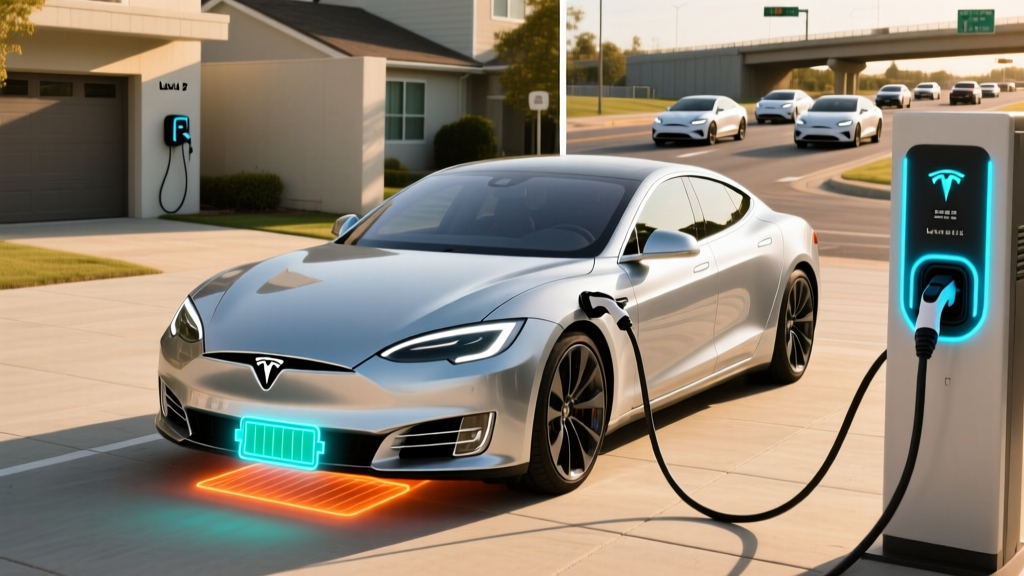
A gasoline engine refuels in five minutes. A Tesla recharges on a spectrum — from a few miles per hour on a wall outlet to over 200 miles added in 15 minutes at a Supercharger. Understanding this spectrum is critical to deciding whether a Tesla fits your lifestyle.
| Level | Power (kW) | Miles of Range Added | Best For |
|---|---|---|---|
| Level 1 (120V household outlet) | ~1.2 kW | ~3-5 mi / hour | Overnight top-up, emergencies |
| Level 2 (240V home / destination) | 7.2-11.5 kW | ~25-44 mi / hour | Daily home charging, workplace |
| DC Fast (Tesla Supercharger V3) | Up to 250 kW | ~200 mi in 15 min (peak) | Road trips, rapid top-ups |
| DC Fast (Supercharger V4) | Up to 350 kW (future-capable) | Currently limited by vehicle architecture to ~250 kW peak | Newer station builds |
The charging curve reality: Tesla's "250 kW peak" is exactly that — a peak, not a sustained rate. On a Model 3 Long Range with an NMC battery, you'll see ~250 kW only between roughly 10-20% state of charge (SoC). The rate then tapers: ~150 kW through 40%, ~100 kW through 60%, and below 50 kW past 80%. This is why Tesla (and the EPA) quote 10-80% charge times rather than 0-100%. Charging from 80% to 100% on DC fast can take as long as the 10-80% session. For road trips, plan to charge to 80% and go — the time penalty of filling the last 20% isn't worth it.
Home charging: Most Tesla owners install a Tesla Wall Connector on a 240V / 60A circuit, delivering up to 11.5 kW (approximately 44 miles of range per hour on a Model 3). A full overnight charge from 20% to 80% takes about 4-5 hours. Installation costs range from $500-$2,000 depending on panel proximity and local permit requirements; a panel upgrade to 200A service can add $1,500-$3,000 if your home has older 100A service. Always consult a licensed electrician for final specs.
Pricing, Tax Credits, and Total Cost vs. Gas Cars
The reason many shoppers search for a "Tesla gasoline engine" is cost anxiety — they assume an EV must be more expensive to own. The math tells a more nuanced story. Tesla's upfront MSRP is higher than a comparable Toyota Camry or Honda CR-V, but fuel savings, reduced maintenance, and federal tax credits narrow the gap significantly over five years.
| Model | Base MSRP | §30D Credit Eligibility | Effective Price (if eligible) |
|---|---|---|---|
| Model 3 RWD | $40,240 | $3,750 (partial — battery sourcing rules apply) | ~$36,490 |
| Model 3 Long Range AWD | $47,740 | $3,750 (partial — battery sourcing rules apply) | ~$43,990 |
| Model Y Long Range AWD | $48,240 | $3,750 (partial — battery sourcing rules apply) | ~$44,490 |
| Model S Long Range | $79,990 | Not eligible (exceeds $55,000 sedan MSRP cap) | $79,990 |
| Model X Long Range | $84,990 | Not eligible (exceeds $80,000 SUV MSRP cap) | $84,990 |
IRS §30D credit rules for 2026: The federal clean vehicle credit offers up to $7,500, but eligibility hinges on three intersecting requirements: (1) buyer income caps ($150K single / $300K joint MAGI), (2) vehicle MSRP caps ($55,000 for sedans, $80,000 for SUVs/trucks), and (3) critical mineral and battery component sourcing thresholds that increase each year. As of the 2026 tax year, most Tesla vehicles assembled for the North American market qualify for a partial credit ($3,750) because Tesla's battery supply chain meets the critical-minerals requirement but has not fully satisfied the battery-component sourcing threshold. These rules change frequently — verify current eligibility at IRS.gov or with a tax professional before purchasing. The credit can now be transferred to the dealer at point of sale, reducing your out-of-pocket cost on delivery day.
Cost per mile — electricity vs. gasoline: At the U.S. average electricity rate of ~$0.17/kWh and the Model 3 LR's efficiency of ~25 kWh/100 mi, fueling costs roughly $0.043 per mile. A comparable gas sedan at 30 MPG combined with gas at $3.50/gallon costs ~$0.117 per mile. Over 15,000 miles/year, that's a $1,110 annual fuel savings. Over five years, you save roughly $5,550 in fuel alone — enough to offset a significant chunk of the Tesla's price premium. Maintenance savings (no oil changes, no transmission fluid, fewer brake replacements due to regen) add another $300-$500/year.
Performance and Driving Dynamics: What Replaces the Engine
An electric motor delivers peak torque at zero RPM — something no gasoline engine can match without a turbocharger spooled up and a transmission in the right gear. This translates to instant, seamless acceleration that makes even the base Model 3 feel quicker than its 0-60 time suggests.
The 2026 Model 3 Long Range AWD pairs a front induction motor with a rear permanent-magnet synchronous motor for a combined 346 hp and a 4.2-second 0-60 mph time. The Model Y Long Range bumps output to 384 hp (4.8 sec), while the Model S Long Range's dual-motor setup produces 670 hp and a 3.1-second sprint — supercar territory from a five-seat sedan.
For buyers cross-shopping with gas cars: a BMW 330i (255 hp, turbo I-4) does 0-60 in ~5.6 seconds and starts around $46,000. The Model 3 LR is quicker, has AWD standard, costs comparably after credits, and never visits a gas station. The trade-off is a heavier vehicle (~4,034 lb for the Model 3 LR) and the aforementioned charging logistics on road trips.
Tesla's single-speed transmission means no shift shock, no gear hunting on inclines, and virtually no drivetrain maintenance. The regenerative braking system captures kinetic energy during deceleration, feeding it back into the battery and reducing wear on the friction brakes — many Tesla owners report original brake pads at 80,000+ miles.
Interior, Cargo, and Tech: Life Without a Transmission Tunnel
Removing the gasoline engine, transmission, and driveshaft gives Tesla a flat floor and unusual packaging flexibility. The Model 3 offers 23 cu ft of trunk space plus a small front trunk (frunk) for charging cables or a laptop bag. The Model Y, with its hatchback design, delivers 30 cu ft behind the second row and up to 76 cu ft with seats folded — competitive with midsize gas crossovers like the Honda CR-V (39 cu ft behind the rear row, 77 cu ft total).
Passenger space is adequate but not class-leading. The Model 3 provides 42.3 inches of front legroom and 35.2 inches rear; the Model Y improves rear headroom thanks to its taller roofline. The Model S and X offer substantially more room, with the X's optional third row (best suited for children) pushing seating capacity to seven.
Standout tech: Tesla's 15.4-inch center touchscreen (17-inch in Model S/X) runs the vehicle's entire interface — climate, navigation, media, and vehicle settings — with no physical buttons beyond the steering wheel stalks and hazard switch. The built-in navigation includes real-time Supercharger routing with battery preconditioning (the car warms the battery en route to a fast charger to maximize charge speed). Over-the-air (OTA) software updates regularly add features, refine efficiency, and update the UI — something no legacy gas car matches in scope.
Driver assistance: Every Tesla ships with Basic Autopilot (lane centering + adaptive cruise). Full Self-Driving (Supervised) is a $8,000 option or $99/month subscription that adds automated lane changes, traffic light recognition, and city-street navigation. Important: FSD (Supervised) is an SAE Level 2 system — the driver must remain fully attentive with hands on the wheel at all times. It is not autonomous driving. Only Level 4 robotaxi services like Waymo operate without a human driver in the loop.
- Drive without an attentive, licensed driver in the seat
- Navigate all construction zones, unmapped roads, or severe weather reliably
- Replace driver judgment — you are liable for all driving decisions
- Operate as a Level 4 or Level 5 autonomous system
Pros, Cons, and Who Should Buy a Tesla
- Class-leading efficiency (134 MPGe combined, Model 3 LR)
- Access to the Tesla Supercharger network — the most reliable DC fast-charging ecosystem in North America
- Strong 0-60 performance across all trims; instant torque
- Over-the-air updates continuously improve the vehicle
- No oil changes, minimal brake wear, low maintenance cost
- Excellent safety ratings (NHTSA 5-star across the lineup)
- No gasoline backup — pure EV only; range drops in extreme cold
- Model S and Model X exceed MSRP caps for the federal tax credit
- Build quality inconsistencies reported (panel gaps, interior rattles)
- Touchscreen-only controls frustrate some drivers (no physical climate knobs)
- Insurance premiums run 15-30% higher than comparable gas vehicles
- Repair costs after collisions can be high due to battery proximity and aluminum panels
Decision Framework: Is a Tesla Right for You?
- You have reliable home or workplace Level 2 charging access
- Your daily driving is under 250 miles round-trip (covers ~95% of American commutes)
- You road-trip 2-4 times per year and can plan around 20-30 minute Supercharger stops
- You value performance, OTA updates, and the Supercharger network over traditional dealership service
- You live in a region with moderate winters or have garage parking to mitigate cold-weather range loss
- You cannot install a home charger and public charging infrastructure near you is sparse
- You regularly tow heavy loads over long distances (range loss is severe)
- You frequently drive in sub-zero temperatures on long rural routes with no fast-charging access
- You want the flexibility of gasoline for remote-area driving
Frequently Asked Questions
Has Tesla ever made a car with a gasoline engine?
No. Since its founding, Tesla has produced only battery-electric vehicles. The original Roadster (2008), Model S (2012), Model X (2015), Model 3 (2017), Model Y (2020), Cybertruck (2023), and all 2026 models are pure BEVs with no internal combustion components.
What happens when a Tesla runs out of battery?
The vehicle will gradually reduce speed and eventually stop, similar to a gas car running out of fuel. You'll need a flatbed tow to a charger — you cannot "pour in" electricity roadside. Tesla's navigation system actively warns you when you're at risk of not reaching a charger and will route you to the nearest option. Running the battery to absolute zero is rare if you heed the onboard warnings.
Does a Tesla qualify for the $7,500 federal EV tax credit?
As of the 2026 tax year, most Tesla models qualify for a partial credit of $3,750 under IRS §30D due to battery-component sourcing requirements. The full $7,500 requires meeting both critical-mineral and battery-component thresholds, which tighten annually. Buyer income caps ($150K single / $300K joint) and MSRP caps ($55K sedans / $80K SUVs) also apply. Always verify at IRS.gov before purchasing.
How long does a Tesla battery last before needing replacement?
Tesla warranties its battery packs for 8 years / 120,000 miles (Model 3/Y) or 8 years / 150,000 miles (Model S/X), guaranteeing at least 70% capacity retention during that period. Real-world degradation data from fleet operators and owner surveys shows most Tesla batteries retain 85-90% capacity at 100,000 miles. Full replacement, if needed out of warranty, costs approximately $12,000-$16,000 depending on the model — but complete failures are uncommon.
Is a Tesla cheaper to own than a gas car over 5 years?
It depends on the comparison vehicle, your electricity rate, and whether you qualify for the tax credit. A Model 3 LR at ~$44,000 after credit, charged at home at $0.17/kWh, and driven 15,000 miles/year will save roughly $5,500 in fuel and $2,000 in maintenance over five years compared to a similarly priced gas sedan getting 30 MPG. Factor in higher insurance premiums (~$1,500-$2,500 more over five years) and the total cost of ownership is competitive or slightly lower. For the Model S/X (no tax credit, higher insurance), the gas-car comparison becomes less favorable to Tesla on pure economics.
Can I tow with a Tesla?
Yes. The Model Y is rated to tow up to 3,500 pounds, and the Model X up to 5,000 pounds. However, towing near maximum capacity cuts range roughly in half due to the massive increase in aerodynamic drag and rolling resistance. Plan charging stops accordingly — every 100-120 miles rather than every 200+.