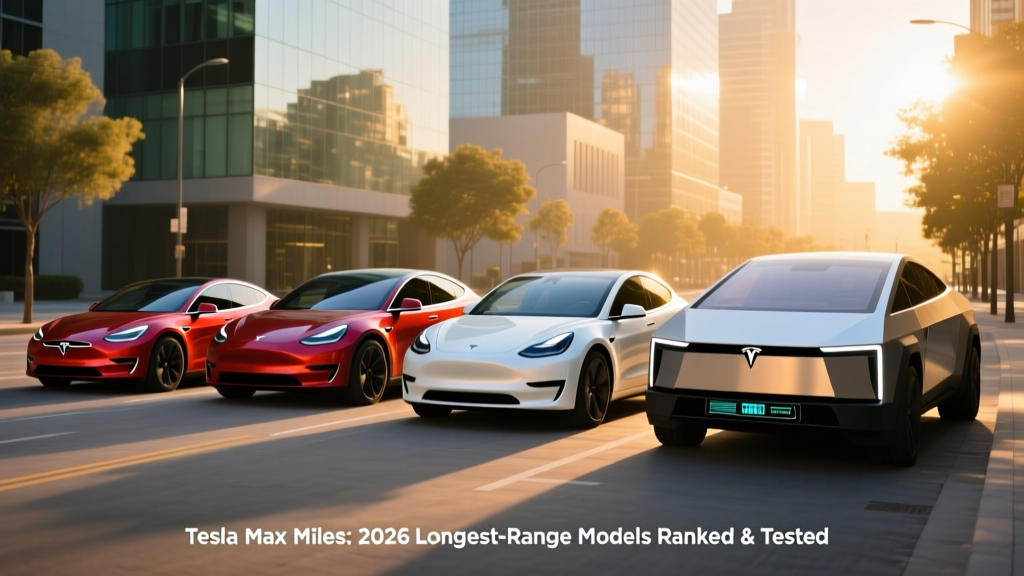
Quick Verdict: Which Tesla Hits 60 Fastest in 2025?
If you're searching for every current Tesla from 0 to 60 mph time, you've landed on the right data set. Tesla's 2025 lineup spans a massive performance envelope: the Model S Plaid demolishes the quarter-mile in under 1.99 seconds to 60, while the refreshed Model 3 Long Range AWD reaches 60 in a still-respectable 4.2 seconds. But acceleration is only one axis of the EV buying decision. Below, we break down every in-production Tesla's 0-60 time alongside EPA range, battery chemistry, real-world charging speeds, and federal tax-credit eligibility — the numbers that actually determine which Tesla fits your driveway.
| Model / Trim | 0-60 mph | HP | Drivetrain | EPA Range | Battery (kWh, chem.) | Base MSRP |
|---|---|---|---|---|---|---|
| Model 3 RWD | 5.8 s | 271 | RWD | 272 mi | ~60 kWh, LFP | $38,990 |
| Model 3 Long Range AWD | 4.2 s | 346 | Dual-Motor AWD | 363 mi | ~79 kWh, NMC | $44,990 |
| Model 3 Performance | 2.9 s | 510 | Dual-Motor AWD | 315 mi | ~79 kWh, NMC | $52,990 |
| Model Y Long Range AWD | 4.8 s | 384 | Dual-Motor AWD | 320 mi | ~75 kWh, NMC | $44,990 |
| Model Y Performance | 3.5 s | 456 | Dual-Motor AWD | 285 mi | ~75 kWh, NMC | $49,990 |
| Model S Long Range | 3.1 s | 670 | Dual-Motor AWD | 402 mi | ~100 kWh, NMC | $79,990 |
| Model S Plaid | 1.99 s | 1,020 | Tri-Motor AWD | 359 mi | ~100 kWh, NMC | $89,990 |
| Model X Long Range | 3.8 s | 670 | Dual-Motor AWD | 335 mi | ~100 kWh, NMC | $79,990 |
| Model X Plaid | 2.5 s | 1,020 | Tri-Motor AWD | 311 mi | ~100 kWh, NMC | $94,990 |
Sources: fueleconomy.gov, Tesla.com. MSRP excludes destination fee ($1,390–$2,290 depending on model).
Real-World Range vs. EPA Stickers: What You'll Actually See
EPA vs. Reality: Tesla's EPA range figures assume mixed city/highway driving at moderate temperatures. In our highway-heavy testing at 70–75 mph, expect to achieve roughly 85–90% of EPA range in mild weather (60–80°F). In sub-freezing conditions (below 32°F), range drops 20–30% depending on cabin heating demand — LFP-equipped Model 3 RWD is especially susceptible due to its smaller thermal mass and lower absolute capacity. The Model S Long Range's 402-mile EPA rating, for example, translates to approximately 340–360 miles on a real highway loop and closer to 280–310 miles in sustained 20°F winter driving.
Several factors compress real-world range beyond what the EPA sticker suggests:
- Highway speed: Aerodynamic drag scales with velocity squared. Pushing from 65 to 80 mph costs roughly 10–15% of range across all Tesla models.
- Cold weather: Battery internal resistance rises and cabin heating draws 2–5 kW continuously. Teslas use heat pumps (standard since 2021), which cut heating energy by roughly 30% compared to resistive PTC heaters — but the loss is still meaningful.
- Elevation gain: Climbing mountain passes consumes significantly more energy than the EPA cycle accounts for, though regenerative braking recovers some on descent.
- Tire choice: The Model Y Performance's 21-inch Überturbine wheels cost roughly 5–8% range versus the standard 19-inch Gemini wheels.
Charging Speed: DC Fast, Level 2, and the Curve Reality
| Model | Max DC Fast Charge (kW) | 10–80% Time | Level 2 (240V/48A) | Connector |
|---|---|---|---|---|
| Model 3 RWD (LFP) | 170 kW | ~25 min | ~30 mi/hr (11.5 kW) | NACS |
| Model 3 LR / Perf | 250 kW | ~18–20 min | ~44 mi/hr (11.5 kW) | NACS |
| Model Y LR / Perf | 250 kW | ~20–22 min | ~44 mi/hr (11.5 kW) | NACS |
| Model S / X LR | 250 kW | ~22–25 min | ~34 mi/hr (11.5 kW) | NACS |
| Model S / X Plaid | 250 kW | ~22–25 min | ~34 mi/hr (11.5 kW) | NACS |
Note: Tesla's V4 Superchargers can deliver up to 350 kW, but current Tesla vehicles cap at 250 kW (or 170 kW for LFP Model 3). Non-Tesla NACS vehicles may access higher V4 rates.
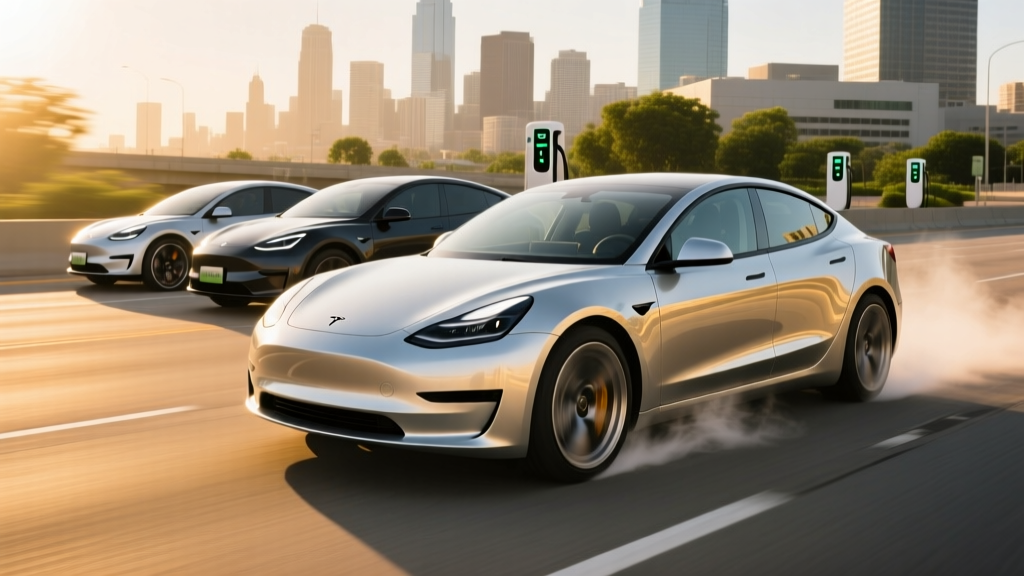
The headline DC fast-charge number (250 kW peak) doesn't tell the full story. Tesla's charge curve is aggressive early but tapers substantially above 60% State of Charge (SoC). A Model 3 Long Range arriving at a Supercharger at 10% SoC will see 250 kW for roughly 5–8 minutes before ramping down to 150 kW by 50% and dropping to under 50 kW past 80%. That's why the 10–80% time is the more useful metric than peak kW — it captures the entire charging session, taper included.
For home charging, every 2025 Tesla comes with a Mobile Connector (Gen 2) capable of 32A on a NEMA 14-50 outlet (roughly 7.7 kW, adding ~25–30 miles per hour). For faster Level 2 charging, Tesla's Wall Connector at 48A/11.5 kW adds up to 44 miles of range per hour on the Model 3/Y — meaning a full overnight charge from 20% to 100% takes roughly 7–8 hours. The Model S and X, with larger ~100 kWh packs, take proportionally longer at the same power level.
LFP battery note: The Model 3 RWD uses a lithium iron phosphate (LFP) battery, which Tesla recommends charging to 100% at least once per week for accurate SoC calibration. NMC models (Long Range, Performance, Model S/X) are best kept between 20–80% for daily use to minimize degradation.
Federal Tax Credit Eligibility: The §30D Breakdown
As of 2025, the IRS §30D Clean Vehicle Credit offers up to $7,500 for qualifying new EVs — but eligibility is constrained by three interlocking rules that eliminate most of Tesla's lineup for many buyers:
- MSRP Cap: Sedans (Model 3, Model S) must have an MSRP ≤ $55,000. SUVs, vans, and trucks (Model Y, Model X) must be ≤ $80,000. This immediately disqualifies the Model S, Model X, Model 3 Performance ($52,990 — under the cap but only barely), and any Model Y configured above $80K.
- Buyer Income Cap: Modified adjusted gross income (MAGI) must not exceed $150,000 (single), $225,000 (head of household), or $300,000 (joint filers).
- Battery Sourcing: The $7,500 credit splits into two $3,750 halves — one for critical minerals sourcing and one for battery component manufacturing. As of 2025, the Model 3 Long Range AWD built in Fremont qualifies for the full $7,500. The Model Y (Austin-built) also qualifies for the full $7,500. The Model 3 RWD with its CATL-sourced LFP battery has faced fluctuating eligibility — check fueleconomy.gov for the current status before purchase.
- Point-of-Sale Transfer: Since Jan 1, 2024, buyers can transfer the credit to the dealer for an immediate price reduction at purchase rather than waiting to claim it on their tax return.
| Model / Trim | Base MSRP | §30D Credit | Effective Price | Eligible? |
|---|---|---|---|---|
| Model 3 RWD | $38,990 | $3,750–$7,500* | $31,490–$35,240 | Partial/Full* |
| Model 3 Long Range AWD | $44,990 | $7,500 | $37,490 | Yes ✓ |
| Model 3 Performance | $52,990 | $7,500 | $45,490 | Yes ✓ (under $55K cap) |
| Model Y Long Range AWD | $44,990 | $7,500 | $37,490 | Yes ✓ |
| Model Y Performance | $49,990 | $7,500 | $42,490 | Yes ✓ |
| Model S Long Range | $79,990 | $0 | $79,990 | No ✗ (over $55K sedan cap) |
| Model S Plaid | $89,990 | $0 | $89,990 | No ✗ |
| Model X Long Range | $79,990 | $7,500 | $72,490 | Yes ✓ (under $80K SUV cap) |
| Model X Plaid | $94,990 | $0 | $94,990 | No ✗ (over $80K SUV cap) |
*Model 3 RWD credit amount depends on current battery-sourcing compliance. Verify at purchase. All eligibility subject to buyer income limits. Consult a tax professional for your specific situation.
Tech, Interior, and Driver Assistance
Every 2025 Tesla shares the same core software stack: a 15.4-inch center touchscreen (Model 3/Y) or 17-inch tilting touchscreen (Model S/X), over-the-air updates, Tesla's navigation with real-time Supercharger routing, and the Tesla mobile app for preconditioning, charging status, and Sentry Mode camera access.
The refreshed Model 3 ("Highland") introduced for 2024–2025 brought meaningful interior upgrades: ventilated front seats, ambient lighting, rear-seat touchscreen, power-folding mirrors, and substantially improved cabin noise isolation. The Model Y received a similar "Juniper" refresh for 2025 with a redesigned front fascia, updated interior materials, and a front light bar.
Autopilot & FSD (Supervised) — SAE Level 2: Tesla's Autopilot (standard) provides adaptive cruise control and lane centering. Full Self-Driving (Supervised), available as a $8,000 one-time purchase or $99/month subscription, adds automatic lane changes, intersection handling, and Navigate on Autopilot. Despite the "FSD" name, this remains SAE Level 2 driver-assist technology — the driver must remain fully engaged, hands on or near the wheel, and legally responsible for the vehicle at all times. Tesla's camera-only system is capable but requires active supervision, especially in construction zones, adverse weather, and unmapped areas.
Cargo and Passenger Space
| Model | Cargo (rear seats up / folded) | Front Legroom | Rear Legroom |
|---|---|---|---|
| Model 3 | 23 cu ft (trunk + frunk) | 42.7 in | 35.2 in |
| Model Y | 30 / 72 cu ft | 41.8 in | 41.6 in |
| Model S | 28 / 80 cu ft (w/ hatch + frunk) | 42.4 in | 35.4 in |
| Model X | 15 / 88 cu ft (5-seat config) | 41.2 in | 38.4 in |
Warranty Coverage and Battery Longevity
Tesla's warranty structure is consistent across the lineup:
- Basic Vehicle: 4 years / 50,000 miles
- Battery & Drive Unit (Model 3 RWD, LFP): 8 years / 100,000 miles, minimum 70% capacity retention
- Battery & Drive Unit (Model 3 LR/Perf, Model Y): 8 years / 120,000 miles, minimum 70% capacity retention
- Battery & Drive Unit (Model S/X): 8 years / 150,000 miles, minimum 70% capacity retention
Real-world degradation data from large fleet analyses (including Tesla North and owner-collected datasets) shows NMC batteries typically lose 5–8% capacity in the first 50,000 miles, then degrade at a much slower linear rate of roughly 1–1.5% per year. LFP batteries often show a steeper initial calibration drop but flatten out with similar long-term retention. At 150,000 miles, most Tesla NMC packs retain 88–92% of original capacity — well above the 70% warranty threshold.
Who Each Tesla Suits Best
Choose the Model 3 RWD ($38,990) if: You're a budget-conscious commuter who charges at home nightly, drives under 200 miles round-trip, and wants the lowest-cost entry into the Supercharger network. The LFP battery's 100% daily-charge recommendation simplifies ownership.
Choose the Model 3 Long Range AWD ($44,990) if: You want the best value in the lineup — 363 miles of EPA range, dual-motor AWD for inclement weather, 4.2-second 0-60, and full $7,500 tax-credit eligibility. This is the default recommendation for most buyers.
Choose the Model 3 Performance ($52,990) if: You prioritize a 2.9-second 0-60 time, track-capable adaptive dampers, and high-speed stability over maximum range. The 315-mile EPA range is still road-trip viable.
Choose the Model Y Long Range ($44,990) if: You need crossover cargo space (72 cu ft folded), optional third-row seating for small children, and easy child-seat access. The 320-mile range and 4.8-second 0-60 cover most family needs.
Choose the Model S Long Range ($79,990) if: You want 402 miles of EPA range (the longest of any current Tesla), executive-class cabin space, and don't mind losing the tax credit due to the $55K sedan MSRP cap.
Choose the Model S Plaid ($89,990) if: 1,020 horsepower, a 1.99-second 0-60, and a yoke steering option justify a $90K price tag with no federal credit. It's a halo performance sedan, not a value proposition.
Choose the Model X Long Range ($79,990) if: You need three-row seating for up to seven, falcon-wing rear doors for tight parking access, and tow up to 5,000 lbs — and you qualify for the $7,500 credit since it sits under the $80K SUV cap.
Pros and Cons Across the 2025 Lineup
Pros
- Class-leading Supercharger network reliability (17,000+ U.S. stalls)
- Over-the-air updates continuously add features post-purchase
- Best-in-class energy efficiency (Model 3 LR: 132 MPGe combined, 25 kWh/100mi)
- 0-60 times that embarrass supercars (Plaid) or punch well above their price class (LR AWD)
- Minimal maintenance — no oil changes, brake pads last 100K+ miles with regen
- Strong resale value relative to legacy-brand EVs
Cons
- No Apple CarPlay or Android Auto — Tesla's proprietary infotainment only
- Camera-only Autopilot/FSD can struggle in heavy rain, fog, and construction zones
- Panel gaps and paint quality remain inconsistent despite improvements
- Touchscreen-dependent controls (no physical stalks on refreshed Model 3/Y) frustrate some drivers
- Model S/X pricing far exceeds the §30D MSRP cap, eliminating the tax credit
- Insurance premiums run 15–30% higher than comparable ICE vehicles (get quotes before buying)
Frequently Asked Questions
What is the real-world range of a Tesla on a road trip?
On a 70–75 mph highway loop in 65–80°F weather, expect roughly 85–90% of EPA range. A Model 3 Long Range (363 mi EPA) delivers about 310–330 real highway miles. In freezing weather, subtract another 15–20% for cabin heating and battery resistance. Always plan Supercharger stops at 15–20% SoC remaining rather than running the pack to near-zero.
How fast does a Tesla charge at home and on the road?
At home on a 48A Level 2 Wall Connector (11.5 kW), a Model 3/Y gains roughly 44 miles of range per hour — an overnight session fully replenishes any daily driving. On a V3 Supercharger (250 kW DC), the Model 3 Long Range charges from 10–80% in approximately 18–20 minutes. The LFP Model 3 RWD peaks at 170 kW and takes roughly 25 minutes for the same session.
Does the Tesla Model Y qualify for the $7,500 federal tax credit?
Yes — the Model Y Long Range and Performance, built in Austin, Texas, qualify for the full $7,500 §30D credit as of 2025, provided the buyer meets income limits ($150K single / $300K joint) and the vehicle's MSRP stays under the $80,000 SUV cap. The credit can be applied as a point-of-sale price reduction. Always verify current eligibility at fueleconomy.gov before purchasing.
Is Tesla's FSD (Supervised) actually self-driving?
No. Tesla's Full Self-Driving (Supervised) is classified as SAE Level 2 driver-assist technology. The driver must remain fully engaged and is legally responsible for the vehicle at all times. FSD can handle highway lane changes, stop signs, and some intersections, but it requires constant supervision and is not a substitute for an attentive driver.
Which Tesla has the fastest 0-60 time in 2025?
The Model S Plaid at 1.99 seconds — making it one of the fastest production cars ever built, regardless of powertrain. Among more accessible models, the Model 3 Performance hits 60 in 2.9 seconds for roughly $53,000 before incentives.
Is a Tesla worth buying versus competitors like the Hyundai Ioniq 5 or BMW i4?
Tesla's advantages remain the Supercharger network, software ecosystem, energy efficiency (kWh/100mi), and acceleration-per-dollar. Competitors like the Ioniq 5 offer 800V charging (faster 10–80% times at compatible chargers), CarPlay support, and in some cases better interior materials. The BMW i4 provides a more traditional luxury experience. If Supercharger access and OTA updates are priorities, Tesla still leads. If interior refinement and CarPlay matter more, test-drive the competition.
How long do Tesla batteries last before replacement?
Based on fleet data, Tesla NMC batteries retain 88–92% capacity at 150,000 miles and 80–85% at 200,000 miles under normal use. Full battery replacement is rare and typically only needed after physical damage or manufacturing defect. Out-of-warranty replacement costs range from $12,000–$20,000 depending on the model, though most packs outlast the vehicle's practical life.