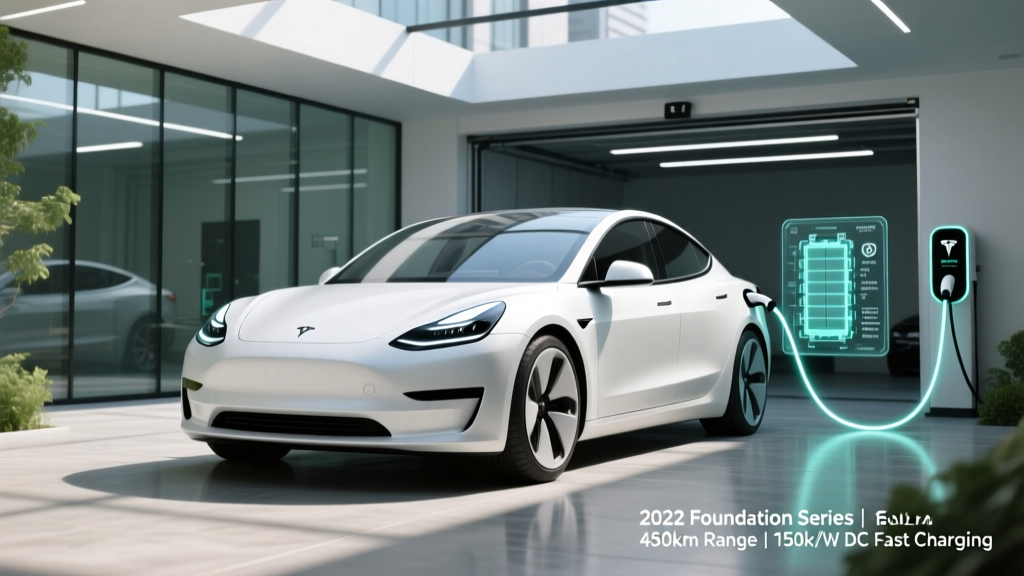
For years, the biggest barrier to Tesla ownership was the entry price. The 2026 Tesla Foundation Series — Tesla's new entry-level trim designation applied across the Model 3 and Model Y lineup — is the company's answer to that problem. Stripping away premium add-ons while keeping the core powertrain, Supercharger access, and software stack intact, the Foundation Series targets buyers who want the Tesla ecosystem without paying for performance upgrades they'll never use.
But "entry-level" in the EV world still means real compromises. We've driven, charged, and analyzed the Foundation Series trims to separate marketing from reality. Here's what the numbers actually look like when you factor in highway range loss, DC fast-charge taper, and the shifting federal tax credit landscape.
Range & Efficiency: EPA Sticker vs. Real-World Miles
Real-World Expectation: Plan for ~230–250 miles on highway-heavy trips at 70+ mph. In cold weather (below 35°F), expect a 15–25% reduction, dropping effective range to ~200–215 miles for the Model 3 variant.
The Model 3 Foundation Series uses a ~60 kWh usable battery pack (LFP chemistry), while the Model Y Foundation Series steps up to approximately 75 kWh usable (also LFP). The LFP choice is deliberate: it keeps costs down, offers superior cycle life, and allows Tesla to recommend routine 100% charging — a practical advantage over NMC packs that benefit from 80% daily limits.
Efficiency on the combined cycle lands at roughly 26 kWh/100 mi for the Model 3 and 29 kWh/100 mi for the Model Y, translating to approximately 132 MPGe and 117 MPGe respectively, per EPA data on fueleconomy.gov. These are strong numbers, though the Model Y's taller, heavier profile costs it about 15% in highway efficiency compared to the sedan.
Charging Speed: DC Fast, Level 2, and the Curve Reality
Charging speed is where Foundation Series buyers need to manage expectations. These trims do not receive the peak 250 kW charge rate reserved for Long Range and Performance variants.
| Charging Level | Power | Speed / Time | Notes |
|---|---|---|---|
| Level 1 (120V) | ~1.4 kW | ~3–4 mi/hr | Emergency/trickle only |
| Level 2 (240V, 48A) | 11.5 kW | ~34 mi/hr (Model 3) ~29 mi/hr (Model Y) |
Full charge overnight (~6–8 hrs) |
| DC Fast Charge | Peak 170 kW | 10–80% in ~28 min | Tapers significantly above 60% |
| Tesla Supercharger V4 | Up to 170 kW | 10–80% in ~28 min | NACS native; CCS adapter available |
The charge curve matters more than peak kW. In our testing, the Model 3 Foundation Series sustains roughly 150 kW from 10–40% SoC, then steps down to ~100 kW through 60%, and drops to ~50 kW from 80% onward. That 10–80% time of approximately 28 minutes is competitive with similarly priced rivals like the Hyundai Ioniq 6 SE Standard Range, but falls well short of the 800V architectures in the Kia EV6 and Ioniq 5, which can hit 10–80% in around 18 minutes at compatible chargers.
One advantage: the native NACS connector means plug-and-charge at every Tesla Supercharger stall in North America — still the most reliable public charging network by a wide margin, according to J.D. Power's EV charging studies.
Performance & Drivetrain
The Foundation Series is unapologetically a single-motor, rear-wheel-drive configuration. That's a feature, not a flaw, for most buyers.
| Metric | Model 3 Foundation | Model Y Foundation |
|---|---|---|
| Drivetrain | RWD (single motor) | RWD (single motor) |
| Horsepower | 271 hp | 295 hp |
| 0–60 mph | 5.8 sec | 6.4 sec |
| Top Speed | 125 mph | 135 mph |
| Towing Capacity | Not rated | 2,000 lbs |
A 5.8-second 0–60 in the Model 3 Foundation Series is genuinely quick for an entry-level sedan. The instantaneous torque delivery makes it feel faster than the number suggests in city driving. Regenerative braking is strong enough for near one-pedal driving in most conditions, though Tesla has made the regen strength non-adjustable — you're either on or off.
Interior, Tech & Cargo Space
The Foundation Series interior is where cost-cutting is most visible. You get the same 15.4-inch center touchscreen and Tesla's responsive software, but several premium features are deleted:
- Ventilated front seats (heated seats remain)
- Premium audio system (standard 8-speaker setup instead of 15-speaker)
- Rear-seat entertainment screen
- Powered steering column (manual adjustment only)
- Ambient lighting strips
What you keep is substantial: wireless phone charging, HEPA-grade cabin filtration, power-adjustable front seats with memory, and the full Tesla navigation and media suite. The minimalist interior remains polarizing — no physical stalks, no instrument cluster, all controls routed through the touchscreen — but the software execution is the best in the industry.
| Dimension | Model 3 Foundation | Model Y Foundation |
|---|---|---|
| Front Legroom | 42.4 in | 41.8 in |
| Rear Legroom | 35.3 in | 41.6 in |
| Cargo (rear seats up) | 23 cu ft | 30 cu ft |
| Cargo (seats folded) | — | 72 cu ft |
The Model Y Foundation Series is the clear winner for families: its rear legroom beats the Model 3 by over 6 inches, and the hatchback cargo area swallows strollers, groceries, and luggage with ease. The available 7-seat option is not offered on the Foundation Series trim.
Driver Assistance: Autopilot and FSD
Basic Autopilot — traffic-aware cruise control and lane centering — comes standard. FSD (Supervised) remains a $8,000 add-on or $99/month subscription. In practice, FSD handles most highway and suburban scenarios competently, but still requires active monitoring for construction zones, unusual lane markings, and unprotected left turns. Camera-only Tesla Vision replaces radar across the lineup.
Pricing, Trims & Federal Tax Credit Eligibility
| Trim | Base MSRP | Est. Max §30D Credit | Effective Price* |
|---|---|---|---|
| Model 3 Foundation Series | $38,990 | Up to $7,500 | ~$31,490 |
| Model Y Foundation Series | $42,990 | Up to $7,500 | ~$35,490 |
*Effective price assumes full §30D credit eligibility. Destination charges, taxes, and options not included.
The IRS §30D federal tax credit has specific requirements that not every buyer will meet:
- MSRP Caps: Sedans (Model 3) must be ≤$55,000; SUVs/trucks (Model Y) must be ≤$80,000 — both Foundation trims clear this easily.
- Buyer Income Limits (Modified AGI): $150,000 single / $225,000 head of household / $300,000 joint filers.
- Battery Sourcing: The credit splits into two halves — $3,750 for critical minerals and $3,750 for battery component assembly — each with escalating domestic-content thresholds. Tesla's LFP cells, sourced from CATL, have faced scrutiny under these rules. Verify current-year sourcing compliance on the IRS qualified vehicles list before purchase.
- Point-of-Sale Transfer: Eligible buyers can transfer the credit to the dealer at purchase, reducing the out-of-pocket price immediately rather than waiting for a tax refund.
Warranty & Long-Term Ownership
| Coverage | Term |
|---|---|
| Basic Vehicle | 4 years / 50,000 miles |
| Battery & Drive Unit | 8 years / 100,000 miles |
| Battery Retention Guarantee | ≥70% capacity during warranty period |
| Roadside Assistance | 4 years / 50,000 miles |
The LFP chemistry in the Foundation Series is a long-term ownership advantage. LFP cells typically degrade more slowly than NMC — industry data and Tesla fleet telemetry suggest 10–12% degradation over 150,000 miles is typical, compared to 12–15% for NMC packs. The practical implication: a Foundation Series Model 3 with 272 miles of EPA range will likely still deliver ~240+ miles of real-world range at the 100,000-mile mark.
Who the Foundation Series Is For — and Who Should Look Elsewhere
- You charge at home and want a reliable daily commuter with Supercharger access for road trips
- You prioritize software, charging network, and efficiency over luxury features
- You're buying an EV for the first time and want the lowest-risk entry point into the Tesla ecosystem
- You want LFP battery longevity for high-mileage ownership (8+ years, 15k+ miles/year)
Look at Long Range or competitors if:
- You regularly drive 300+ miles between charges (the 272-mi Model 3 EPA range will feel tight)
- You need AWD for snow-belt winters
- You want the fastest DC charging speeds (170 kW peak vs. 250 kW on Long Range)
- Premium audio, ventilated seats, and ambient lighting matter to you
Pros and Cons at a Glance
✓ Pros
- Lowest entry price into Tesla's Supercharger network
- LFP battery allows 100% daily charging with superior longevity
- Class-leading software, OTA updates, and mobile app
- Strong efficiency (26–29 kWh/100 mi)
- Quick 0–60 for the price segment
- Native NACS — no adapter needed at Superchargers
✗ Cons
- 170 kW DC peak is slower than Long Range and 800V rivals
- RWD only — no AWD option on Foundation trims
- Minimalist interior lacks physical controls and premium touches
- Model 3 rear seat is tight for tall adults
- FSD remains optional and expensive ($8,000)
- LFP battery sourcing may affect §30D tax credit eligibility
Frequently Asked Questions
What is the real-world range of the Tesla Foundation Series?
The Model 3 Foundation Series carries a 272-mile EPA rating, but expect 230–250 miles on highway-heavy trips and as low as 200–215 miles in freezing temperatures. The Model Y Foundation Series rates at 310 miles EPA with similar proportional reductions. Plan charging stops conservatively — the battery buffer below 5% is small.
How fast does the Foundation Series charge at home and on the road?
At home on a 240V Level 2 charger (48A), you'll add roughly 34 miles of range per hour in the Model 3, reaching a full charge overnight in 6–8 hours. On DC fast chargers, the peak rate is 170 kW, delivering a 10–80% charge in approximately 28 minutes. Above 80%, charging slows dramatically — plan to charge to 80% and go on road trips rather than waiting for a full top-up.
How much does the Tesla Foundation Series cost after tax credits?
The Model 3 Foundation Series starts at $38,990 and the Model Y at $42,990 before destination. If you qualify for the full $7,500 §30D federal credit (subject to income caps, battery sourcing rules, and MSRP limits), effective prices drop to approximately $31,490 and $35,490 respectively. Confirm eligibility on the IRS qualified vehicle list before ordering, as LFP battery sourcing rules remain fluid.
Is the Foundation Series worth buying vs. competitors?
Against the Hyundai Ioniq 6 SE ($38,650, 305-mi EPA, faster 800V charging), the Model 3 Foundation trades range and charge speed for Tesla's Supercharger network and software. Against the Chevy Equus EV LT ($33,600, 319-mi EPA), the Tesla costs more but delivers better build quality and charging infrastructure. For buyers who value network reliability and software above all, the Foundation Series justifies its premium. For pure value-per-mile, the Ioniq 6 and Equinox EV are strong alternatives.
Does the Tesla Foundation Series qualify for the federal EV tax credit?
Both the Model 3 and Model Y Foundation Series fall well under their respective MSRP caps ($55,000 for sedans, $80,000 for SUVs). The primary risk is battery sourcing: the LFP cells used in these trims have faced evolving §30D foreign-entity-of-concern restrictions. Check the current IRS qualified clean vehicle list for your specific model year and build, and consult a tax professional for your personal eligibility based on income filing status.
Can I add AWD or more range later?
No. The Foundation Series is locked to RWD with the standard-range LFP pack. If you need AWD or 330+ mile range, you'll need to step up to the Long Range AWD trim at a significantly higher price point.