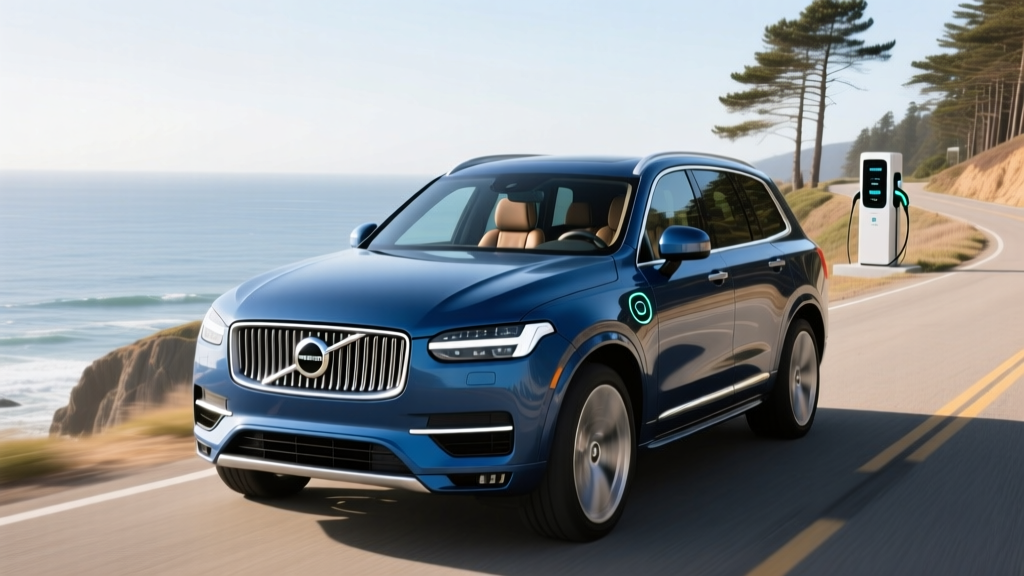
Quick Verdict: A Luxury Family PHEV With Real Electric Commute Credibility
The 2024 Volvo XC90 Recharge occupies a specific niche: a three-row luxury SUV that handles the daily school run and commute on battery power alone, then switches to its turbocharged engine for weekend road trips without range anxiety. With 455 combined horsepower and an EPA-estimated 32 miles of electric-only range, it bridges the gap between full EVs and conventional hybrids — but at a premium price that demands scrutiny against rivals like the BMW X5 xDrive50e and Lincoln Aviator Grand Touring.
This isn't a pure electric vehicle. The XC90 Recharge is a plug-in hybrid (PHEV), pairing an 18.8 kWh lithium-ion battery with a 2.0-liter turbocharged four-cylinder engine and rear-mounted electric motor. For buyers who want electric daily driving but aren't ready to commit to a BEV — especially those without reliable home charging or who tow regularly — it's a compelling compromise. For everyone else, the math gets complicated fast.
| Specification | Value |
|---|---|
| Powertrain | 2.0L turbo I4 + rear electric motor (AWD) |
| Combined Horsepower | 455 hp |
| Combined Torque | 523 lb-ft |
| 0–60 mph | 4.5 seconds |
| Battery Capacity (gross / usable) | 18.8 kWh / ~16.0 kWh (NMC chemistry) |
| EPA Electric-Only Range | 32 miles |
| EPA Combined MPGe (electric + gas) | 55 MPGe |
| EPA Combined MPG (gas only, after battery depleted) | 27 MPG |
| Max DC Fast Charge Rate | Not supported (AC only) |
| Level 2 Charge Rate (240V) | 3.7 kW (~5 hours for full charge) |
| Level 1 Charge Rate (120V) | ~1.4 kW (~13 hours) |
| Seating Capacity | 6 or 7 passengers |
| Cargo Volume (behind 3rd / 2nd / 1st row) | 15.8 / 41.8 / 85.7 cu ft |
| Towing Capacity | 5,000 lbs |
| Base MSRP (Core Plus) | $76,850 |
| As-Tested Price (Ultimate trim) | $84,150 |
| Battery / Powertrain Warranty | 8 years / 100,000 miles (hybrid components) |
Electric Range and Real-World Efficiency
The EPA rates the 2024 XC90 Recharge at 32 miles of electric-only driving. That figure assumes moderate temperatures, flat terrain, and speeds under 50 mph. In practice, your results will diverge based on conditions.
Real-World Expectation: 25–28 miles in mixed city/highway driving; as low as 18–22 miles in sustained cold weather (below 32°F) or at highway speeds above 70 mph; up to 30–32 miles in mild-weather city commuting with gentle acceleration.
The 18.8 kWh battery uses NMC (nickel manganese cobalt) chemistry, chosen for its energy density in a packaging-constrained SUV platform. Volvo reserves a buffer at the top and bottom of the state of charge to protect long-term battery health, meaning roughly 16.0 kWh is usable for driving. Once the battery depletes, the turbocharged engine takes over, and the EPA rates gas-only efficiency at 27 MPG combined — respectable for a 5,100-pound luxury SUV, though the BMW X5 xDrive50e achieves 30 MPG combined in its gas-only mode.
For context on how MPGe works: the 55 MPGe figure blends electric and gas operation and is most meaningful if you charge daily and drive under 35 miles between charges. If you rarely plug in, expect the 27 MPG gas-only figure to dominate your fuel bills. According to fueleconomy.gov, the XC90 Recharge's efficiency profile is competitive within the luxury PHEV SUV segment but trails the more aerodynamic X5.
Charging Speeds: AC-Only Means Overnight Top-Ups
Here's where the XC90 Recharge's PHEV architecture shows its limitations. Unlike full battery-electric vehicles, this SUV does not support DC fast charging. You cannot pull up to a 150 kW Electrify America or Tesla Supercharger station and add range in 20 minutes. All charging happens via AC power — either a standard 120V household outlet (Level 1) or a 240V home or public Level 2 station.
| Charging Level | Power (kW) | Time to Full (0–100%) | Practical Notes |
|---|---|---|---|
| Level 1 (120V household) | ~1.4 kW | ~13 hours | Emergency/trickle only; adds ~4–5 miles per hour |
| Level 2 (240V, 16A) | 3.7 kW | ~5 hours | Standard home wall-box speed; overnight top-up |
| Level 2 (240V, 32A+) | Capped at 3.7 kW by onboard charger | ~5 hours | Higher-amperage stations do not charge faster |
| DC Fast Charging | N/A | N/A | Not supported on XC90 Recharge |
The onboard charger is capped at 3.7 kW, which means even if you plug into a 48-amp Level 2 station capable of delivering 11.5 kW, the XC90 Recharge will only accept 3.7 kW. For a PHEV with a small battery, this is typically adequate — a full overnight charge easily replenishes the 32-mile electric range. But it does mean you can't take advantage of faster public Level 2 chargers during a midday stop.
Home charging installation for a 240V Level 2 circuit typically runs $500–$1,500 for equipment and electrician labor if your electrical panel has capacity. If a panel upgrade to 200 amps is needed, expect $1,500–$3,000 additional. Always consult a licensed electrician for final specifications.
Performance and Drivetrain
The 455-horsepower combined output makes the XC90 Recharge one of the quickest vehicles in Volvo's lineup. The 2.0-liter turbocharged engine produces 312 hp on its own, while the rear-axle electric motor (called ERAD, or Electric Rear Axle Drive) contributes 143 hp. Together with the integrated starter generator, the system delivers 523 lb-ft of torque and a 4.5-second 0–60 mph sprint.
The electric motor powers the rear wheels exclusively in EV mode, giving the SUV a rear-biased feel during electric commuting. When the engine engages, the all-wheel-drive system distributes torque across both axles. The transition between electric and gas power is generally smooth, though under hard acceleration you'll feel a brief hesitation as the turbo spools and the transmission downshifts.
Drive modes include Pure (electric-only, limited to ~80 mph), Hybrid (default, blends power sources), Power (maximum output), and Off-Road (low-speed AWD optimization). The Pure mode is ideal for daily commuting, while Hybrid handles longer trips seamlessly. Regenerative braking is present but mild — this is not a one-pedal-driving vehicle like a pure EV. You'll use the brake pedal normally.
Interior, Cargo, and Technology
The XC90 Recharge's interior remains one of the most refined in the luxury SUV segment. Scandinavian minimalism defines the cabin: open-pore wood, wool-blend upholstery options (a Volvo signature), and a vertically oriented 9-inch touchscreen running Google Built-In (Android Automotive OS). Google Maps navigation, Google Assistant voice control, and access to the Google Play Store for apps are integrated natively — no phone mirroring required, though Apple CarPlay and Android Auto are both supported.
Space is generous for a midsize luxury SUV:
- Front legroom: 41.2 inches
- Second-row legroom: 37.0 inches
- Third-row legroom: 31.9 inches (best for children or short trips)
- Cargo behind 3rd row: 15.8 cu ft
- Cargo behind 2nd row: 41.8 cu ft
- Maximum cargo (all rows folded): 85.7 cu ft
The PHEV battery is mounted in the center tunnel between the front seats rather than under the floor, which preserves cargo space compared to some competitors but eliminates the possibility of a flat load floor in certain configurations. The third row remains usable, though adults will find it tight beyond 30-minute rides.
Driver-assistance technology falls under Volvo's Pilot Assist umbrella — a Level 2 SAE system providing adaptive cruise control with stop-and-go, lane centering, and run-off-road protection. It is not a self-driving system; the driver must keep hands on the wheel and eyes on the road at all times. Volvo's safety suite also includes automatic emergency braking with pedestrian/cyclist/large-animal detection, run-off-road mitigation, and intersection auto-brake — all standard across trims.
Pricing, Trims, and Federal Tax Credit Eligibility
The 2024 XC90 Recharge starts at $76,850 (including destination) for the Core Plus trim and climbs to approximately $84,150 for the fully loaded Ultimate trim. Key trim distinctions:
- Core Plus ($76,850): 20-inch wheels, panoramic roof, Harman Kardon audio, Pilot Assist, Google Built-In, heated front seats
- Plus Bright ($79,250): Adds 21-inch wheels, head-up display, 360-degree camera, four-zone climate
- Ultimate ($84,150): Adds 22-inch wheels, Bowers & Wilkins premium audio, air suspension, Nappa leather, ventilated front seats
| Trim | MSRP | Max §30D Credit | Effective Price (if eligible) |
|---|---|---|---|
| Core Plus | $76,850 | $7,500 | ~$69,350 |
| Plus Bright | $79,250 | $7,500 | ~$71,750 |
| Ultimate | $84,150 | $7,500 | ~$76,650 |
Regarding the IRS §30D federal tax credit: the 2024 XC90 Recharge is a PHEV with an MSRP under the $80,000 SUV cap (for Core Plus and Plus Bright trims — the Ultimate trim at $84,150 exceeds the cap and is ineligible). However, credit eligibility depends on multiple factors beyond MSRP:
- Vehicle MSRP must be ≤ $80,000 for SUVs/vans/pickups
- Buyer modified adjusted gross income must be ≤ $300,000 (joint), $225,000 (head of household), or $150,000 (single)
- Battery components must meet North American assembly thresholds (phasing in annually)
- Critical minerals must meet sourcing requirements from the US or FTA partners
- Credit can now be transferred to the dealer at point of sale as an immediate discount (new for 2024+)
- Always consult a tax professional to confirm your specific eligibility before purchasing
The battery-sourcing and critical-minerals requirements have tightened significantly since 2023, and eligibility can change mid-year as manufacturers adjust supply chains. Verify current eligibility on the IRS clean vehicle credit page or with your Volvo dealer at the time of purchase.
Warranty and Long-Term Ownership
Volvo covers the XC90 Recharge's hybrid-specific components — including the high-voltage battery, electric motor, and power electronics — under an 8-year/100,000-mile warranty, whichever comes first. This aligns with the federal mandate for PHEV and EV emissions-related components. The standard new-vehicle warranty is 4 years/50,000 miles, and complimentary scheduled maintenance covers the first 3 years or 36,000 miles.
For the NMC battery pack, Volvo guarantees it will retain a minimum capacity threshold (typically 70% of original capacity) during the warranty period. Real-world PHEV battery degradation data is limited compared to full EVs, but the smaller battery in a PHEV undergoes more frequent charge/discharge cycles since you're using a larger percentage of its capacity daily. Expect some range loss over 5–8 years — potentially dropping from 32 miles to 25–28 miles of electric range as the battery ages. Replacement cost for the high-voltage battery, should it fail outside warranty, is estimated at $8,000–$12,000 based on industry averages for PHEV packs of this size.
How It Compares: XC90 Recharge vs. Key Rivals
The luxury PHEV SUV segment gives buyers several alternatives, each with distinct trade-offs:
- BMW X5 xDrive50e ($74,700): 38 miles EV range, 483 hp, 30 MPG gas-only, supports DC fast charging at up to 50 kW. More athletic handling, better efficiency, but only two rows of seating.
- Lincoln Aviator Grand Touring ($73,000+): 21 miles EV range, 494 hp, 23 MPG gas-only. Three rows like the Volvo, but significantly less electric range and lower efficiency.
- Mercedes-Benz GLE 450e ($67,000+): 48 miles EV range, 375 hp, 23 MPG gas-only. Best-in-class electric range but less power and only two rows.
The XC90 Recharge wins on seating capacity (three rows as standard) and safety technology depth. It loses to the X5 on electric range, charging capability, and driving dynamics, and to the GLE 450e on pure EV commuting range. If three rows are non-negotiable, the Volvo is the strongest PHEV option; if you can live with two rows, the BMW X5 xDrive50e is the more technically advanced vehicle.
- 32-mile EV range covers most daily commutes
- 455 hp provides effortless passing power
- Standard third row seats 6 or 7
- Top-tier safety suite standard on all trims
- Google Built-In infotainment is responsive and intuitive
- Eligible for up to $7,500 federal tax credit (qualifying trims/buyers)
- No DC fast charging — AC-only at 3.7 kW
- Third row is cramped for adults
- Ultimate trim exceeds $80K MSRP cap for tax credit
- Real-world cold-weather EV range drops to ~20 miles
- 9-inch touchscreen feels small for 2024 luxury standards
- Regen braking is weak — no true one-pedal driving
Who Should Buy the 2024 Volvo XC90 Recharge?
- You need three rows of seating but want electric daily commuting
- Your round-trip commute is under 30 miles and you can charge at home nightly
- You prioritize safety technology and Scandinavian interior design
- You take regular road trips where a pure EV's charging logistics feel impractical
- You tow occasionally (5,000-lb capacity covers most small boats and trailers)
- You want DC fast charging for public-charging flexibility (consider the BMW X5 xDrive50e)
- You need adult-friendly third-row space (consider a full-size SUV or minivan PHEV)
- Your budget is under $70,000 (the Kia Sorento PHEV offers 32 miles EV range for ~$52,000)
- You want maximum electric-only range (the Mercedes GLE 450e delivers 48 miles)
Frequently Asked Questions
What is the real-world electric range of the 2024 Volvo XC90 Recharge?
The EPA rates it at 32 miles electric-only. Real-world results typically fall between 25–28 miles in mixed driving, with cold weather and highway speeds reducing that to 18–22 miles. City commuting in mild weather can approach the full 32-mile EPA figure.
How fast does the XC90 Recharge charge at home?
At 3.7 kW on a 240V Level 2 charger, a full charge takes approximately 5 hours. On a standard 120V outlet (Level 1), expect about 13 hours. DC fast charging is not supported. For most PHEV owners, overnight Level 2 charging is perfectly adequate to replenish the 32-mile range each morning.
Does the 2024 XC90 Recharge qualify for the $7,500 federal tax credit?
It can, but with conditions. The Core Plus ($76,850) and Plus Bright ($79,250) trims fall under the $80,000 SUV MSRP cap. The Ultimate trim ($84,150) exceeds it and is ineligible. Buyer income must not exceed IRS thresholds ($300K joint / $150K single), and battery-sourcing requirements must be met at time of purchase. The credit can now be applied as a point-of-sale discount through the dealer. Always verify current eligibility with your dealer and a tax professional, as sourcing rules change periodically.
Is the XC90 Recharge worth buying over a pure EV like the Tesla Model X or Rivian R1S?
It depends on your charging access and driving patterns. If you have reliable home charging and rarely drive more than 300 miles in a day, a pure EV offers lower operating costs, stronger acceleration, and zero tailpipe emissions. The XC90 Recharge makes sense if you frequently exceed 300-mile trips, lack dependable public charging infrastructure in your area, or want the flexibility of a gas engine as backup. It's a bridge solution, not a destination.
How does the battery hold up over time?
Volvo warrants the hybrid battery for 8 years or 100,000 miles with a minimum capacity retention threshold (typically ~70%). NMC chemistry in PHEV applications tends to degrade faster than in full EVs because the smaller battery cycles through a deeper percentage of its capacity daily. Expect some electric range reduction over 5–8 years, though the gas engine compensates for any loss.
Can the XC90 Recharge tow?
Yes. It's rated for 5,000 pounds of towing capacity, which covers utility trailers, small campers, and most aluminum-hull boats. Towing will significantly reduce electric-only range (expect roughly 50% reduction) and fuel economy, as with any vehicle.
Sources: EPA efficiency data via fueleconomy.gov; IRS §30D credit rules via irs.gov; Volvo USA specifications.