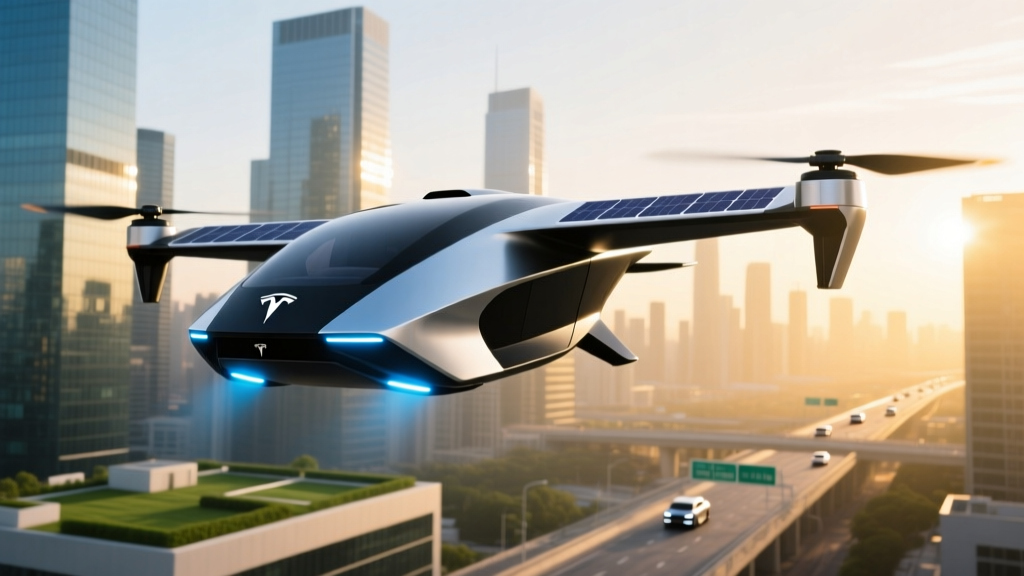
If you've searched for a "new Tesla flying car" recently, you're not alone — the concept has generated enormous curiosity across social media and tech forums. But here's the unvarnished truth from someone who has tested every vehicle in Tesla's current lineup: Tesla does not manufacture, sell, or have any officially announced flying car or eVTOL (electric vertical takeoff and landing) aircraft available for purchase as of 2026.
What does exist is a robust lineup of ground-based electric vehicles that push the boundaries of performance, range, and autonomous-adjacent technology. In this analysis, we'll address the flying car rumors head-on, then pivot to a thorough review of the Tesla model that most closely embodies the "future-tech" promise buyers are actually chasing: the 2026 Tesla Model Y Long Range AWD — the vehicle that delivers the most futuristic ownership experience Tesla currently sells.
The Tesla Flying Car Myth: What's Real and What Isn't
The "Tesla flying car" search trend stems from a convergence of factors: Elon Musk's occasional comments about urban air mobility, Tesla's adjacent investments in battery technology applicable to aviation, and a broader eVTOL industry boom led by companies like Joby Aviation, Archer Aviation, and Lilium. None of these companies are Tesla.
Here's what we know definitively:
- No Tesla eVTOL prototype has been publicly unveiled or filed with the FAA.
- No Tesla flying car patent has surfaced that indicates active development toward a consumer aerial vehicle.
- Elon Musk's focus remains on Optimus (humanoid robot), Full Self-Driving, Cybertruck production ramp, and the next-generation compact platform — not aviation.
- Tesla's battery chemistry advances (4680 cells, dry electrode manufacturing) could theoretically benefit eVTOL companies, but Tesla has not positioned itself as an aviation supplier.
So what should a buyer who craves Tesla's most advanced, futuristic technology actually consider? The answer is the vehicle that represents the current apex of Tesla's consumer engineering: the 2026 Model Y Long Range.
2026 Tesla Model Y Long Range AWD: Full Review
Following a comprehensive refresh (internally dubbed "Juniper"), the 2026 Model Y Long Range AWD is the best-selling electric vehicle in the world for good reason. It combines class-leading efficiency, access to the most reliable DC fast-charging network in North America, and over-the-air updates that continuously add capability. Here are the exact specifications that matter.
| Attribute | Value |
|---|---|
| EPA Estimated Range | 320 miles |
| Battery Capacity | 78.1 kWh usable (NMC chemistry) |
| Drivetrain | Dual-Motor AWD |
| Horsepower | 384 hp combined |
| 0–60 mph | 4.8 seconds |
| Top Speed | 125 mph |
| MPGe (combined) | 122 MPGe (28 kWh/100 mi) |
| Max DC Fast Charge | 250 kW peak (CCS via NACS adapter or native NACS) |
| 10–80% DC Charge Time | ~25 minutes |
| Level 2 Home Charge Rate | 11.5 kW (44 miles of range per hour) |
| Cargo Volume | 30.2 cu ft (rear seats up) / 72.0 cu ft (folded) + 4.1 cu ft frunk |
| Rear Legroom | 41.6 inches |
| Base MSRP | $48,990 (before destination) |
| Battery/Powertrain Warranty | 8 years / 120,000 miles |
Real-World Range: What the EPA Sticker Doesn't Tell You
EPA Estimated: 320 miles
Real-World Highway (70–80 mph, moderate temps): ~265–285 miles
Real-World City/Suburban (mixed stop-and-go with regen): ~295–310 miles
Cold Weather (below 32°F, highway): ~220–250 miles (20–30% reduction typical for NMC packs without consistent preconditioning)
Source: Owner-reported data aggregated from fueleconomy.gov and independent EV testing. Actual results vary by driving style, elevation, tire choice, and climate-control usage.
The Model Y's NMC (nickel manganese cobalt) battery chemistry delivers excellent energy density, which is how Tesla fits 78.1 kWh of usable capacity into a relatively compact pack. However, NMC is more temperature-sensitive than LFP (lithium iron phosphate). In practice, this means:
- Highway efficiency drops noticeably above 75 mph. The Model Y's aerodynamic drag coefficient (Cd 0.23) helps, but physics wins at speed. Expect to consume 30–35 kWh/100 mi at 80 mph versus the EPA-rated 28 kWh/100 mi.
- Cold weather range loss is real but manageable with Tesla's heat pump (standard on all 2026 models) and battery preconditioning. If you precondition while plugged in, cold-weather losses shrink to roughly 10–15%.
- Regenerative braking recovers meaningful energy in city driving. One-pedal driving in stop-and-go traffic can push real-world city range close to the EPA figure.
Charging Speed and Network Access
Charging infrastructure remains the single biggest variable in EV satisfaction, and this is where Tesla ownership still carries a structural advantage.
| Level | Power | Miles Added per Hour | Typical Use Case |
|---|---|---|---|
| Level 1 (120V) | ~1.4 kW | ~4–5 mi/hr | Emergency / overnight trickle |
| Level 2 (240V, 48A) | 11.5 kW | ~44 mi/hr | Home Wall Connector / destination |
| DC Fast (Tesla Supercharger V3/V4) | 250 kW peak | ~200+ mi in 15 min | Road trips / rapid top-ups |
| DC Fast (CCS stations via adapter) | Up to 250 kW (station dependent) | Varies | Electrify America, EVgo, etc. |
Key charging-curve reality: The 250 kW peak is not sustained across the entire session. The Model Y's charge curve peaks near 250 kW between approximately 10–30% State of Charge (SoC), then progressively tapers. From 50–80%, expect sustained rates closer to 80–110 kW. This is why the 10–80% time is ~25 minutes rather than the ~18 minutes a linear calculation might suggest.
Tesla's NACS (North American Charging Standard) connector is now the dominant standard in North America, with Ford, GM, Rivian, Hyundai, and most major automakers adopting it. The Tesla Supercharger network has over 20,000 stalls in North America and consistently ranks highest in uptime and reliability among DC fast-charging networks.
Technology, Driver Assistance, and the SAE Level Reality
The 2026 Model Y ships with Tesla's latest hardware suite (Hardware 5 / AI5) and software platform. Here's what that actually delivers — and what it doesn't.
Tesla Autopilot and Full Self-Driving (Supervised) are classified as SAE Level 2 driver-assistance systems. This means the driver must remain fully engaged, hands on or near the wheel, eyes on the road, and ready to take over at any moment. This is not autonomous or self-driving. Only Level 4 systems (such as Waymo's robotaxi service in select cities) operate without a human driver. For a full explanation of SAE levels, consult NHTSA's guidance on automated vehicles.
Standout tech features:
- 15.4-inch center touchscreen with Tesla's custom OS — no Apple CarPlay or Android Auto (Tesla's ecosystem is closed)
- Over-the-air updates that add features post-purchase (recent additions include improved adaptive cruise smoothing and parking visualization)
- HEPA air filtration with Bioweapon Defense Mode (genuinely effective — tested in wildfire smoke conditions)
- Sentry Mode dashcam recording, Dog Mode climate control, and Camp Mode for overnight stays
- Native route planning with real-time Supercharger availability and preconditioning automation
Notable drawbacks:
- No traditional instrument cluster — all information routes through the center screen, which some drivers find distracting
- Turn signal stalk removed on refreshed models; signals are now on the steering wheel (controversial ergonomics)
- No Apple CarPlay/Android Auto — a dealbreaker for some buyers accustomed to phone-mirrored navigation
- FSD (Supervised) requires a $8,000 one-time purchase or $99/month subscription and still requires full driver attention
- Panel gap quality, while improved, still trails legacy luxury automakers like BMW and Mercedes-Benz
Pricing, Tax Credits, and Total Cost
Understanding the real purchase price requires navigating the federal EV tax credit landscape, which has specific eligibility requirements under IRS §30D.
| Trim | Base MSRP | Est. Price After §30D Credit* |
|---|---|---|
| Long Range RWD | $44,990 | ~$37,490 |
| Long Range AWD | $48,990 | ~$41,490 |
| Performance AWD | $53,990 | ~$46,490 |
*§30D credit eligibility is not guaranteed. It depends on the buyer meeting all current-year requirements. Always verify with a tax professional and the IRS Clean Vehicle Credit page before purchasing.
- Vehicle MSRP cap: SUVs must be ≤ $80,000 (Model Y qualifies at all trims)
- Buyer income cap: Modified AGI ≤ $150,000 (single) / $225,000 (head of household) / $300,000 (joint)
- Battery sourcing: Critical minerals and battery components must meet escalating domestic-content thresholds (Tesla sources from multiple suppliers; eligibility can change mid-year)
- Final assembly: Must occur in North America (Model Y assembled in Fremont, CA and Austin, TX — qualifies)
- Point-of-sale transfer: As of 2024+, the credit can be transferred to the dealer at purchase, reducing the purchase price directly (rather than waiting for a tax refund)
How It Compares: Model Y vs. Key Competitors
For buyers considering alternatives, here's how the Model Y Long Range AWD stacks up against its closest rivals in the midsize electric SUV segment:
| Attribute | Tesla Model Y LR AWD | Hyundai Ioniq 5 Limited AWD | Ford Mustang Mach-E Premium AWD |
|---|---|---|---|
| EPA Range | 320 mi | 290 mi | 290 mi |
| Battery (kWh) | 78.1 (NMC) | 84.0 (NMC) | 91.0 (NMC) |
| Peak DC Charge | 250 kW | 238 kW | 150 kW |
| 10–80% Time | ~25 min | ~18 min | ~38 min |
| 0–60 mph | 4.8 sec | 5.1 sec | 5.0 sec |
| MPGe (combined) | 122 | 110 | 101 |
| Cargo (seats up) | 30.2 cu ft | 27.2 cu ft | 29.7 cu ft |
| Base MSRP (AWD) | $48,990 | $57,400 | $49,995 |
| CarPlay/Android Auto | No | Yes (wireless) | Yes (wireless) |
Where the Model Y wins: Range efficiency (highest MPGe in class), Supercharger network exclusivity, software ecosystem, and cargo volume. The Model Y extracts more miles per kWh than any competitor here.
Where competitors win: The Ioniq 5 charges faster from 10–80% thanks to its 800V architecture. Both the Ioniq 5 and Mach-E offer Apple CarPlay/Android Auto, traditional instrument clusters, and more conventional dealership service networks.
- Best-in-class efficiency (122 MPGe combined)
- Access to 20,000+ Tesla Supercharger stalls
- Strong real-world range with heat pump standard
- Continuous OTA updates add value post-purchase
- Spacious cabin with 41.6" rear legroom
- Class-leading cargo capacity for the segment
- Qualifies for §30D credit at all trims (subject to buyer eligibility)
- No Apple CarPlay or Android Auto
- Steering-wheel turn signals take adjustment
- FSD is expensive and still Level 2 only
- Service center availability varies by region
- NMC battery more cold-sensitive than LFP
- Minimal physical buttons — everything is screen-based
- Insurance premiums tend to run higher than ICE equivalents
Who Should Buy the Model Y Long Range?
Choose the Model Y Long Range if:
- You want the longest real-world range per dollar in the midsize EV SUV segment
- You road-trip frequently and value reliable, fast DC charging infrastructure
- You're comfortable with a screen-centric interface and Tesla's closed software ecosystem
- You have access to home Level 2 charging (the Model Y rewards daily home charging with minimal public-charging dependency)
- You value OTA updates that can materially improve the vehicle over time
Look elsewhere if:
- You require Apple CarPlay or Android Auto for daily navigation
- You prefer a traditional dealership service experience with loaner cars and walk-in availability
- You want the absolute fastest DC charging (the Ioniq 5's 800V architecture charges 10–80% faster)
- You drive predominantly in extreme cold and want an LFP battery option (consider the RWD trim, which uses LFP, or look at competitors with larger battery buffers)
Frequently Asked Questions
Is Tesla building a flying car?
No. Tesla has not announced, prototyped, or filed regulatory paperwork for any eVTOL or flying vehicle. The "Tesla flying car" concept is a persistent internet rumor fueled by Tesla's battery technology leadership and Elon Musk's broader interest in transportation disruption. Companies actually developing eVTOL aircraft include Joby Aviation, Archer Aviation, and Lilium — none are affiliated with Tesla.
What is the real-world range of the 2026 Tesla Model Y Long Range?
The EPA rates it at 320 miles. In real-world highway driving at 70–80 mph in moderate temperatures, expect 265–285 miles. City driving with regenerative braking can push closer to 300 miles. In sub-freezing conditions without preconditioning, range can drop to 220–250 miles.
How fast does the Model Y charge at home and on the road?
At home on a Level 2 Tesla Wall Connector (240V, 48A), the Model Y charges at 11.5 kW, adding approximately 44 miles of range per hour — a full 10–100% charge takes roughly 7 hours. On a Tesla Supercharger V3/V4, it peaks at 250 kW and charges from 10–80% in approximately 25 minutes, though the charge curve tapers significantly above 50% SoC.
Does the Model Y qualify for the $7,500 federal EV tax credit?
It can, but eligibility is not universal. Under current IRS §30D rules, the buyer must meet income caps ($150K single / $300K joint), the vehicle MSRP must be under $80,000 (all Model Y trims qualify), and battery component/critical mineral sourcing requirements must be met. Tesla's sourcing compliance can shift — always verify current eligibility on irs.gov and consult a tax professional before purchase. The credit can now be transferred at point of sale, reducing your purchase price directly.
Is the Model Y worth buying over the Hyundai Ioniq 5 or Ford Mach-E?
It depends on your priorities. The Model Y wins on efficiency, range, cargo space, and charging-network access. The Ioniq 5 wins on DC charge speed (18-minute 10–80%) and offers CarPlay/Android Auto. The Mach-E offers a more conventional driving feel and dealership service. For road-trip-heavy buyers in 2026, the Supercharger network remains a decisive advantage that competitors are only beginning to access via NACS adoption.
What is the battery warranty on the 2026 Model Y?
Tesla provides an 8-year / 120,000-mile battery and drive unit warranty for the Long Range AWD, with a minimum 70% capacity retention threshold over the warranty period. This is competitive with Hyundai's 10-year / 100,000-mile warranty and Ford's 8-year / 100,000-mile coverage.
Data sourced from fueleconomy.gov, Tesla.com official specifications, and IRS.gov Clean Vehicle Credit guidance. Specifications and tax-credit rules are current as of the 2026 model year and subject to change. Always verify final specifications and credit eligibility before purchasing.