When Did Tesla Come Out With Their First Car?
Tesla delivered its first production car — the original Roadster — to customers in February 2008. Built on a modified Lotus Elise chassis, it carried a 53 kWh lithium-ion battery (the first highway-legal EV to use lithium-ion cells) and posted a then-astonishing 245 miles of range. Only 2,450 units were produced through 2012, at a base price around $109,000.
That debut matters because it established Tesla's playbook: start with a low-volume, high-performance sports car to prove electric drivetrains could excite, then scale down in price and up in volume. The Model S followed in 2012, the Model X in 2015, the mass-market Model 3 in 2017, and the Model Y in 2020. The Cybertruck arrived in late 2023.
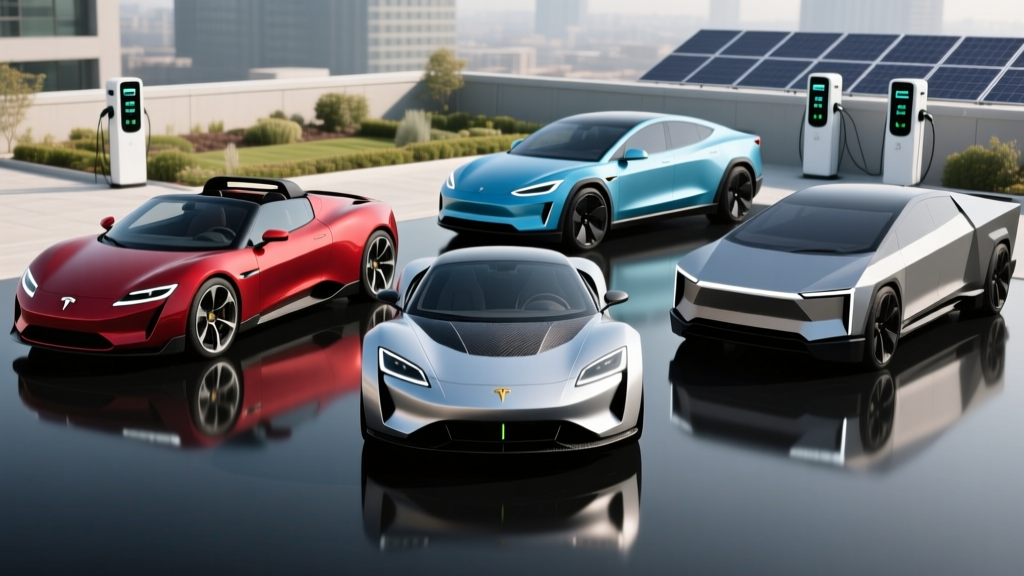
As of 2026, Tesla sells five consumer vehicles in the U.S. Below, we profile every current model with the exact specs buyers need: EPA range, battery chemistry, real-world charging speeds, tax-credit eligibility, and who each one actually fits.
The Original Roadster (2008–2012): Specs That Started It All
| Spec | 2008–2012 Roadster |
|---|---|
| 0-60 mph | 3.7 seconds |
| Range (EPA-equivalent) | 245 miles |
| Battery | 53 kWh, lithium-cobalt (NMC variant) |
| Motor | Single rear, 288 hp |
| Charge (Level 2) | ~3.5 hours (70 A proprietary) |
| Units built | ~2,450 |
| Base price | $109,000 |
The Roadster is long out of production and ineligible for any modern tax credit. It remains a collector piece — Tesla offered a battery upgrade program (to 80 kWh) for existing owners around 2014, but that has ended. If you're asking "when did Tesla come out with their first car" for historical context, 2008 is your answer. If you're shopping, read on.
Tesla's 2026 Lineup: At-a-Glance Specs
| Model | EPA Range | Battery (kWh, chemistry) | 0-60 | HP | Base MSRP |
|---|---|---|---|---|---|
| Model 3 RWD | 363 mi | ~60, LFP | 5.8s | 271 | $38,990 |
| Model 3 Long Range AWD | 363 mi | ~79, NMC | 4.2s | 346 | $44,990 |
| Model Y Long Range AWD | 320 mi | ~79, NMC | 4.8s | 384 | $44,990 |
| Model S Long Range | 402 mi | ~100, NMC | 3.1s | 670 | $74,990 |
| Model X Long Range | 335 mi | ~100, NMC | 3.8s | 670 | $79,990 |
| Cybertruck AWD | 340 mi | ~123, NMC | 4.1s | 600 | $79,990 |
Sources: fueleconomy.gov, Tesla owner manuals and spec pages. Ranges and pricing reflect 2026 model year; verify at purchase as Tesla adjusts pricing frequently.
Charging Speeds: Supercharger Network and Home Level 2
Tesla's Supercharger network remains its strongest ownership advantage. As of 2026, most new Tesla vehicles use the NACS (North American Charging Standard) connector natively — the same connector Tesla opened to other automakers in 2024.
| Model | Peak DC kW | 10–80% Time | Level 2 (240V/48A) |
|---|---|---|---|
| Model 3 RWD (LFP) | 170 kW | ~30 min | ~30 mi/hr (11.5 kW) |
| Model 3/Y Long Range | 250 kW | ~25 min | ~44 mi/hr (11.5 kW) |
| Model S/X | 250 kW | ~27 min | ~40 mi/hr (11.5 kW) |
| Cybertruck | 250+ kW (800V capable) | ~20 min | ~38 mi/hr (11.5 kW) |
Charging-curve reality: Peak kW is only sustained between roughly 10–40% state of charge. Above 60%, charge rate tapers significantly. A "25-minute 10–80%" claim means the final 20% takes nearly as long as the first 50%. For road trips, plan stops around 10–70% for the fastest throughput.
At home, Tesla's Wall Connector ($475) delivers up to 11.5 kW (48 amps) on a 60-amp circuit. Most owners install a NEMA 14-50 outlet ($300–$800 for electrician work, depending on panel proximity) and use the Mobile Connector instead — a practical, lower-cost option that still delivers ~30 miles of range per hour of charging.
Federal Tax Credit Eligibility (2026 IRS §30D Rules)
The IRS §30D clean vehicle credit remains complex in 2026. Eligibility hinges on three hurdles: buyer income caps, vehicle MSRP caps, and battery critical-mineral/component sourcing requirements that tighten annually.
| Model | MSRP Cap Met? | Estimated Credit | Notes |
|---|---|---|---|
| Model 3 RWD | Yes (sedan cap: $55,000) | $3,750–$7,500 | Varies by battery sourcing quarter |
| Model 3 Long Range | Yes | $3,750–$7,500 | Same sourcing variability |
| Model Y (SUV cap: $80,000) | Yes | $3,750–$7,500 | Classified as SUV — higher cap |
| Model S | Yes (under $55K sedan cap? No) | $0 | Exceeds $55,000 sedan MSRP cap |
| Model X | Yes (SUV cap) | $3,750–$7,500 | SUV classification helps |
| Cybertruck | Yes (truck/SUV cap) | $3,750–$7,500 | Verify sourcing at purchase |
Income caps (MAGI): $150,000 single / $300,000 joint / $225,000 head of household. Exceed these and you get $0 regardless of the vehicle. Point-of-sale transfer is available — you can apply the credit as a down-payment reduction at delivery rather than waiting for tax filing. Always verify current sourcing requirements on irs.gov before purchase; they shift quarterly.
Driver Assistance: Autopilot and FSD Supervised
Autopilot includes adaptive cruise, lane-keeping, and automatic emergency braking. FSD Supervised adds city-street navigation, traffic-light recognition, and lane changes on surface streets — impressive when it works, but inconsistent in construction zones, unmapped areas, and heavy rain. Most buyers are better served by standard Autopilot and investing the $8,000 elsewhere.
Who Should Buy a Tesla in 2026?
Pros
- Supercharger network: 60,000+ global stalls, highest reliability in public charging
- OTA updates add features years after purchase
- Class-leading efficiency (kWh/100mi)
- Strong resale value relative to other EVs
- Minimal scheduled maintenance
Cons
- No Apple CarPlay or Android Auto
- Build quality variability (panel gaps, paint)
- Service center wait times in high-volume metro areas
- FSD Supervised remains Level 2 despite the name
- LFP batteries lose more range in extreme cold
Best for commuters and road-trippers: Model 3 RWD offers the best value at ~$31,500 after a $7,500 credit — 363 miles of EPA range handles any commute, and Supercharger access makes 500-mile days routine.
Best for families: Model Y Long Range AWD provides 76 cu ft of cargo space (rear seats folded), standard AWD, and the same Supercharger advantage. It's the default EV family hauler for good reason.
Best for performance seekers: Model S Plaid (not profiled above — 1,020 hp, 1.99s 0-60, $89,990) exists, but the Long Range at 402 miles and 3.1s 0-60 is the rational pick.
Skip if: You need Apple CarPlay, live far from a Tesla service center, or prefer traditional dealer interactions. Hyundai Ioniq 5, Kia EV6, and Ford Mustang Mach-E offer competitive specs with dealer networks and phone integration.
Warranty and Long-Term Ownership
Tesla provides a 4-year/50,000-mile basic warranty and an 8-year/120,000-mile battery and drive unit warranty (100,000 miles for Model 3 RWD). The warranty guarantees 70% minimum battery capacity retention — below that threshold within the term, Tesla replaces or refurbishes at no cost.
Real-world degradation data from owner communities shows most Tesla batteries retain 90%+ capacity at 100,000 miles. LFP chemistry (Model 3 RWD) shows slower degradation but a steeper cold-weather range penalty. NMC variants (Long Range, Model S/X) degrade slightly faster but tolerate cold better and support faster DC charging.
Frequently Asked Questions
When did Tesla come out with their first car?
The Tesla Roadster entered production in 2008, with first customer deliveries in February 2008. It was based on the Lotus Elise and produced through 2012.
What was Tesla's first affordable car?
The Model 3, launched in July 2017 at a $35,000 base price (though early production was limited to higher trims). It was Tesla's first mass-market vehicle.
Does the Model 3 qualify for the $7,500 tax credit in 2026?
It can — the Model 3 RWD and Long Range fall under the $55,000 sedan MSRP cap. However, the exact credit ($3,750 or $7,500) depends on battery critical-mineral and component sourcing rules that shift quarterly. Buyer income must also fall under IRS MAGI caps.
Is Tesla's Supercharger network really better than other public charging?
By reliability metrics, yes. Third-party surveys consistently rank Tesla Superchargers above Electrify America, EVgo, and ChargePoint DC networks for uptime and accurate power delivery. The gap has narrowed since 2024 as competitors upgraded, but Tesla still leads.
Should I wait for the next-gen Tesla (Roadster 2 or cheaper model)?
The new Roadster has been "coming soon" since 2017 with no firm delivery date — treat it as vaporware until VINs are assigned. A lower-cost Tesla platform has been rumored for 2026–2027 but remains unannounced with confirmed specs. If you need a car now, buy now; Tesla's price-cut history means waiting rarely pays off predictably.
What's the real-world range of a 2026 Model 3 Long Range?
EPA rates it at 363 miles. Expect ~310–325 miles in mixed driving, ~280–300 miles at 75 mph highway speeds, and ~240–260 miles in sub-30°F winter conditions with cabin heat. Preconditioning while plugged in mitigates cold loss significantly.