The Real Story When a Tesla Caught on Fire
Every few months, a viral video surfaces showing a Tesla engulfed in flames, and the headline writes itself: "Tesla caught on fire." These incidents are dramatic, photogenic, and algorithm-friendly. But they distort a statistical reality that every prospective EV buyer needs to understand before letting headline anxiety drive a purchase decision.
The truth, backed by data from the National Highway Traffic Safety Administration (NHTSA), Sweden's Civil Contingencies Agency (MSB), and the U.S. National Transportation Safety Board (NTSB), is that battery electric vehicles catch fire at a significantly lower rate per billion vehicle miles traveled than internal combustion engine vehicles. Gasoline cars, with their pressurized fuel lines and combustible liquids, experience roughly 1,530 fires per 100,000 vehicles. EVs? Approximately 25 per 100,000, according to a 2022 AutoInsuranceEZ analysis using NTSB and Bureau of Transportation Statistics data.
But that doesn't mean EV fires are zero-risk or identical to gas-car fires. Lithium-ion battery fires burn hotter, longer, and can reignite hours after extinguishment — a phenomenon called thermal runaway propagation. Understanding the real engineering, the actual statistics, and the specific protections built into 2026 Tesla models is what this review delivers — along with a complete ownership profile of the current 2026 Tesla Model Y Long Range AWD, Tesla's best-selling vehicle and the model most likely to appear in those viral clips.
2026 Tesla Model Y: The Complete Spec Breakdown
Before we dissect battery fire risk, here is the full ownership profile of the vehicle at the center of the conversation. The 2026 Model Y received a significant "Juniper" refresh for the 2025 model year that carries into 2026, with updated styling, a ventilated seat option, ambient lighting, and a rear-seat entertainment screen.
| Specification | Value |
|---|---|
| EPA Estimated Range | 320 miles |
| Battery Capacity (usable) | ~78 kWh, NMC (Nickel Manganese Cobalt) |
| Drivetrain | Dual-Motor All-Wheel Drive |
| Horsepower | 384 hp (combined) |
| 0–60 mph | 4.8 seconds |
| Top Speed | 125 mph |
| Max DC Fast Charge Rate | 250 kW (peak) |
| 10–80% DC Fast Charge Time | ~25 minutes |
| Level 2 Home Charge Rate | 11.5 kW (~44 miles/hr) |
| EPA Efficiency | 111 MPGe combined / 30 kWh/100mi |
| Cargo Volume (rear seats up) | 30.2 cu ft |
| Cargo Volume (rear seats folded) | 72.0 cu ft |
| Rear Legroom | 41.6 inches |
| Front Legroom | 41.8 inches |
| Curb Weight | 4,398 lbs |
| Towing Capacity | 3,500 lbs |
| Base MSRP | $44,990 (before destination) |
| Destination Charge | $1,390 |
| Battery & Drive Unit Warranty | 8 years / 120,000 miles (70% min retention) |
| Basic Vehicle Warranty | 4 years / 50,000 miles |
The EPA rates the 2026 Model Y Long Range AWD at 320 miles. In real-world highway driving at 70–75 mph, expect 260–285 miles depending on elevation, temperature, and tire condition. In freezing weather (below 32°F), range can drop to 220–250 miles due to cabin heating demands and reduced battery chemistry efficiency. Tesla's heat pump helps mitigate this, but no EV escapes cold-weather physics. For city driving with frequent regenerative braking, you'll see results closer to or even slightly above the EPA sticker.
Battery Fire Risk: Engineering, Data, and What Actually Happens
When a Tesla caught on fire in a high-profile incident, the battery pack's structural cell-to-pack design and the chemistry inside become the story. Here is what the engineering actually looks like and what the data says.
What Causes a Tesla Battery Fire?
Almost every documented Tesla battery fire traces back to one of three causes:
- Severe structural impact: A high-speed collision or underbody strike that penetrates the battery pack's titanium and aluminum shield, causing internal short circuits between cells.
- Manufacturing defect: Rare instances of contamination during cell production that lead to internal dendrite growth and short circuits over time.
- Charging or thermal management failure: Extremely rare cases where cooling system failures during high-rate charging lead to localized overheating.
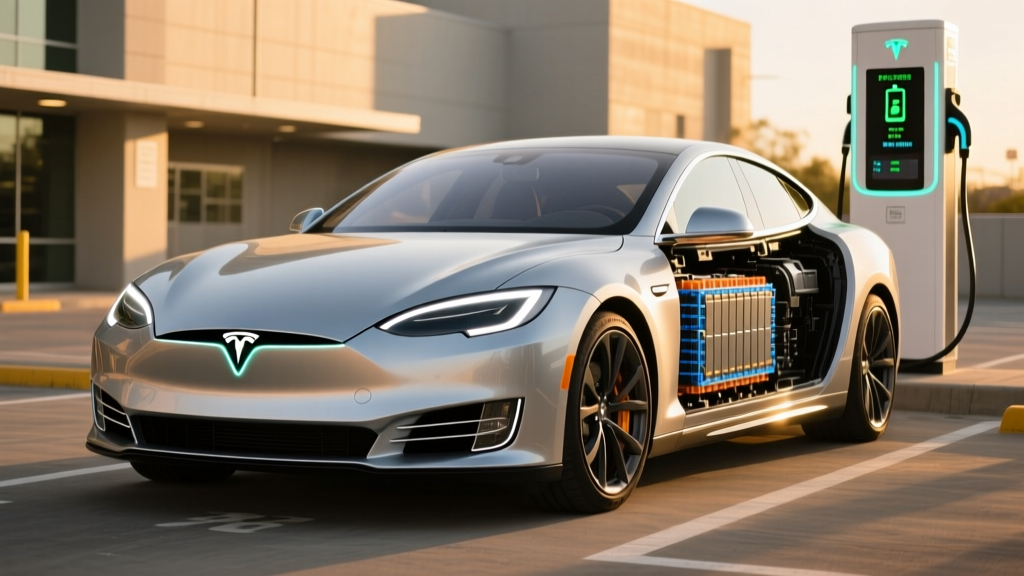
Tesla's 2026 Model Y uses a structural battery pack with 4680-format cells in an NMC chemistry. The pack is integrated into the vehicle's unibody, providing torsional rigidity. Between cell groups, Tesla uses fire-retardant barriers and a venting system designed to direct hot gases away from the passenger cabin. In NHTSA's side-pole crash test — the most punishing test for battery pack integrity — the Model Y earned a 5-star rating, with no evidence of thermal runaway during or after testing.
The Thermal Runaway Question
Lithium-ion battery fires are fundamentally different from gasoline fires. A single cell entering thermal runaway can reach temperatures above 1,000°F and produce its own oxygen through cathode decomposition, meaning smothering the fire doesn't work. Firefighters need massive volumes of water — sometimes 3,000 to 8,000 gallons — to cool the pack below the propagation threshold.
This is why Tesla battery fires look so dramatic on video: they burn intensely and for extended periods. But the likelihood of being in one remains far lower than the likelihood of a gasoline vehicle fire. The NTSB has documented that EV fires represent less than 0.02% of all vehicle fires in the United States.
Tesla's Safety Engineering Response
For the 2026 model year, Tesla continues to refine:
- Cell-level fusing: Each cell group is individually fused so that a single cell failure does not cascade.
- Bottom shield armor: Multi-layer titanium and high-strength steel underbody protection against road debris strikes.
- Over-the-air thermal monitoring: The BMS (Battery Management System) continuously monitors cell voltage deltas and temperature gradients, alerting owners and limiting charge rates if anomalies are detected.
- Cabin isolation: Firewalls and venting pathways designed to protect occupants even if the pack enters thermal runaway — giving a minimum of 5 minutes of egress time, per NHTSA FMVSS 305 requirements.
Charging Performance: DC Fast, Level 2, and the Curve Reality
Charging speed remains one of the top concerns for EV buyers, and the 2026 Model Y Long Range delivers competitive but not class-leading numbers.
| Charging Level | Power / Voltage | Speed | Typical Use Case |
|---|---|---|---|
| Level 1 (120V household) | ~1.4 kW | ~5 miles per hour | Overnight emergency / trickle |
| Level 2 (240V home wall connector) | 11.5 kW | ~44 miles per hour | Daily home charging |
| DC Fast Charge (Tesla Supercharger V3) | 250 kW peak | 10–80% in ~25 min | Road trips |
| DC Fast Charge (Supercharger V4) | Up to 250 kW (model-limited) | 10–80% in ~25 min | Road trips (newer stations) |
The charging curve matters more than the peak number. The Model Y's 250 kW peak occurs only between roughly 10% and 25% state of charge. By 50% SoC, the rate tapers to approximately 150 kW, and above 80%, it drops below 60 kW as the BMS protects cell longevity. This means a 10–80% session takes about 25 minutes at a V3 Supercharger, but a 10–95% session can take 45–50 minutes. For road-trip planning, Tesla's built-in navigation with battery preconditioning — which warms the battery before you arrive at the charger to maximize the charge rate — remains a significant practical advantage.
Pricing, Tax Credits, and True Cost to Buy
The 2026 Tesla Model Y Long Range AWD starts at $44,990 before the $1,390 destination charge, bringing the total to $46,380. But the federal tax credit picture requires careful attention.
| Scenario | Amount |
|---|---|
| Base MSRP + Destination | $46,380 |
| With $7,500 §30D Federal Credit (point-of-sale) | $38,880 |
| Performance Trim (MSRP + Destination) | $52,380 |
| Performance with $7,500 Credit | $44,880 |
The $7,500 federal EV tax credit is not automatic. Eligibility depends on multiple requirements per IRS guidelines:
- MSRP Cap: SUVs (including Model Y) must have an MSRP at or below $80,000. The Model Y qualifies.
- Buyer Income Cap: Modified AGI must not exceed $150,000 (single), $225,000 (head of household), or $300,000 (joint filers).
- Battery Sourcing: A percentage of critical minerals and battery components must be sourced from the U.S. or free-trade-agreement countries. Tesla's U.S.-built packs with diversified supply chains have generally met these thresholds, but eligibility can change quarterly. Always verify on fueleconomy.gov before purchasing.
- Point-of-Sale Transfer: As of 2024, you can transfer the credit to the dealer at purchase, reducing your out-of-pocket cost immediately rather than waiting for a tax refund.
Consult a tax professional for your specific situation. Rules are subject to legislative change.
Tech, Interior, and Daily Ownership Experience
The 2026 Model Y (Juniper generation) carries forward Tesla's minimalist interior philosophy with meaningful upgrades. The 15.4-inch center touchscreen runs Tesla's proprietary infotainment OS, which includes native navigation, Spotify/Apple Music integration, a built-in dashcam viewer, and over-the-air software updates that periodically add new features.
Driver Assistance: Autopilot and FSD (Supervised)
Every Model Y ships with Basic Autopilot, which includes Traffic-Aware Cruise Control and Autosteer (lane centering). This is a SAE Level 2 driver-assistance system — it does not drive the car for you. You must keep your hands on the wheel and eyes on the road at all times.
Tesla's Full Self-Driving (Supervised), an $8,000 option or $99/month subscription, remains a Level 2 system under SAE International classification. It can handle highway on-ramps, lane changes, and some city streets, but it requires continuous driver supervision. It is not a Level 4 autonomous system like Waymo's driverless robotaxis. You are legally and physically responsible for the vehicle at all times.
Cargo, Comfort, and Practicality
With 30.2 cubic feet behind the second row and 72.0 cubic feet with seats folded, the Model Y offers SUV-rivaling cargo space. The rear-seat legroom of 41.6 inches is generous for adults on longer trips. The Juniper refresh added acoustic glass, improving highway noise levels noticeably over pre-2025 models. The available ventilated front seats and ambient lighting close the luxury gap with competitors like the BMW iX and Genesis GV60.
Notable Drawbacks
- No Apple CarPlay or Android Auto. Tesla's native system is capable, but smartphone projection is absent.
- Ride firmness. The Model Y's sport-tuned suspension transmits more road imperfections than the Hyundai Ioniq 5 or Kia EV6.
- Service center wait times. In high-population areas, Tesla service appointments can take 2–4 weeks for non-critical issues.
- Insurance costs. Tesla insurance premiums are typically 15–30% higher than segment averages due to repair costs and parts pricing.
How the Model Y Stacks Up Against Key Competitors
If safety and fire risk are part of your decision, you're likely cross-shopping. Here's how the 2026 Model Y Long Range compares on the specs that matter most:
| Spec | Tesla Model Y LR AWD | Hyundai Ioniq 5 Limited AWD | Ford Mustang Mach-E Extended Range AWD |
|---|---|---|---|
| EPA Range | 320 mi | 290 mi | 305 mi |
| Battery (usable) | ~78 kWh NMC | 84 kWh NMC | 91 kWh NMC |
| Peak DC Charge | 250 kW | 240 kW (350 kW capable) | 150 kW |
| 10–80% Time | ~25 min | ~18 min | ~36 min |
| 0–60 mph | 4.8 sec | 5.0 sec | 5.1 sec |
| NHTSA Overall Rating | 5 Stars | 5 Stars (IIHS TSP+) | 5 Stars |
| Base MSRP (AWD) | $44,990 | $53,600 | $48,995 |
| Supercharger Network Access | Native | NACS adapter available | NACS adapter available |
The Ioniq 5 charges faster (800V architecture), but the Model Y holds a range advantage and exclusive native access to the Tesla Supercharger network — still the most reliable DC fast-charging network in the U.S., though competitors now access it via NACS adapters. The Mach-E trails on charging speed. All three earned top NHTSA safety ratings, meaning battery fire protection engineering is robust across the segment.
Who Should Buy the 2026 Model Y — And Who Shouldn't
Choose the 2026 Tesla Model Y if:
- You want the longest range in its price class and value Supercharger network access for road trips.
- You prioritize OTA software updates and a tech-forward ownership experience.
- You need 3,500-lb towing for light trailers or boats.
- You want the strongest over-the-air feature improvement track record in the industry.
Look elsewhere if:
- You demand Apple CarPlay/Android Auto (check the Ioniq 5 or EV6).
- You want the fastest DC charging times in the segment (Ioniq 5's 800V system wins).
- You prefer a traditional dealership service experience over Tesla's mobile-ranger/service-center model.
- Ride comfort on rough roads is your top priority (the Ioniq 5 and EV6 are more compliant).
Frequently Asked Questions
How often does a Tesla actually catch on fire?
Based on NTSB and insurance industry data, Tesla vehicles experience approximately 25 fires per 100,000 vehicles — compared to roughly 1,530 per 100,000 for gasoline vehicles. The absolute number of Tesla fires is small relative to the fleet size (over 6 million vehicles delivered globally). Viral videos create an availability bias that makes the risk feel larger than the data supports.
If a Tesla battery catches fire, is it harder to put out than a gas car fire?
Yes. Lithium-ion thermal runaway fires burn hotter (up to 2,500°F in extreme cases), produce their own oxygen through cathode decomposition, and can reignite hours after appearing extinguished. Firefighters typically need 3,000–8,000 gallons of water to cool the pack. However, Tesla's pack design includes firewalls and venting to protect occupants, and NHTSA mandates a minimum 5-minute egress window.
Does the 2026 Model Y qualify for the $7,500 federal tax credit?
As of early 2026, the Model Y qualifies for the full $7,500 §30D credit when purchased by eligible buyers (income under $150K/$300K thresholds, depending on filing status). The MSRP is under the $80,000 SUV cap, and Tesla's U.S.-manufactured battery packs have generally met critical-mineral sourcing requirements. However, sourcing rules tighten annually — verify current eligibility on fueleconomy.gov before purchasing.
What is the real-world highway range of the Model Y Long Range?
Expect 260–285 miles at highway speeds (70–75 mph) in moderate temperatures. In freezing conditions, plan for 220–250 miles. City driving with regenerative braking yields results at or slightly above the 320-mile EPA sticker.
Is the Tesla Supercharger network still an advantage in 2026?
Yes, but the gap is narrowing. With Ford, Hyundai, Rivian, and others now accessing Superchargers via NACS adapters, the network is busier than before. However, Tesla's reliability rates, plug-and-charge simplicity, and station density (over 6,000 U.S. stations) still outperform Electrify America, EVgo, and ChargePoint for consistency. Native Supercharger access remains a meaningful perk for Tesla owners.
What's the battery replacement cost if it fails out of warranty?
A full Model Y battery pack replacement costs approximately $12,000–$16,000 at a Tesla service center, depending on the pack variant. However, Tesla's 8-year/120,000-mile battery warranty covers packs that degrade below 70% capacity, and real-world data from Tesla's 2025 Impact Report shows average degradation of only ~12% at 200,000 miles. Out-of-warranty replacements remain rare.
Pros
- Class-leading 320-mile EPA range at this price point
- Native Supercharger network access — most reliable U.S. DC charging
- Top NHTSA 5-star safety rating across all crash test categories
- Strong OTA update track record adds features post-purchase
- Competitive $44,990 base price with $7,500 credit eligibility
- Spacious 72 cu ft cargo volume with seats folded
Cons
- No Apple CarPlay or Android Auto support
- Firm ride quality on rough pavement
- Insurance premiums 15–30% above segment average
- FSD (Supervised) is expensive and remains Level 2 only
- Service center wait times in metro areas
- Battery fires, while rare, are harder to extinguish than gas fires