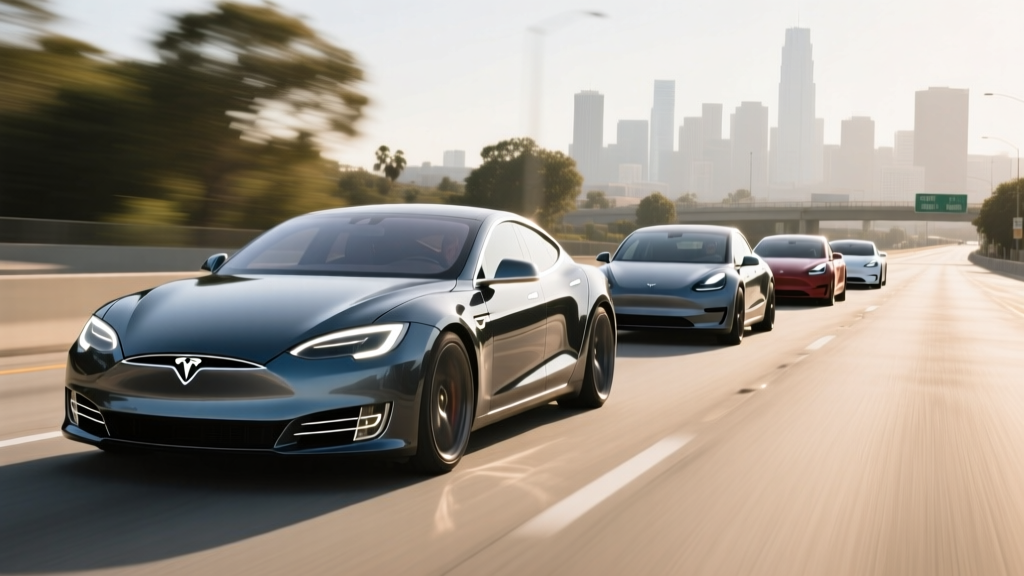
Acceleration defines the Tesla brand as much as its Supercharger network. When buyers search for the Tesla fastest 0-60 times, they're usually weighing raw performance against daily usability, range, and price. In 2026, Tesla's lineup spans a 1.99-second hypercar-slayer and a 5.8-second family crossover — and the differences in battery chemistry, charging speed, and tax-credit eligibility matter just as much as the stopwatch numbers.
This guide ranks every current Tesla model by 0-60 mph time, then digs into the ownership data that spec sheets bury: real-world range, sustained charging curves, battery chemistry, and whether each model actually qualifies for the IRS §30D federal tax credit under current MSRP and income caps.
Tesla 0-60 Rankings: Full Lineup at a Glance
The table below sorts every 2026 Tesla by its quickest factory 0-60 mph time. Note that Tesla's published times typically use a rollout-adjusted methodology (subtracting the first foot of travel), which shaves roughly 0.2–0.3 seconds versus standard timing. We've flagged those where applicable.
| Model / Trim | 0-60 mph | Horsepower | Drivetrain | EPA Range | Battery (kWh / Chem.) | Base MSRP |
|---|---|---|---|---|---|---|
| Model S Plaid | 1.99 s* | 1,020 hp | Tri-Motor AWD | 396 mi | ~100 kWh / NMC | $89,990 |
| Model 3 Performance | 2.9 s | 510 hp | Dual-Motor AWD | 315 mi | ~79 kWh / NMC | $54,990 |
| Model S Long Range | 3.1 s | 670 hp | Dual-Motor AWD | 402 mi | ~100 kWh / NMC | $74,990 |
| Model X Plaid | 2.5 s* | 1,020 hp | Tri-Motor AWD | 326 mi | ~100 kWh / NMC | $94,990 |
| Model X Long Range | 3.8 s | 670 hp | Dual-Motor AWD | 335 mi | ~100 kWh / NMC | $79,990 |
| Model Y Long Range AWD | 4.8 s | 384 hp | Dual-Motor AWD | 320 mi | ~79 kWh / NMC | $48,990 |
| Model 3 Long Range AWD | 4.2 s | 346 hp | Dual-Motor AWD | 341 mi | ~79 kWh / NMC | $45,990 |
| Model 3 RWD (Standard) | 5.8 s | 271 hp | Rear-Wheel Drive | 272 mi | ~60 kWh / LFP | $38,990 |
*Rollout-adjusted timing per Tesla methodology; add ~0.2–0.3 s for standard measurement.
Model S Plaid: The 1.99-Second Flagship
The Model S Plaid remains the Tesla fastest 0-60 production car and one of the quickest accelerating vehicles ever sold at any price. Its tri-motor powertrain (one front, two rear) produces 1,020 horsepower and uses carbon-sleeved rotors to sustain peak output without the thermal derating that hobbled earlier Performance models on repeated launches.
Real-World Expectation: Expect ~310–330 miles at sustained 75 mph highway speeds in mild weather. In freezing temperatures (below 32°F), plan for 250–280 miles due to cabin heating load and battery resistance. The Plaid's aggressive rear-biased torque vectoring also reduces efficiency during spirited driving.
Charging: Peak Power Meets a Mature Network
The Model S Plaid peaks at 250 kW on V3 Superchargers (CCS/NACS) and sustains roughly 200+ kW through 50% state of charge before tapering. A 10–80% DC fast charge takes approximately 27 minutes when preconditioned. On Level 2 (48A home wall connector at 11.5 kW), you'll recover about 41 miles per hour of charging — enough to fully replenish overnight.
Who the Plaid Is For
This is a low-volume halo car for buyers who want Bugatti-tier acceleration in a four-door sedan with access to the Supercharger network. It does not qualify for the federal EV tax credit (MSRP exceeds the $55,000 sedan cap under §30D). If you need a daily commuter with maximum efficiency, the Long Range variant — or a Model 3 — makes more financial sense.
Model 3 Performance: The Value Speed King
At 2.9 seconds to 60 mph and $54,990, the Model 3 Performance (refreshed for 2024 and carried into 2026) delivers supercar acceleration at a fraction of the Plaid's price. It also clears the §30D sedan MSRP cap, making it eligible for the full $7,500 federal tax credit — provided you meet income limits and the vehicle's battery sourcing satisfies critical-mineral requirements.
Its dual-motor AWD layout produces 510 hp and 546 lb-ft of torque. The 2026 model carries over the "Highland" interior refresh with ventilated seats, ambient lighting, a rear passenger touchscreen, and significantly improved NVH (noise/vibration/harshness) compared to pre-2024 Model 3s.
Real-World Expectation: ~260–280 miles highway at 70–75 mph. Cold weather (sub-30°F) drops this to ~220–240 miles. The Performance trim's 20" wheels and stickier compound tires cost roughly 15–20 miles versus the Long Range on identical batteries.
Efficiency and Running Costs
The Model 3 Performance achieves 113 MPGe combined (30 kWh/100 mi) per EPA data. At the US average electricity rate of ~$0.17/kWh, fueling costs roughly $5.10 per 100 miles — about one-third the cost of a comparable BMW M3 on premium gasoline.
Model 3 Long Range and RWD: The Everyday Picks
Most Tesla buyers don't need a 2.9-second 0-60. The Model 3 Long Range AWD (4.2 seconds, 341 miles EPA, $45,990) and the base Model 3 RWD (5.8 seconds, 272 miles EPA, $38,990) serve the majority of use cases — commuting, road trips, and family duty — at substantially lower cost.
LFP vs NMC: The Battery Chemistry Split
The base RWD Model 3 uses a lithium iron phosphate (LFP) battery (~60 kWh), while Long Range and Performance trims use nickel manganese cobalt (NMC) chemistry (~79 kWh). The differences matter:
| Attribute | LFP (Model 3 RWD) | NMC (LR / Performance) |
|---|---|---|
| Energy density | Lower (shorter range) | Higher (longer range) |
| Cold-weather performance | More range loss (~30–35%) | Moderate loss (~20–25%) |
| Charging to 100% | Recommended regularly | 80% daily; 100% for trips only |
| Cycle life / longevity | Longer (3,000+ cycles) | Good (~1,500–2,000 cycles) |
| Cost | Lower | Higher |
If you charge at home every night and commute under 60 miles round-trip, the LFP Model 3 RWD is arguably the best value in the lineup — and it qualifies for the full $7,500 credit.
Model Y: The Best-Selling EV — How Quick Is It?
The Model Y Long Range AWD hits 60 mph in 4.8 seconds — quick by any crossover standard, though it doesn't chase headline acceleration numbers. With 320 miles of EPA range, 76 cubic feet of cargo space (seats folded), and available 7-seat configuration, it prioritizes utility over drag-strip performance.
For 2026, the Model Y "Juniper" refresh brings a redesigned front fascia, updated interior with rear touchscreen, power-folding second row, and improved suspension tuning. The Long Range AWD starts at $48,990 and clears the §30D SUV/truck MSRP cap of $80,000 (Tesla classifies the Model Y as an SUV for credit purposes), making it eligible for the $7,500 credit.
Real-World Expectation: ~270–290 miles highway; ~230–250 miles in freezing conditions. The Model Y's taller profile and greater frontal area cost it 20–30 miles versus an equivalently equipped Model 3 Long Range.
Charging Speeds Across the Tesla Lineup
Tesla's Supercharger network (now open to non-Tesla EVs via the NACS standard) remains the most reliable DC fast-charging ecosystem in the US. Here's what each model delivers:
| Model | Peak DC kW | 10–80% Time | Level 2 Home (kW) | Mi/Hr at Home |
|---|---|---|---|---|
| Model S Plaid | 250 kW | ~27 min | 11.5 kW (48A) | ~41 mi/hr |
| Model 3 Performance | 250 kW | ~25 min | 11.5 kW (48A) | ~44 mi/hr |
| Model 3 Long Range | 250 kW | ~25 min | 11.5 kW (48A) | ~44 mi/hr |
| Model 3 RWD (LFP) | 170 kW | ~30 min | 11.5 kW (48A) | ~48 mi/hr |
| Model Y Long Range | 250 kW | ~27 min | 11.5 kW (48A) | ~42 mi/hr |
| Model X Plaid | 250 kW | ~30 min | 11.5 kW (48A) | ~36 mi/hr |
Charging curve reality: Peak kW is not sustained kW. Teslas (like all EVs) charge fastest between 10–50% SoC, then taper significantly above 80%. If you're road-tripping, plan stops around 10–80% rather than topping off — the last 20% can take as long as the first 70%.
Federal Tax Credit Eligibility (§30D) for 2026
Not every Tesla qualifies for the federal clean vehicle credit. Under current IRS §30D rules, eligibility depends on three factors:
- MSRP cap: Sedans (Model S, Model 3) must be priced at or below $55,000. SUVs and trucks (Model Y, Model X) must be at or below $80,000.
- Buyer income cap: Modified AGI must not exceed $150,000 (single), $225,000 (head of household), or $300,000 (joint).
- Battery sourcing: Critical minerals and battery components must meet phased-in domestic/free-trade sourcing thresholds (increasing annually through 2032).
| Model | MSRP | Vehicle Class | MSRP Cap | Credit Eligible? |
|---|---|---|---|---|
| Model 3 RWD | $38,990 | Sedan | $55,000 | Yes (full $7,500 if sourcing qualifies) |
| Model 3 Long Range | $45,990 | Sedan | $55,000 | Yes |
| Model 3 Performance | $54,990 | Sedan | $55,000 | Yes (narrowly — options may push over) |
| Model Y Long Range | $48,990 | SUV | $80,000 | Yes |
| Model S Long Range | $74,990 | Sedan | $55,000 | No (exceeds sedan cap) |
| Model S Plaid | $89,990 | Sedan | $55,000 | No |
| Model X Long Range | $79,990 | SUV | $80,000 | Yes (base only) |
| Model X Plaid | $94,990 | SUV | $80,000 | No |
Critical caveat: Even when MSRP and income qualify, the battery's critical-mineral and component sourcing must meet the year's thresholds. Tesla's US-built models (Fremont, Austin) generally satisfy these requirements, but always verify the specific VIN on fueleconomy.gov before purchasing. The credit can now be transferred to the dealer at point of sale as an instant discount.
Warranty, Tech, and Drawbacks
Battery and Powertrain Warranty
All 2026 Teslas carry an 8-year / 100,000-mile battery and drive unit warranty (120,000 miles for Model S and Model X), guaranteeing a minimum of 70% capacity retention. Tesla's LFP packs (Model 3 RWD) historically degrade slower than NMC, often retaining 90%+ capacity at 100,000 miles based on fleet data.
Standout Tech
- Autopilot / FSD (Supervised): Standard Autopilot includes adaptive cruise and lane centering. FSD (Supervised) is a $8,000 option or $99/month subscription — it is a SAE Level 2 system requiring full driver attention, not autonomous driving.
- 15.4" center touchscreen (Model 3/Y) or 17" tilting display (Model S/X) with integrated navigation, media, and vehicle controls.
- Over-the-air updates continuously add features — recent additions include adaptive headlights, improved regen profiles, and UI refinements.
- Sentry Mode, Dashcam, and Dog Mode remain class-leading utility features.
Notable Drawbacks
- No Apple CarPlay or Android Auto — Tesla's proprietary infotainment is the only option.
- FSD (Supervised) is not self-driving — despite the name, it requires constant supervision and can make errors in construction zones, rain, and unmapped areas.
- Minimalist interior polarizes — no physical stalks on refreshed Model 3/Y (turn signals are on the steering wheel).
- Insurance costs tend to run 15–30% higher than comparable ICE vehicles due to repair costs and parts pricing.
Pros and Cons: Which Tesla Should You Buy?
Pros (Across Lineup)
- Class-leading acceleration at every price point
- Access to 6,000+ NACS Superchargers in North America
- Industry-best efficiency (kWh/mile)
- OTA updates keep vehicles current years after purchase
- Strong resale value relative to most EV competitors
- LFP option (Model 3 RWD) offers excellent longevity
Cons (Across Lineup)
- No Apple CarPlay / Android Auto
- FSD (Supervised) overpromises in naming vs. capability
- Higher insurance premiums
- Model S/X pricing eliminates tax-credit eligibility
- Panel upgrade may be needed for 48A home charging (200A service minimum)
- Phantom braking reports persist with Autopilot
Is Tesla's Fastest 0-60 Worth It vs. Competitors?
The Model S Plaid's 1.99-second time beats the Lucid Air Sapphire (2.0 s, $249,000) and Porsche Taycan Turbo GT (2.1 s, $230,000) on price alone — at $89,990, it's the cheapest way to a sub-2-second 0-60. But if you're cross-shopping the Model 3 Performance, consider:
- BMW i4 M50 (3.3 s, $67,795): More traditional luxury interior, CarPlay, but slower and pricier.
- Hyundai Ioniq 5 N (3.25 s, $67,495): Enthusiast-tuned chassis with simulated shifts, but 220-mile range.
- Porsche Taycan 4S (3.8 s, $103,800): Superior ride quality, but 2.5× the price.
For pure acceleration-per-dollar, no competitor matches Tesla's Model 3 Performance. For overall refinement and interior quality, Porsche and BMW still lead.
Frequently Asked Questions
What is the fastest Tesla 0-60 time in 2026?
The Model S Plaid achieves a 1.99-second 0-60 mph time (rollout-adjusted), making it the quickest-accelerating Tesla and one of the fastest production cars ever sold. The Model X Plaid follows at 2.5 seconds, and the Model 3 Performance at 2.9 seconds.
Does the Tesla Model 3 Performance qualify for the $7,500 tax credit?
Yes — at $54,990 base MSRP, the Model 3 Performance falls just under the $55,000 sedan cap for §30D eligibility. However, adding options that push the sticker above $55,000 will disqualify it. Buyer income must also fall under $150K (single) / $300K (joint), and the vehicle's battery sourcing must meet critical-mineral thresholds. Always verify on fueleconomy.gov before purchasing.
What is the real-world range of a Tesla Model S Plaid?
While the EPA rates the Model S Plaid at 396 miles (19" wheels), real-world highway driving at 75 mph yields approximately 310–330 miles in mild weather and 250–280 miles in freezing conditions. Aggressive driving further reduces range due to the tri-motor system's power delivery.
How fast does a Tesla charge at home?
Using a Tesla Wall Connector on a 60A circuit (48A continuous), all current Teslas charge at up to 11.5 kW, adding roughly 36–48 miles of range per hour depending on the model's efficiency. A full charge from 10% to 100% takes 7–9 hours — easily accomplished overnight. Installation typically costs $500–$2,000 depending on panel capacity and wiring distance.
Is Tesla FSD (Supervised) actually self-driving?
No. Tesla Full Self-Driving (Supervised) is an SAE Level 2 driver-assistance system. It requires the driver to remain fully engaged, monitor the road, and be prepared to take over at any moment. It is not a Level 4 or Level 5 autonomous system. Only driverless robotaxi services like Waymo operate at Level 4 in geofenced areas.
Which Tesla is best for a family?
The Model Y Long Range AWD offers the best combination of space (76 cu ft cargo, available 7-seat layout), range (320 mi EPA), performance (4.8 s 0-60), and tax-credit eligibility ($48,990, qualifies for $7,500). For larger families or those needing more third-row space, the Model X is an option but loses the tax credit on most trims.
LFP or NMC — which Tesla battery should I choose?
If you prioritize longevity, lower cost, and can charge to 100% daily, choose the LFP battery (Model 3 RWD). If you need maximum range, better cold-weather performance, and faster DC charging, choose NMC (Long Range or Performance trims). LFP is ideal for commuters with home charging; NMC suits road-trippers and cold-climate drivers.