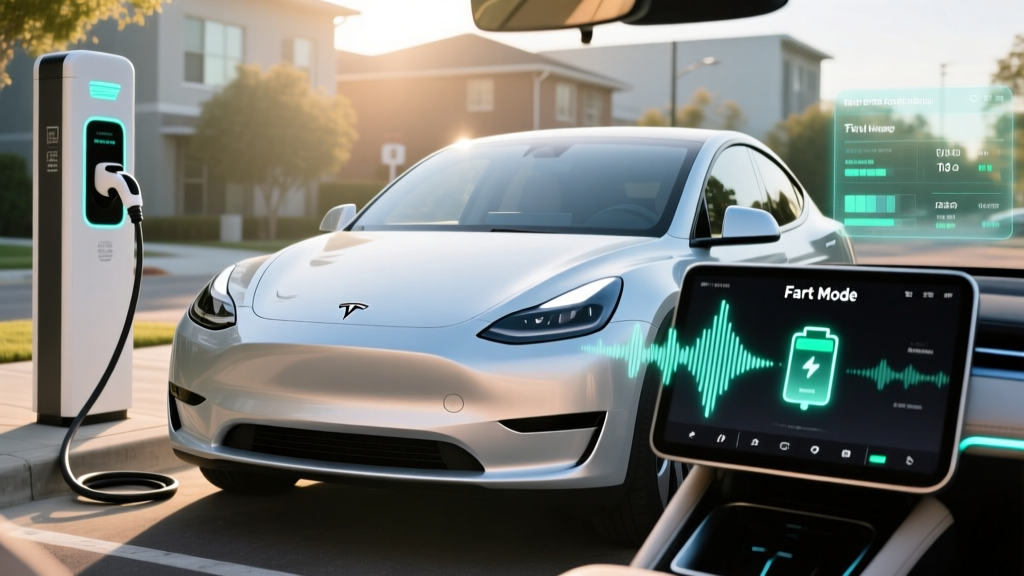
If you've ever seen a Tesla emit a comical sound from its exterior speaker and wondered what on earth is happening, you've witnessed Tesla Fart Mode — one of the most searched, shared, and frankly bizarre features in the EV world. It's a novelty function, sure, but the fact that thousands of shoppers search for it monthly says something about Tesla's cultural footprint. So let's get the giggles out of the way, then do what actually matters: evaluate the vehicle behind the whoopee cushion.
This review covers the 2026 Tesla Model Y (the refreshed "Juniper" generation introduced for the 2025 model year), examining its real-world range, charging speed, pricing after federal tax credits, and whether it still earns its spot as America's best-selling EV.
What Is Tesla Fart Mode, Exactly?
Tesla Fart Mode is part of the vehicle's Toybox / Boombox feature suite. Using the exterior pedestrian-warning speaker (mandated on all EVs for low-speed operation), the car plays a variety of fart sounds on command. You can trigger it via the touchscreen or, in some configurations, by pressing a steering-wheel button while the car is in Park or moving at low speed.
It's harmless fun — a cultural hallmark of Tesla ownership — but it also highlights something important: Tesla's over-the-air (OTA) update ecosystem. Features like Fart Mode, light shows, and Sentry Mode arrive as software updates, making the car functionally newer over time. No other automaker leans this hard into software-defined personality.
Now, let's talk about the machine underneath the memes.
2026 Tesla Model Y: Quick Spec Overview
| Spec | Long Range RWD | Long Range AWD | Performance |
|---|---|---|---|
| EPA Range | 320 mi | 296 mi | 285 mi |
| Battery (usable) | ~75 kWh (NMC) | ~75 kWh (NMC) | ~75 kWh (NMC) |
| Drivetrain | Rear-Wheel Drive | Dual-Motor AWD | Dual-Motor AWD |
| Horsepower | 346 hp | 384 hp | 456 hp |
| 0–60 mph | 5.4 sec | 4.6 sec | 3.5 sec |
| Max DC Fast Charge | 250 kW | 250 kW | 250 kW |
| 10–80% DCFC Time | ~25 min | ~25 min | ~25 min |
| Level 2 Home Charge | 11.5 kW (~44 mi/hr) | 11.5 kW (~44 mi/hr) | 11.5 kW (~44 mi/hr) |
| MPGe (combined) | 111 MPGe | 105 MPGe | 102 MPGe |
| Efficiency | 30 kWh/100 mi | 32 kWh/100 mi | 33 kWh/100 mi |
| Cargo (rear seats up) | 30.2 cu ft | 30.2 cu ft | 30.2 cu ft |
| Cargo (rear seats folded) | 72.0 cu ft | 72.0 cu ft | 72.0 cu ft |
| Base MSRP | $44,990 | $47,990 | $53,990 |
Source: fueleconomy.gov and Tesla.com. Specs reflect 2025/2026 model year Juniper refresh.
Real-World Range vs. the EPA Sticker
Real-World Expectation: 260–290 miles highway in mild weather; 220–250 miles highway in freezing temps (below 32°F). City/regenerative driving can push closer to or slightly above EPA in warm conditions.
The EPA range figure assumes a mix of city and highway driving at moderate temperatures. In our experience and consistent with independent testing, sustained 75+ mph highway driving reduces range by roughly 10–15%. Cold weather compounds this: LFP batteries suffer more, but the Model Y's NMC pack still loses 15–25% in sub-freezing conditions without preconditioning.
The Juniper refresh improved thermal management with a more efficient heat pump, which helps cabin energy draw in winter. Preconditioning the battery before fast charging (automatic when a Supercharger is set as your navigation destination) also reduces cold-weather charging penalties. If you're a cold-climate buyer in Minnesota or Maine, budget for ~230 miles of usable winter highway range on the AWD variant.
Charging Speed: Supercharger Network Advantage
The 2026 Model Y peaks at 250 kW on DC fast charging via V3/V4 Tesla Superchargers. A 10–80% session takes approximately 25 minutes under optimal conditions (warm battery, low state of charge). The charging curve tapers significantly above 80%, as is standard for NMC chemistry — a 10–100% session will take closer to 45–50 minutes.
At home on a Level 2 (240V) connection, the onboard charger accepts up to 11.5 kW, adding roughly 44 miles of range per hour. A full overnight charge from 20% to 80% takes about 4 hours on a 48-amp circuit.
With the NACS connector now adopted industry-wide, the Model Y also has growing access to non-Tesla networks equipped with NACS plugs (Electrify America, EVgo), plus legacy CCS stations via adapter. However, the Tesla Supercharger network remains the gold standard for reliability and plug-and-charge simplicity — a genuine ownership advantage that competitors are still chasing.
| Charging Level | Power | Rate | Notes |
|---|---|---|---|
| Level 1 (120V household) | ~1.4 kW | ~5 mi/hr | Emergency/trickle only |
| Level 2 (240V home/public) | 11.5 kW max | ~44 mi/hr | Overnight sweet spot |
| DC Fast (Supercharger V3/V4) | 250 kW peak | 10–80% in ~25 min | Tapers above 80% |
Pricing, Trims, and Federal Tax Credit Eligibility
The 2026 Model Y lineup starts at $44,990 for the Long Range RWD. The dual-motor Long Range AWD adds $3,000 at $47,990, and the Performance variant tops out at $53,990 (all prices before destination fees of ~$1,390).
Tesla's pricing has stabilized after years of volatility, but the key question for buyers remains: does the Model Y qualify for the $7,500 federal EV tax credit under IRS §30D?
| Trim | MSRP | Est. Federal Credit | Effective Price |
|---|---|---|---|
| Long Range RWD | $44,990 | Up to $7,500* | ~$37,490* |
| Long Range AWD | $47,990 | Up to $7,500* | ~$40,490* |
| Performance AWD | $53,990 | Up to $7,500* | ~$46,490* |
*Eligibility depends on buyer income, battery critical-mineral sourcing, and MSRP caps. See IRS §30D rules. The Model Y qualifies as an SUV under the $80,000 MSRP cap. As of 2026, point-of-sale transfer is available, letting you apply the credit at purchase rather than waiting for tax filing.
Key eligibility requirements for §30D:
- Income caps: Modified AGI ≤ $150,000 (single), $225,000 (head of household), $300,000 (joint).
- MSRP cap: ≤ $80,000 for SUVs/vans/pickups (Model Y qualifies).
- Battery sourcing: Critical minerals and battery components must meet escalating North American/free-trade-partner thresholds. Tesla's domestic battery production (Nevada, Texas) has largely kept the Model Y eligible, but always verify at the point of sale — rules tighten annually.
Performance, Ride, and Interior
The Juniper refresh brought meaningful improvements to the Model Y's driving dynamics. The suspension tuning is noticeably more compliant than the pre-2025 model, absorbing highway imperfections without the crashy ride that plagued earlier versions. Road noise has been reduced through additional acoustic glass and insulation.
The Performance trim's 3.5-second 0–60 time is genuinely rapid, but the Long Range AWD at 4.6 seconds is more than adequate for daily merging and passing. All trims offer one-pedal driving via strong regenerative braking, though Tesla removed the adjustable regen setting — it's now fixed at maximum, which some drivers love and others find abrupt.
Inside, the minimalist cabin is defined by the 15.4-inch center touchscreen. The Juniper update added ambient lighting, ventilated front seats, a rear-seat touchscreen for climate/entertainment, and power-folding second-row seats. Cargo space is generous at 30.2 cu ft behind the second row and 72.0 cu ft folded — competitive with midsize gas SUVs. The front trunk (frunk) adds useful small-item storage.
Legroom is adequate for adults in the rear (40.5 inches front / 37.2 inches rear), though the sloping roofline limits headroom for taller passengers compared to boxier competitors like the Hyundai Ioniq 5 or Kia EV6.
Driver Assistance: Autopilot and FSD (Supervised)
Tesla's Autopilot (standard) provides adaptive cruise control and lane centering that performs well on highways. FSD (Supervised), available as an $8,000 add-on or $99/month subscription, extends capability to city streets, stop signs, and traffic lights. FSD has improved substantially but still requires active supervision — expect occasional phantom braking, hesitation at complex intersections, and lane-change decisions that demand override.
Competing Level 2 systems like Ford BlueCruise and GM Super Cruise offer comparable or better hands-free highway driving on pre-mapped roads, though Tesla's camera-only approach covers more road types without HD map dependency.
Pros and Cons
Pros
- Supercharger network: most reliable DC fast-charging ecosystem in North America
- OTA updates continuously add features (Toybox, Fart Mode, security, efficiency tweaks)
- Class-leading efficiency (~30 kWh/100 mi on RWD) reduces charging cost per mile
- Strong cargo capacity (72 cu ft) and practical SUV form factor
- Federal tax credit eligible (verify sourcing requirements at purchase)
- Juniper refresh fixed ride quality and noise issues from prior generation
Cons
- Camera-only vision system: no radar/lidar redundancy; poor visibility conditions challenge Autopilot
- 250 kW peak DC charge rate trails 800V competitors (Hyundai Ioniq 5 at 350 kW)
- No Apple CarPlay or Android Auto — Tesla's proprietary infotainment only
- Rear headroom compromised by coupe-like roofline
- FSD is expensive and still requires full driver supervision
- Service center wait times remain long in many metro areas
How It Stacks Up Against Competitors
The Model Y's closest rivals in 2026 are the Hyundai Ioniq 5, Kia EV6, and Ford Mustang Mach-E. The Ioniq 5 and EV6 charge faster (up to 350 kW on 800V architecture, 10–80% in ~18 minutes) and offer CarPlay. The Mach-E provides a more traditional driving feel and strong BlueCruise hands-free capability.
Where the Model Y still wins: Supercharger access, software ecosystem, resale value retention, and efficiency. If your road-trip routes are well-covered by Superchargers and you value OTA feature updates, the Tesla ownership experience remains difficult to replicate. If you prioritize the fastest possible DC charging, a more conventional interior, or Android Auto/CarPlay, the Korean platforms have a legitimate edge.
Who Should Buy the 2026 Tesla Model Y?
- You road-trip frequently and want the most reliable fast-charging network
- You value software updates, novelty features (yes, including Fart Mode), and tech-forward ownership
- You need SUV cargo space with strong efficiency (~30 kWh/100 mi)
- You can charge at home and want a competitive price after the $7,500 credit
- You need the absolute fastest DC charging (consider Ioniq 5/EV6 at 350 kW)
- You require Apple CarPlay/Android Auto
- You want hands-free highway driving on mapped routes (BlueCruise/Super Cruise are more polished for this specific use case)
- You regularly carry tall rear-seat passengers who need maximum headroom
Frequently Asked Questions
What is Tesla Fart Mode and how do I activate it?
Fart Mode is a novelty feature in Tesla's Toybox menu that plays sound effects through the exterior pedestrian-warning speaker. Activate it from the touchscreen Toybox menu or assign it to a steering-wheel shortcut. It works in Park and at low speeds.
What is the real-world range of the 2026 Tesla Model Y?
The EPA rates the Long Range RWD at 320 miles and the AWD at 296 miles. In real-world highway driving at 75 mph in mild weather, expect 260–290 miles. In freezing temperatures, that drops to 220–250 miles without preconditioning.
How fast does the Model Y charge at home and on the road?
On DC fast charging (Supercharger), it peaks at 250 kW with a 10–80% time of approximately 25 minutes. At home on Level 2 (240V, 48A), it charges at 11.5 kW, adding about 44 miles per hour — a full overnight session easily covers daily needs.
Does the 2026 Tesla Model Y qualify for the $7,500 federal tax credit?
Yes, the Model Y is generally eligible under IRS §30D as an SUV under the $80,000 MSRP cap. However, eligibility depends on your income (≤$150K single / ≤$300K joint), battery critical-mineral sourcing compliance, and point-of-sale verification. Always confirm with your tax professional and at the dealership. See IRS guidance.
Is the Model Y worth buying over the Hyundai Ioniq 5 or Ford Mach-E?
The Model Y wins on Supercharger network reliability, software ecosystem, and per-mile efficiency. The Ioniq 5 charges significantly faster (350 kW capable) and has CarPlay. The Mach-E offers polished hands-free driving via BlueCruise. Your priority — charging speed vs. network reliability vs. infotainment preference — should drive the decision.
What is the battery warranty on the 2026 Model Y?
Tesla covers the battery and drive unit for 8 years or 120,000 miles (Long Range/Performance), whichever comes first, with a minimum 70% capacity retention threshold. This is competitive with industry norms (Hyundai offers 10yr/100,000 mi).
Is Tesla's Full Self-Driving actually self-driving?
No. FSD (Supervised) is an SAE Level 2 driver-assistance system. You must keep your hands on the wheel, monitor the road, and be ready to intervene at any moment. It is not autonomous driving. Only Level 4 services like Waymo operate without a driver.
Sources: EPA / fueleconomy.gov, Tesla Model Y specifications, IRS §30D Clean Vehicle Credit.