If you've been searching for how to make my Tesla fart, you've landed on the right guide — but we're also going to give you something most novelty-focused articles skip: a complete, data-driven ownership profile of the vehicles behind the whoopee cushion. Tesla's fart mode is one of the brand's most famous Easter eggs, and it's available on every current Model 3, Model Y, Model S, and Model X. Below, we'll walk you through exactly how to trigger it, then dive deep into the specs that actually matter for your purchase decision.
How to Make Your Tesla Fart: Step-by-Step
Tesla's fart sounds are built into the vehicle's Toybox menu, which uses the external pedestrian warning speaker (Boombox) or the cabin speakers to play novelty audio. Here's how to access it on any Tesla running software version 2025.44 or later:
- Tap the car icon on the bottom-left of your touchscreen to open Controls.
- Scroll down and select Toybox.
- Tap Boombox (for external speaker playback) or browse the sound library.
- Select Fart — you'll see several variations including "Close Range," "Long Range," and the fan-favorite "Emissions Test."
- Choose your trigger: play manually from the screen, or set it to activate via the key fob, phone key, or when turn signals are engaged (yes, really).
2026 Tesla Model 3: Real Specs Behind the Easter Eggs
The fart mode gets laughs, but the 2026 Tesla Model 3 is a serious EV. Let's look at what you're actually buying. The current Model 3 comes in three primary trims: Long Range RWD, Long Range AWD, and Performance AWD. The base Standard Range RWD was discontinued for the 2025 model year, consolidating the lineup around the larger battery pack.
| Spec | Long Range RWD | Long Range AWD | Performance AWD |
|---|---|---|---|
| EPA Range | 363 mi | 341 mi | 315 mi |
| Battery (usable) | ~79 kWh (NMC) | ~79 kWh (NMC) | ~79 kWh (NMC) |
| Drivetrain | Rear-Wheel Drive | Dual-Motor AWD | Dual-Motor AWD |
| Horsepower | 271 hp | 346 hp | 510 hp |
| 0–60 mph | 5.8 sec | 4.2 sec | 2.9 sec |
| MPGe (combined) | 132 MPGe | 125 MPGe | 115 MPGe |
| Energy Consumption | 25 kWh/100mi | 27 kWh/100mi | 29 kWh/100mi |
| Peak DC Charge Rate | 250 kW | 250 kW | 250 kW |
| 10–80% DCFC Time | ~25 min | ~25 min | ~25 min |
| Level 2 Charge Rate | 11.5 kW (~44 mi/hr) | 11.5 kW (~44 mi/hr) | 11.5 kW (~44 mi/hr) |
| Cargo Volume | 23 cu ft (rear) + 3.1 cu ft (frunk) | 23 cu ft + 3.1 cu ft | 23 cu ft + 3.1 cu ft |
| Rear Legroom | 35.2 in | 35.2 in | 35.2 in |
| Base MSRP | $44,130 | $47,130 | $54,630 |
2026 Tesla Model Y: The Family Hauler That Farts
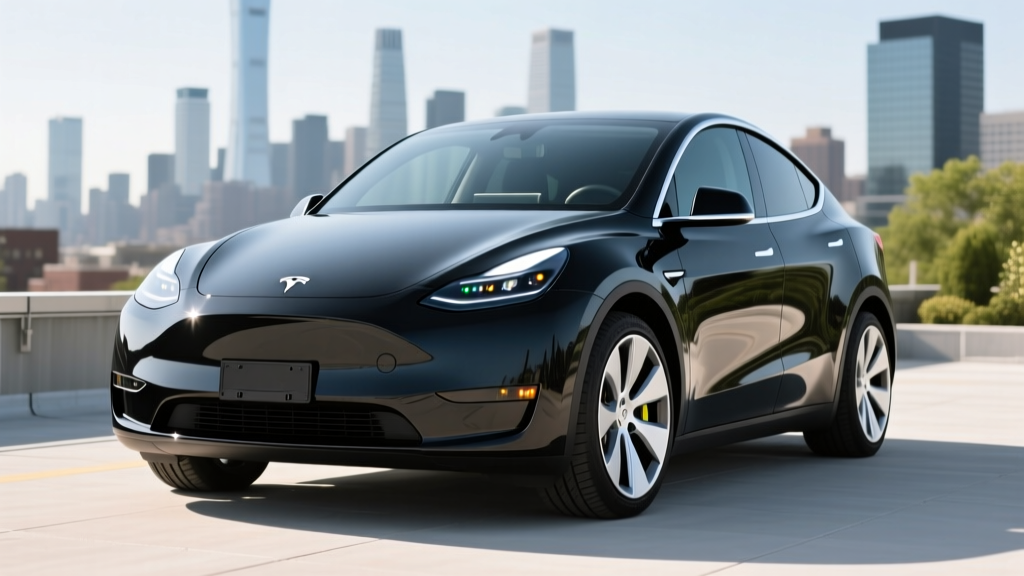
If you need more space but still want Boombox fart capability, the 2026 Tesla Model Y (refreshed for the 2025 model year with updated styling and interior) is the best-selling EV in the United States for good reason. Here's how the refreshed Juniper-generation Model Y stacks up:
| Spec | Long Range RWD | Long Range AWD | Performance AWD |
|---|---|---|---|
| EPA Range | 340 mi | 320 mi | 295 mi |
| Battery (usable) | ~79 kWh (NMC) | ~79 kWh (NMC) | ~79 kWh (NMC) |
| Drivetrain | Rear-Wheel Drive | Dual-Motor AWD | Dual-Motor AWD |
| Horsepower | 295 hp | 384 hp | 510 hp |
| 0–60 mph | 5.8 sec | 4.6 sec | 3.3 sec |
| MPGe (combined) | 123 MPGe | 117 MPGe | 111 MPGe |
| Peak DC Charge Rate | 250 kW | 250 kW | 250 kW |
| 10–80% DCFC Time | ~27 min | ~27 min | ~27 min |
| Level 2 Charge Rate | 11.5 kW (~40 mi/hr) | 11.5 kW (~40 mi/hr) | 11.5 kW (~40 mi/hr) |
| Cargo Volume | 34 cu ft (rear) + 4.1 cu ft (frunk) | 34 cu ft + 4.1 cu ft | 34 cu ft + 4.1 cu ft |
| Rear Legroom | 38.9 in | 38.9 in | 38.9 in |
| Base MSRP | $46,630 | $49,630 | $55,630 |
The Model Y's crossover body gives it a meaningful cargo and rear-seat advantage over the Model 3 — that 34 cu ft rear cargo area (72 cu ft with seats folded) easily swallows strollers, camping gear, or a week's worth of groceries. The frunk adds another 4.1 cu ft for charging cables or a soft-sided cooler.
Charging Speed: What the Numbers Actually Mean
Both the Model 3 and Model Y use Tesla's proven NMC (nickel manganese cobalt) battery chemistry with approximately 79 kWh of usable capacity. Here's what your charging experience looks like in practice:
| Charging Level | Power | Miles Added per Hour | Typical Use Case |
|---|---|---|---|
| Level 1 (120V outlet) | ~1.4 kW | ~5 mi/hr | Emergency / overnight trickle |
| Level 2 (240V home) | 11.5 kW | 40–44 mi/hr | Daily home charging |
| DC Fast (Tesla Supercharger V3) | Up to 250 kW peak | ~1,000 mi/hr (peak) | Road trips |
| DC Fast (CCS adapter + third-party) | Up to 150–250 kW | Varies by station | Non-Tesla networks |
Charging curve reality check: The 250 kW peak rate is only sustained from roughly 10–30% State of Charge. Above 50%, the rate tapers to approximately 120 kW, and above 80%, it drops further to around 50–60 kW as the battery management system protects cell longevity. A 10–80% session takes approximately 25–27 minutes at a V3 Supercharger, but plan for 35–40 minutes if you need to charge to 90% or higher. Always enable navigation to a Supercharger to trigger battery preconditioning — this warms the battery to optimal charging temperature and can shave 5–10 minutes off your session, especially in cold weather.
Tax Credits, Pricing, and What You'll Actually Pay
Tesla's pricing has shifted multiple times, so here's where things stand for the 2026 model year. The critical question is whether you qualify for the federal §30D clean vehicle tax credit, which can reduce your effective cost by up to $7,500 — now available as a point-of-sale transfer to the dealer, meaning you don't have to wait until tax filing to benefit.
| Model / Trim | Base MSRP | Est. After §30D Credit | Credit Eligibility |
|---|---|---|---|
| Model 3 Long Range RWD | $44,130 | ~$36,630 | Eligible (subject to sourcing rules) |
| Model 3 Long Range AWD | $47,130 | ~$39,630 | Eligible (subject to sourcing rules) |
| Model 3 Performance | $54,630 | ~$47,130 | Eligible (under $55K sedan cap) |
| Model Y Long Range RWD | $46,630 | ~$39,130 | Eligible (under $80K SUV cap) |
| Model Y Long Range AWD | $49,630 | ~$42,130 | Eligible (under $80K SUV cap) |
| Model Y Performance | $55,630 | ~$48,130 | Eligible (under $80K SUV cap) |
Critical eligibility caveats: The §30D credit has three requirements that can disqualify buyers:
- Income caps: Modified AGI must not exceed $300,000 (joint filers), $225,000 (head of household), or $150,000 (single). Check IRS guidelines for current-year thresholds.
- MSRP caps: Sedans (Model 3) must be under $55,000; SUVs/trucks (Model Y) under $80,000. All current trims qualify.
- Battery sourcing: A portion of the credit ($3,750) depends on critical minerals sourcing, and the other $3,750 on battery component manufacturing. Tesla's US-built battery packs have historically met these requirements, but the rules tighten annually. Verify current eligibility on Tesla's website at purchase time, as supply-chain changes can affect qualification mid-year.
Standout Tech and Notable Drawbacks
✅ Pros
- Class-leading Supercharger network access (20,000+ stations in North America)
- Over-the-air updates add features continuously (including new Toybox sounds)
- Top safety ratings from NHTSA (5-star overall) and IIHS Top Safety Pick+
- Excellent energy efficiency (25 kWh/100mi on LR RWD) keeps charging costs low
- 15.4" touchscreen with fast response, native streaming, and gaming
- Autopilot standard; FSD (Supervised) available as add-on
- Low center of gravity and instant torque deliver engaging driving dynamics
❌ Cons
- No Apple CarPlay or Android Auto — Tesla's ecosystem only
- Turn-signal stalks removed on refreshed Model 3/Y (steering-wheel buttons instead)
- Rear visibility in Model 3 is tight; no rear wiper on Model 3
- FSD (Supervised) remains SAE Level 2 — driver must stay fully engaged
- Insurance premiums run 15–30% higher than comparable ICE sedans
- Build quality improving but panel-gap variability still noted by some owners
- No physical buttons for climate, glovebox, or mirrors — all screen-controlled
On the tech side, Tesla's infotainment is the benchmark for responsiveness and feature depth. The 15.4-inch touchscreen handles navigation, media, climate, vehicle settings, and the Toybox (where your fart sounds live) with zero lag. Over-the-air updates mean your car can gain new features months or years after purchase — Tesla has added new Boombox sounds, light shows, and even Sentry Mode improvements via OTA.
Regarding driver assistance: Autopilot (standard) provides adaptive cruise control and lane centering on highways. Full Self-Driving (Supervised), a $8,000 add-on or $99/month subscription, adds automatic lane changes, traffic light recognition, and city-street navigation. However, FSD is firmly SAE Level 2 — you must keep your hands on the wheel and eyes on the road at all times. This is not autonomous driving. Tesla's camera-only vision system is capable but can struggle in heavy rain, construction zones, and faded lane markings.
Warranty and Long-Term Battery Outlook
Tesla provides a straightforward warranty package:
- Basic vehicle: 4 years / 50,000 miles
- Battery and drive unit: 8 years / 120,000 miles (Long Range & Performance) with a minimum 70% capacity retention guarantee
The NMC battery chemistry in the Model 3 and Model Y has a well-documented track record. Based on fleet data, Tesla's NMC packs typically lose 8–12% capacity over the first 100,000 miles, with degradation slowing significantly after the initial break-in period. To maximize longevity, Tesla recommends daily charging to 80% for NMC packs and only charging to 100% when you need maximum range for a trip. This differs from LFP (lithium iron phosphate) packs, which Tesla recommends charging to 100% regularly — but LFP is currently only used in the Standard Range Model 3 (not available for 2026 in the US market).
Who Should Buy the Tesla Model 3 or Model Y?
Decision Framework
Choose the Model 3 if: You're a commuter or couple who prioritizes range and efficiency over cargo space. The Long Range RWD at 363 miles EPA and 132 MPGe is one of the most efficient long-range EVs you can buy. It's ideal for drivers who mostly carry one or two passengers and want the lowest per-mile charging cost.
Choose the Model Y if: You have a family, need cargo versatility, or regularly carry rear-seat passengers. The additional 3.7 inches of rear legroom and 11 extra cubic feet of cargo space make a substantial daily difference. The higher ride height also makes car-seat installation easier.
Look elsewhere if: You need Apple CarPlay, prefer physical buttons and stalks, want a ride quality closer to luxury sedans (consider the BMW i4 or Mercedes EQB), or need a truck bed (look at the Cybertruck or Rivian R1T).
Frequently Asked Questions
How do I make my Tesla fart when I walk away from it?
In Toybox → Boombox, you can assign fart sounds to the lock/unlock action on your phone key or key fob. When enabled, the car will play the selected sound through the external speaker when you lock or unlock the vehicle — perfect for startling friends in a parking lot.
Does the Tesla fart mode work while driving?
The Boombox external speaker feature is restricted at higher speeds in many regions for safety reasons. Above approximately 5 mph, external audio playback may be disabled depending on your local regulations. Internal cabin speakers can play sounds at any speed, but the external "fart" that bystanders hear requires the car to be stationary or moving very slowly.
What is the real-world range of the 2026 Tesla Model 3 Long Range?
The EPA rates it at 363 miles. In real-world mixed driving, expect 310–340 miles. On sustained highway trips at 75 mph, plan for approximately 280–310 miles before needing to charge. In freezing weather (below 32°F), range can drop to 240–270 miles due to battery resistance and cabin heating demands. Preconditioning the battery and using seat heaters instead of cabin heat can recover some of this loss.
How fast does the Model 3 charge at home?
On a 240V Level 2 home charger (such as the Tesla Wall Connector on a 60-amp circuit), the Model 3 charges at up to 11.5 kW, adding approximately 44 miles of range per hour. A full charge from 10% to 90% takes roughly 7–8 hours — easily accomplished overnight. Most owners plug in each evening and wake up to a full battery every morning, making public charging irrelevant for daily driving.
Does the 2026 Tesla Model Y qualify for the $7,500 federal tax credit?
Yes, all Model Y trims qualify under the §30D credit rules, provided you meet the income caps ($300K joint / $150K single) and the vehicle's battery sourcing meets current-year critical mineral and component requirements. The Model Y is classified as an SUV, so the MSRP cap is $80,000 — well above even the Performance trim's $55,630 base price. The credit can be transferred to Tesla at point of sale, reducing your purchase price directly. Always verify current sourcing eligibility on IRS.gov before purchasing, as rules update periodically.
Is a Tesla still worth buying versus the Hyundai Ioniq 6 or BMW i4?
The Tesla's advantages are the Supercharger network, OTA updates, efficiency, and the lowest cost-per-mile in its class. The Hyundai Ioniq 6 (360 mi range, 800V architecture for faster charging) and BMW i4 (superior ride quality, CarPlay, physical controls) are strong alternatives. If Supercharger access matters to you for road trips — and it still does in many regions — Tesla retains a practical edge. If you value interior refinement and traditional controls, test-drive the i4 before committing.