Quick Answer: Can Electric Cars Use HOV Lanes?
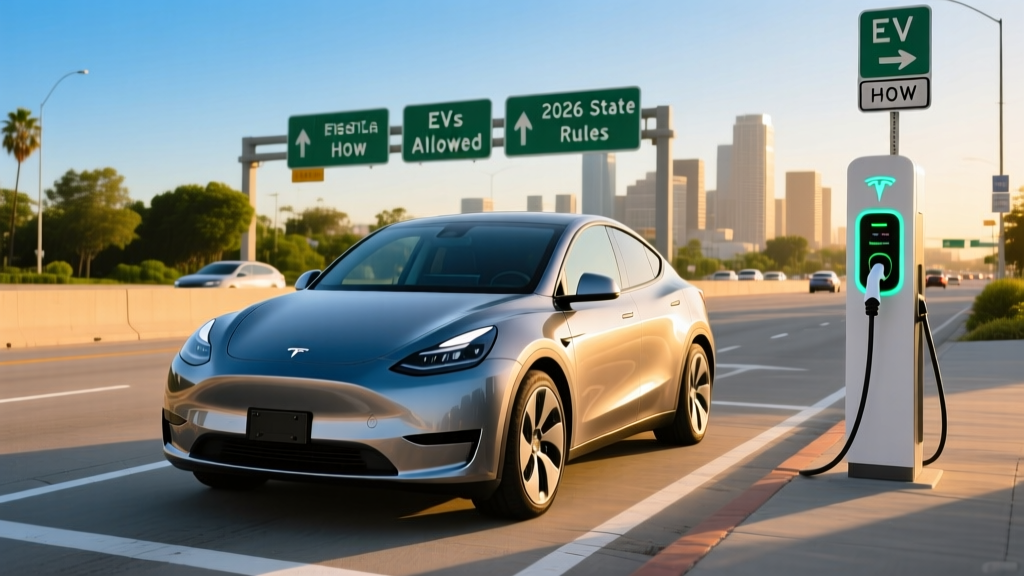
Yes — but only in certain states, and only with a special decal or plate. As of 2026, states including California, Colorado, Florida, Georgia, Maryland, Minnesota, New York, Utah, and Virginia allow qualifying electric vehicles (BEVs and some PHEVs) to use High-Occupancy Vehicle (HOV) or carpool lanes with a single occupant. However, the rules vary dramatically: some states offer free unlimited access, others cap decals or have waitlists, and several states have phased out the perk entirely as EV adoption has grown. You must apply for a state-issued clean-air decal — simply owning an EV does not automatically grant HOV lane access.
How EV HOV Lane Access Works: State by State
HOV lane access for solo-driving EVs is a state-level incentive, not a federal one. The U.S. Department of Energy's AFDC database tracks these perks, and the landscape has shifted significantly as EV adoption has surged past 10% of new-car sales nationally.
Here's where things stand in 2026 for the most commuter-relevant states:
| State | Eligible Vehicles | Decal Cost | Duration | Notes |
|---|---|---|---|---|
| California | BEVs, FCVs, qualifying PHEVs (>50 mi EV range) | $22 application | Through 9/30/2029 (for decals issued by 1/1/2025) | DMV issues CAV decals; must display on vehicle. Income-based phase-out was proposed but not enacted as of 2026. |
| Colorado | BEVs, FCVs | Free (special plate) | Ongoing while owned | Requires HOV Express Vehicle decal from CDOT. PHEVs no longer qualify as of 2024. |
| Florida | BEVs only | Free (special decal) | Ongoing | Available through FDOT; decal must be displayed on rear bumper. |
| Georgia | BEVs, qualifying PHEVs | $15 decal | Annual renewal | Alternative Fuel Vehicle plate required; PHEV must meet minimum EV range threshold. |
| Maryland | BEVs, FCVs | Free (special plate) | Ongoing | HOV permit through MVA; I-270 and I-95 express lanes. |
| Minnesota | BEVs | Free decal | Ongoing | MnPASS program; applies to MnPASS lanes only. |
| New York | BEVs | Free (HOV sticker) | Ongoing | Thruway and select HOV lanes; DMV application required. |
| Utah | BEVs, PHEVs, FCVs | Free decal | Limited decals issued annually; waitlist possible | Decal cap reached in prior years; check UDOT for current availability. |
| Virginia | BEVs, qualifying PHEVs | Free (special plate) | Ongoing | HOV-privileged plates through DMV; I-95/I-395/I-66 express lanes. |
Critical caveat: Several states that previously offered HOV access — including Arizona, New Jersey, and Tennessee — have sunset or restricted these programs as EV adoption grew. Always verify current rules with your state DMV or DOT before purchasing an EV primarily for the HOV perk.
The Real Dollar Value of HOV Lane Access
For commuters in congested metro areas, HOV lane access isn't just a convenience — it's a measurable financial benefit that can rival or exceed the federal tax credit in practical value.
Consider a typical commuter in the Los Angeles basin driving 30 miles each way on the I-10 or I-405:
| Factor | Gas Car (No HOV) | EV (With HOV Access) |
|---|---|---|
| Daily commute time (60 mi round trip) | 95 minutes | 58 minutes |
| Time saved per year (240 workdays) | — | ~148 hours |
| Value of time saved (@ $25/hr) | — | $3,700/year |
| Annual fuel/energy cost (60 mi/day × 240 days) | $3,456 (28 MPG @ $4.50/gal) | $1,152 (3.5 mi/kWh @ $0.22/kWh home charging) |
| Annual fuel savings | — | $2,304 |
| Combined annual benefit (time + fuel) | — | ~$6,004 |
Over a 5-year ownership period, the HOV lane time savings plus reduced energy cost can total $30,000+ in effective value — a figure that dwarfs the one-time $7,500 federal credit. Of course, this only applies if your commute actually uses an HOV-equipped corridor and the lane is meaningfully faster than general-purpose lanes during your travel hours.
EV vs Gas vs Hybrid: Which Gets HOV Access?
Not every electrified vehicle qualifies. Here's how the major powertrain types compare for HOV lane eligibility:
| Powertrain | Example Models (2026) | HOV Eligible? | EPA Range / MPG | Federal §30D Credit |
|---|---|---|---|---|
| BEV (Battery Electric) | Tesla Model 3, Hyundai Ioniq 5, Chevy Equinox EV | ✅ Yes (most states with HOV programs) | 250–363 mi range | Up to $7,500 (subject to MSRP, income, sourcing rules) |
| PHEV (Plug-in Hybrid) | Toyota RAV4 Prime, Jeep Wrangler 4xe | ⚠️ Limited — some states require ≥50 mi EV range | 25–42 mi EV + 38–94 MPGe | Up to $7,500 (varies by battery size & sourcing) |
| HEV (Standard Hybrid) | Toyota Prius, Honda Accord Hybrid | ❌ No — no longer qualifies in most states | 48–57 MPG combined | ❌ Not eligible |
| Gas (ICE) | Toyota Camry LE, Honda Civic | ❌ No | 28–36 MPG combined | ❌ Not eligible |
Key takeaway: Standard hybrids like the Prius lost HOV lane privileges in most states years ago as programs shifted to reward zero-tailpipe-emission vehicles. If HOV access is a primary motivation, a full BEV is the safest bet. PHEVs can qualify but require careful research — California's CAV decal, for example, requires at least 50 miles of EV-only range, which excludes some shorter-range PHEVs.
Total Ownership Cost: EV with HOV vs Gas Car
Let's run a realistic 5-year cost comparison for a commuter choosing between a popular BEV and a comparable gas sedan, factoring in HOV lane time value.
| Cost Factor (5 Years) | 2026 Tesla Model 3 RWD ($38,990 MSRP) | 2026 Toyota Camry LE ($29,495 MSRP) |
|---|---|---|
| Purchase price (after $7,500 §30D credit for Tesla) | $31,490 | $29,495 |
| Energy/fuel (14,400 mi/yr × 5 yrs) | $5,760 (home charging @ $0.22/kWh) | $17,280 (28 MPG @ $4.50/gal) |
| Maintenance (5 years) | $2,100 (tires, cabin filter, wiper fluid) | $5,400 (oil, brakes, filters, belts) |
| Insurance (5-year average) | $11,500 | $8,200 |
| HOV decal/application | $22 | $0 |
| Depreciation (est. 5-yr resale value loss) | $15,200 | $11,800 |
| Total 5-year cost | $66,072 | $72,175 |
| HOV time savings (148 hrs/yr × 5 yrs × $25/hr) | −$18,500 (value gained) | $0 |
| Effective 5-year cost (with time value) | $47,572 | $72,175 |
When you account for the time savings of HOV lane access, the EV's effective cost of ownership drops substantially below the gas alternative — even though the EV costs more for insurance and depreciates faster in absolute terms. This calculation is highly personal: if your commute doesn't involve a congested HOV corridor, the time-value benefit disappears and the cost gap narrows or reverses.
On the §30D federal tax credit: The Tesla Model 3 RWD qualifies for up to $7,500 under current IRS rules, but eligibility depends on your adjusted gross income (≤$150K single / ≤$300K joint), the vehicle's MSRP (≤$55K for sedans), and battery critical-mineral and component sourcing requirements. The credit can now be transferred to the dealer at point of sale as an immediate price reduction. Always verify current eligibility at IRS.gov or consult a tax professional.
Common Misconceptions About EVs and HOV Lanes
| Myth | Fact |
|---|---|
| "Any EV can drive in the carpool lane." | You must apply for and display a state-issued clean-air decal or special plate. Driving in the HOV lane without one is a ticketable offense — typically $350–$500 in fines. |
| "HOV access is permanent once you get it." | States set expiration dates. California's current CAV decals expire 9/30/2029 for those issued before 1/1/2025. Programs can be modified or sunset by legislation. |
| "Hybrids like the Prius still get HOV access." | Most states removed standard-hybrid HOV eligibility years ago. Only BEVs, FCVs, and some longer-range PHEVs currently qualify. |
| "The HOV lane is always faster." | In some metros (looking at you, I-405 in LA), HOV lanes can become congested during peak hours as more EVs gain access. Real-world time savings vary by corridor and time of day. |
| "I can use HOV lanes in any state with my EV." | HOV access is state-specific. A California CAV decal does not grant HOV access in Nevada or Arizona. Check each state's rules if you commute across state lines. |
What First-Time EV Buyers Should Know About HOV Perks
If HOV lane access is a significant factor in your EV purchase decision, build your strategy around these realities:
1. Apply for the decal immediately after purchase. Processing times vary from 2–6 weeks depending on the state. You cannot legally use the HOV lane solo while waiting for the decal — even if your vehicle qualifies.
2. Check whether your specific model qualifies. Not every EV sold in your state may meet the threshold. In California, for example, PHEVs must have at least 50 miles of EV-only range for CAV decal eligibility. Verify on your state DMV's eligible-vehicle list before signing a purchase agreement.
3. Factor in decal expiration and program risk. If you're buying an EV in 2026 and the decal expires in 2029, that's only 3 years of HOV access — not the full ownership period. States facing HOV lane congestion from too many EVs may tighten rules or introduce fees.
4. Home charging matters more than the HOV perk. The HOV lane saves you time, but the real daily EV ownership experience hinges on charging. If you can install a Level 2 home charger (240V, 32–48 amps, adding 25–40 miles of range per hour of charging), your EV becomes a "start every morning with a full battery" vehicle. Without home charging, public charging logistics add 30–60 minutes per week for most owners. A Level 2 home installation typically costs $800–$2,500 depending on panel capacity and wiring distance.
5. Cold weather still cuts range 20–35%. If you're in Minnesota or Colorado and relying on a 250-mile EPA-rated EV for a 100-mile round-trip commute, winter range loss can make that commute tight — especially with highway speeds and cabin heating. A heat pump (standard on the Hyundai Ioniq 5, Tesla Model 3, and others) mitigates this but doesn't eliminate it.
Decision Framework: Should You Buy an EV for HOV Lane Access?
Choose a BEV with HOV access if:
- Your daily commute uses a congested HOV-equipped corridor (I-405, I-95, I-270, I-80, etc.)
- You have access to home Level 2 charging (garage or driveway with 240V circuit capability)
- Your round-trip commute is under 70% of the vehicle's real-world range (accounting for winter and highway loss)
- You qualify for the §30D tax credit (check income caps and vehicle sourcing on IRS.gov)
- You plan to keep the vehicle through the decal's expiration period
Stick with a hybrid or gas car if:
- Your commute doesn't use an HOV-equipped highway, or the HOV lane isn't meaningfully faster
- You live in an apartment without charging access and public charging infrastructure is sparse in your area
- You frequently drive 300+ mile road trips through regions with limited DC fast-charging coverage
- Your state has sunset or capped its EV HOV program
- The HOV time savings don't justify the higher insurance premiums and upfront cost
Real-World EV Commuter Considerations Beyond the HOV Lane
HOV lane access is a compelling perk, but it's one variable in a larger ownership equation. Here are the factors that determine whether an EV actually works for your commute:
Charging speed matters for flexibility. A 2026 Hyundai Ioniq 5 with its 800V architecture peaks at 240 kW on a DC fast charger, going from 10–80% in roughly 18 minutes. A Chevy Equinox EV peaks at around 150 kW, taking 10–80% in about 30 minutes. If you occasionally need a midday top-up, the faster-charging vehicle gives you back more of your day — a relevant consideration when time savings is the whole point of HOV access.
Insurance costs are higher for EVs. Industry data shows EV insurance premiums run 15–30% higher than comparable gas vehicles due to higher repair costs and total-loss thresholds after battery damage. Budget an extra $500–$800/year for insurance when comparing ownership costs.
Maintenance is genuinely cheaper. No oil changes, no transmission fluid, no spark plugs, no timing belts. Brake pad life is dramatically extended thanks to regenerative braking. Expect to spend roughly $350–$500/year on EV maintenance (tire rotations, cabin air filter, wiper fluid) versus $800–$1,200/year for a gas sedan.
Battery longevity is less of a concern than most buyers fear. Modern LFP (lithium iron phosphate) batteries — used in the Tesla Model 3 RWD and some other affordable EVs — show less than 10% degradation after 200,000 miles in fleet data. NMC (nickel manganese cobalt) chemistries degrade slightly faster but still retain 85–90% capacity at 150,000 miles with normal use. Federal law mandates a minimum 8-year/100,000-mile battery warranty, and most manufacturers warrant against dropping below 70% state of health.
Frequently Asked Questions
Do I need a special decal to use the HOV lane in my EV?
Yes. In every state that offers EV HOV access, you must apply for and display a state-issued clean-air decal, special plate, or sticker. Simply driving an EV without the proper decal in the HOV lane is a traffic violation. Application processes are handled through your state DMV or DOT.
Can plug-in hybrids like the RAV4 Prime use HOV lanes?
It depends on the state and the vehicle's electric-only range. California requires at least 50 miles of EV range for CAV decal eligibility, which the RAV4 Prime (42 miles EPA EV range) does not meet. Colorado removed PHEV eligibility entirely in 2024. Check your state's specific qualifying-vehicle list.
What happens to my HOV access if I sell the EV?
HOV decals and plates are generally tied to the vehicle, not the owner. In California, CAV decals transfer with the car to the new owner, but the expiration date does not reset. In some states, you must surrender the plate or decal upon sale. Check your state's transfer rules.
Are HOV lanes getting too crowded with EVs?
In some metro areas, yes. California's I-405 and I-10 carpool lanes have seen measurable speed reductions during peak hours as EV adoption has increased. This is one reason some states have capped decal issuance or introduced sunset dates for the programs. The time-savings benefit is real but may erode over time in the most popular corridors.
Does HOV access work across state lines?
No. A California CAV decal does not grant HOV access in Nevada, Oregon, or any other state. Each state administers its own program independently. If you commute across state lines, you'll need to research HOV rules in each state you drive through.
Is HOV lane access worth buying an EV for?
For heavy commuters on congested HOV corridors, the time savings alone can be worth $3,000–$5,000 per year — making it one of the most valuable EV incentives available. But it should be one factor among many: home charging access, real-world range for your commute, total cost of ownership, and your state's program longevity all matter. Don't buy an EV solely for the HOV perk without running the full ownership math.