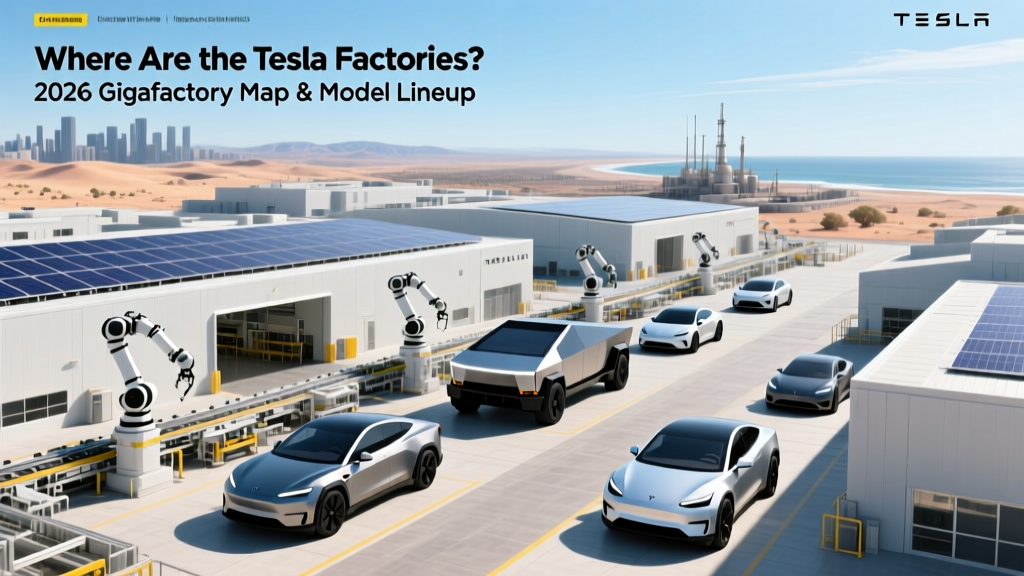
If you've ever wondered where are the Tesla factories that build the cars showing up in your driveway, the answer spans four continents and six major production sites as of early 2026. Tesla's global manufacturing footprint determines not only which models you can order, but also whether your vehicle qualifies for the federal EV tax credit under IRS §30D sourcing rules.
Below, we map every active Tesla Gigafactory, break down which models roll off each line, and deliver the full spec-and-price picture for Tesla's current U.S. lineup — including real-world range, charging curves, and credit eligibility.
The Global Tesla Factory Map in 2026
Tesla operates six primary vehicle and battery production facilities worldwide. Each plant specializes in specific models, and the location of manufacture can affect everything from delivery timelines to battery chemistry (LFP vs. NMC) installed in your car.
| Facility | Location | Models Produced | Battery/Notes |
|---|---|---|---|
| Gigafactory Texas | Austin, TX, USA | Model Y, Cybertruck | 4680 structural pack (NMC) |
| Gigafactory California | Fremont, CA, USA | Model S, Model X, Model 3, Model Y | Mixed 2170 & LFP packs |
| Gigafactory Nevada | Sparks, NV, USA | Battery cells, drive units, Semi | Cell & powertrain supply |
| Gigafactory Shanghai | Shanghai, China | Model 3, Model Y (export & domestic) | CATL LFP prismatic cells |
| Gigafactory Berlin | Grünheide, Germany | Model Y (European market) | 4680 & 2170 mixed supply |
| Gigafactory New York | Buffalo, NY, USA | Supercharger hardware, Solar Roof | No vehicle assembly |
For U.S. buyers, the plants that matter most are Fremont and Austin. Model 3 and Model Y variants ship from both, while the refreshed Model S and Model X remain Fremont-exclusive. Cybertruck is an Austin-only product. Understanding this helps explain why certain configurations have longer delivery windows and why battery chemistry can differ even within the same trim.
2026 Tesla Model 3: The Volume Sedan
The refreshed Model 3 (internally called "Highland" and further updated for the 2026 model year) remains Tesla's entry point and one of the most efficient EVs on the market. Built primarily at Fremont for North American deliveries, the Long Range AWD variant delivers exceptional range for its price class.
| EPA Range | 341 miles |
| Usable Battery | ~79 kWh (NMC 2170 cells) |
| Drivetrain | Dual-motor AWD |
| Horsepower | ~346 hp combined |
| 0–60 mph | 4.2 seconds |
| Peak DC Fast Charge | 250 kW (V3 Supercharger) |
| 10–80% DCFC Time | ~25 minutes |
| Level 2 Home Charge | 11.5 kW (~44 mi/hr) |
| Efficiency | 132 MPGe / 25 kWh/100mi |
| Cargo Volume | 23 cu ft (trunk + frunk) |
| Rear Legroom | 35.2 inches |
| Battery Warranty | 8 years / 120,000 miles (70% retention) |
| Base MSRP | $47,740 |
The Model 3's 250 kW peak charge rate is strong, but Tesla's V3 Supercharger curve tapers noticeably above 60% state of charge. In practice, you'll see 250 kW for roughly the first 10–15 minutes, then a step-down to ~150 kW, then further reduction above 80%. This is normal lithium-ion behavior but worth planning for on road trips — charge to 80% and go rather than waiting for a full top-off.
2026 Tesla Model Y: The Best-Selling EV
The Model Y is the world's best-selling vehicle (not just EV), and for 2026 the refreshed "Juniper" version is built at both Austin and Fremont for U.S. customers. It's the family crossover benchmark, balancing range, cargo, and access to the Supercharger network.
| EPA Range | 320 miles |
| Usable Battery | ~78 kWh (NMC/LFP depending on plant) |
| Drivetrain | Dual-motor AWD |
| Horsepower | ~384 hp combined |
| 0–60 mph | 4.8 seconds |
| Peak DC Fast Charge | 250 kW |
| 10–80% DCFC Time | ~27 minutes |
| Level 2 Home Charge | 11.5 kW (~37 mi/hr) |
| Efficiency | 122 MPGe / 28 kWh/100mi |
| Cargo Volume | 76 cu ft (rear seats folded) |
| Rear Legroom | 36.5 inches |
| Battery Warranty | 8 years / 120,000 miles (70% retention) |
| Base MSRP | $49,990 |
Austin-built Model Y vehicles increasingly use Tesla's 4680 structural battery pack, which offers slightly higher energy density but has shown a slower DC charge curve in some owner testing — peaking closer to 220–230 kW in real-world conditions versus the 250 kW nameplate. Fremont-built Juniper models tend to use proven 2170 cells. You generally cannot choose which factory your car comes from at order time, but delivery location often correlates with the nearest plant.
Model S, Model X, and Cybertruck: The Specialty Lineup
Tesla's flagship sedan and SUV (Model S and Model X) continue at Fremont. The Model S Long Range achieves an EPA-estimated 402 miles — still among the highest of any production EV. The Plaid tri-motor variants sacrifice roughly 50 miles of range for 1,020 hp and a 1.99-second 0–60 time, but at $89,990+ they serve a niche audience.
The Cybertruck, built exclusively at Giga Texas, is available in AWD ($79,990) and Cyberbeast ($99,990) trims for 2026. Its stainless-steel exoskeleton and 4680 battery pack make it a technology showcase, but its EPA range of ~325 miles (AWD) and ~225 kW peak charge rate place it behind the Model Y in efficiency. Towing capacity is rated at 11,000 lbs, though real-world towing cuts range roughly in half — a universal EV truck reality.
Federal Tax Credit Eligibility: What the Factory Location Means
Under the Inflation Reduction Act's IRS §30D rules, the federal EV tax credit provides up to $7,500 — but eligibility is complex and depends on battery sourcing, critical-mineral content, MSRP caps, and buyer income limits. Here's where Tesla's factory strategy matters:
- MSRP Caps: Sedans (Model 3) must be under $55,000; SUVs and trucks (Model Y, Cybertruck) must be under $80,000.
- Buyer Income Limits: Modified AGI cannot exceed $150,000 (single), $225,000 (head of household), or $300,000 (joint filing).
- Battery Sourcing: A percentage of critical minerals must be sourced from the U.S. or FTA-partner nations, and battery components must be manufactured or assembled in North America. Tesla's North American production and supply chain give it an advantage here.
- Point-of-Sale Transfer: As of 2024, buyers can transfer the credit to the dealer for an immediate price reduction rather than waiting for a tax refund.
| Model / Trim | Base MSRP | Under MSRP Cap? | Est. Credit | Effective Price* |
|---|---|---|---|---|
| Model 3 RWD | $40,240 | Yes ($55K sedan cap) | Up to $7,500 | ~$32,740 |
| Model 3 Long Range AWD | $47,740 | Yes | Up to $7,500 | ~$40,240 |
| Model Y Long Range AWD | $49,990 | Yes ($80K SUV cap) | Up to $7,500 | ~$42,490 |
| Model Y Performance | $53,990 | Yes | Up to $7,500 | ~$46,490 |
| Model S Long Range | $79,990 | No (exceeds $55K sedan) | $0 | $79,990 |
| Cybertruck AWD | $79,990 | Yes ($80K truck cap) | Up to $7,500 | ~$72,490 |
*Effective price assumes full $7,500 credit eligibility. Verify current sourcing requirements and income limits at fueleconomy.gov before purchase.
Because battery-sourcing and critical-mineral thresholds tighten each year under IRA rules, a vehicle that qualifies in January may see its credit reduced or eliminated later in the year. Tesla's vertical integration — building cells in Nevada and Texas, assembling packs domestically — positions it better than most automakers, but always confirm eligibility at purchase time.
Autopilot & FSD: What Level of Automation Are You Getting?
Every Tesla ships with Basic Autopilot, a Level 2 driver-assist system providing adaptive cruise control and lane centering on highways. The optional Full Self-Driving (Supervised) package, currently priced at $8,000 or $99/month, adds automated lane changes, traffic-light recognition, and a city-streets navigation mode.
FSD's capability has improved substantially through 2025–2026 neural-network updates, but it still makes errors in construction zones, unprotected left turns, and edge-case scenarios. Treat it as a fatigue-reducing assist, not a replacement for driving.
Pros, Cons, and Who Should Buy
Pros
- Access to the Supercharger network — the most reliable and widespread DC fast-charging system in North America, now open to other brands via NACS adoption.
- Class-leading efficiency (Model 3 achieves up to 140 MPGe on the RWD trim).
- Over-the-air updates continuously add features post-purchase.
- Strong tax-credit eligibility for Model 3 and Model Y thanks to domestic production.
- Resale values remain among the best in the EV segment, though they've softened since 2023 price cuts.
Cons
- Minimal physical controls — nearly everything routes through the central touchscreen, including climate, mirrors, and glovebox.
- Rear-seat comfort and visibility in Model 3 are tighter than competitors like the Hyundai Ioniq 6 or BMW i4.
- No Apple CarPlay or Android Auto — Tesla's proprietary infotainment is the only option.
- Build quality has improved but still shows occasional panel-gap and paint inconsistencies, especially from Fremont.
- Insurance premiums are 20–40% higher than comparable gas sedans due to repair costs.
Best for: Tech-forward commuters and families who want maximum range per dollar, reliable fast charging, and a minimalist cabin. The Model 3 suits single professionals and couples; the Model Y fits families needing cargo space and road-trip capability. The Cybertruck serves truck buyers who want EV performance and don't need maximum efficiency.
Look elsewhere if: You prefer traditional controls, need Apple CarPlay, want a luxury interior (consider BMW i5 or Mercedes EQE), or live in an area where Tesla service centers are sparse — rural coverage remains a gap.
Frequently Asked Questions
Where are Tesla cars made for the U.S. market?
U.S.-market Teslas come primarily from two plants: Gigafactory Texas (Austin) produces Model Y and Cybertruck, while Gigafactory California (Fremont) builds Model 3, Model Y, Model S, and Model X. Giga Nevada supplies battery cells and drive units. Some Model 3 and Model Y vehicles sold in other markets come from Shanghai or Berlin.
Does the factory location affect my Tesla's battery?
Yes. Austin-built Model Y vehicles increasingly use Tesla's in-house 4680 cells (NMC chemistry), while Fremont-built cars may use 2170 cells from Panasonic or LFP cells sourced from CATL. LFP batteries are heavier and offer slightly less range but tolerate daily 100% charging better and have longer cycle life. Your window sticker or Tesla app will show battery type.
How fast does a Tesla charge at home?
On a Level 2 home charger (48-amp circuit, 11.5 kW), a Model 3 Long Range gains roughly 44 miles of range per hour, meaning a full 10–100% charge takes about 8 hours — easily done overnight. A standard 120V outlet (Level 1) adds only ~3–4 miles per hour and is impractical as a primary charging method. Budget $500–$1,500 for a licensed electrician to install a 240V NEMA 14-50 outlet or hardwired Tesla Wall Connector.
Does the Tesla Model Y qualify for the $7,500 tax credit?
The Model Y Long Range and Performance (both under the $80,000 SUV cap) are generally eligible for up to $7,500 under IRS §30D, provided the buyer meets income limits ($300K joint / $150K single) and the vehicle's battery meets critical-mineral and component-sourcing thresholds. Because these thresholds tighten annually, always verify current eligibility at irs.gov or fueleconomy.gov before finalizing your order. The credit can be transferred at point of sale for an immediate price reduction.
Is a Tesla worth it vs. competitors in 2026?
The Model 3 and Model Y remain benchmark EVs for range, efficiency, and charging infrastructure. The Hyundai Ioniq 5 and Kia EV6 match or exceed Tesla's DC charge speed (up to 350 kW on 800V architecture) and offer more physical controls and Apple CarPlay. The Ford Mustang Mach-E provides a more traditional driving feel. However, no competitor yet matches Tesla's combination of Supercharger access, efficiency, software updates, and domestic tax-credit positioning. If the Supercharger network and software ecosystem matter to you, Tesla still leads. If you prioritize interior quality or charging speed, cross-shop the Korean alternatives.
What is Tesla's battery warranty?
Tesla covers the battery and drive unit for 8 years or 120,000 miles (whichever comes first) on Model 3 and Model Y Long Range, with a guaranteed minimum 70% capacity retention. Model S and Model X carry the same 8-year term at 150,000 miles. Out-of-warranty battery replacement costs range from $12,000 to $20,000 depending on pack size, though most Tesla batteries show only 5–10% degradation at 100,000 miles based on fleet data.