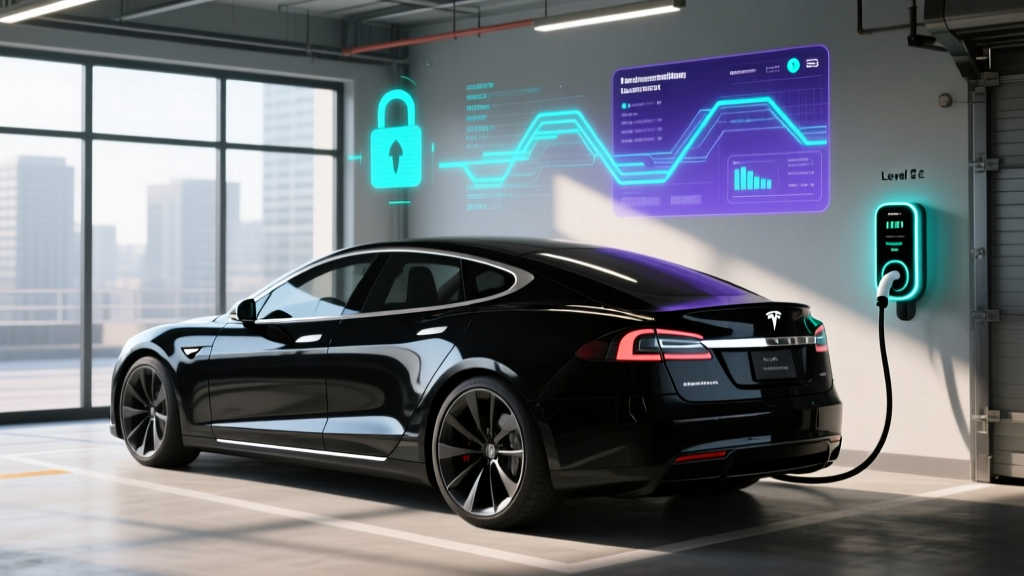
Understanding Tesla Energy Telemetry: What Owners Should Monitor
Tesla vehicles generate and transmit vast amounts of telemetry data — from battery state-of-health (SoH) and energy consumption patterns to GPS location, charging behavior, and driver-assist engagement metrics. This data flows through Tesla's connected services infrastructure, enabling features like remote climate control, Sentry Mode alerts, real-time range estimation, and over-the-air (OTA) updates. But as the fleet has scaled past 6 million vehicles globally, Tesla energy telemetry security incidents and monitoring gaps have drawn scrutiny from researchers, regulators, and owners alike.
This article examines what Tesla telemetry encompasses, documented security concerns heading into 2026, how monitoring gaps can affect owners, and what practical steps EV buyers and current Tesla drivers can take to protect their data and vehicle access.
What Tesla Telemetry Data Is Collected and Transmitted?
Every Tesla on the road operates as a connected device. The vehicle's telematics control unit (TCU) communicates with Tesla's servers via embedded LTE/5G connectivity. The data categories transmitted include:
- Energy and battery telemetry: State of charge (SoC), state of health (SoH), cell-level voltage data, thermal management status, charge session logs, and energy consumption per drive cycle.
- Location and navigation: GPS coordinates, route history, Supercharger session locations, and Home/Work address pins.
- Vehicle status: Odometer, tire pressure, door/lock state, window position, cabin temperature, and 12V auxiliary battery voltage.
- Driver-assist engagement: Autopilot/FSD (Supervised) activation logs, steering torque input, disengagement events, and camera clip captures from incidents.
- Infotainment and connectivity: App usage, Bluetooth-paired devices, Wi-Fi networks, and media preferences.
Owners can view a subset of this data through the Tesla mobile app and the in-car Controls > Safety > Data Sharing menu, where telemetry sharing preferences can be adjusted. However, the granularity of data collected versus data visible to the owner remains a point of contention among privacy advocates.
Documented Tesla Telemetry Security Incidents (2023–2026)
Several security research findings and reported incidents have highlighted vulnerabilities in Tesla's telemetry ecosystem:
Third-Party App API Access Vulnerabilities
In 2023 and 2024, security researchers identified that popular third-party Tesla fleet-tracking apps (such as TeslaMate and Tessie) relied on OAuth tokens that, if compromised, could grant unauthorized access to vehicle location, charge status, and limited remote commands. Tesla responded by tightening token expiration policies and introducing enhanced API rate limiting in mid-2024, but the incident underscored the risk surface created when owners authorize third-party services to ingest their telemetry.
Fleetwide Telemetry Data Leak Concerns
In early 2025, a whistleblower report alleged that internal Tesla dashboards used for fleet analytics aggregated driver telemetry — including cabin camera snapshots and route data — with insufficient access controls between engineering teams. Tesla stated that customer data access was governed by internal policies and that no external breach occurred, but the report raised questions about internal monitoring gaps rather than external hacking risks.
Sentry Mode and Dashcam Clip Access
Sentry Mode clips stored on the vehicle's USB drive or transmitted to the Tesla app via the Premium Connectivity package have been flagged in forensic analyses as retaining metadata (GPS coordinates, timestamps, vehicle VIN) that could be extracted if the storage medium is physically accessed. For owners who sell or trade in their Tesla without performing a factory reset, this represents a residual telemetry exposure.
How Monitoring Gaps Affect EV Owners Practically
For the average Tesla owner, telemetry security is not an abstract concern — it maps directly to tangible risks:
| Risk Category | Example Scenario | Owner Impact |
|---|---|---|
| Unauthorized vehicle access | Compromised Tesla account credentials or OAuth token theft | Remote unlock, drive-away theft, or location tracking |
| Residual data exposure | Selling vehicle without factory reset or USB wipe | New owner accesses prior routes, Home/Work addresses, paired devices |
| Third-party app overreach | Fleet analytics app retains data after subscription cancellation | Driving patterns, charge locations stored on external servers indefinitely |
| Insurance telemetry use | Tesla Insurance Safety Score data shared with underwriting | Premium adjustments based on driving behavior metrics owner may not fully understand |
What Tesla Has Done to Address Telemetry Security
Tesla has made incremental improvements to its telemetry security posture, particularly in the 2024–2026 timeframe:
- Vehicle Command SDK (2024): Tesla deprecated the legacy Owner API in favor of the Fleet API and Vehicle Command SDK, which uses cryptographic key-pair authentication rather than bearer tokens alone. This significantly reduces the risk of token-replay attacks.
- Enhanced 2FA enforcement (2025): Tesla began requiring multi-factor authentication (MFA) for account access on new accounts and prompted existing users to enable it, reducing credential-stuffing attack success rates.
- OTA security patches: Tesla regularly delivers security patches via over-the-air updates, including fixes for identified Bluetooth and Wi-Fi stack vulnerabilities in the infotainment system.
- Data minimization commitments: In its 2025 privacy policy update, Tesla committed to reducing the retention period for certain telemetry categories (e.g., non-incident Sentry Mode clips are no longer uploaded to Tesla servers unless explicitly shared by the owner).
Despite these steps, independent security audits of Tesla's full telemetry pipeline remain limited. Unlike some automakers that submit to third-party penetration testing and publish summaries, Tesla's security posture is largely self-reported.
Practical Steps for Tesla Owners to Reduce Telemetry Risk
Whether you drive a Model 3, Model Y, Model S, Model X, or the Cybertruck, these steps can meaningfully reduce your exposure to telemetry-related security incidents:
- Enable MFA on your Tesla account immediately. Use an authenticator app (not SMS-based 2FA, which is vulnerable to SIM-swapping).
- Audit third-party app authorizations. Visit your Tesla account settings and revoke access for any app you no longer actively use. Check the scope of permissions granted — some apps request full vehicle command access when read-only telemetry would suffice.
- Perform a factory reset before selling or trading in. Go to Controls > Service > Factory Reset and physically remove and format the USB drive used for Sentry Mode and dashcam clips.
- Review Data Sharing toggles. In Controls > Safety > Data Sharing, disable analytics categories you're uncomfortable contributing to. Note that disabling certain toggles may limit Tesla's ability to diagnose issues remotely.
- Use PIN to Drive. This adds a second authentication factor inside the vehicle itself, preventing drive-away theft even if an attacker gains remote unlock access via a compromised account.
- Monitor login notifications. Tesla sends email alerts for new device logins. Treat unexpected login alerts as a security incident: change your password and revoke all active sessions immediately.
Tesla Telemetry vs. Competitor Connected-Car Data Practices
Tesla is not unique in collecting extensive vehicle telemetry — every modern connected EV from BMW, Hyundai, Ford, and Rivian transmits similar data categories. However, Tesla's vertically integrated approach (controlling hardware, software, connectivity, and the app layer) creates both advantages and unique risks:
| Factor | Tesla | Traditional OEMs (Ford, Hyundai, BMW) |
|---|---|---|
| Telemetry granularity | Very high — cell-level battery data, camera clips, steering input | Moderate — pack-level battery data, fewer camera integrations |
| Third-party API ecosystem | Large (Fleet API, many community apps) | Smaller, more controlled partner programs |
| OTA update security patches | Frequent, full-stack | Periodic, sometimes dealer-required for certain modules |
| Insurance telemetry integration | Tesla Insurance uses real-time Safety Score | OEM telematics sold to insurers as aggregated data |
| Owner data access/transparency | Request-your-data portal available; limited in-car visibility | Varies by brand; some offer detailed connected-car dashboards |
Regulatory Landscape: What's Changing in 2025–2026
The regulatory environment around vehicle telemetry is tightening. The National Highway Traffic Safety Administration (NHTSA) has expanded its Standing General Order to require more detailed incident reporting from automakers deploying ADAS and autonomous features, which increases the volume of telemetry data subject to regulatory oversight.
At the state level, California's privacy regulations under the CCPA/CPRA framework require automakers to disclose telemetry data categories and provide deletion mechanisms. The European Union's GDPR enforcement has similarly compelled OEMs to offer data-export and right-to-erasure tools.
For Tesla owners, the practical implication is that your right to access, export, and request deletion of your telemetry data is strengthening — but exercising those rights still requires proactive effort through Tesla's privacy portal.
Frequently Asked Questions
Can someone hack my Tesla remotely through its telemetry connection?
Remote exploitation of a Tesla's telemetry connection is theoretically possible but has proven extremely difficult in practice. Tesla's Vehicle Command SDK uses cryptographic key-pair authentication, and the vehicle's critical drive systems are architecturally separated from the infotainment/telematics domain. The more realistic risk is account-level compromise — where an attacker gains access to your Tesla account credentials and uses the app to remotely unlock or locate the vehicle. Enabling MFA and using PIN to Drive mitigate this substantially.
Does Tesla share my driving data with insurance companies?
Tesla operates its own insurance product (Tesla Insurance) in many states that uses the vehicle's Safety Score — derived from telemetry including hard braking, aggressive turning, and Autopilot engagement patterns — to calculate premiums. If you use a third-party insurer, Tesla does not automatically share your driving telemetry with them. However, some insurers offer usage-based programs that may request access to your vehicle data through third-party aggregators. Always review what data you're authorizing before enrolling.
How do I check what third-party apps have access to my Tesla data?
Log into your Tesla account at tesla.com, navigate to Account > Third Party Apps (or Manage > Authorized Apps), and review the list. Revoke any app you don't recognize or no longer use. Each app listing shows the scope of permissions granted (e.g., vehicle commands, vehicle information, charging management).
What happens to my telemetry data if I sell my Tesla?
Performing a factory reset via Controls > Service > Factory Reset wipes personal settings, navigation history, paired devices, and stored credentials from the vehicle. Tesla's servers retain historical telemetry associated with the VIN, but your personal identifiers are disassociated from the vehicle record upon ownership transfer. Remove and format the USB drive used for dashcam and Sentry Mode clips separately.
Is Tesla's telemetry data collection more invasive than other EV brands?
Tesla collects more granular telemetry than most legacy OEMs due to its camera-heavy approach (8 exterior cameras, cabin camera) and vertically integrated software stack. However, brands like Ford (with Ford Pro telematics), GM (with OnStar), and BMW (with ConnectedDrive) also collect extensive location, usage, and diagnostic data. The key differentiator is Tesla's larger third-party app ecosystem, which expands the potential attack surface if owners grant broad permissions without auditing them regularly.